Mountain Railways and Cable Cars: Reaching Switzerland’s Peaks
Oh, the Swiss Alps! They loom so majestically, don't they? But for many of us expats, the sheer thought of actually getting up there can be daunting. You see these incredible peaks, these impossibly steep faces, and you just know there must be a secret. And there is! This isn't just a country of stunning landscapes; it's a country built with an engineering obsession that makes accessing those views unbelievably convenient. This guide is your ultimate companion to understanding the magical network of mountain railways and cable cars that whisk you to Switzerland's breathtaking summits, demystifying the process, the costs, and all the incredible experiences awaiting you at the top.
The Magic of Swiss Mountain Transport: More Than Just a Ride
When you first arrive in Switzerland, the mountains are undoubtedly the star of the show. But it's not just their beauty that's impressive; it's the ingenious ways the Swiss have found to make them accessible to everyone, from toddlers to grandparents. Forget grueling multi-day treks if that's not your style; here, you can be sipping coffee at 3,000 meters within an hour of leaving a city. This accessibility is a huge part of what makes living here so special, allowing us to truly integrate with the landscape rather than just admire it from afar.
Why Switzerland Dominates Mountain Accessibility
Switzerland didn't just stumble upon this incredible network of mountain transport; it's the result of centuries of ingenuity, necessity, and a healthy dose of Swiss precision. Back in the 19th century, as tourism started to boom, engineers faced the seemingly impossible task of building railways up vertical rock faces and across deep ravines. They didn't just succeed; they set global standards. What started as ambitious projects for early alpinists and wealthy tourists has evolved into a comprehensive system that serves everyone. From the moment you step onto a cogwheel train or a cable car, you're not just taking a ride; you're experiencing a piece of living history and a marvel of modern engineering. This extensive network means that no matter your fitness level or age, you can experience the breathtaking high alpine environment without needing to be a mountaineer. It’s part of the Swiss promise, really – making the extraordinary accessible.
Understanding the Different Types: A Quick Overview
Navigating the various types of mountain transport can feel like learning a new language, but once you get the hang of it, it's pretty straightforward. Each type is designed for specific terrain and offers a unique experience.
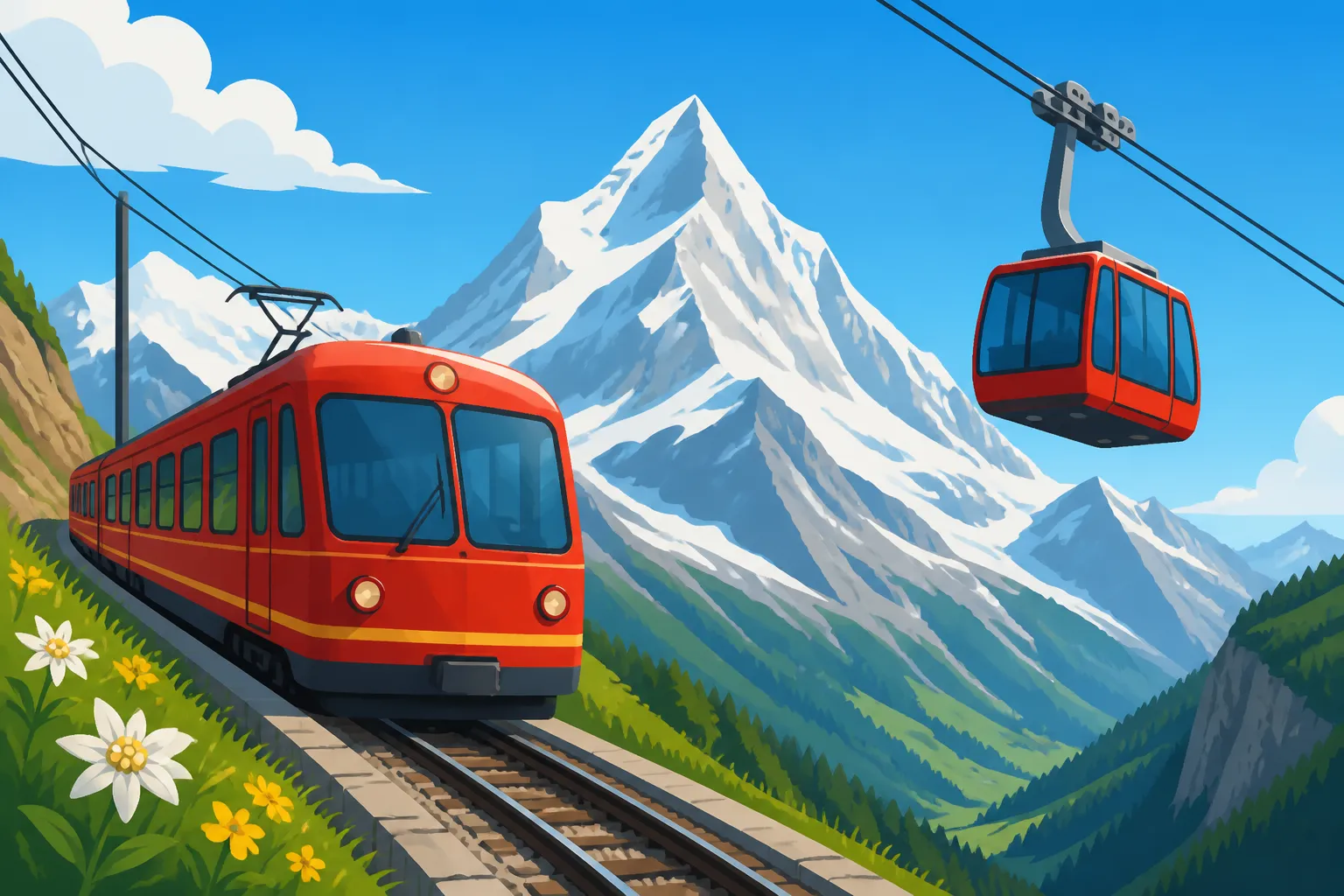
First, you have the cogwheel railways (Zahnradbahn in German). These are essentially trains with an extra, toothed wheel (the 'cog') that engages with a rack between the rails. This system allows them to climb incredibly steep inclines that normal trains simply couldn't handle. They're often slower, offering a majestic, unhurried journey, and are usually found on the more famous, dramatic ascents.
Then there are the cable cars – and here it gets a little nuanced. You'll hear terms like Gondelbahn, Luftseilbahn, and sometimes even Sessellift. A Gondelbahn is what most people think of as a "gondola lift" – a continuous loop of small cabins, typically seating 4-10 people, that move constantly. They're great for ski resorts and getting hikers up quickly. A Luftseilbahn is a larger, often two-cabin system, where one cabin goes up while the other comes down, suspended by massive cables. These are for really significant vertical climbs, like those to glacier resorts. Sessellifte, or chairlifts, are mostly found in ski areas, open-air seats that carry you up shorter distances, primarily used by skiers and snowboarders.
Finally, we have funiculars (Standseilbahn). These are like mini-trains on a very steep incline, often operating on a single track with a passing loop in the middle. Two cars are usually connected by a cable, so as one goes up, the other comes down, counterbalancing each other. They're common for urban connections to viewpoints (think the Polybahn in Zurich) or for reaching small, steep mountain villages. Each type offers a distinct perspective and a unique sense of adventure.
Cogwheel Railways: Engineering Marvels That Conquer Steep Slopes
These aren't your average trains. Swiss cogwheel railways are feats of engineering, defying gravity and logic to deliver you to panoramas that feel truly out of this world. The journey itself becomes part of the adventure, slowly chugging up incredible inclines, offering ever-expanding views as you ascend.
The Mechanics of a Cogwheel Train
The secret to a cogwheel train's incredible climbing ability lies in its unique rack-and-pinion system. Unlike conventional adhesion railways, which rely solely on the friction between wheels and rails, cogwheel railways use a toothed gear (the pinion) on the underside of the locomotive that meshes with a special toothed rail (the rack) laid between the running rails. There are a few different rack systems (like Riggenbach, Abt, and Strub), each with slight variations, but the principle is the same: positive engagement that prevents slipping, even on gradients exceeding 48%! This ingenious design not only allows them to climb mountains like Mount Pilatus or the Jungfraujoch, but it also provides a robust braking mechanism for the descent, making them incredibly safe. When you're on one, you can often hear and feel the rhythmic clicking of the cog engaging with the rack, a comforting mechanical symphony confirming your safe ascent.
Iconic Cogwheel Journeys for Every Expat
Switzerland is peppered with these magnificent railways, each offering a distinct journey and view. If you're going to splurge on a few, these are the ones that should be on your list.
Pilatus Railway: The World's Steepest Cogwheel Railway
Just imagine: you're sitting on a train, and it feels like you're going straight up! The Mount Pilatus from Lucerne: The World's Steepest Cogwheel Railway is truly a marvel. Ascending from Alpnachstad near Lucerne, it boasts a gradient of up to 48%, making it the steepest cogwheel railway in the world. As it slowly pulls itself up the limestone flanks of Mount Pilatus, the views of Lake Lucerne and the surrounding peaks are simply astounding. My first time, I kept leaning forward, convinced I was going to tip backwards – it's that steep!
The journey takes about 30-40 minutes and is often combined with the "Golden Round Trip," which includes a boat trip across Lake Lucerne and a gondola/aerial cable car descent back to Lucerne. It's a full-day adventure, showcasing the best of Central Switzerland's diverse landscapes. Don't forget to look out for the mythical dragons said to inhabit the mountain!
Gornergrat Railway: Matterhorn Views from Zermatt
No trip to Switzerland is complete without witnessing the majesty of the Matterhorn. And the best, most comfortable way to get unparalleled views of it (and 28 other 4,000-meter peaks!) is via the Gornergrat Railway: Matterhorn Views from Zermatt. Departing from the charming, car-free village of Zermatt, this electric cogwheel railway climbs to the Gornergrat viewpoint at 3,089 meters.
The ride itself is spectacular, winding through larch forests and past alpine meadows before reaching the stark, rocky landscape of the high Alps. Each turn offers a new, breathtaking angle of the iconic pyramidal peak. When you get to the top, the observation deck provides panoramic vistas that will literally make you gasp. There's a hotel, restaurant, and even a small chapel up there, allowing you to linger and soak in the raw power of the mountains. It's an experience that stays with you long after you've descended.
Jungfraujoch Railway: The Top of Europe
This one is legendary. The journey to the Jungfraujoch 'Top of Europe': Planning the Trip and Saving Money takes you to the highest railway station in Europe, nestled between the Mönch and Jungfrau peaks at a staggering 3,454 meters. It’s not just a train ride; it’s an expedition into a high-alpine wonderland. You start your journey from Grindelwald Terminal or Lauterbrunnen, connecting through Kleine Scheidegg, where you transfer to the Jungfrau Railway.
Much of the final ascent is inside a tunnel carved through the Eiger and Mönch mountains, with intermediate stops that offer incredible window views into the Eiger North Face. Once at the top, you're greeted by a research station, an ice palace carved into the glacier, a Sphinx observation deck, and, of course, absolutely astounding views of the Aletsch Glacier – Europe's longest glacier. Yes, it's an expensive outing, but the sheer scale of the landscape, the engineering achievement, and the unique experience of being on a permanent glacier make it worth considering at least once.
Cable Cars and Gondolas: Soaring Above the Valleys
If cogwheel trains offer a steady climb, cable cars are all about the breathtaking sensation of flight. Gliding silently above forests, waterfalls, and rock faces, they provide a bird's-eye perspective that's utterly unique. These are your tickets to instant alpine immersion.
The Different Flavors of Aerial Transport
While they all get you up a mountain using cables, there are some distinct differences in the types of aerial transport you'll encounter.
The grand dames of the cable car world are the large aerial cable cars (Luftseilbahn). These usually consist of one or two large cabins that can hold anywhere from 30 to 100 people. They're designed for long, steep hauls, often covering vast distances and vertical meters in a single, exhilarating swoop. Think of the journey to the Klein Matterhorn or the final ascent on Mount Titlis. The experience is incredibly dramatic as you rise above the landscape, with sweeping panoramic views that evolve from green valleys to snow-capped peaks in mere minutes. There's a sense of communal awe as everyone in the cabin looks out at the unfolding scenery.
Then you have the more common gondola lifts (Gondelbahn). These feature smaller, enclosed cabins (typically seating 4 to 8 people) that are attached to a continuously moving cable loop. They're much faster for high-volume transport and are very prevalent in ski resorts and areas with extensive hiking trails, offering quick access to various points on the mountain. They provide a more intimate experience than the larger cable cars, allowing for quiet conversations or simply absorbing the views in peace. They're often less intimidating for those who might be nervous about heights due to their smaller scale and continuous motion.
Finally, the ubiquitous chairlifts (Sessellift) primarily serve ski areas. These open-air seats are great for a quick hop up a slope, allowing skiers and snowboarders to keep their equipment on. While less common for pure sightseeing, some offer scenic summer rides for hikers, giving you a chance to feel the fresh mountain air on your face as you glide along.
Unforgettable Cable Car Experiences
From revolving cabins to James Bond hideouts, Swiss cable cars offer more than just a ride; they offer an experience.
Titlis Rotair: Europe's First Revolving Cable Car
You absolutely have to try the Mount Titlis: Year-Round Snow and the Rotating Cable Car experience. Departing from Engelberg, the journey to the summit of Mount Titlis is a multi-stage adventure, culminating in the world's first revolving cable car, the Titlis Rotair. As the name suggests, the cabin slowly rotates 360 degrees during the five-minute journey, giving you continuous panoramic views of the glacier, the imposing rock faces, and the distant peaks.
Once at the top, you're on a permanent glacier. There's an ice cave to explore, a cliff walk (suspension bridge) for the brave, and even year-round snow activities. It’s a fantastic way to experience a high-alpine glacier without needing any special equipment or mountaineering skills. The combination of the rotating views and the glacier wonderland at the summit makes it a truly unique day out, whether you're visiting in the height of summer or the depths of winter.
Schilthorn and Piz Gloria: The Bond Mountain Above Lauterbrunnen
If you're a James Bond fan, or just love incredible views, the Schilthorn and Piz Gloria: The Bond Mountain Above Lauterbrunnen is a must. High above the picturesque Lauterbrunnen Valley, with its dramatic waterfalls and sheer cliffs, the Schilthorn cable car takes you on a multi-stage ascent to Piz Gloria, a revolving restaurant at 2,970 meters. This iconic location gained fame as Blofeld's lair in the 1969 Bond film "On Her Majesty's Secret Service."
The views from the top are nothing short of spectacular, offering a 360-degree panorama that includes the Eiger, Mönch, Jungfrau, and even Mont Blanc on a clear day. The revolving restaurant ensures every diner gets to see every angle. Beyond the restaurant, there's the "Bond World 007" exhibition and the thrilling "Skyline Walk" and "Thrill Walk" attractions that provide adrenaline-pumping experiences suspended over dizzying drops. It's a full package of history, film, and breathtaking nature.
Klein Matterhorn: Europe's Highest Cable Car
For the ultimate high-altitude cable car experience, the Klein Matterhorn in Zermatt is unparalleled. Known as "Matterhorn Glacier Paradise," this cable car takes you to the highest cable car station in Europe at 3,883 meters. The cabins are incredibly modern, and some even feature Swarovski crystals for a touch of alpine luxury.
At the summit, you're practically touching the sky. The views of the Matterhorn, Mont Blanc, and a vast expanse of glaciated peaks are simply mind-blowing. There's an observation platform, a glacier palace carved deep into the ice, and year-round skiing and snowboarding on the glacier. It’s an otherworldly experience that will leave you feeling tiny amidst the giants of the Alps. Just remember to dress warmly, even in summer, as it's truly high alpine conditions up there!
Pfannenstiel: A Local Gem Near Zurich
Not every cable car needs to take you to 3,000 meters. Sometimes, a short, pleasant ride to a local viewpoint is all you need. For those living around Zurich, the Forchbahn (a light railway) takes you out to the Pfannenstiel area, and while it's not a 'cable car' in the traditional sense, the gentle climb and easy access to fantastic views over Lake Zurich and the Alps are absolutely priceless. It’s a perfect example of how accessible even smaller, local peaks are, offering stunning scenery without the epic journey or price tag of the bigger mountains. It's a great spot for a relaxed afternoon walk, a picnic, or simply soaking in some fresh air.
Funiculars: Short, Sharp Ascents for City and Mountain Alike
Funiculars might not have the dramatic flair of a large aerial cable car, but they are equally ingenious and offer a unique, often historic, way to scale steep inclines. They're often found in surprising places, connecting bustling city districts with quiet, elevated neighborhoods or providing access to remote mountain hamlets.
What Makes a Funicular Unique
A funicular operates on a beautifully simple principle: two cars are permanently attached to opposite ends of a single cable that runs through a pulley system at the top station. As one car ascends, the other descends, acting as a counterweight. This system is incredibly energy-efficient, as the descending car helps pull the ascending one. They run on very steep tracks, often with a passing loop in the middle for the cars to cross.
Historically, funiculars were vital for urban development, allowing cities to expand onto hillsides that would otherwise be impractical to build on, and providing convenient transport for residents and goods. In mountain regions, they offered a robust and reliable way to connect remote villages or power plants to the main valleys. They often have a charm all their own, with their distinctive carriages and the rhythmic clatter of their ascent. It's a different kind of thrill than a cable car, more grounded but no less impressive.
Funiculars You'll Love
From the world's steepest to charming city transporters, Swiss funiculars are a delightful part of the transport tapestry.
Stoos Bahn: World's Steepest Funicular
Prepare for a wild ride on the Stoos Bahn near Schwyz! Reopened in 2017, this modern funicular holds the record for the steepest funicular in the world, tackling an incredible gradient of 110% (47.7 degrees) on its ascent to the car-free mountain village of Stoos. The innovative design of its cylindrical cabins ensures that passengers always remain level, regardless of the incline, which is a blessing because the views through the tunnels and over the valleys are spectacular.
The journey itself is thrilling, a rollercoaster-like experience as you're pushed and pulled up the side of the mountain. Once at Stoos, you can enjoy stunning views, easy family-friendly hikes, and a wonderful escape into a tranquil alpine environment. It’s a fantastic example of Swiss engineering pushing boundaries for both utility and tourist attraction.
Polybahn: Zurich's Historic City Lift
For a taste of Zurich's past and a convenient shortcut, hop on the Polybahn. This charming bright red funicular has been connecting Zurich's central Limmatquai with the university quarter (specifically the ETH Zurich and University of Zurich campuses) since 1889. It's a short, quick ride, perfect for avoiding a steep walk up the hill, and offers lovely views over the rooftops of the old town and the Limmat River.
What's great about the Polybahn for expats is that it's often covered by your standard ZVV public transport tickets, making it a budget-friendly and fun little excursion. It’s a small piece of history that remains a vital part of everyday life for students and locals alike. For newcomers, it's a delightful way to get a quick elevated perspective on the city.
Montreux to Rochers-de-Naye: Panoramic Views over Lake Geneva
If you're in the Lake Geneva region, the funicular ride from Montreux up to Rochers-de-Naye is an absolute treat. This cog railway climbs steadily from the lakeside promenade, offering increasingly spectacular views of Lake Geneva, the surrounding mountains, and even across to France.
The journey itself is relatively long, allowing plenty of time to soak in the evolving panorama. At the summit, around 2,000 meters, you'll find panoramic restaurants, marmot enclosures (a hit with the kids!), and walking trails. In winter, it transforms into a charming Santa's House experience, making it a year-round destination. It’s a wonderful way to experience the beauty of the Vaud Alps and Lake Geneva from a unique vantage point, a truly grand journey that feels like stepping into a postcard.
Practicalities for Expats: Tickets, Passes, and Planning
Now, let's talk brass tacks. While getting to these incredible peaks is easy, understanding the ticketing system and managing the costs can sometimes feel like climbing a mountain itself. But fear not, with a little planning, you can navigate it like a pro.
The Cost Conundrum: Why Mountain Excursions Aren't Cheap
Let's be blunt: a trip up a Swiss mountain is rarely a cheap affair. I remember my first time checking prices, and my jaw nearly hit the floor. A return ticket to the Jungfraujoch can easily set you back over CHF 200, and even a mid-range peak might be CHF 50-80. It's a common shock for new expats, and you're not alone in feeling it!
There are good reasons for these prices, however. Firstly, the engineering and maintenance of these intricate systems are incredibly expensive. Think about the infrastructure needed to keep cogwheel tracks safe on steep slopes, or hundreds of kilometers of steel cables and cabins operating smoothly year-round. Switzerland also has high labor costs, from the engineers to the ticket booth staff. Finally, these attractions are often privately owned or managed, operating as businesses that need to turn a profit to reinvest in their operations. While it stings the wallet, you're paying for world-class safety, reliability, and an unparalleled experience. It really is an investment in an unforgettable memory.
Maximizing Savings with Passes and Discounts
This is where your inner Swiss budgeter needs to come out! There are many ways to make these fantastic experiences more affordable, especially if you plan to do a few mountain excursions.
The The Half-Fare Travelcard Halbtax: The Must-Have Pass for Swiss Residents is, without a doubt, the most important pass for anyone living in Switzerland. It gives you 50% off virtually all public transport, including trains, buses, boats, and crucially, most mountain railways and cable cars. Even if you only go up a few mountains in a year, it often pays for itself.
If you're a serious explorer, the SBB Travelcards: Is the Generalabonnement GA Worth the CHF 4000+ Cost? might be for you. The GA gives you unlimited travel on almost all public transport. While it covers the approach to many mountain railways, it usually only provides a discount (typically 50% or 25%) on the mountain ascent itself, not full coverage. Always check specific routes.
Then there are regional passes, which can be fantastic if you're concentrating your travels in one area. Examples include the Jungfrau Travel Pass (for the Berner Oberland), the Tell Pass (for Central Switzerland), or the Top of Europe Pass. These often include unlimited travel on specific mountain railways and cable cars within their validity area for a set number of days. They can offer significant savings if you're exploring intensively.
Don't forget the kids! The Traveling with Children: The SBB Junior Travelcard for CHF 30/Year is a lifesaver. For just CHF 30 per year, children aged 6-16 can travel free when accompanied by a parent who holds a valid ticket or pass. If the parent doesn't have a Half-Fare or GA, the Children's Co-Travelcard offers the same benefit when accompanied by any adult with a valid ticket. These are invaluable for family outings.
Finally, always check for local discounts. Many cantons or specific regions offer guest cards (often provided by your accommodation) that give discounts on local transport or attractions, including smaller mountain lifts. Every little bit helps!
Booking Your Mountain Adventure
For most standard mountain railway and cable car trips, especially outside of peak holiday periods, you usually don't need to book tickets far in advance. You can often just show up at the base station and buy your ticket. However, there are a few exceptions and smart practices:
- Peak Season & Popular Routes: For extremely popular routes like the Jungfraujoch, during summer high season, Swiss public holidays, or school breaks, booking online in advance can save you time waiting in queues. Some routes might even have timed entry slots.
- Special Experiences: If you're looking for a specific package, a guided tour, or a special dinner on a mountain, then yes, book ahead. Websites like GetYourGuide are excellent for finding these bundled experiences, often including transport and activities, and they make planning seamless.
- Accommodation & Travel: If you're arranging your entire trip, including hotels, you can often find good deals by bundling. Booking.com is a great resource for finding accommodation near base stations, and sometimes they'll even have packages that include activity tickets. For getting to the region by train, Omio is super handy for comparing and booking train tickets, helping you plan your journey to the mountain base efficiently.
- Weather: This is critical! Always check the weather forecast and mountain webcams before you depart. There's nothing worse than paying for an expensive trip to the top only to find yourself in a cloud, seeing nothing but fog. Many mountain websites have live webcams, which are your best friend here.
Insider Tips for a Smooth Mountain Experience
Living here for a while, you pick up a few tricks. These aren't just for tourists; they're essential for us expats to truly enjoy our time in the mountains without unnecessary stress.
Weather Wisdom and Timing Your Trip
The Swiss weather is fickle, especially in the mountains. What starts as a glorious sunny morning in the valley can quickly turn into a cloudy, rainy, or even snowy whiteout at higher altitudes. This is especially true for the dreaded "Föhn" wind – a warm, dry down-slope wind that can bring clear visibility but also sudden changes, intense headaches for some, and can even temporarily halt some cable car operations for safety reasons.
Always, always check the weather forecast specifically for the mountain peak you plan to visit. Don't just rely on the valley forecast. Most mountain websites have live webcams at various altitudes. Look at these in the morning before you leave! If it’s cloudy at the top, save your money and pick another day or a lower-altitude activity.
Timing is everything. For the best views and fewest crowds, aim to start your ascent early in the morning, ideally before 9 am. The air is often clearest, the light is soft for photography, and you'll beat the rush of tour groups. Plus, mountain weather tends to deteriorate in the afternoon.
What to Pack and Wear
You hear it all the time, but it bears repeating: layering is key! Even in the height of summer, temperatures at 3,000 meters can be near freezing, especially if there's wind.
- Base Layer: Moisture-wicking material.
- Mid-Layer: Fleece or light insulated jacket.
- Outer Layer: Windproof and waterproof jacket, even if it's sunny.
- Bottoms: Comfortable hiking trousers or sturdy jeans. Shorts might be fine for the valley, but not for the peak.
- Footwear: Sturdy, closed-toe shoes with good grip are essential, even if you only plan to walk a few meters from the station. If you plan any hiking, proper hiking boots are a must.
- Accessories: Sunglasses (the glare off snow and ice is intense), sun cream (UV radiation is much stronger at altitude), a hat, and gloves (even light ones for glacier areas).
- Essentials: Bring plenty of water and some snacks. While there are restaurants, having your own supplies saves money and offers flexibility.
Navigating Crowds and Peak Seasons
Switzerland gets busy, especially its iconic mountain destinations. If you have the flexibility, try to avoid Swiss school holidays, public holidays, and weekends during peak summer or winter. Mid-week, outside of these periods, will always be more relaxed.
If you can only go during busy times, as mentioned, go early! The first train or cable car of the day often offers a serene experience before the masses arrive. Another trick is to consider visiting lesser-known peaks. While the Jungfraujoch and Matterhorn are incredible, Switzerland has hundreds of other stunning mountains with equally impressive views, often at a fraction of the crowd and cost. Local tourist offices can advise on these hidden gems.
Staying Safe and Respectful
The mountains are majestic but demand respect. Safety is paramount here, and the Swiss take it very seriously.
- Stay on Marked Paths: If you venture out for a hike from a mountain station, always stick to the clearly marked trails. Swiss trails are meticulously signed with yellow (hiking), white-red-white (mountain hiking), and white-blue-white (alpine hiking) markers, as explained in our guide on Swiss Hiking for Beginners: Trail Grades and the SAC System. Straying off can lead to dangerous situations, sudden drops, or even falling rocks.
- Respect Nature and Private Property: Leave no trace. Pack out everything you pack in. Be mindful of alpine farmers, their animals, and their property. Close gates behind you.
- Emergency Numbers: In a medical emergency in the mountains, dial 144 for an ambulance or alpine rescue. For air rescue specifically, REGA is the national service, and a patronage can be a good idea for expats as detailed in our guide on REGA Membership: Why Expats Need Air Rescue Insurance in the Alps. Always be aware of your surroundings, and don't take unnecessary risks. Our comprehensive guide on Mountain Safety in Switzerland: Weather, Gear, and Emergency Numbers provides even more critical information.
Beyond the Ride: What Awaits You at the Top
The journey up is undoubtedly thrilling, but the real reward is what awaits you when you step out at the summit station. These aren't just transport hubs; they're gateways to unforgettable alpine experiences.
Panoramic Views and Photo Opportunities
The first thing you'll want to do, without fail, is simply look. The panoramic views from Switzerland's peaks are legendary for a reason. Whether it's the 360-degree sweep from the Schilthorn, the majestic Matterhorn dominating the horizon from Gornergrat, or the vast, silent expanse of the Aletsch Glacier from Jungfraujoch, each summit offers a unique and awe-inspiring vista. Take your time. Breathe it in.
For photographers, these locations are a dream. Golden hour (sunrise/sunset) can be tricky to catch unless you're staying overnight in a mountain hotel, but early mornings often provide the clearest air and dramatic light. Look for observation decks, designated viewpoints, and paths that lead to slightly different angles for your perfect shot. Don't just focus on the famous peaks; sometimes the quieter, less-photographed valleys and cloud formations are just as captivating.
Hiking, Activities, and Dining at Altitude
Stepping off a mountain railway or cable car often means stepping into a playground of alpine activities. Many summits offer a range of options suitable for all ages and fitness levels.
For hikers, even a short, accessible path around the summit can offer a delightful stroll with incredible views. Many mountain stations are trailheads for longer hikes, ranging from easy panoramic walks to challenging alpine treks. You can easily find information on these trails at the station or by checking apps like SwitzerlandMobility.
Families will often find playgrounds, interactive exhibits, or even adventure parks at various mountain stations. Glacier experiences, like ice palaces or snow tubing, are common at higher, permanently snow-covered peaks.
And then, of course, there's the food! Almost every major mountain station boasts a restaurant, ranging from self-service cafeterias to upscale dining. Enjoying a warm Rösti, a hearty soup, or a delicious slice of cake with a coffee while gazing out at the Alps is one of life's great pleasures in Switzerland. These Mountain Restaurants Bergrestaurants: Dining With a View offer not just sustenance but an integral part of the mountain experience. Be prepared for slightly higher prices, but the view often makes it worth it.
Regional Highlights: A Taste of Switzerland's Diversity
While many of the grand peaks are famous, Switzerland’s network of mountain transport allows you to explore the distinct character of each region. From the dramatic, iconic peaks of the Bernese Oberland to the softer, charming mountains of Eastern Switzerland, there’s a peak for every mood.
The Jungfrau Region: Iconic Alpine Grandeur
The Jungfrau Region, often accessed from towns like Interlaken, Grindelwald, Wengen, and Lauterbrunnen, is arguably the most famous and visually stunning alpine area in Switzerland. It's home to the towering Eiger, Mönch, and Jungfrau peaks, and the impressive Aletsch Glacier.
This region boasts an incredible density of mountain transport options. Beyond the Jungfraujoch and Schilthorn, you have cable cars and cogwheel trains to places like First (Grindelwald), with its adventure activities like the First Cliff Walk and mountain carting; Männlichen, known for its Royal Walk and easy panoramic trails; and Harder Kulm, Interlaken’s "Top of Interlaken" with its beautiful restaurant and viewing platform. The sheer scale and number of options here mean you could spend a week just exploring different peaks. The network is so well-connected that you can easily combine journeys, for instance, taking a train up to Kleine Scheidegg and then hiking down through alpine meadows.
Central Switzerland: Lakes and Legends
Around Lucerne, you'll find a different kind of alpine charm, one that beautifully blends majestic mountains with serene lakes. This region, often called the "Heart of Switzerland," is home to some legendary peaks.
Mount Pilatus, as we discussed, is easily accessible and offers an incredible panorama. Another absolute must-do is Mount Rigi, known as the "Queen of the Mountains." It's unique because you can approach it from several directions via cogwheel train (from Vitznau or Arth-Goldau) or cable car (from Weggis or Goldau), and combine it with stunning boat trips on Lake Lucerne. Rigi offers incredible 360-degree views and a network of easy walking paths, even a mineral bath and spa at Rigi Kaltbad. The combination of water and peaks makes for a truly romantic and scenic experience, as you can see in our guide on Lake Lucerne: Cruises, Mountains, and the Swiss Path. Then there's Mount Titlis, the glacier paradise we explored, providing year-round snow fun. This region perfectly encapsulates the postcard image of Switzerland: blue lakes, green meadows, and snow-capped peaks.
Valais: Home of the Matterhorn
The canton of Valais, in the southwest, is a rugged, French-speaking (mostly) region dominated by high peaks, glaciers, and, of course, the iconic Matterhorn. The undisputed capital for mountain excursions here is Zermatt.
As a car-free village, Zermatt itself is charming, and its accessibility to the mountains is fantastic. From here, you have the Gornergrat Railway for those classic Matterhorn views, and the Klein Matterhorn cable car for the highest ascent. But there are also cable cars to other fantastic viewpoints like Sunnegga, Blauherd, and Rothorn, each offering unique perspectives of the Matterhorn and access to wonderful hiking trails. Zermatt offers an intense, immersive alpine experience, where you truly feel surrounded by the giants of the Alps. It’s a place that commands respect and offers rewards in equal measure, perfect for those who want to lose themselves in the grandeur, as outlined in our article Exploring Zermatt: Car-Free Living Under the Matterhorn.
Eastern Switzerland: Quaint Charms and Panoramic Trails
While perhaps less dramatic than the Jungfrau or Zermatt, Eastern Switzerland offers a gentler, yet equally captivating, alpine experience, particularly in the Appenzell region. Here, you’ll find charming, verdant hills and distinctive peaks accessible by cable car.
One popular destination is the Ebenalp cable car, which whisks you up to a plateau renowned for its unique mountain guesthouses built into the cliffs, like Äscher. From here, easy hiking trails lead to breathtaking viewpoints and even a prehistoric cave. Another gem is the Hoher Kasten cable car, offering a revolving restaurant (like Titlis!) and panoramic views that stretch across six countries on a clear day. This region is perfect for those seeking picturesque landscapes, traditional Swiss culture, and more relaxed hiking opportunities. It’s a refreshing change of pace and shows the diversity of Swiss mountain experiences.
Comparative Table of Popular Mountain Excursions
To help you get a handle on some of the most popular (and sometimes expensive!) mountain trips, here's a quick comparison. Remember that prices are indicative for a return journey for an adult without any pass, and how much a Half-Fare will save you. Always check current prices!
| Mountain Destination | Location | Type of Transport | Key Feature(s) | Est. Adult Return Cost (No Pass) | Est. Adult Return Cost (with Half-Fare) |
|---|---|---|---|---|---|
| Jungfraujoch | Grindelwald | Cogwheel Railway | Highest train station in Europe, Ice Palace, Aletsch Glacier | CHF 220-250 | CHF 110-125 |
| Gornergrat | Zermatt | Cogwheel Railway | Matterhorn panorama, 29 other 4000m peaks | CHF 110-130 | CHF 55-65 |
| Mount Pilatus | Lucerne | Cogwheel (up), Cable Car (down) | World's steepest cogwheel, Golden Round Trip | CHF 78-85 | CHF 39-42.50 |
| Mount Titlis | Engelberg | Cable Car (Rotair) | Revolving cable car, glacier, Cliff Walk | CHF 96-100 | CHF 48-50 |
| Schilthorn | Lauterbrunnen | Cable Car | Piz Gloria (revolving restaurant), James Bond | CHF 108-115 | CHF 54-57.50 |
| Mount Rigi | Lucerne | Cogwheel / Cable Car | "Queen of the Mountains," easy access, spa | CHF 72-80 | CHF 36-40 |
| Stoos | Schwyz | Funicular | World's steepest funicular, car-free village | CHF 22-24 | CHF 11-12 |
Note: Prices are approximate for 2026 and subject to change. Always verify on official websites. Many regional passes can offer even better value for these destinations.
Disclaimer
The information provided in this guide is for general informational purposes only and is based on typical experiences for expats in Switzerland. While every effort has been made to ensure accuracy and provide up-to-date details for 2026, regulations, prices, opening hours, and specific offerings for mountain transport can change frequently. It is always recommended to consult official websites, local tourist information centers, and the relevant transport providers for the most current and precise information before planning any trip. We cannot be held responsible for any discrepancies or changes that may occur.