The Half-Fare Travelcard (Halbtax): The Must-Have Pass for Swiss Residents
Standing at a ticket machine in Zurich Main Station, watching the screen demand eighty Swiss francs for a simple one-way trip, is a rite of passage every newcomer endures. I remember feeling a genuine sense of panic during my first week, wondering if I’d have to choose between seeing the Alps and buying groceries. This guide solves that financial friction by detailing the Half-Fare Travelcard, the single most important investment for your Swiss life.
What is the Half-Fare Travelcard and Why Does It Matter
If you are planning on staying in Switzerland for more than a few weeks, the Half-Fare Travelcard—known locally as the Halbtax in German, or demi-tarif in French—is not a luxury; it is a fundamental part of the local infrastructure. Switzerland has one of the most efficient, yet expensive, public transport networks in the world. Without this card, you are essentially paying a "tourist tax" on every single movement you make across the country.
The Core Concept of 50 Percent Savings
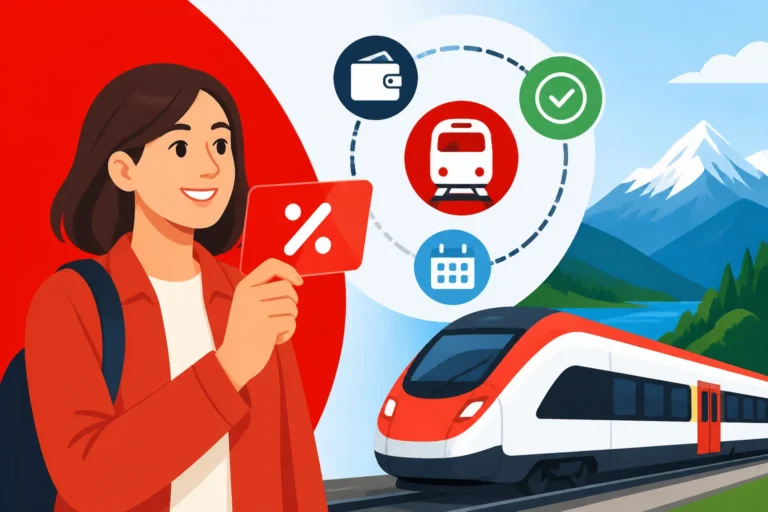
The premise is deceptively simple: you pay an annual fee, and in return, you get 50% off almost all public transport. This includes the SBB (Federal Railways) network, most private railways, postal buses (PostBus), lake steamers, and even urban transport networks like trams and buses in cities like Geneva, Basel, and Zurich. When you look at the Cost of Living in Switzerland 2026: Budgeting for Singles and Families, you will quickly realize that transport is a major line item. Reducing that by half with a single card is the most effective way to keep your monthly burn rate under control.
I’ve spent years explaining this to friends who move here, and the most common misconception is that the discount only applies to long-distance trains. In reality, it applies to that short bus ride to the pharmacy and the ferry crossing across Lake Brienz. It even extends to many mountain cable cars, which are notoriously pricey. When you are Renting in Switzerland: The Complete 2027 Guide for Expats, you might choose a flat further from the city center to save money, making the Halbtax even more critical for your daily commute.
Integration with the SwissPass System
The Half-Fare Travelcard is no longer a standalone paper card. It lives on the "SwissPass," a red plastic card that serves as the digital hub for all your Swiss subscriptions. This card doesn't just hold your Half-Fare status; it can also store your ski passes, PubliBike rentals, and even your SBB Travelcards: Is the Generalabonnement (GA) Worth the CHF 4000+ Cost?.
The beauty of the SwissPass is its integration. Once you have it, the SBB Mobile app automatically recognizes your discount. When you search for a ticket, the price you see is the "Half-Fare" price by default, because the system assumes every resident has one. If you don't, you have to manually toggle the setting to see the "Full Fare," which is a painful experience for any wallet. Having this card makes you feel like a local, allowing you to breeze through ticket inspections with a quick scan of a QR code on your phone.
Why Expats Often Overlook It At First
Many expats arrive and focus solely on the immediate logistics, like finding a temporary home through platforms like HousingAnywhere or Registering Your Address at the Kreisbüro Within 14 Days of Moving. Because the upfront cost of the Halbtax (currently around CHF 190 for the first year) seems high, people hesitate. They think, "I'll just buy individual tickets for now."
This is a classic "newcomer's trap." If you take a return trip from Zurich to Lugano once, the card has almost paid for itself. I waited three months to get mine because I was overwhelmed with paperwork, and I probably wasted CHF 400 in that window. Don't make that mistake. The moment you have your residence permit or even just your work contract, this should be at the top of your to-do list, right alongside setting up your Transport in Switzerland: SBB, GA, Half-Fare Cards, and Commuting plans.
Eligibility and the Application Process
One of the most confusing things for newcomers is whether they are actually "allowed" to buy the resident version of the Half-Fare Travelcard. While there is a "Half-Fare Travelcard for Tourists" (often called the Swiss Half Fare Card), the version we are discussing here is the one intended for people living and working in Switzerland.
Who Can Buy a Halbtax
Essentially, anyone with a valid Swiss residence permit (L, B, or C) can and should buy the standard Half-Fare Travelcard. It is also available to cross-border commuters who hold a G permit. Even if you are still waiting for your physical permit card to arrive in the mail, you can usually purchase the Halbtax at an SBB ticket counter by showing your "Meldebestätigung" (the registration confirmation from the commune) and your passport.
If you are a student, there are often discounted versions or combined offers, particularly for those under 25. The Swiss system is designed to encourage public transport use from a young age, so if you fall into the "Youth" category, your annual fee will be significantly lower. I’ve seen many young professionals move here and forget that they still qualify for youth pricing until they turn 25, so double-check your age bracket before paying the full adult rate.
Documents and Photo Requirements
To get your SwissPass and the Half-Fare Travelcard, you need a high-quality passport-sized photo. It doesn't have to be a professional studio shot, but it needs to be clear, against a plain background, and with no headgear. You can actually take this with your phone and upload it if you are buying online.
When I first applied, I went to the SBB counter at the airport. They were incredibly helpful but did require my physical passport and my residence permit. If you are doing this in person, make sure you have your original documents. They will scan your ID, take your photo (or scan the one you brought), and hand you a "temporary" paper Half-Fare card. This paper version is valid for about 10 days, allowing you to start saving immediately while your permanent red SwissPass is printed and mailed to your home address.
Ordering Online vs At the Counter
The SBB website and app are remarkably user-friendly, but for your first-ever SwissPass, I actually recommend going to a staffed ticket counter at a major station like Zurich HB, Geneva Cornavin, or Bern. The reason is simple: Swiss transport bureaucracy has nuances. A human clerk can ensure your name is spelled exactly as it appears on your permit, which prevents issues later when you are Changing Your Swiss Health Insurance Provider: Deadlines and Notice Periods or dealing with other official documents.
If you prefer the digital route, you can do it all through the SBB webshop. You will need to create an "SBB ID" first. Once you’ve uploaded your photo and paid via credit card or TWINT, your Half-Fare status is active instantly in the app. If you're doing this while on the move, ensure you have a reliable data connection. I always suggest expats grab an eSIM from Airalo when they first arrive to avoid being stranded without data while trying to show a digital ticket to a conductor in a remote valley.
Deep Dive into the Costs and Return on Investment
Let’s talk about the cold, hard numbers. The Swiss are pragmatic people, and the Halbtax is a masterclass in pragmatic pricing. As of 2026, the price for an adult Half-Fare Travelcard is CHF 190 for the first year.
Current Pricing and the Loyalty Discount
The "loyalty" aspect of the SwissPass is where it gets interesting. After your first year, if you don't cancel your subscription, it automatically renews at a discounted rate—currently around CHF 170. This CHF 20 "thank you" for staying in the system is a nice touch, but it also means the card is an ongoing commitment.
| Category | First Year Price (CHF) | Renewal Price (CHF) |
|---|---|---|
| Adult (25+) | 190 | 170 |
| Youth (16-25) | 120 | 100 |
| Children (6-16) | Use Junior Card | Use Junior Card |
For families, the math changes slightly. While children under 6 travel for free, children aged 6 to 16 can benefit from the Traveling with Children: The SBB Junior Travelcard for CHF 30/Year. This card allows them to travel for free as long as they are accompanied by a parent who has a valid ticket (including a Half-Fare ticket). This is perhaps the greatest travel bargain in Europe.
Calculating the Break-Even Point
To see if the Halbtax is worth it, you simply need to look at the "Full Fare" price of a few common routes. A return trip from Zurich to Zermatt at full price can easily exceed CHF 250. With the Halbtax, that drops to CHF 125. In that one weekend trip, you have already saved CHF 125, which is more than 65% of the card's annual cost.
If you commute even twice a week using a local bus that costs CHF 4.40 for a full-fare "Zone 1" ticket, you save CHF 2.20 per trip. Over a year, those small local trips add up to hundreds of francs in savings. I’ve found that even for expats who primarily drive, having a Halbtax for those occasions when you want to head into the city for dinner or take a scenic train ride is still financially sound. It's about the freedom to choose the train without feeling like you're being robbed.
Halbtax Plus: The New Prepaid Innovation
In the last couple of years, SBB introduced a "top-up" model called Halbtax Plus: How the New Prepaid Discount System Works for SBB. This is essentially a savings account for your travel. You pay in a lump sum (for example, CHF 800), and SBB gives you a "bonus" credit (for example, an extra CHF 200), giving you CHF 1,000 worth of travel.
This is an excellent option for those who travel frequently but not enough to justify the CHF 3,995 for a full GA. It sits in that "sweet spot" of the market. If you are someone who works in an office three days a week and explores the mountains on weekends, the Halbtax Plus can stack with your existing Half-Fare discount, leading to some of the lowest per-kilometer costs available in the country.
Where and How You Can Use Your Half-Fare Savings
The versatility of the Halbtax is its strongest selling point. It isn't just a "train card"; it’s a "mobility card." When you're Healthcare in Switzerland for Expats: The Complete System Overview (2027) and need to visit a specialist in another canton, the Halbtax makes that journey affordable.
Beyond Trains: Buses Boats and Trams
Almost every yellow "PostBus" that winds its way up into the alpine villages accepts the Half-Fare card. These buses are the lifeline of rural Switzerland. Similarly, the local transport authorities in every major city (VBZ in Zurich, TPG in Geneva, BVB in Basel) honor the card. When you buy a "Short Haul" or "Local" ticket at a kiosk, you select the "1/2" button.
One of my favorite ways to use the card is on the lakes. If you want to take the paddle steamer from Lucerne to Fluelen, a trip that feels like a luxury cruise, your Half-Fare card applies. It turns a CHF 70 excursion into a CHF 35 afternoon out. It’s these "lifestyle" uses that really make the card feel valuable beyond just the daily grind of commuting.
Mountain Railways and Cable Cars
This is where the rules get a bit "Swiss"—which is to say, specific. Most major mountain railways (like the one to the Jungfraujoch or the Gornergrat) offer a 50% discount with the Halbtax. However, some smaller, private cable cars might only offer a 25% discount, or in rare cases, none at all.
As a rule of thumb, if a cable car serves a residential area or a major peak, it usually takes the Halbtax. Always look for the "SBB" logo or the "1/2" symbol on the price boards at the valley stations. If you’re a hiker, this card is your best friend. It allows you to take a cable car up to 2,000 meters and hike down, or vice versa, without spending a fortune. I often order my hiking gear on Amazon Germany to save on equipment costs, but there's no way to "hack" the cable car prices other than having this card.
International Travel Connections
A common question I get is: "Does my Half-Fare card work if I'm going to Paris or Milan?" The answer is yes, but only for the Swiss portion of the journey. When you book a ticket from Zurich to Paris on the TGV Lyria, the SBB system will calculate the discount for the distance traveled on Swiss tracks (from Zurich to the border at Basel).
This makes international travel from Switzerland significantly cheaper than if you were buying the ticket from the French or Italian side. Additionally, the SwissPass itself can sometimes be used to get discounts on RailPlus-supported international journeys, though this is becoming less common as digital systems evolve. Always check the "Discount" section when booking international trains through the SBB app.
Advanced Tips for Savvy Swiss Travelers
Once you have your Halbtax, you can start "stacking" discounts. This is how the veterans manage to travel across the country for less than the price of a pizza.
Combining Halbtax with Supersaver Tickets
The "Supersaver" (Sparbillette) tickets are SBB’s way of filling seats on off-peak trains. These tickets are tied to a specific train at a specific time. If you have a Half-Fare Travelcard, the Supersaver discount is applied on top of your 50% discount.
I’ve managed to get from Zurich to Geneva for CHF 12 by booking a Supersaver ticket three weeks in advance and applying my Halbtax discount. The trick is to use the SBB app and look for the black % icon next to the price. These tickets are non-refundable, so make sure you’re going to make that train, but the savings are incredible. This is particularly useful if you are traveling to another city to look at apartments and don't want the trip to eat into your rental deposit.
Traveling with Children and the Junior Travelcard
If you have kids, the combination of your Halbtax and their Junior Travelcard is the ultimate "cheat code" for Swiss life. For CHF 30 a year, your child travels for free anywhere you go. This includes the most expensive trains in the country.
I remember taking my niece on the Glacier Express. My ticket was half-price thanks to my Halbtax, and her "ticket" was essentially free because of the Junior card. If you have three children, you only pay for the first two Junior cards; the third and subsequent children get theirs for free. It’s an incredibly pro-family policy that makes exploring the country as an expat family much more feasible.
Digital Integration with the SBB Mobile App
The SBB Mobile app is arguably the best travel app in the world. Once you log in with your SwissPass ID, your Halbtax is "baked in." You can use the "EasyRide" feature—where you simply swipe a button when you get on a train and swipe it again when you get off. The system tracks your GPS, calculates the route, and charges your credit card the cheapest possible Half-Fare price for that journey.
This eliminates the need to ever stand at a ticket machine again. It also handles zone transitions automatically. If you’re using an Airalo eSIM for your data, you can rely on this system even in the deepest valleys. It’s the height of convenience, and it ensures you never accidentally buy the wrong ticket and face a hefty fine from a conductor.
Renewal Cancellation and Managing Your Subscription
The SwissPass is a "subscription" service, not a one-off purchase, which can lead to some frustrations if you aren't careful. Understanding how to manage the lifecycle of your card is essential for avoiding unnecessary charges.
The Automatic Renewal Trap
By default, the Half-Fare Travelcard renews automatically every year. SBB will send you a "reminder" (usually a physical letter or an email) about 60 days before the expiration. If you do nothing, they will send you an invoice for the next year.
If you are planning on staying, this is great because you get the loyalty discount. However, if you are planning on leaving Switzerland, you must actively cancel the subscription. You can do this online through the SwissPass portal or at an SBB counter. The deadline to cancel is usually one month before the renewal date. I’ve known several expats who moved back to the US or UK and were surprised by an invoice for a Swiss train card they no longer needed.
Changing Personal Details and Address
When you move apartments—which happens often in the first few years as you graduate from temporary housing to a permanent home—you must update your address on the SwissPass website. Since the SwissPass is a physical card, any new cards or important legal notices regarding your subscription will be sent to the address on file.
If you lose your card, a replacement costs about CHF 30. However, if you have the SBB app, you can show the digital version of your card to conductors, which is a lifesaver if you realize at the station that you left your wallet at home. Most conductors are very understanding about this, provided your digital SwissPass has a valid photo.
What to Do If You Leave Switzerland
If you are leaving Switzerland permanently, you can sometimes get a pro-rata refund on your Half-Fare card, but the conditions are strict. Usually, you need to show proof that you are officially "de-registering" from your commune.
If you have only a few months left on the card, it’s often easier just to let it expire and ensure the "auto-renew" is turned off. For many, the Halbtax is the very last thing they cancel, using it one final time to get to the airport with their suitcases, signaling the end of their Swiss adventure. It’s a small red card that holds a lot of memories for many of us who have called this beautiful, expensive country home.
Disclaimer
This guide is for informational purposes only. Transport prices, terms and conditions of the SwissPass, and SBB regulations are subject to change. Always verify the current rates and rules on the official SBB or SwissPass websites before making a purchase. The experiences shared are personal and may not reflect every individual's situation.