E-Biking Through the Swiss Countryside: Routes and Charging
Dreaming of exploring Switzerland's breathtaking countryside, its rolling hills, pristine lakes, and charming villages, but feeling a bit daunted by the infamous Swiss climbs? You're not alone. Many expats, myself included, arrive here with grand visions of active holidays, only to find the sheer gradients quite challenging. This guide is your key to unlocking those scenic dreams without breaking a sweat (or at least, not too much of one!) by diving deep into the world of e-biking through the stunning Swiss landscape, covering everything from the best routes to keeping your trusty electric steed charged up.
Why E-Biking is Your Swiss Countryside Game-Changer
Let's be honest, Switzerland is a land of unparalleled beauty, but it's also a land of hills, mountains, and more hills! Traditional cycling can be an absolute lung-buster, especially if you're not a seasoned athlete. This is precisely where the magic of e-biking comes in, transforming what might feel like an arduous climb into an enjoyable, breezy ascent.
Conquering the Hills (and Your Doubts)
When I first moved here, I bought a regular mountain bike with grand ambitions. Those ambitions quickly dissolved into sweaty, breathless reality on the first significant incline outside of Zurich. E-bikes change that narrative entirely. The motor assistance, often adjustable to your desired level, means you can tackle those seemingly impossible ascents with a smile on your face. You still get a fantastic workout, mind you – it's not a scooter – but the motor just smooths out the struggle. It means you can keep pace with fitter friends, explore more remote areas, or simply enjoy the scenery without fixating on the next hill. Imagine effortlessly cycling through the Lavaux vineyards, a UNESCO World Heritage site, enjoying the panoramic views of Lake Geneva and the Alps, rather than pushing your bike up every terrace. It's a game-changer for accessibility, allowing people of all fitness levels to enjoy Switzerland's diverse topography.
Expanding Your Horizon: More Exploration, Less Exhaustion
One of the biggest frustrations for new arrivals is how much effort it takes to see the "real" Switzerland beyond the train windows. With an e-bike, suddenly that charming village nestled high above the valley floor or that hidden lake in the Jura mountains becomes an accessible day trip, not an epic expedition. You can cover greater distances with less fatigue, opening up a world of possibilities for exploration. Instead of being limited to flat lakeside paths, you can venture into the alpine foothills, discover secluded valleys, and explore interconnected regions. This means you can truly immerse yourself in the local culture, stopping at a remote farm for fresh cheese, or a tiny village bakery for a treat, without worrying about having the energy for the ride back. It simply expands your radius of adventure significantly.
The Eco-Friendly Swiss Experience
Switzerland is deeply committed to sustainability, and cycling, especially e-biking, fits right into that ethos. You're exploring the pristine landscapes with a minimal carbon footprint, breathing in that crisp mountain air, and contributing to the quiet, respectful enjoyment of nature. There's a certain satisfaction in knowing you're experiencing the country authentically, moving at a pace that allows you to truly see and appreciate your surroundings, rather than whizzing by in a car. Plus, with the widespread availability of public transport for those longer hauls, you can often combine train travel with your e-bike adventures, making it an even greener way to travel. For those interested in how to combine transport, check out our guide on how to take bicycles on Swiss trains: Taking Bicycles on Swiss Trains: Mandatory Reservations and Velo Tickets—it’s super helpful for planning multi-modal trips.
Planning Your E-Bike Adventure: Top Routes and Resources
Switzerland boasts an incredible network of cycling paths, meticulously signposted and maintained. Many of these routes are perfectly suited for e-bikes, offering a mix of challenging climbs and leisurely stretches through stunning scenery.
Discovering Switzerland's National Cycling Routes
The national cycling routes are the backbone of Swiss cycling tourism. There are nine main routes, each offering a unique perspective on the country. For e-bikers, these are fantastic as they often combine flat sections with more demanding ascents, making the assistance invaluable.
- Rhône Route (Route 1): Starting in Andermatt and following the Rhône river all the way to Geneva, this route offers stunning glacier views in its upper reaches before mellowing out through Valais's vineyards and finally along Lake Geneva. The sections through the Valais are particularly e-bike friendly, with gentle climbs and long, beautiful descents.
- Aare Route (Route 8): Tracing the path of Switzerland's longest river from its glacier source down to the Rhine, this route offers a captivating journey through the heart of Switzerland. From the rugged alpine scenery near Meiringen to the picturesque Old Town of Bern and the lakes of Thun and Brienz, an e-bike makes the longer stretches incredibly enjoyable.
- Heart Route (Route 9): As the name suggests, this route takes you through the very "heart" of Switzerland, winding through Emmental's rolling hills, past iconic cheese dairies, and through serene pre-alpine landscapes. This is where an e-bike truly shines, allowing you to conquer those quintessential Swiss hills with their charming farmhouses, without feeling utterly depleted. You can easily do day segments from cities like Lucerne or Bern.
For a comprehensive overview of these and other fantastic options, definitely check out our post on Cycling Routes in Switzerland: The National Bike Network. It breaks down each route, helping you pick the perfect one for your adventure.
Cantonal and Regional Gems
Beyond the national routes, each canton offers a wealth of regional and local cycling paths, many of which are explicitly designed or perfectly suited for e-bikes.
- Graubünden's Engadine Valley: Imagine cruising through pristine alpine meadows, past turquoise lakes, and through charming villages like St. Moritz and Pontresina. The Engadine offers designated e-bike routes that connect valleys and villages, often with panoramic views. The flatter sections around the lakes are a joy, while the climbs to higher passes are easily manageable with assistance.
- Ticino's Lakeside Trails and Valleys: Down in the Italian-speaking canton, the climate is milder, and the trails often lead through palm trees and along stunning lakeshores like Lugano and Maggiore. E-biking is fantastic here, allowing you to explore the lush valleys (such as Valle Verzasca) and charming grotto restaurants without the intense heat making climbs unbearable.
- Lake Zurich and Lake Lucerne (Vierwaldstättersee): Both offer beautiful lakeside paths, but venturing just slightly inland reveals delightful villages and rolling hills perfect for e-biking. You can easily spend a day looping around, stopping at local farms or lakeside cafes. For those interested in other activities around Lake Zurich, exploring the Best Lakes for Swimming Near Zurich in Summer could be a great addition to an e-bike tour.
Many local tourist offices provide maps and suggested e-bike tours, often highlighting charging points. Websites like SchweizMobil (SwitzerlandMobility) are indispensable resources for planning, offering detailed maps, route descriptions, and elevation profiles.
Essential Planning Tools and Apps
Planning is key to any successful Swiss adventure. Here are some tools that will become your best friends:
- SchweizMobil (SwitzerlandMobility): This is the official Swiss network for non-motorized traffic. Their website and app are incredibly detailed, showing all national, regional, and local cycling routes, including elevation profiles, surface types, and points of interest. You can filter for e-bike specific routes or just see where the charging stations are. It's truly a goldmine.
- Komoot and Strava: These popular cycling apps are great for discovering user-generated routes, tracking your rides, and finding local recommendations. They can also help you visualize elevation changes and plan your battery usage more effectively.
- Google Maps (with cycling layer): While not as detailed as SchweizMobil, Google Maps can be useful for quick navigation and finding specific points of interest along your route.
- Omio: If you're planning a multi-day trip and want to get to a starting point or return from a distant finish line without cycling the whole way, Omio is excellent for booking train tickets. Remember to check the rules for bringing your bike on the train; often you need a special ticket or reservation for it.
When planning, always consider the weather. Switzerland can be gloriously sunny one moment and have a sudden shower the next, especially in the mountains. Check out our guide on Weather and Geography: Föhn Winds, Winter Readiness, and Alpine Living to understand the regional weather patterns and prepare accordingly.
Keeping Your E-Bike Charged: Navigating the Swiss Infrastructure
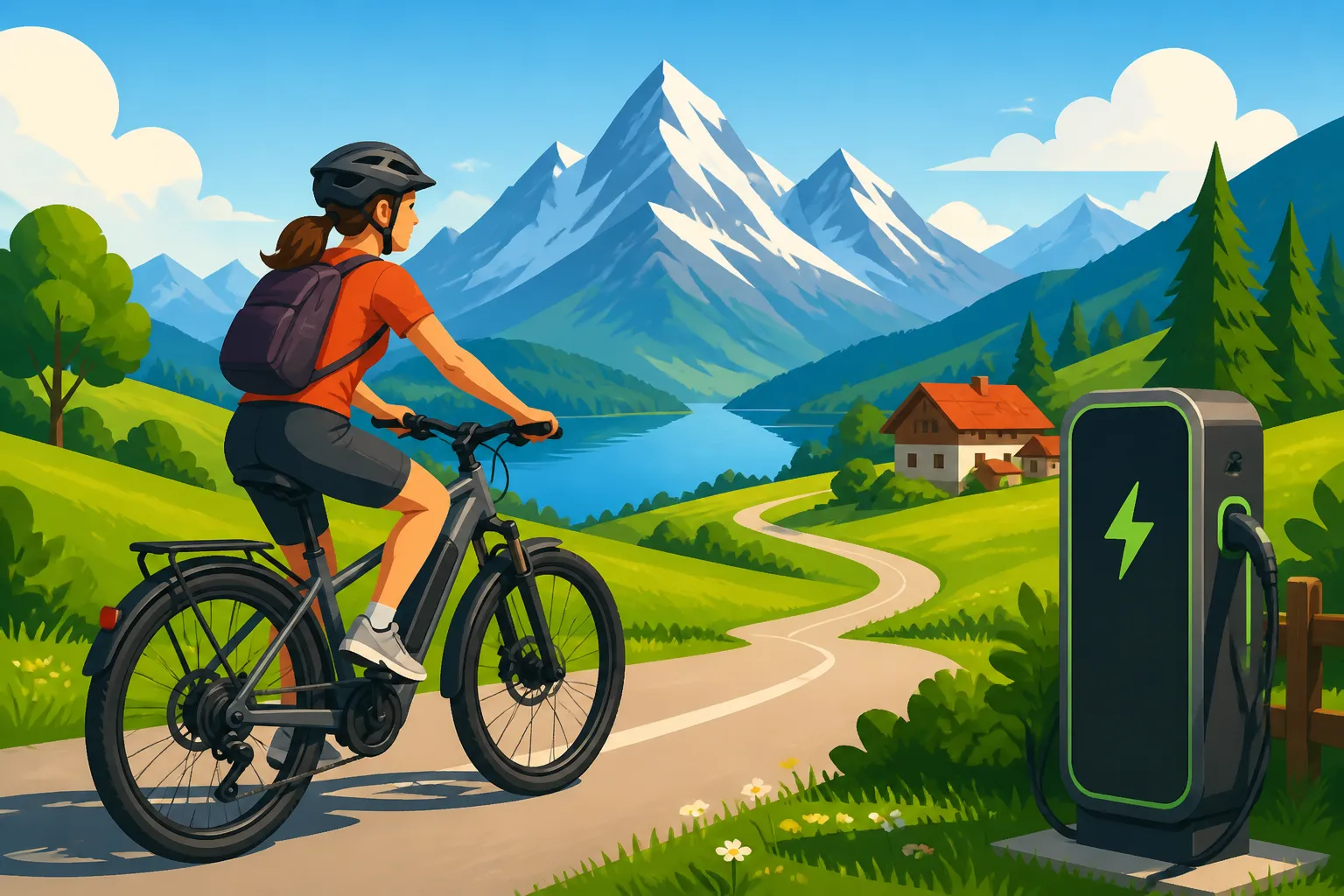
"Range anxiety" is a real thing for e-bikers, especially when you're out in the middle of nowhere and your battery indicator dips into the red. Thankfully, Switzerland has a surprisingly robust and growing infrastructure for e-bike charging.
Public Charging Stations: Where to Find Them
You'll be pleased to know that Switzerland has embraced e-bikes, and public charging stations are becoming increasingly common, especially in tourist areas and along popular cycling routes.
- Tourist Information Offices and Mountain Huts: Many tourist info points, as well as alpine restaurants and mountain huts (known as Berggasthaus or Alpwirtschaft), offer charging facilities, often for free or a small fee. It’s a win-win: you refuel your body with a delicious Rösti or a local specialty, and your bike refuels its battery.
- Dedicated E-Bike Stations: Some regions have installed purpose-built charging stations, sometimes even with secure lockers for your battery or the whole bike. These are usually indicated on official cycling maps and apps like SchweizMobil.
- SBB Stations and Mobility Hubs: As the national rail service, SBB is increasingly integrating e-bike services. Some major train stations might have charging lockers or facilities. It's worth inquiring at the station or checking the SBB website. You can purchase your train tickets through Omio for seamless travel to these hubs.
It's always a good idea to bring your own charger, as most public stations only offer standard outlets (Type J, the Swiss standard). Some newer stations might have universal charging cables or connectors, but don't count on it.
Restaurant and Hotel Charging: Fueling Up While You Refuel
This is perhaps the most common and convenient way to charge your e-bike while on a tour. Many hotels, guesthouses, and restaurants, especially in areas popular with cyclists, are more than happy to let you charge your battery while you enjoy a meal or stay overnight.
- Ask Nicely: Don't be shy! A polite "Entschuldigung, darf ich mein E-Bike Akku hier aufladen, während ich bei Ihnen esse/übernachte?" (Excuse me, may I charge my e-bike battery here while I eat/stay?) usually does the trick.
- Look for "E-Bike Freundlich" Signs: Many establishments advertise themselves as "e-bike friendly" with special signs, indicating they have charging facilities, secure bike storage, and sometimes even tools for minor repairs.
- Booking.com for E-Bike Friendly Stays: When planning longer trips and booking accommodation, use Booking.com and specifically look for hotels that mention bicycle storage or e-bike charging in their amenities. A quick call ahead to confirm can save you a lot of hassle.
Remember that charging a full battery can take several hours, so plan your stops accordingly. A strategic lunch break can often give you enough juice to complete your afternoon ride.
Battery Management and Range Anxiety: Practical Tips
Even with ample charging options, a bit of savvy battery management goes a long way.
- Start with a Full Charge: Obvious, but crucial. Always begin your day with a fully charged battery.
- Conserve Power on Flats and Downhills: Use the lowest (or no) assist mode on flat sections or when going downhill. Save the turbo mode for those steep climbs!
- Carry a Portable Charger/Power Bank: For your phone, not your bike! You'll be using navigation apps, taking photos, and possibly making emergency calls. A dead phone is more frustrating than a low bike battery.
- Understand Your Bike's Range: Get to know your e-bike's typical range under different conditions (flat vs. hilly, high vs. low assist, rider weight). Manufacturers' stated ranges are often optimistic, so factor in a buffer.
- Consider a Spare Battery (if practical): For multi-day, remote tours, some dedicated e-bikers carry a spare battery, though they are heavy and expensive. This is usually only for extreme adventures.
For those considering purchasing their own e-bike, or even just renting, it's vital to understand the different legal classifications. Our guide on E-Bike Categories in Switzerland: Helmets, Plates, and Speed Limits will give you all the details on what's required for various types of electric bicycles in Switzerland, from slow e-bikes to faster ones that act more like mopeds.
Renting an E-Bike and Essential Gear
Don't own an e-bike? No problem! Switzerland has excellent rental options, and knowing what to bring will make your journey even more comfortable.
Renting Your Ride: From SBB to Local Shops
- Rent a Bike (SBB Partner): This is a fantastic option, often available directly at major SBB train stations. You can rent high-quality e-bikes for a day or longer, and sometimes even drop them off at a different station. This is ideal for point-to-point tours. You can combine your e-bike rental with a Half-Fare Travelcard (Halbtax): The Must-Have Pass for Swiss Residents to get discounts on your train journey to pick up your bike.
- Local Bike Shops: Almost every town, especially in popular tourist regions, will have a bike shop that rents e-bikes. These often offer a wider variety of models and can provide local route advice. Prices generally range from CHF 50-80 per day, depending on the bike quality and rental duration.
- Hotels and Tourist Centers: Many hotels and some tourist information centers also offer e-bike rentals as part of their services, especially in areas like the Engadine or around Lake Lucerne.
- Guided E-Bike Tours: If you're new to e-biking or the area, a guided tour can be a great way to start. Companies found on platforms like GetYourGuide offer tours that include e-bike rental, a guide, and often highlight local attractions or culinary stops.
Always reserve your e-bike in advance, especially during peak season (spring to autumn), to ensure availability. Check the bike thoroughly before you set off – brakes, tires, battery level, and saddle height.
Must-Have Gear for Your Swiss E-Bike Tour
Even with the motor doing some of the work, being prepared is crucial for an enjoyable day out.
- Helmet: Mandatory for faster e-bikes, and highly recommended for all. Safety first!
- Weather-Appropriate Clothing: Layers are your friend. Even on a sunny day, temperatures can drop quickly at higher elevations or in shaded valleys. A lightweight rain jacket is a must.
- Water and Snacks: Stay hydrated, especially on longer rides. Swiss tap water is safe to drink, so refill your bottles whenever possible. Small snacks like nuts, energy bars, or a local Bündner Nusstorte will keep your energy up. For picnic inspiration, check out our guide on Picnicking in Switzerland: Where to Buy Supplies and Sit.
- Sun Protection: Sunscreen, sunglasses, and a hat or bandana are essential, especially in the mountains where the sun is intense.
- Basic Repair Kit: While e-bikes are generally reliable, a spare inner tube, tire levers, a small pump, and a multi-tool can save the day for a flat tire or minor adjustment.
- Navigation: Your phone with SchweizMobil or Komoot, and perhaps a physical map as a backup.
- Power Bank: To keep your phone charged.
- ID and Money: Always carry identification and some cash, especially for smaller mountain restaurants that might not accept cards.
Safety First: Swiss Cycling Rules You Need to Know
Swiss traffic laws apply to e-bikes just as they do to regular bicycles, with a few extra nuances depending on the e-bike category.
- Helmets: As mentioned, mandatory for "fast" e-bikes (up to 45 km/h assist), highly recommended for "slow" e-bikes (up to 25 km/h assist).
- Lights and Reflectors: Your e-bike must have functioning front and rear lights, and reflectors, especially if you plan to ride in low light conditions.
- Pillion Passengers: Carrying a passenger is generally only permitted on e-bikes specifically designed for it (e.g., cargo bikes).
- Signaling: Always signal clearly when turning or stopping.
- Respect Pedestrians: Give way to pedestrians, especially on shared paths. The Swiss are very particular about their rules, and respecting common courtesy is part of Swiss Customs and Etiquette: Social Norms Every Newcomer Should Know.
- Drinking and Cycling: Just like driving, cycling under the influence of alcohol is illegal and can lead to hefty fines and even loss of your driver's license.
Always err on the side of caution. The Swiss road and trail network is generally very safe, but being aware of your surroundings and following the rules ensures a pleasant experience for everyone.
Popular E-Bike Routes and Their Features
To help you get started, here's a little taste of some fantastic routes across different regions, keeping in mind ease of charging and accessibility.
| Route Name | Region / Starting Point | Difficulty (E-Bike) | Key Features | Charging Availability | Best For |
|---|---|---|---|---|---|
| Heart Route (Segments) | Central Switzerland (e.g., Lucerne) | Moderate | Rolling hills, Emmental cheese dairies, charming villages | Good (restaurants, towns) | Cultural immersion, culinary stops |
| Engadine Valley Trails | Graubünden (St. Moritz, Pontresina) | Easy to Moderate | Alpine lakes, picturesque villages, stunning mountain vistas | Excellent (hotels, shops) | Scenic beauty, high-altitude exploration |
| Lavaux Vineyard Terraces | Lake Geneva Region (Lausanne, Vevey) | Moderate | UNESCO World Heritage vineyards, lake views, charming wine villages | Good (wineries, restaurants) | Wine tasting, panoramic views, cultural experience |
| Aare Route (Bern to Thun) | Bernese Oberland (Bern) | Easy | Riverside paths, historic city views, Lake Thun | Good (cities, towns) | Relaxed rides, city & nature combo |
| Bodensee-Radweg (Swiss Segment) | Northeastern Switzerland (Romanshorn) | Easy | Lake Constance shoreline, gentle terrain, charming towns | Excellent (all towns) | Family-friendly, international connections |
| ViaRhôna (Valais Segment) | Valais (Visp to Montreux) | Easy to Moderate | Rhône river, vineyards, castles, scenic towns | Good (towns along route) | Long-distance touring, diverse landscapes |
These are just a few suggestions, but the possibilities for e-biking through the Swiss countryside are truly endless. Whether you're a seasoned cyclist or a complete novice, an e-bike allows you to experience the magic of Switzerland in a way that's both exhilarating and accessible. So, get out there, explore those stunning routes, and don't forget your charger!
Disclaimer
The information provided in this guide is for general informational purposes only and does not constitute professional advice. While we strive to provide accurate and up-to-date information, rules and regulations in Switzerland, particularly regarding cycling laws, may change. Always consult official sources, such as local tourist offices, cantonal authorities, or the relevant transport agencies, for the most current and specific information before planning your e-bike journey. E-biking, like any outdoor activity, carries inherent risks; always prioritize safety, wear appropriate gear, and be aware of your surroundings.