Weather and Geography: Föhn Winds, Winter Readiness, and Alpine Living
If you arrive in Switzerland during the vibrant, postcard-perfect summer, the sudden shift to the "gray season" can be a genuine shock to your system. I remember my first November in Zurich, staring at a literal wall of white fog for three weeks straight, wondering if I’d accidentally moved to a different planet. This guide breaks down the atmospheric quirks of the Alps, from the mysterious Föhn winds to the practicalities of surviving a Swiss winter.
Understanding the Föhn: The Headache Inducing Alpine Wind
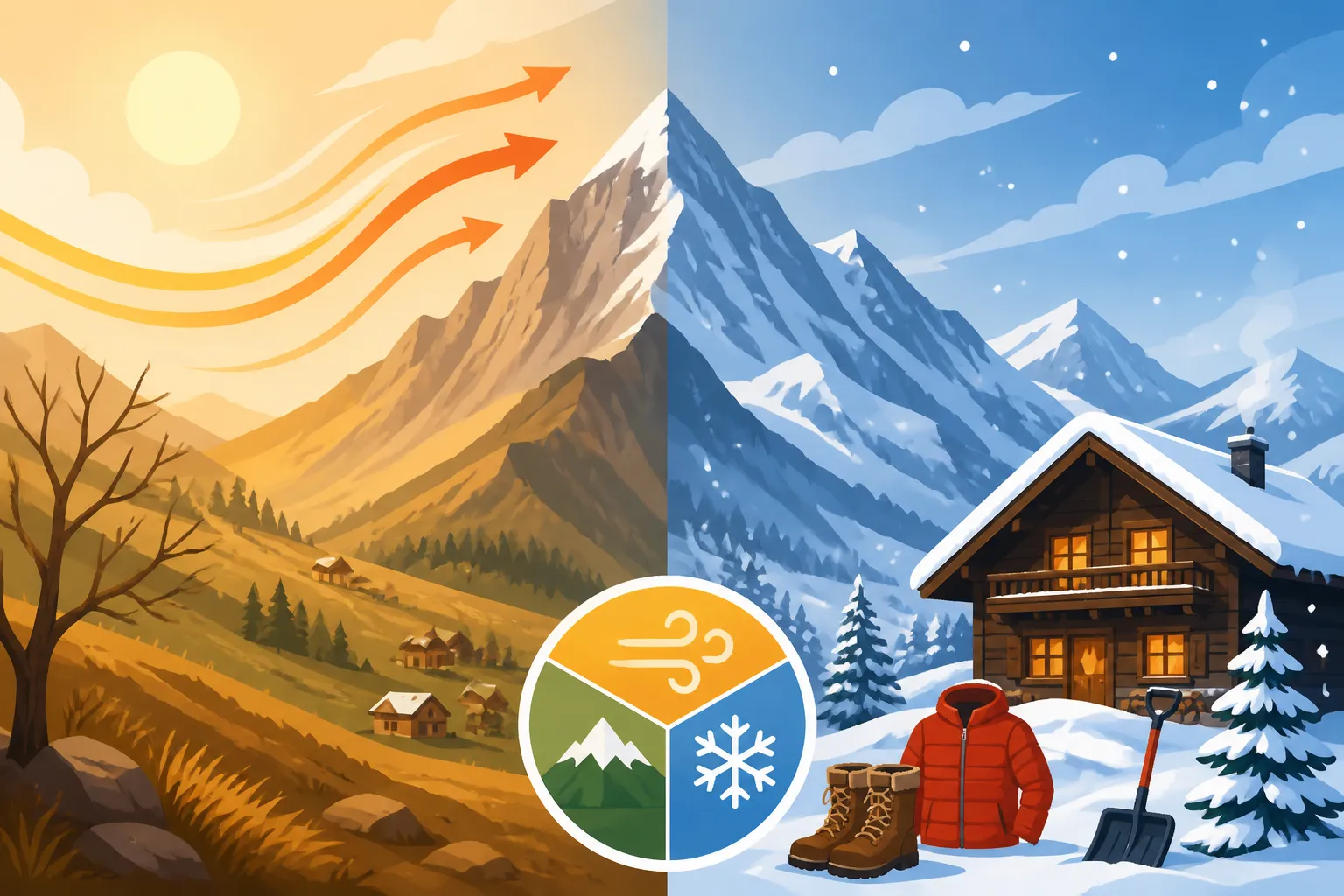
One of the most unique and often frustrating aspects of Swiss geography is the Föhn. This is a warm, dry, down-slope wind that occurs on the lee side of the Alps. While a warm breeze in the middle of winter sounds like a blessing, it comes with a psychological and physical price tag that many expats aren't prepared for. When the Föhn blows, the sky becomes an impossibly crisp, electric blue, and the mountains look so close you feel like you could reach out and touch them. But for many of us, that beauty is accompanied by a nagging pressure in the temples.
The Science and Sensation of the Föhn
Scientifically, the Föhn occurs when moist air is pulled up over the mountains from the south. As it rises, it cools and dumps its moisture as rain or snow on the southern side (Ticino). By the time the air crests the peaks and spills down into the northern valleys, it has become incredibly dry and heats up rapidly as it descends. This creates a massive pressure differential.
In places like Lucerne, Altdorf, or the Rhine Valley, temperatures can jump 10 to 15 degrees Celsius in a matter of hours. From a veteran’s perspective, the "Föhn window" is a surreal experience. You might be wearing a heavy parka in the morning and find yourself down to a t-shirt by lunch, all while watching the clouds form a distinct, stationary "Föhn wall" over the mountain ridges. If you are sensitive to these pressure changes, you might want to look into Swiss Föhn Sickness: Why the Mountain Wind Causes Headaches to understand why your mood or sleep patterns suddenly shift.
Living with Föhn Sickness
It sounds like folklore until it happens to you. "Föhnkrankheit" or Föhn sickness is a widely recognized phenomenon in Switzerland. Symptoms include migraines, irritability, fatigue, and even joint pain. Many Swiss companies and schools actually acknowledge that productivity might dip when the Föhn is strong. I’ve spent many afternoons stocked up on painkillers and wondering why I felt so out of sorts, only to realize the wind was gusting at 100km/h through the Glarus Alps.
To manage this, locals often suggest hydration and avoiding heavy meals. If you’re just moving and haven't found a permanent home yet, check Finding Temporary Serviced Apartments: Vision Apartments and CityPop for places with good climate control, as the dry air of the Föhn can also make indoor environments feel quite parched. If you find yourself needing specific remedies or humidifiers, you can often find better deals on specialized home equipment via Amazon Germany which ships many items directly to Swiss addresses, often bypassing the higher local markups.
The Impact on Alpine Activities
Geography dictates that the Föhn isn't just a headache; it’s a safety hazard. In the mountains, the Föhn can melt snow packs dangerously fast, leading to increased avalanche risks. It also makes cable car operations impossible. If you’re planning a weekend in the mountains, always check the "Meteo" app for Föhn warnings. A sunny day doesn't always mean a safe day for skiing or hiking. The wind can be violent enough to knock a person off a ridge or cause sudden, blinding snowdrifts.
Winter Readiness: Preparing Your Home and Life
Winter in Switzerland isn't just a season; it's a lifestyle shift that requires meticulous administrative and physical preparation. Unlike many other countries where "winter" might just mean a few extra layers, here it involves legal obligations and community expectations that can catch an expat off guard.
The Swiss Heating Season and Nebenkosten
In most Swiss apartments, the "Heizperiode" (heating season) typically runs from mid-October to April. Most buildings use central heating systems, and you’ll find that your radiators have a mind of their own. One of the biggest financial traps for newcomers is failing to account for the Nebenkosten (Ancillary Costs): Heating, Water, and Annual Adjustments. These are the monthly prepayments you make for heating and water.
If the winter is particularly brutal, your prepayments might not cover the actual cost of the oil or gas used by the building. Come springtime, you might receive a "pro-rata" bill for several hundred, or even a thousand, francs. To avoid this, I always recommend keeping your thermostat at a steady level—usually "3" on the dial—rather than turning it off and on. It’s actually more expensive to heat a stone-cold room than to maintain a moderate temperature in a well-insulated Swiss "Neubau."
Essential Gear and Winter Maintenance
Swiss winters demand high-quality gear. This isn't the place for fashion boots with no grip. You need waterproof, insulated footwear with heavy-duty soles, especially if you live in hilly cities like Lausanne or St. Gallen. If you’re trying to keep your Cost of Living in Switzerland 2026: Budgeting for Singles and Families under control, don't skimp on the basics. I learned the hard way that cheap gloves from a supermarket won't survive a 15-minute wait for a tram in January.
For your car, preparation is even more critical. While there isn't a federal law that says you must change your tires on a specific date, you are legally responsible for having a car that is "roadworthy" for the conditions. If you cause an accident in the snow with summer tires, your insurance will likely refuse to pay. Most locals follow the "O to O" rule: Oktober bis Ostern (October to Easter). Check the details in our guide on Winter Tires in Switzerland: Are They Legally Mandatory in 2027? to stay on the right side of the law.
Community Duties and Snow Removal
If you live in a house or a small apartment block, you might be surprised to find that snow removal is often your responsibility. The "Schneeräumungspflicht" means you must clear the sidewalk in front of your property by a certain time in the morning (usually 7:00 AM). If a pedestrian slips on ice in front of your home because you didn't salt the path, you could be held liable.
Even in apartment buildings, there is often a "Putzplan" (cleaning schedule) that includes clearing the entrance or the shared balcony. It’s part of the unspoken social contract here. Being the "lazy expat" who doesn't shovel is a quick way to alienate your neighbors. If you’re currently looking for a place and want to know what kind of neighborhood responsibilities you're signing up for, read through Where to Live in Switzerland: Cantons, Cities, and Commuter Zones for a better idea of urban vs. rural expectations.
| City | Avg. Winter Temp (°C) | Fog Days (Nov-Jan) | Snow Probability |
|---|---|---|---|
| Zurich | -1 to 4 | High | Moderate |
| Geneva | 0 to 6 | Moderate | Low |
| Lugano | 3 to 10 | Low | Very Low |
| St. Moritz | -12 to -2 | Very Low | Guaranteed |
| Basel | 1 to 5 | High | Low |
Geography and Alpine Living: Choosing Your Altitude
The geography of Switzerland is divided into three main regions: the Jura mountains, the Central Plateau (Mittelland), and the Alps. Where you choose to live within these zones will drastically change your daily experience of weather and light.
Living Above the Nebelmeer
The "Nebelmeer" (sea of fog) is a defining feature of the Swiss Mittelland (the flat-ish area between the Jura and the Alps where most people live). During the winter, cold air gets trapped under a layer of warmer air, creating a thick, persistent fog that can last for weeks. In Zurich, Zug, or Aarau, you might not see the sun for a month, even though it’s perfectly clear just 200 meters higher up.
This is why many expats and locals prefer living at higher elevations. Moving just a few kilometers up the side of a mountain like the Uetliberg or the Rigi can put you above the fog line. Suddenly, you're in bright sunshine looking down at a white "ocean" covering the valleys. When you are Buying a Property in Switzerland: Process, Fees, and Real Estate Reality, the "Sonnenlage" (sunny position) and altitude are massive factors in the price. A south-facing slope above the fog line is the gold standard of Swiss real estate.
Terrain and Daily Logistics
Living in the "Alpine" zone comes with logistical hurdles that city dwellers don't face. Your commute might involve steep, winding roads that require 4-wheel drive in the winter. Parking becomes a complex issue because of snow-clearing requirements. You also have to consider the "sun-hours." In deep Alpine valleys, the sun might disappear behind a mountain peak at 1:00 PM in December, leaving you in shadow for the rest of the day.
However, the trade-off is the access to nature. If you live in a place like Engelberg or Davos, you have world-class skiing on your doorstep. For those who commute from these regions, the SBB Travelcards: Is the Generalabonnement (GA) Worth the CHF 4000+ Cost? is often a lifesaver, as Swiss trains are remarkably resilient in the face of heavy snow, often running when the roads are treacherous.
Regional Microclimates
Don't assume the whole country is a frozen tundra. Ticino, the Italian-speaking canton to the south of the Alps, has a Mediterranean microclimate. While Zurich is shivering in the fog, Lugano might be enjoying 12-degree sunshine and palm trees. Similarly, the Valais region is one of the driest parts of the country, protected by high peaks on all sides. When you’re using HousingAnywhere to search for your next home, consider how much the regional climate matters to your mental health. If you suffer from Seasonal Affective Disorder (SAD), a move to Ticino or a high-altitude spot in Valais might be worth the extra commute.
The Logistics of Swiss Seasons
The transition between seasons in Switzerland is managed with a level of precision that is almost obsessive. There are protocols for everything, from when the cows come down from the mountains to when the national sirens are tested.
Winter Tires and Road Safety
As mentioned, winter tires are a non-negotiable part of the geography here. But it’s not just about the tires; it’s about the "Vignette" and road salt. The salt used on Swiss roads is incredibly corrosive. Veterans know that you need to wash the undercarriage of your car frequently during the winter to prevent rust.
Additionally, if you’re driving into the high Alps, you are often required by road signs to carry snow chains, even if you have winter tires. Knowing how to put these on in a dark, freezing mountain pass is a rite of passage. If you’re renting a car for a weekend trip, always ensure it comes with these essentials. For staying connected while navigating these remote passes, I highly recommend getting an eSIM from Airalo to ensure you have GPS data even when your primary provider’s signal drops in the deep valleys.
Emergency Preparedness and the Sirenentest
Geography also plays into Switzerland's famous obsession with safety. Because of the risk of avalanches, floods, and the proximity to nuclear plants, the country has a massive network of sirens. On the first Wednesday of every February, the entire country participates in the "Sirenentest." Don't panic when you hear the wailing—it’s just a test.
Most Swiss apartment buildings built before the late 20th century are also required by law to have a nuclear bunker in the basement. Nowadays, these are usually used to store bikes or old wine, but the geography of being a small, mountainous country has dictated this high level of preparedness. You can learn more about these quirks in our guide on Emergency Preparedness: Sirens (Sirenentest) and Nuclear Bunkers.
The Seasonal Shift in Social Life
The weather also dictates the social calendar. Winter is the season of "Raclette" and "Fondue" evenings. It’s a time for indoor gatherings and "Apéro" culture in cozy, wood-paneled bars. Once the snow melts, the geography transforms into a playground for hiking and "Badi" (lido) culture. Understanding this rhythm is key to your integration. If you try to organize a mountain hike in April, locals will look at you like you're crazy because of the "Zwischenzeit"—the muddy, slushy period between ski season and hiking season.
Seasonal Shopping and Resources
Surviving the Swiss climate as an expat means knowing where to get the right tools without breaking the bank. The local market is high-quality but expensive, so strategic shopping is a must.
Finding Quality Gear Without the Swiss Premium
While places like Transa offer incredible outdoor gear, the prices can be eye-watering. Many expats use Amazon Germany for things like winter car kits, high-end humidifiers for Föhn days, and specialized thermal wear. Since Switzerland has a VAT agreement, you often get the German VAT (19%) deducted at checkout and the lower Swiss VAT (8.1%) applied, sometimes making it significantly cheaper than buying locally in Zurich or Geneva.
Connectivity in Remote Areas
If you’re living in or visiting the Alpine regions, your standard mobile plan might struggle with "dead zones" in the deep valleys. Having a backup is essential for safety. Airalo offers Swiss-specific data packages that often roam on the strongest available local network (like Swisscom), which is vital if you're out hiking or driving in the mountains and need reliable weather updates.
Finding Your Alpine Sanctuary
If the fog of the Mittelland is getting to you, or if you want to experience a "test run" of Alpine living, using a platform like HousingAnywhere can help you find mid-term rentals in different cantons. This allows you to experience a winter in the mountains or a spring in Ticino without the massive commitment of a long-term lease. It’s a great way to "weather-test" a region before you decide to settle down permanently.
Disclaimer
This guide is intended for informational purposes only and reflects the personal experiences and observations of the author. Weather patterns and geographical risks in Switzerland can change rapidly. Always consult official local sources, such as MeteoSwiss and the Swiss Federal Institute for Forest, Snow and Landscape Research (WSL) for avalanche bulletins and severe weather warnings. The author and publisher are not responsible for any accidents, legal issues, or health problems resulting from the application of the advice contained in this article.