Emergency Medical Services: Ambulances, REGA, and Crisis Protocols
Standing in your kitchen at 2:00 AM while a family member is doubled over in pain is a terrifying experience, made worse when you are in a country where you don't fully understand the emergency protocols. I remember my first midnight dash to a Zurich clinic, clutching a residency permit and praying the staff spoke English. This guide will walk you through everything from ambulance costs to REGA air rescue so you are never left guessing in a crisis.
The Swiss Emergency Landscape: Why It Feels Different
In many countries, an emergency room is a catch-all for any medical concern after hours. In Switzerland, the system is highly tiered and designed for efficiency, which can feel cold or bureaucratic to the uninitiated. The Swiss medical philosophy leans heavily on personal responsibility; they expect you to use the lowest level of care appropriate for your situation. This means that if you show up at a major trauma center with a minor cut, you will likely wait for hours and receive a stern look from the triage nurse.
I have spoken to dozens of expats who were shocked to find that the "emergency" they perceived was viewed as a "routine inconvenience" by Swiss medical staff. Understanding this cultural difference is the first step toward navigating the system without unnecessary stress. The system works remarkably well, but it operates on a logic of strict necessity. If you are not in immediate danger of losing life or limb, the system expects you to go through a family doctor or a local walk-in clinic rather than the main hospital ER.
Validating your frustration is important here. It is incredibly difficult to be told to wait when you are in pain or worried about a child. However, knowing that this is part of the Finding Medical Care in Switzerland: Doctors, Specialists, and Referrals process helps you manage your expectations. You aren't being ignored because you are a foreigner; you are being triaged according to a very rigid, but fair, Swiss standard.
The Triage Mentality
When you enter a Swiss emergency department, you will be met by a triage nurse who uses the Swiss Triage Scale. This is a standardized system that ranks patients from 1 (immediate life-threatening) to 5 (non-urgent). As an expat, you might feel the urge to "oversell" your symptoms to get seen faster. Don't. The nurses are highly trained and will see through it quickly. Be honest, be clear about your pain levels, and understand that a Level 4 patient will always be bumped for a Level 1 or 2 arrival.
During my time here, I’ve seen parents get incredibly upset when a person who walked in after them is taken back immediately. In Switzerland, the "invisible" emergencies—like a suspected stroke or cardiac event—are handled with lightning speed, while a broken arm might sit in the waiting room for three hours. This is why Emergency Rooms in Switzerland: Triage, Waiting Times, and Billing can be a confusing experience for those used to a first-come, first-served model.
If you find the wait times in public hospitals too long, you might consider how Supplementary Health Insurance (VVG): What It Covers and When to Buy It can sometimes provide access to private clinics with shorter queues. However, in a true life-or-death crisis, the public system is world-class and is exactly where you want to be.
Language Barriers in High-Stress Moments
One of the biggest fears for any expat is the inability to communicate during a medical crisis. While most doctors in major Swiss cities like Zurich, Geneva, and Basel speak excellent English, the support staff, ambulance drivers, or receptionists might not. This is particularly true in the more rural cantons or during the high-stress environment of a trauma bay.
I always recommend having a "crisis card" in your wallet. This should list your basic medical history, any allergies, and your current medications in the local language (German, French, or Italian). You can find services for Translating Medical Records from English to German/French for Your Hausarzt that can help you prepare these documents before an emergency occurs. Being able to hand a piece of paper to a medic when you are too panicked to speak is a lifesaver.
In the heat of the moment, if you cannot find the words, remember that medical terms often have Latin roots that are similar across languages. If you are struggling, try to stay calm. The Swiss medical system is used to international residents, especially in hubs like Geneva. If you have a complex medical history, having an international policy through Cigna Global can sometimes provide access to helplines that offer translation support or coordination with local facilities.
Emergency Numbers You Must Know by Heart
In Switzerland, there isn't just one "911" or "999" for everything. While 112 works as a general European emergency number, the Swiss have specific lines for specific crises. Calling the wrong one won't prevent help from coming, but it might slow down the dispatch process. You need to memorize 144. This is the number for medical emergencies. If you see an accident or someone collapses, dial 144 immediately.
When you call 144, the operator will likely ask "Wo?" (Where?) first. This is because if the call drops, they at least know where to send the ambulance. Be prepared to give your exact address, including the floor and the name on the doorbell. Swiss apartment buildings can be labyrinths, and precious minutes are lost when paramedics are wandering a hallway. I’ve learned to always send someone down to the street to wave the ambulance in if possible.
It is also helpful to understand that the Emergency Numbers 144 vs 112: Which to Call in a Swiss Medical Crisis distinction is real. 112 will get you to a general dispatcher who then forwards you to the police, fire, or medical branch. Calling 144 skips that middle step, putting you directly in touch with medical professionals who can give you life-saving instructions over the phone while the ambulance is en route.
Special Services: 1414, 145, and 143
Beyond the standard medical line, there are "niche" emergency numbers that are vital for expats to know. 1414 is the direct line for REGA, the Swiss air rescue service. If you are hiking in the mountains or skiing in the Alps and an accident happens, 1414 is your lifeline. They can pinpoint your location via your smartphone's GPS and send a helicopter directly to you.
Then there is 145, the National Poison Centre. This is a 24/7 service that is incredibly helpful for parents. If your child swallows a cleaning product or an unknown berry in the woods, call 145 before doing anything else. They have a massive database of toxins and can tell you immediately if you need to induce vomiting, head to the ER, or just monitor the situation.
Finally, 143 is "The Doutbul Hand" (Die Dargebotene Hand), a crisis line for those struggling with mental health or emotional distress. Moving to a new country is hard, and the isolation can be overwhelming. If you feel like you are at a breaking point, 143 provides anonymous, 24/7 support. For more structured help, you might look into Mental Health in Switzerland: Accessing Therapists and Psychiatric Care, but for immediate crisis, 143 is the number.
117 and 118: Police and Fire
While this guide focuses on medical needs, you should also know 117 for the police and 118 for the fire department. In Switzerland, these services are often integrated into the same dispatch centers as the medical lines. If a car accident involves injuries and a fire risk, calling any of these numbers will trigger a multi-agency response.
I’ve found that the Swiss police (117) are very formal. If you call them for a non-emergency, they will politely but firmly tell you to call your local station instead. This goes back to the Swiss rule of using the right channel for the right problem. Reserve 117 for active crimes or situations where there is an immediate threat to public safety.
For many expats, the fear of "making a scene" prevents them from calling these numbers. Don't let that stop you. If you genuinely feel unsafe or see someone else in danger, call. The Swiss system is built on a high level of social trust, and that trust includes the expectation that people will report emergencies when they see them.
Ambulances in Switzerland: Costs and Expectations
This is the section where most expats get their biggest shock. In many countries, an ambulance ride is either free at the point of use or fully covered by insurance. In Switzerland, an ambulance is a premium service with a price tag to match. A single ride can cost anywhere from CHF 700 to CHF 2,000 depending on the canton and the medical interventions required.
The biggest frustration is the billing. Under the Understanding KVG/LAMal: Mandatory Basic Health Insurance Explained rules, your basic insurance only covers 50% of the cost of an ambulance, and even then, only up to a maximum of CHF 500 per calendar year. Let that sink in. If your ambulance ride costs CHF 1,200, your insurance pays CHF 500, and you are left with a CHF 700 bill. If you need a second ambulance in the same year, you pay 100% of it out of pocket.
This is why I always tell new arrivals to check their Supplementary Health Insurance (VVG): What It Covers and When to Buy It policies immediately. Many "Ambulatory" supplements will cover the remaining 50% or increase the cap to CHF 10,000 or more. Without this, a single medical crisis can blow your entire monthly budget. If you are an expat with a high-end international plan like Cigna Global, these costs are often fully covered, which provides massive peace of mind.
The "Taxi with a Siren" Sticker Shock
The Swiss view an ambulance as a highly specialized medical transport, not a "fast taxi" to the hospital. If you call 144 and the paramedics arrive but determine that you are stable enough to take a regular taxi or have a friend drive you, they might suggest you do so to save you the cost. This isn't them being lazy; it's them trying to save you CHF 1,000.
I once spoke to an expat who called an ambulance for a high fever. The paramedics arrived, gave him some basic meds, monitored him for 20 minutes, and then left without taking him to the hospital. A week later, he received a bill for CHF 600 for the "on-site intervention." Even if you don't get a ride, the dispatch of the team costs money.
This is why Does Basic Swiss Insurance Cover Ambulance Rides? The 50% Rule Explained is one of the most-read topics for foreigners. You must understand that every time those sirens turn on, a bill is being generated. If the situation is not life-threatening, consider whether a taxi or a ride from a neighbor is a viable alternative.
Tiers Garant vs. Tiers Payant in Emergencies
Another point of confusion is how the bill actually gets paid. Most ambulance services in Switzerland operate on the "Tiers Garant" system. This means the ambulance company sends the bill directly to you. You are responsible for paying it within 30 days. You then send a copy of the bill (the Rückforderungsbeleg) to your insurance company to get your 50% reimbursement.
This can be a nightmare if you are already dealing with the aftermath of a health crisis. Imagine recovering from a surgery only to find a CHF 1,500 bill in your mailbox that you have to pay upfront. Some insurers and cantons are moving toward "Tiers Payant," where the insurer pays the provider directly, but it is not yet universal.
You can read more about How to Pay Medical Bills: Tiers Garant vs. Tiers Payant Billing Systems to prepare yourself for the paperwork. My advice: always keep a "health emergency fund" of about CHF 2,000 in a savings account just to cover these upfront costs while you wait for insurance to pay you back.
| Service Type | Estimated Cost | KVG Basic Coverage | Expat Tip |
|---|---|---|---|
| Basic Ambulance | CHF 700 – 1,200 | 50% (Max CHF 500/yr) | Get VVG Supplement |
| Special Rescue (e.g. trapped) | CHF 2,000+ | 50% (Max CHF 5,000/yr) | Join REGA |
| REGA Helicopter | CHF 3,500+ | Often 0% if "rescue" only | Become a Patron |
| Emergency Doc (on-site) | CHF 300 – 500 | Standard Franchise/Copay | Check "Telmed" first |
REGA and Air Rescue: The Expat Safety Net
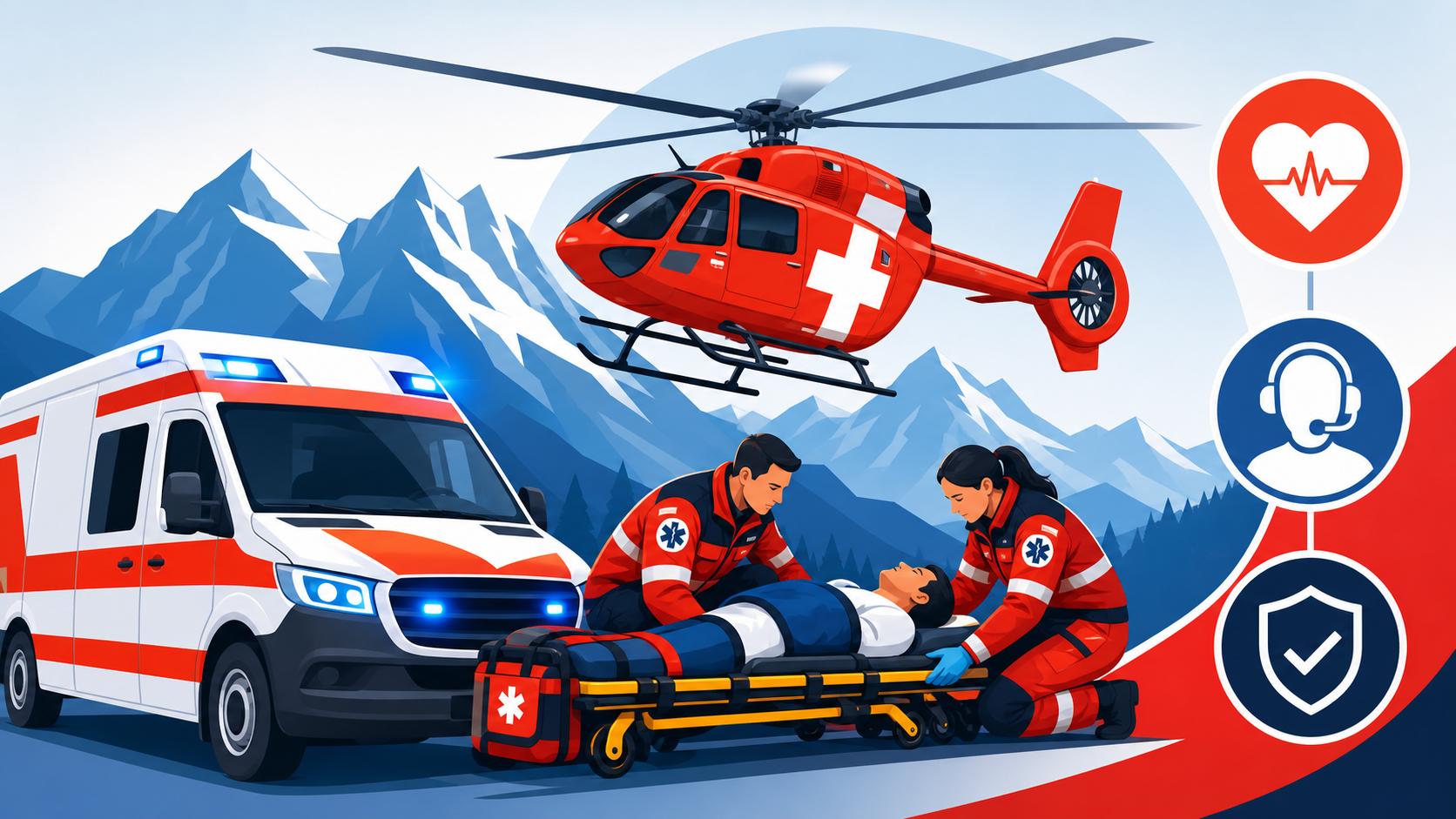
If you live in Switzerland, you will eventually see the bright red helicopters of REGA (Swiss Air Rescue) buzzing over the mountains or even landing in city parks. REGA is a non-profit foundation that provides emergency medical assistance by air. For hikers, skiers, and mountain bikers, REGA is not just a luxury; it is an absolute necessity.
The catch with REGA is that it is not technically insurance. It is a "patronage" system. You pay an annual donation (usually around CHF 40 for an individual or CHF 80 for a family), and in return, REGA may waive the costs of any rescue mission they perform for you if those costs aren't covered by your insurance. In 20 years of living here, I have never heard of them refusing to waive the cost for a patron.
Without REGA patronage, a helicopter rescue from a ski slope can cost upwards of CHF 5,000. Your basic health insurance (KVG) is notoriously stingy with search and rescue costs. They might pay a portion if there is a medical emergency involved, but if you are just "lost" or "stuck" but not injured, KVG may pay zero. This is why REGA Membership: Why Expats Need Air Rescue Insurance in the Alps is the first thing I tell every new expat to sign up for.
What is REGA Patronage?
Think of REGA patronage as a "thank you" for your support that comes with a massive benefit. It covers you not just in the Swiss mountains, but also provides repatriation services if you are seriously injured abroad and need to be flown back to Switzerland for treatment. This is a huge comfort for expats who travel frequently within Europe.
Signing up is incredibly easy and can be done online in five minutes. You get a card to keep in your wallet, but more importantly, you can download the REGA app. The app is a marvel of Swiss engineering. If you are in trouble, you press a button in the app, and it automatically sends your coordinates and your medical profile to the REGA dispatch center. Even if you don't know where you are, they will.
I've had friends who were airlifted after skiing accidents, and they all say the same thing: the relief of seeing that red helicopter is immense, but the relief of not getting a CHF 6,000 bill a month later is even better. It is the best CHF 40 you will spend in Switzerland. You can find more details on How to Join REGA and What the Patronage Actually Covers through our dedicated guide.
Why Basic Insurance Isn't Enough for Mountains
Many expats assume that because they have "Accident Insurance" through their employer (UVG), they are fully covered for mountain rescues. This is a dangerous half-truth. While Accident Insurance (UVG): Occupational vs. Non-Occupational Coverage is excellent, it often has limits on "rescue" versus "medical transport."
If you fall and break your leg, UVG will likely pay for the transport. But what if you are caught in a storm, or you get hypothermia and need to be searched for? Those "search and rescue" costs are where the bills become astronomical. REGA fills that specific gap.
Furthermore, if you are a stay-at-home parent or a student, you aren't covered by employer UVG. You are covered by your basic health insurance (KVG) for accidents, which has the 50% limit we discussed earlier. In that scenario, REGA patronage is the only thing standing between you and financial ruin after a hiking mishap.
Navigating the Emergency Room (Notfall)
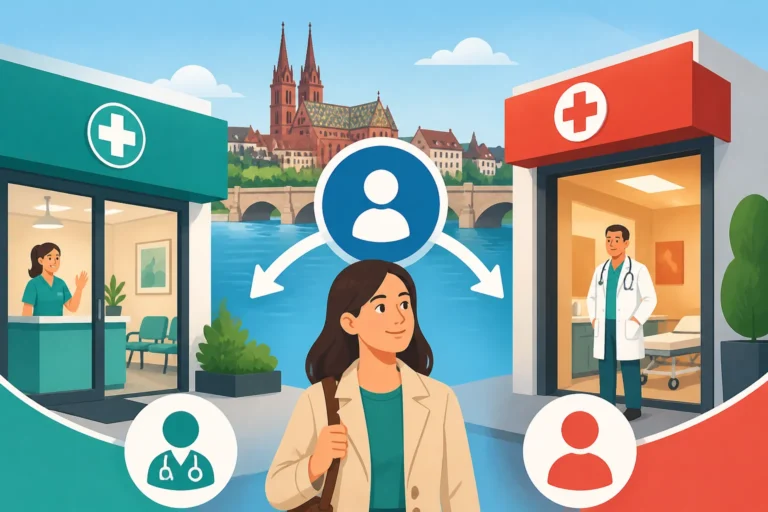
If you are not in need of an ambulance but need urgent care, you will head to a "Notfall" (Emergency) department. In major cities, you usually have two choices: a public hospital ER or a private walk-in clinic (often called a "Permanence"). If you have a choice and it's not a major trauma, go to the Permanence. They are specifically designed for urgent but non-life-threatening issues like stitches, minor breaks, or sudden infections.
Public hospitals, like the Universitätsspital Zürich or the Hôpitaux Universitaires de Genève (HUG), are world-class but can be overwhelming. When you arrive, you will need to present your Swiss health insurance card (the VeKa). This card is your golden ticket; it contains your insurance details and allows the hospital to bill your provider. If you forget it, you may be asked to pay a deposit upfront, which can be several hundred francs.
For a detailed look at local options, check out our Zurich Expat Healthcare Guide: Hospitals, Clinics, and Emergency Contacts or similar guides for Geneva and Basel. Knowing which tram line leads to the nearest "Permanence" is the kind of local knowledge that saves you a lot of grief when you're feeling miserable.
Walk-in Clinics vs. Public Hospitals
Walk-in clinics are a fantastic part of the Swiss system. For example, the Walk-in Clinics in Zurich: Permanence Hautbahnhof Guide highlights a clinic located right inside the main train station that is open until midnight (or even 24/7 in some cases). These clinics are staffed by excellent doctors and have on-site X-ray and lab facilities.
The advantage of a clinic like Permanence is speed. Because they don't handle major ambulance traumas (like heart attacks or car accidents), the wait times are generally much more predictable. If your child has a high fever or you suspect a urinary tract infection on a Sunday, this is where you should go.
However, be aware that if a walk-in clinic realizes your condition is more serious than they can handle, they will stabilize you and call an ambulance to take you to the main hospital. You will then have to pay for both the clinic visit and the ambulance ride. It’s a bit of a gamble, but for 90% of "emergencies," the walk-in clinic is the right call.
Triage Levels and Wait Times
As mentioned, wait times in Swiss ERs are dictated by triage, not arrival time. If you arrive at 7:00 PM with a Level 4 issue (e.g., a sore throat and mild fever), and a Level 2 patient (e.g., chest pain) arrives at 9:00 PM, they go in before you. This is why you should always bring a book, a phone charger, and some water.
One thing that surprises expats is that Swiss ERs are generally very quiet. There is no shouting, no chaotic waiting rooms filled with people. It is a very orderly, hushed environment. This can sometimes make you feel like "nothing is happening," but behind the doors, the staff is working at a furious pace.
If you are waiting, don't be afraid to check in with the nurse if your symptoms change or worsen. They will re-triage you if necessary. For a deeper understanding of what to expect, read Emergency Rooms in Switzerland: Triage, Waiting Times, and Billing. And remember, if you have a "Telmed" insurance model, you are usually required to call a medical hotline before going to the ER, or you might face a penalty on your claim.
Pharmacies and After-Hours Crisis Care
What happens if you don't need a doctor, but you desperately need medication at 11:00 PM on a Sunday? In Switzerland, almost everything closes on Sundays, including most pharmacies (Apotheken). However, every region has a designated "Notfallapotheke" (Emergency Pharmacy) that is open 24/7 or has extended hours.
Finding these is easy if you know where to look. Usually, the nearest open pharmacy is posted on the door of every closed pharmacy. You can also search for "Notfallapotheke [Your City]" online. Be prepared: using an emergency pharmacy often comes with a "Notfallpauschale" (emergency fee) of around CHF 20-50, which is added to the cost of your medication. This fee is often covered by insurance if you have a prescription, but not for over-the-counter (OTC) purchases.
I always suggest keeping a well-stocked "home pharmacy" to avoid these midnight runs. For basic supplements and health maintenance, I often use iHerb to get international brands that might be harder to find locally. Having a supply of vitamin C, electrolytes, and basic first-aid supplies on hand can prevent a minor issue from becoming a midnight crisis.
Finding a Notfallapotheke
In cities like Zurich, the pharmacy at the Main Station (Bahnhof Apotheke) is open 365 days a year from early morning until late at night. In smaller towns, the emergency duty rotates between different local pharmacies. You can find the schedule on your canton's official website or by calling 144 (though 144 should really be for medical emergencies, they can often direct you).
Our guide on Finding the Notfallapotheke (Emergency Pharmacy) on Sundays is a great resource to bookmark. Remember that Swiss pharmacists are highly trained and can provide a lot of medical advice. For minor issues like stings, rashes, or mild coughs, the pharmacist can often suggest an OTC solution that saves you a trip to the doctor entirely.
Just be aware that Swiss laws on medication are quite strict. Many things that are OTC in the US or UK (like high-dose ibuprofen or certain allergy meds) require a prescription here. This is why Pharmacies and Medication: Prescriptions, Costs, and OTC Regulations is essential reading for understanding what you can and cannot buy easily.
Medication Stockpiling and Supplements
While I don't advocate for "stockpiling" prescription drugs, having a solid supply of basics like Dafalgan (paracetamol) and Algifor (ibuprofen) is a must. You can read more about Over-the-Counter Painkillers in Switzerland: Dafalgan, Algifor, and Costs to know what to ask for. The Swiss brands might have different names, but the active ingredients are the same.
For expats who prefer specific brands from home, especially for vitamins or organic supplements, iHerb is a reliable way to get those delivered to Switzerland. Just be mindful of customs limits; if you order too much at once, you might get hit with a VAT bill and administrative fees from the Swiss Post.
Having a "crisis kit" at home that includes a digital thermometer, antiseptic spray, and rehydration salts is the best way to handle the "is this an emergency?" stage. If you can manage a fever or a stomach bug at home for a few hours, you might avoid the stress and cost of a midnight clinic visit.
Mental Health and Emotional Crisis Protocols
Emergency services aren't just for physical injuries. Mental health crises are taken very seriously in Switzerland. If you or a loved one is experiencing a psychiatric emergency—such as suicidal thoughts, severe mania, or a psychotic break—the protocols are similar to physical emergencies, but with specialized teams.
You can still call 144, and they can dispatch a specialized psychiatric ambulance or a doctor to evaluate the situation. Most major cities also have a "Kriseninterventionszentrum" (KIZ) or Crisis Intervention Centre. These are walk-in facilities where you can go if you are in emotional distress and need immediate stabilization. They are often less intimidating than a general hospital ER.
For many expats, the cultural isolation of living in Switzerland can trigger or exacerbate mental health issues. It is important to know that Mental Health Coverage: What Basic KVG Insurance Actually Pays For has improved significantly in recent years. Since 2022, the "Anordnungsmodell" allows for much better coverage of psychotherapy when prescribed by a doctor.
Accessing Immediate Psychiatric Help
In a crisis, if you can get yourself to a hospital, look for the "Psychiatrischer Notfall" (Psychiatric Emergency) sign. These departments are staffed 24/7 by psychiatrists and psychiatric nurses. They provide a safe space for stabilization and can admit you to a clinic if necessary for your safety.
If the situation is not an immediate danger but you need to speak to someone in English, there are resources for English-Speaking Therapists: Counseling and Psychological Support Directories. However, these are generally for ongoing care. For a crisis, you want the KIZ or the hospital emergency psychiatric ward.
One thing to note: in Switzerland, if someone is an immediate danger to themselves or others and refuses help, a doctor can issue a "Fürsorgerische Unterbringung" (FU), which is a compulsory admission for a limited time. This is a last resort, but it exists to protect vulnerable people in extreme crises.
Support Lines for Expats
As mentioned, 143 is the primary crisis line in Switzerland. While they try to provide English speakers, it isn't always guaranteed. Another vital resource is the 147 line, which is specifically for children and teenagers. If your child is struggling and feels they can't talk to you, 147 is a free, anonymous, and very professional service.
For expats, sometimes the "emergency" is simply the overwhelming weight of relocation. Don't wait until you are in a full-blown crisis to seek help. Many international companies in Switzerland provide an Employee Assistance Programme (EAP) that offers free, confidential counseling sessions in English.
Connecting with the expat community through clubs or volunteering is another way to build a support network that can catch you before you fall. You can read more about Community and Integration: Making Friends and Adapting to Swiss Life to see how to build those essential social safety nets.
Proactive Planning: Protecting Your Family
The best way to handle a Swiss medical emergency is to prepare for it when things are calm. This means more than just saving numbers in your phone. It means having a "grab-and-go" folder with your insurance cards, a list of current medications, your REGA patronage number, and copies of your residence permits.
You should also ensure that everyone in your household—including older children and any houseguests—knows how to call 144 and how to describe your location. If you live in an apartment, make sure they know the floor number (remember, the "1st floor" in Switzerland is the one above the ground floor).
If you have a complex medical history, I highly recommend looking into international coverage options like Cigna Global. While the local Swiss system is mandatory and excellent, international plans often offer higher limits for things like medical evacuation, repatriation, and specialized second opinions that can be vital if you need care that spans multiple countries.
Translating Medical Dossiers
If you have moved to Switzerland with a chronic condition, your medical records from home are likely in English. While your Swiss specialist will understand them, the emergency room doctor at 3:00 AM might struggle with complex terminology. Getting a summary of your condition translated is an investment in your safety.
There are services for Translating Medical Records from English to German/French for Your Hausarzt that specialize in medical terminology. Having a one-page "Emergency Summary" in the local language can save time and prevent dangerous misunderstandings when every second counts.
This is especially important for allergies. Make sure you know the local word for your specific allergy (e.g., "Erdnussallergie" for peanut allergy in German). Wear a medical alert bracelet if your allergy is life-threatening; the symbols on these are universal and recognized by all Swiss paramedics.
Supplemental Coverage for Peace of Mind
Finally, I cannot stress enough the value of supplementary insurance. The Swiss Franchise System: How Deductibles and Copays Work means that in an emergency, you are often hit with multiple bills at once: the ambulance, the ER visit, the lab tests, and the pharmacy.
A good VVG (supplementary) policy can reduce these costs significantly. Some even provide for a private or semi-private room if you need to stay in the hospital, which can be a huge comfort during recovery. If you haven't reviewed your policy lately, now is the time to do it.
Don't wait for a crisis to realize that your insurance won't cover the full cost of a helicopter rescue or that you'll be stuck in a 4-bed ward. A little proactive planning now will allow you to focus on what matters most in an emergency: getting better.
Important Disclaimer
The information provided in this article is for general informational and educational purposes only and does not constitute professional medical or legal advice. While we strive to provide accurate and up-to-date information, the Swiss healthcare system and emergency protocols are subject to change. Always consult with a qualified healthcare professional, insurance advisor, or the official Swiss authorities regarding your specific situation. In a life-threatening emergency, always dial the local emergency numbers (144 or 112) immediately. We are not responsible for any actions taken based on the content of this guide.