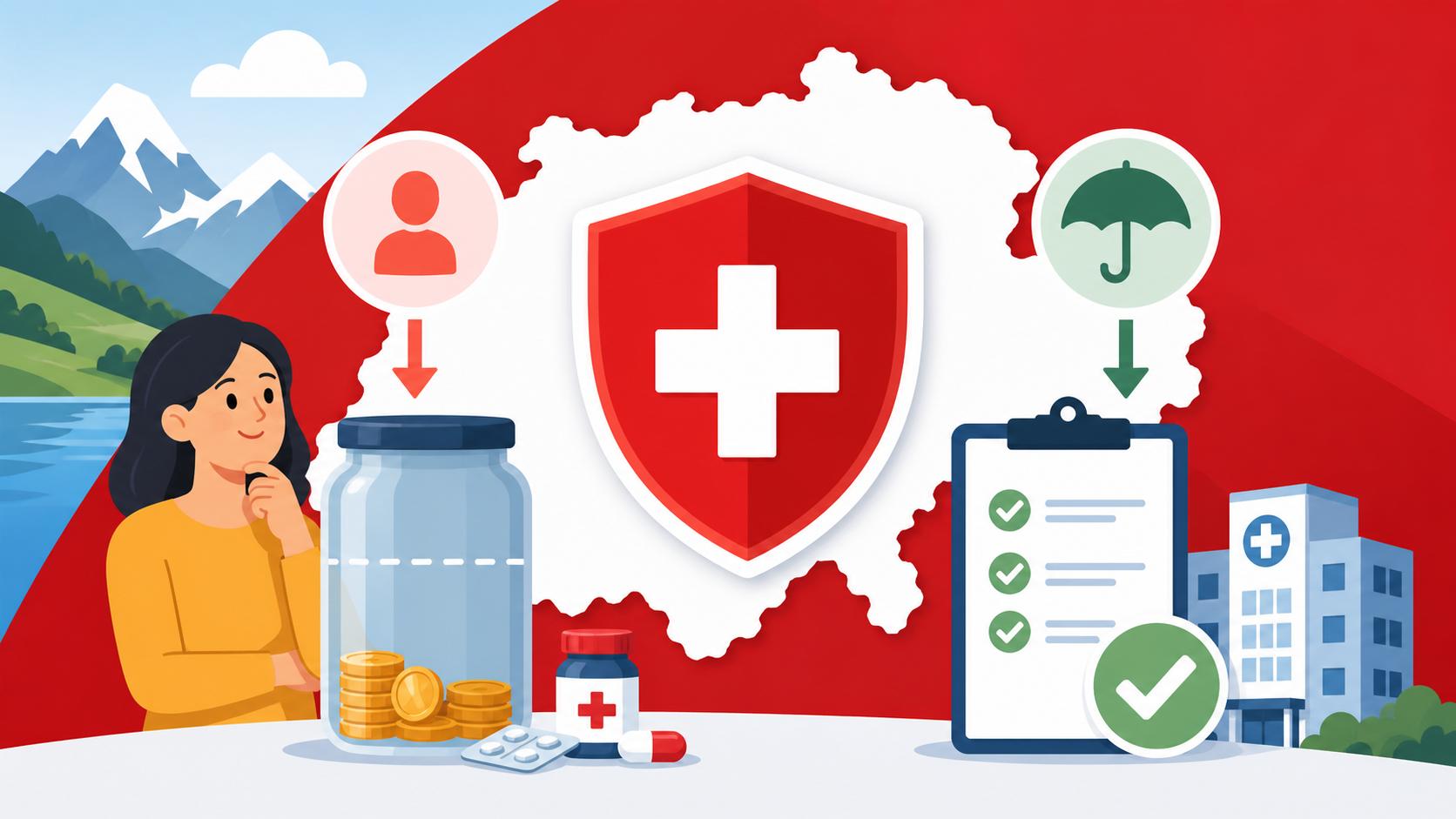
The Swiss Franchise System: How Deductibles and Copays Work
Staring at a medical bill from a specialist in Zurich for CHF 450 and realizing your insurance won't cover a single rappen is a rite of passage for every expat. I remember my first year in Geneva, sitting in a pile of "Rückforderungsbeleg" forms, feeling absolutely cheated by the system. This guide demystifies the Swiss franchise and copay system so you can choose the right plan and avoid financial surprises.
Understanding the Pillars of Swiss Healthcare Costs
The Swiss healthcare system is often lauded as one of the best in the world, but for the uninitiated expat, the billing structure feels like a labyrinth designed by a mathematician with a grudge. Unlike systems in the UK or Canada where care is "free" at the point of use, or the US where employer-led PPOs dominate, Switzerland operates on a mandatory private insurance model (KVG/LAMal). Every resident is responsible for three distinct layers of costs: the monthly premium, the annual deductible (Franchise), and the percentage-based copay (Selbstbehalt).
The monthly premium is the most visible cost. This is the flat fee you pay every month just to have the right to access care. These premiums vary wildly based on your age, your canton of residence, and the specific insurance company you choose. However, the premium is only the entry ticket. To understand your true financial liability, you must grasp The Swiss Franchise System: How Deductibles and Copays Work and how it interacts with your daily life. It is a system built on the "Solidarity Principle," where everyone contributes, but the financial burden of minor ailments is largely placed on the individual to keep the overall system sustainable.
One of the first things I learned after moving here is that the Swiss system expects you to be a proactive consumer. You aren't just a patient; you are a client. This means you need to keep track of your "Franchise" throughout the calendar year. The year always runs from January 1st to December 31st. If you move to Switzerland in October, your full annual franchise still applies for those remaining three months, which is a common trap for new arrivals. This is why many expats look into international options like Cigna Global to bridge gaps or provide more familiar coverage structures during their transition.
When you receive a medical bill, it usually isn't sent to your insurance first—it's sent to you. You are the middleman. You pay the doctor, send the receipt to the insurer, and then wait to see if you've "cleared" your franchise. Only after you have spent out-of-pocket an amount equal to your chosen franchise does the insurance company start picking up the majority of the tab. Understanding this sequence is vital for How to Read a Swiss Medical Bill (Rückforderungsbeleg) and Claim Refunds without losing your mind in the process.
Choosing Your Franchise: The CHF 300 vs CHF 2500 Debate
The "Franchise" (pronounced fron-sheeze) is the amount you must pay out of your own pocket each year before your insurance company contributes a single franc to your medical expenses. In Switzerland, adults can choose from several levels: CHF 300, 500, 1000, 1500, 2000, or 2500. The rule of thumb is simple but counterintuitive: if you expect to have very low or very high medical expenses, you save money. If you fall in the middle, you lose.
When I first arrived, I opted for the CHF 2,500 franchise because I was young and healthy. The benefit here is that your monthly premiums are significantly lower—often by as much as CHF 1,200 to 1,500 per year compared to the CHF 300 model. This "savings" on premiums acts as a buffer. If you don't go to the doctor all year, that money stays in your pocket. However, you must have the discipline to keep CHF 2,500 in a savings account at all times. If you have an accident or a sudden illness, you will be hit with that full bill immediately. For a deep dive on this strategy, see How to Choose the Right Deductible (Franchise) for Your First Year.
On the other end of the spectrum is the CHF 300 franchise. This is the "peace of mind" option. Your monthly premiums will be the highest possible, but as soon as you spend CHF 300 on doctors or medicine, the insurance kicks in. This is almost always the right choice for children, pregnant women, or anyone with a chronic condition requiring regular medication. If you're someone who feels a bit of anxiety every time they sneeze, the lower franchise allows you to visit a "Hausarzt" without performing a cost-benefit analysis in your head first.
The "Intermediate Trap" is a real phenomenon in Switzerland. Choosing a franchise of CHF 1,000 or CHF 1,500 rarely makes mathematical sense. The premium discounts for these middle tiers are not usually steep enough to offset the added risk. Most financial advisors in Switzerland will tell you to either "Go Low" (300) or "Go High" (2500). If you are struggling to decide, it helps to look at your past three years of medical history. To help visualize this, let's look at the typical cost breakdown.
| Franchise Level | Monthly Premium (Approx.) | Annual Premium Cost | Max Out-of-Pocket Risk | Total Potential Annual Cost |
|---|---|---|---|---|
| CHF 300 | CHF 450 | CHF 5,400 | CHF 1,000 | CHF 6,400 |
| CHF 1,500 | CHF 370 | CHF 4,440 | CHF 2,200 | CHF 6,640 |
| CHF 2,500 | CHF 310 | CHF 3,720 | CHF 3,200 | CHF 6,920 |
Note: Total potential cost includes the 10% copay (Selbstbehalt) up to the CHF 700 limit.
How the 10 Percent Copay (Selbstbehalt) Adds Up
Many expats think that once they hit their CHF 2,500 franchise, healthcare becomes free. I certainly did, and I was quite annoyed to find another bill in my mailbox after I’d already cleared my limit. This is the "Selbstbehalt," or the 10% copay. Even after your franchise is exhausted, you are still responsible for 10% of every medical franc spent. This applies to doctor visits, lab tests, and hospital stays.
The good news is that this 10% copay is capped. For adults, the maximum you will pay in copays per year is CHF 700. For children, it is capped at CHF 350. Once you have reached both your franchise AND your CHF 700 copay limit, the insurance company finally covers 100% of your medical expenses for the remainder of the calendar year. This is the "Safety Net" that prevents medical bankruptcy in the event of a catastrophic illness or a major surgery. You can find more details on this in our guide to Out-of-Pocket Maximums: Calculating Your True Annual Healthcare Costs.
There is a specific nuance regarding medications that often catches foreigners off guard. If you choose a brand-name drug when a generic version is available, your copay can jump from 10% to 20% or even higher. The Swiss government is very aggressive about promoting generics to keep costs down. When you go to a pharmacy (Apotheke), always ask for the "Generikum." For non-prescription items like vitamins or basic skincare, I’ve found that ordering from iHerb is often significantly cheaper than buying locally, as Swiss pharmacy markups on OTC products are legendary.
Hospital stays have their own unique "extra" fee. If you are hospitalized, you must pay a daily contribution of CHF 15. This isn't a medical fee; it's considered a "contribution toward room and board" because you aren't paying for food and utilities at home while you're in the hospital. While CHF 15 sounds small, if you are in rehab for three weeks after a skiing accident, it adds up. It’s these little details that make Understanding KVG/LAMal: Mandatory Basic Health Insurance Explained so important for long-term planning.
Navigating the Billing Maze: Tiers Garant vs. Tiers Payant
One of the most confusing aspects of the Swiss system is who pays whom and when. There are two primary billing systems: Tiers Garant and Tiers Payant. Which one you use depends on your specific insurance provider and the type of medical service you receive. Understanding this will save you from "billing shock" when you see a four-figure invoice in your mailbox.
Tiers Garant is the "I pay, then I get paid back" system. This is very common with smaller insurance companies and for outpatient visits to specialists. You visit the doctor, the doctor sends you a bill (usually via a billing service like Curamed or Aerztecasse), you pay that bill within 30 days, and then you send a copy of the "Rückforderungsbeleg" to your insurance. The insurance company then checks if you’ve met your franchise and sends you a reimbursement. This can be a huge cash-flow burden if you have a high franchise.
Tiers Payant is the "Insurance pays directly" system. This is standard for hospital stays and is becoming more common for pharmacies and large medical groups. In this scenario, the doctor sends the bill directly to the insurer. The insurer pays the doctor and then sends you an invoice for your share (either because you haven't hit your franchise yet or for your 10% copay). Many expats prefer this because it requires less personal administration. For a breakdown of which companies use which system, check Tiers Payant: Which Swiss Insurances Pay the Pharmacy Directly?.
I always tell new expats to keep a dedicated "Medical Folder" (either physical or digital). Swiss billing is incredibly precise but slow. You might receive a bill in June for a blood test you had in February. If you aren't organized, it’s easy to lose track of whether you’ve actually met your franchise. If you are using a digital-first insurer, they usually have an app where you can scan your bills. This is a lifesaver. For more on the administrative side, see How to Pay Medical Bills: Tiers Garant vs. Tiers Payant Billing Systems.
Regardless of the system, you should always check your bills for errors. I once had a clinic in Bern charge me for a "consultation by phone" that never happened. Because the Swiss system is so trust-based, these errors often go unnoticed unless the patient is vigilant. If you’re unsure how to read the codes on your bill, our guide on Understanding KVG/LAMal: Mandatory Basic Health Insurance Explained has a section on decoding the TARMED tariff system.
Real-World Scenarios: What You Will Actually Pay
To make this concrete, let's look at a few scenarios that I’ve personally seen or experienced during my years here. These examples assume you have a CHF 2,500 franchise, as that’s where the math gets most interesting (and stressful).
Scenario 1: The Winter Flu. You feel terrible and visit a local GP in Oerlikon. The consultation is CHF 120. You are prescribed antibiotics and some high-strength cough syrup at the pharmacy, which costs CHF 80. Total cost: CHF 200. Because you have a CHF 2,500 franchise and this is your first visit of the year, you pay the full CHF 200. The insurance pays nothing, but those 200 francs are credited toward your annual deductible. For help finding a doctor, see Finding an English-Speaking Family Doctor (Hausarzt) in Major Cantons.
Scenario 2: The Hiking Mishap. You trip on a trail near Zermatt and need an X-ray and a soft cast. The total bill from the clinic and the radiologist comes to CHF 1,200. If this is still your first medical event of the year, you pay the full CHF 1,200. Again, your insurance pays nothing directly, but now your "used" franchise is CHF 1,200 out of CHF 2,500. You still have CHF 1,300 to go before the insurance starts paying 90%.
Scenario 3: The Major Surgery. You need an appendectomy. The total cost for the surgery, the hospital stay, and the follow-up care is CHF 15,000. This is where the franchise and copay system "protects" you. You pay the remaining CHF 1,300 of your franchise. This leaves CHF 13,700 of the bill. You pay 10% of that (CHF 1,370), but wait—the copay is capped at CHF 700! So, you pay CHF 1,300 (franchise) + CHF 700 (max copay) = CHF 2,000. The insurance company pays the remaining CHF 13,000. In this case, your "expensive" high franchise actually saved you a lot in monthly premiums over the year. To understand how accidents are handled differently from illnesses, read Accident Insurance (UVG): Occupational vs. Non-Occupational Coverage.
Strategic Tips for Expats to Lower Healthcare Costs
Living in Switzerland is expensive, but there are ways to "hack" the healthcare system if you're smart about it. Beyond just choosing the right franchise, you can opt for specific insurance models that offer premium discounts in exchange for certain restrictions. The most popular are Telmed, HMO, and the Family Doctor model.
In the Telmed model, you agree to call a medical hotline before seeing a doctor in person. This hotline (often staffed by nurses or doctors) does an initial triage. If they can solve your problem over the phone or via a photo, you save the cost of a doctor's visit. If you need to see a specialist, they give you a referral. This model can save you 15-20% on your monthly premiums. I’ve used this for years and found it quite efficient for minor issues. Learn more at Telmed Insurance Explained: How Calling First Saves You Premium Costs.
Another strategy is to utilize Supplementary Health Insurance (VVG): What It Covers and When to Buy It. While the basic KVG covers the essentials, it doesn't cover things like dental, vision, or private hospital rooms. Some expats choose a high-franchise basic plan to save money, then use those savings to buy a robust supplementary plan or an international policy like Cigna Global. This gives you the "Swiss basics" required by law but adds the "Expat comfort" of being able to choose any doctor or clinic worldwide.
Finally, don't forget about Cantonal Premium Reductions (Prämienverbilligung) for Low-Income Households. Many expats—especially students or those working for NGOs and startups—don't realize they might qualify for a subsidy. If your income falls below a certain threshold (which varies by canton), the government will pay a portion of your health insurance premiums for you. It’s not "welfare" in the traditional sense; it’s a standard part of the Swiss social tax system designed to ensure healthcare remains affordable for everyone.
Key Deadlines and Changing Your Franchise
The Swiss healthcare system is not a "set it and forget it" arrangement. You have the opportunity to change your insurance company or your franchise level once a year. This happens during the "open enrollment" period in the autumn. If you miss these dates, you are locked into your current plan for another 12 months, which can be a very expensive mistake.
The most important date is November 30th. This is the deadline by which your current insurance company must receive your cancellation letter if you want to switch providers for January 1st. Note that it’s not the postmark date that matters, but the date they actually receive it. I always recommend sending this via "Einschreiben" (registered mail) by mid-November to be safe. For a step-by-step checklist, see November 30 Deadline: The Exact Steps to Switch Your Swiss Health Insurance.
If you only want to change your franchise level (e.g., moving from CHF 2,500 down to CHF 300 because you're planning to start a family), the deadlines are also strict. To decrease your franchise, you must notify your insurer by the last working day of November. To increase your franchise (and lower your premium), you usually have until the last working day of December. However, I always tell people to do both by the November 30th deadline to avoid any administrative hiccups.
When you move between cantons, your premiums will change automatically. If you move from a high-cost canton like Geneva to a lower-cost one like Zug, your insurance company will send you a new policy with the adjusted rate. This is also a good time to re-evaluate your franchise choice, as the premium "spread" between a 300 and 2500 franchise might be different in your new home. For more on the logistics of moving, check Mandatory Registration: How to Sign Up for Health Insurance Within 90 Days.
Comparison of Swiss Health Insurance Models
Choosing a model is just as important as choosing a franchise. Here is a quick comparison to help you decide which "gatekeeper" you are comfortable with.
| Model Name | Primary Contact | Flexibility | Typical Discount |
|---|---|---|---|
| Standard (Free Choice) | Any doctor | Highest – No referral needed | 0% |
| HMO (Health Org) | A specific HMO clinic | Low – Must stay in network | 15% – 25% |
| Family Doctor | Your chosen GP | Medium – GP must refer you | 10% – 15% |
| Telmed | Medical Hotline | Medium – Must call first | 15% – 20% |
Choosing the right combination of model and franchise is the key to surviving the Swiss medical system financially. While the initial shock of paying for your own care is real, the system's transparency and quality are world-class once you understand the rules of the game. Whether you're stocking up on essentials from iHerb or navigating a complex surgery, being an informed patient is your best defense against high costs.
Disclaimer
The information provided in this article is for informational purposes only and does not constitute financial, legal, or medical advice. Swiss healthcare laws and premiums change annually; always consult with an official insurance broker or the Federal Office of Public Health (FOPH) for the most current regulations.