Finding the Notfallapotheke (Emergency Pharmacy) on Sundays
It is 4:00 PM on a Sunday in Zurich, your child has a sudden spiking fever, and you realize your medicine cabinet is completely empty. I remember pacing my living room in a cold sweat during my first month in Switzerland, convinced that the country’s strict Sunday closing laws meant I was simply out of luck until Monday morning. This guide explains exactly how to locate a Notfallapotheke, navigate the extra fees involved, and manage your medical needs when the rest of the country is buttoned up tight.
The Cultural Reality of Sundays in Switzerland
If you are new to the country, the "Sonntagsruhe" or Sunday rest can feel less like a peaceful tradition and more like a logistical barricade. In most Swiss towns, the shutters come down on Saturday afternoon and do not lift again until Monday morning. This is rooted in labor laws that prioritize rest, but it creates a high-stress environment for expats who aren't used to planning their medical needs 48 hours in advance. You quickly learn that while the local Coop or Migros is closed, the healthcare system has a very specific, albeit slightly hidden, "on-call" infrastructure.
The system relies on a rotation known as the Apotheken-Notfalldienst. Instead of every pharmacy staying open, the pharmacies in a specific district or canton take turns being the designated emergency point. This ensures that even in rural areas, no one is more than a reasonable drive away from medication. However, because these rotations change, you cannot simply rely on the shop you visited last week. You have to know where to look for the current "duty" pharmacy. Understanding Pharmacies and Medication: Prescriptions, Costs, and OTC Regulations is the first step in realizing that the Swiss system is highly regulated but incredibly reliable once you know the rules.
In larger cities like Zurich, Geneva, or Basel, there are "permanence" pharmacies that are open 365 days a year, often located at major train stations or airports. These are your lifelines. For those living in the suburbs or the countryside, the process involves a bit more detective work. I once spent an hour driving through the Aargau countryside because I hadn't checked the online roster correctly, only to find the "open" pharmacy was actually two villages over. It is a rite of passage for every expat, but one you can navigate much more smoothly with the right tools.
How to Locate an Emergency Pharmacy Right Now
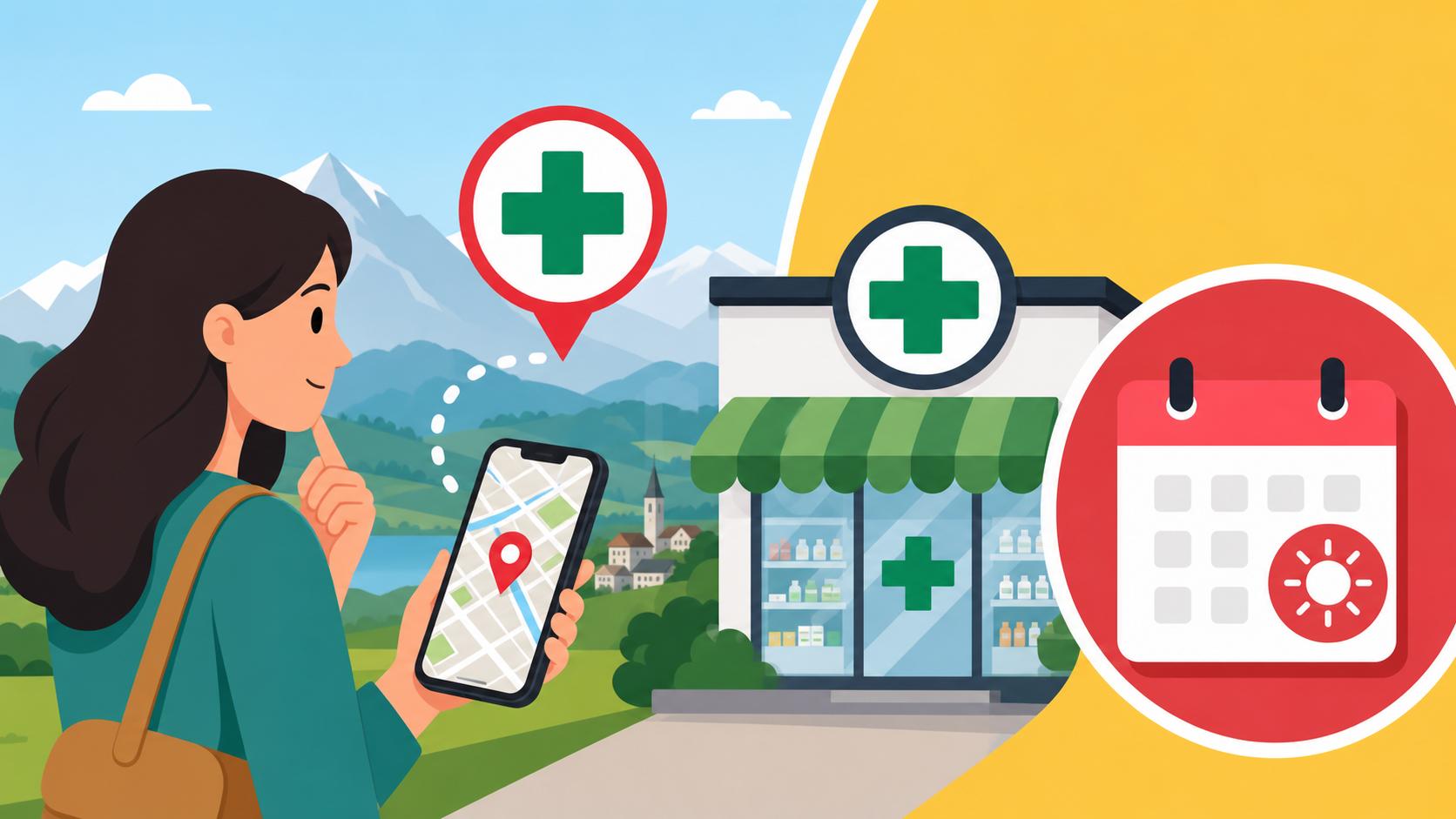
The most efficient way to find an open pharmacy on a Sunday or a public holiday is to use the official cantonal search portals. Almost every canton has a dedicated website or a shared platform like SOS-Apotheke. These databases are updated in real-time. You simply enter your postal code, and the system shows you the nearest location currently on duty. This is far more reliable than Google Maps, which often fails to account for the rotating "emergency hour" schedules that pharmacies use.
If you don't have internet access or find the German/French/Italian websites confusing, you can use the Swiss short-number system. Dialing 1811 (the general directory) or 144 (for medical emergencies) can help you get the address of the nearest Notfallapotheke. However, 144 should be reserved for genuine medical crises. For a simple prescription or over-the-counter need, many cantons have a specific non-emergency medical hotline. Knowing Emergency Numbers 144 vs 112: Which to Call in a Swiss Medical Crisis will help you decide which path to take when the pressure is on.
Another very "Swiss" way to find this information is to physically walk to the nearest pharmacy to your house—even if it is closed. By law, pharmacies must display a notice in their window indicating which nearby pharmacy is currently on emergency duty. This sign will usually include the address and a phone number. It’s a low-tech solution that has saved me more than once when my phone battery died at the worst possible moment. These signs are part of the broader Finding Medical Care in Switzerland: Doctors, Specialists, and Referrals network that keeps the population safe during off-hours.
| Feature | Standard Pharmacy Visit | Sunday Notfallapotheke Visit |
|---|---|---|
| Opening Hours | Typically 8:00 AM – 6:30 PM | 24/7 or specific rotation hours |
| Surcharge | None | CHF 10 to CHF 50 (Notfalldienstgebühr) |
| Availability | Full range of products | Emergency medications and basics |
| Access | Walk-in through main door | Often via a "Night Window" (Notfenster) |
| Prescriptions | Standard processing | Priority for urgent prescriptions |
Understanding the Emergency Surcharge and Fees
One of the biggest shocks for expats visiting a pharmacy on a Sunday is the "Notfall-Zuschlag" or emergency fee. This is a legal surcharge added to your bill to cover the costs of keeping staff on call during unsocial hours. Depending on the canton and the time of day, this fee typically ranges from CHF 10 to CHF 50. If you are showing up at 2:00 PM on a Sunday, the fee might be lower than if you are ringing the bell at 3:00 AM on a Tuesday.
It is important to know that most Understanding KVG/LAMal: Mandatory Basic Health Insurance Explained policies will cover this fee if you are filling a prescription that was issued by an emergency doctor on that same day. However, if you are just stopping by because you ran out of contact lens solution or need some Cough and Cold Medicine in Switzerland: Local Brands and Pharmacy Advice, you will have to pay this surcharge out of pocket. The pharmacist is required to inform you of the fee, but it is often posted clearly at the night window or entrance.
Payment methods at emergency pharmacies are generally the same as standard ones—cash, credit cards, and TWINT are all accepted. However, if you are using the "Tiers Payant" system where the pharmacy bills your insurance directly, make sure you have your physical insurance card (VeKa) with you. Without it, you might be forced to pay the full amount upfront. If you are confused about how the billing works, reading up on How to Pay Medical Bills: Tiers Garant vs. Tiers Payant Billing Systems will save you a lot of headache at the counter.
Navigating the Night Window (Notfenster) Experience
In many smaller towns or during late-night hours on a Sunday, the pharmacy won't actually let you inside the store. Instead, you will have to use the "Notfenster" or night window. This is usually a small, reinforced glass window near the main entrance with a doorbell and an intercom. It can feel a bit intimidating the first time you use it—standing on a quiet street in the dark, waiting for a pharmacist to slide open a small hatch—but it is standard procedure.
When you ring the bell, be prepared to explain your situation clearly. If you have a prescription, hold it up to the glass so the pharmacist can see it. They will then take the prescription through the slot, prepare your medication, and return with the items and the bill. Because you are at a window, the pharmacist might not be able to offer the same level of browsing or advice as they would in a store, so it is helpful to know exactly what you need beforehand, especially when looking for Over-the-Counter Painkillers in Switzerland: Dafalgan, Algifor, and Costs.
One tip I always give fellow expats is to have a translation app ready if your German or French is shaky. Pharmacists in major hubs like Zurich or Geneva usually speak excellent English, but in more rural cantons, the night-shift pharmacist might only speak the local language. Being able to say "My child has a fever" or "I have a severe allergic reaction" in the local tongue is vital. If you find the local system too restrictive, some expats choose to complement their local coverage with Cigna Global, which can provide additional support and resources for navigating international healthcare hurdles.
Emergency Pharmacies in Major Swiss Hubs
If you live near a major city, you are in luck because these locations host "permanent" pharmacies that function almost like small convenience stores for health needs. They are exempted from many of the Sunday closing rules because they are located in "transit zones" like train stations. These pharmacies are usually large, well-stocked, and very used to dealing with the expat community.
In Zurich, the Apotheke Bellevue is the most famous 24/7 location. It is situated right at the Bellevue tram stop and never closes its doors. Another great option is the Amavita at the Zurich Main Station (Hauptbahnhof), which is open from early morning until late at night every single day. For those in Geneva, the Pharmacie de la Gare Cornavin is the go-to Sunday spot. It is bustling, efficient, and everyone there speaks multiple languages.
In Basel, the Notfallapotheke Basel at the Bahnhof SBB is the primary Sunday resource, while in Bern, you should head to the Bahnhof Apotheke in the main station. These locations do not just carry medicine; they often have a range of high-end skincare, baby formula, and even healthy snacks. If you find yourself needing specialized vitamins or supplements that aren't available at the local emergency window, I often recommend using iHerb to keep your home cabinet stocked in advance so you don't have to make these Sunday runs in the first place.
Alternatives to the Pharmacy: When to Seek Higher Care
Sometimes, finding an emergency pharmacy is only half the battle. If you are looking for medication because of a symptom that is rapidly worsening, you might need a "Permanence" (a walk-in clinic) rather than just a pharmacist. In Switzerland, pharmacies have strict limits on what they can diagnose. While a pharmacist can give you Cough and Cold Medicine in Switzerland: Local Brands and Pharmacy Advice, they cannot prescribe antibiotics for a suspected ear infection without a doctor’s note.
If you are in pain and don't have a prescription, your best bet is a walk-in clinic. These are often located near the same major train stations mentioned above. For example, the Zurich Expat Healthcare Guide: Hospitals, Clinics, and Emergency Contacts highlights several clinics that are open late. Once a doctor at a Permanence sees you, they will print a prescription that you can take immediately to the nearest open pharmacy. This "one-two punch" is the most common way to handle Sunday health scares.
It is also worth noting that if you are bringing medication from abroad and run out on a Sunday, the pharmacist will be very hesitant to give you a refill based on a foreign bottle. They generally require a Swiss prescription. This is why Bringing Prescription Medication into Switzerland: Customs and Legal Limits is such a critical topic for new arrivals to understand. Always keep a digital copy of your original prescription, but be prepared to see a Swiss doctor to get a local equivalent during Sunday hours.
Proactive Steps: Stocking Your Swiss Medicine Cabinet
The best way to handle a Sunday medical emergency is to prevent the need for one. Since moving here, I have become much more disciplined about my "Hausapotheke." Because iHerb ships efficiently to Switzerland, I usually order my non-prescription staples like Melatonin, high-dose Vitamin C, and basic first aid supplies in bulk. This ensures that I am never at the mercy of the 1811 hotline just because I ran out of band-aids or electrolytes.
In your Swiss home kit, you should always have at least one pack of Algifor (Ibuprofen) and Dafalgan (Paracetamol). These are the "Big Two" of Swiss home care. Having these on hand means you can wait until Monday morning for a standard pharmacy visit rather than paying a CHF 40 surcharge at 10:00 PM on a Sunday. Additionally, if you have a complex medical history or family members with chronic conditions, having a robust international plan like Cigna Global ensures you have access to telehealth services that can advise you before you even leave the house.
Finally, keep a "Sunday Cheat Sheet" on your fridge. Note down the address of your nearest train station pharmacy and the URL for your canton's Notfalldienst. Switzerland runs on preparation and clockwork; if you adopt that same mindset, the Sunday lockdown stops being a source of anxiety and becomes just another part of the quiet, predictable Swiss life we all eventually grow to love.
Disclaimer
This guide is for informational purposes only and does not constitute medical or legal advice. Healthcare regulations and pharmacy opening hours in Switzerland are subject to change by cantonal authorities. Always consult with a qualified healthcare professional or contact official emergency services (144) in the event of a life-threatening medical crisis. The author and publisher are not responsible for any actions taken based on the information provided in this article.