Out-of-Canton Hospital Treatment: When Insurance Covers the Extra Cost
The Swiss healthcare system, with its distinct cantonal structures, can feel like navigating a complex maze, especially when you suddenly find yourself needing medical attention outside your registered canton. It's a common fear among expats: will my insurance cover the extra cost if I get sick or injured while skiing in Graubünden but live in Zurich? This guide is here to shed light on exactly when your Swiss health insurance steps up to cover out-of-canton hospital treatments, helping you understand the rules and avoid unexpected bills.
Understanding Switzerland's Cantonal Healthcare System
Switzerland's healthcare setup is wonderfully efficient but also uniquely decentralized. Each of the 26 cantons holds significant autonomy in how it manages its public services, and healthcare is no exception. For newcomers, this can be quite a shock, especially coming from countries with more centralized national health services. It's not just about finding an English-speaking family doctor (Hausarzt) in Major Cantons; it's about understanding the underlying financial structures.
The Basic Principle of Cantonal Responsibility
At its core, Switzerland's mandatory basic health insurance (KVG/LAMal) operates on a principle of residence. Your premiums are tied to your canton of residence, and historically, each canton was primarily responsible for its residents' healthcare costs, particularly for hospital stays. This meant that cantons maintained "hospital lists" (Spitallisten), detailing which hospitals were approved for general basic insurance coverage within their borders. If you opted for a planned, non-emergency treatment at a hospital not on your home canton's list, you could face hefty out-of-pocket expenses for the difference in cost between what your home canton would pay and what the out-of-list hospital charges.
This system aims to encourage residents to use their local facilities and help cantons manage their healthcare budgets. However, as you can imagine, this creates a lot of confusion and anxiety for expats who might not fully grasp these invisible administrative borders. You might assume that because you have health insurance, you're covered for any hospital in Switzerland. While largely true for emergencies, planned procedures are where the nuances of the system truly come into play. It's essential to grasp the fundamentals of Understanding KVG/LAMal: Mandatory Basic Health Insurance Explained to truly appreciate these intricacies.
When Your Home Canton Pays for Out-of-Canton Care
Here’s the good news: basic health insurance always covers emergency treatment anywhere in Switzerland. So, if you're hiking in Valais and twist your ankle, or find yourself with an unexpected appendicitis attack while visiting Geneva, you absolutely do not need to worry about the immediate cost of getting to a hospital or receiving essential care. Your basic insurance will cover the standard ward treatment at the canton's rate where you receive the emergency care. This is a crucial distinction and often a relief for many expats initially daunted by the system's reputation.
However, beyond emergencies, your home canton will typically cover planned out-of-canton hospital treatment only under specific, limited circumstances. These generally involve situations where:
- Specialized Care is Unavailable: The necessary medical procedure or specialized treatment is simply not offered in any hospital on your home canton's approved list. For instance, if you live in a smaller canton that doesn't have a highly specialized neurological clinic for a rare condition, your home canton will likely approve treatment at a university hospital in, say, Bern or Zurich.
- Medical Necessity and Referral: Your doctor can prove that a specific out-of-canton hospital offers a superior or more appropriate treatment for your condition due to specific medical expertise, technology, or facilities that are genuinely unavailable locally. This often requires a strong medical justification and a referral from your primary physician.
- Cost-Effectiveness (sometimes): In rare cases, if the out-of-canton treatment is demonstrably more cost-effective for the same quality of care than what's available within your canton, prior approval might be granted. This is less common but can be a factor.
The key takeaway here is prior authorization. For anything beyond immediate emergencies, seeking care outside your registered canton without checking first is like playing Russian roulette with your finances. It's a step-by-step process that needs careful navigation. For a broader overview, take a look at our guide on Healthcare in Switzerland for Expats: The Complete System Overview (2027).
Navigating Planned vs. Emergency Out-of-Canton Treatment
The distinction between an emergency and a planned treatment is paramount in Switzerland when it comes to out-of-canton care. Misunderstanding this can lead to considerable financial stress.
Emergency Situations: No Prior Approval Needed
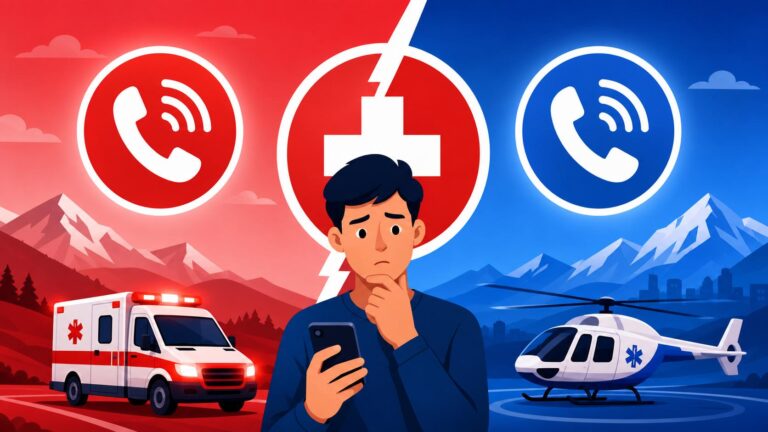
Let's talk emergencies. Imagine you're enjoying a weekend getaway by Lake Lucerne, far from your usual stomping grounds in Basel, and suddenly develop severe chest pains. You call 144 (Switzerland's emergency medical number), and an ambulance takes you to the nearest cantonal hospital. In this scenario, your basic health insurance (KVG) will cover the costs for your treatment in the general ward, regardless of which canton the hospital is in. The critical aspect is that the situation is acute and unforeseen, requiring immediate medical intervention to prevent serious harm or death.
This robust emergency coverage extends to all necessary initial diagnostics, stabilization, and essential treatment. The hospital will bill your insurer, and your insurer will pay according to the rates negotiated for the canton where the hospital is located, after applying your chosen franchise (deductible) and copay. For more details on emergency services, check out our guide on Emergency Medical Services: Ambulances, REGA, and Crisis Protocols. However, remember, while the emergency itself is covered, subsequent non-emergency care related to that event, like follow-up appointments, rehabilitation, or a transfer to a non-emergency hospital in another canton, might fall under the "planned treatment" rules if not carefully managed.
Planned Treatments: The Prior Authorization Maze
This is where things can get truly frustrating for expats. Let's say your doctor recommends a knee surgery, and you've heard amazing things about a particular clinic in Canton Vaud, but you reside in Canton Aargau. For your basic health insurance to cover this planned procedure in Vaud, you must obtain prior authorization from your health insurer. This isn't a suggestion; it's a non-negotiable step.
The process typically involves:
- Doctor's Recommendation: Your doctor must provide a strong medical justification as to why the specific out-of-canton hospital or specialist is necessary or superior for your treatment compared to options within your home canton's hospital list. This often includes details about the specialized expertise, unique technology, or better success rates for your specific condition at the chosen out-of-canton facility.
- Application to Your Insurer: This documentation is then submitted to your KVG insurer. They will review it against legal criteria, specifically looking at whether the proposed treatment meets the "medical necessity" and "unavailability within canton" requirements.
- Waiting for Approval: This can take time, sometimes weeks. During this period, you are in limbo. If you proceed with treatment without explicit written approval, you risk being personally liable for the difference between what your home canton would have paid and the actual cost of the treatment in the other canton. This "difference" can be tens of thousands of Swiss francs, as cantons can charge very different rates for the same procedure.
It's a bureaucratic hurdle, yes, but it's designed to keep healthcare costs in check within the cantonal framework. Expats often find this particularly challenging because it runs counter to expectations of free choice within a country. It’s also why understanding Hospital Choice in Switzerland: Can You Pick Any Hospital on Basic Insurance? is so critical.
Costs Beyond Basic Insurance: What Supplementary Plans Cover
While basic insurance offers a solid safety net, it's often the supplementary health insurance (VVG) that truly expands your options and offers peace of mind regarding hospital choice across cantonal borders.
Private and Semi-Private Hospital Stays
Many expats opt for supplementary hospital insurance, known as VVG Zusatzversicherungen, which allow for semi-private (two-person room) or private (single room) hospital stays. Crucially, these supplementary plans often grant you "free choice of hospital" (freie Spitalwahl) anywhere in Switzerland. This means that if you have semi-private or private supplementary insurance, you can generally choose any hospital in Switzerland for planned treatments, even if it's not on your home canton's basic insurance list, and your supplementary insurance will cover the additional costs associated with the upgraded room class and physician choice (e.g., being treated by the chief physician).
This offers immense flexibility and removes the cantonal barrier for planned procedures. For many, the peace of mind of knowing they can select the best specialist or hospital for their specific condition, regardless of canton, is well worth the extra premiums. When exploring this, it’s worth reading about Supplementary Health Insurance (VVG): What It Covers and When to Buy It. It's a game-changer for many, eliminating the headache of prior authorizations for cantonal jurisdiction when seeking non-emergency care.
The Role of Accident Insurance (UVG) in Out-of-Canton Incidents
Here's another important layer: accident insurance (UVG). If your out-of-canton hospital treatment is the result of an accident, it might not even fall under your basic health insurance, but rather under your accident insurance.
- Occupational Accident Insurance: If you are employed for more than eight hours a week, your employer is legally required to provide occupational accident insurance (BUV) and non-occupational accident insurance (NBUV). This covers all medical costs related to an accident, whether it happened at work or during your free time, anywhere in Switzerland (and often even abroad, within limits). So, if you crash your mountain bike in Ticino while living in Geneva, your NBUV will typically cover the costs of your treatment, often without the same cantonal limitations as basic KVG.
- Non-Occupational Accident Insurance (NBUV): If you work less than eight hours a week, or are self-employed, unemployed, or retired, you need to ensure you have NBUV coverage, which is usually included in your basic KVG plan by default or can be opted out of if you have equivalent coverage elsewhere (e.g., through a separate policy). This is important because if you don't have NBUV, any accident-related costs will be billed directly to your basic health insurance (KVG), which means your deductible (franchise) and copay will apply.
Understanding Accident Insurance (UVG): Occupational vs. Non-Occupational Coverage is paramount. The key benefit of UVG is that it covers 100% of medical costs arising from an accident, with no franchise or copay applied, right from the first franc. This makes it a powerful form of coverage for unpredictable events, which are often the very situations that lead to out-of-canton treatment.
Practical Tips for Expats Seeking Out-of-Canton Care
Navigating Swiss healthcare, especially when it involves crossing cantonal lines, requires a proactive approach. Here are some seasoned tips to keep in mind:
Always Communicate with Your Insurer
This cannot be stressed enough. For any planned medical procedure that you anticipate receiving outside your canton of residence, pick up the phone and call your health insurance provider before making any firm arrangements. They are the ultimate authority on what will be covered under your specific policy. Explain your situation clearly: where you live, where you want to be treated, and why. They can guide you through the prior authorization process, tell you exactly what documentation is needed, and confirm your coverage.
Don't rely on assumptions or anecdotes from other expats, as individual policies and cantonal regulations can vary. A quick call can save you thousands of francs and immeasurable stress. Remember, insurers are there to process claims, but they prefer to guide you correctly upfront to avoid disputes later. It's much easier for them to give you approval than to deal with an appeal after the fact.
Document Everything
In Switzerland, paperwork is king, and healthcare is no exception. For any significant medical treatment, especially if it's out-of-canton or involves a complex referral, keep meticulous records. This includes:
- Correspondence with your insurer: Dates, times, names of people you spoke to, and a summary of the conversation. If possible, always try to get key approvals or denials in writing.
- Doctor's referrals and justifications: Ensure you have copies of all medical reports and letters from your doctor justifying the need for out-of-canton care.
- Hospital admission forms: Understand what you're signing and keep copies.
- Bills and payment receipts: Keep track of all medical bills, especially if they initially arrive as a Tiers Garant bill, which you pay first and then claim a refund. Learn more about How to Pay Medical Bills: Tiers Garant vs. Tiers Payant Billing Systems.
Having a clear paper trail is invaluable if any disputes arise regarding coverage. It empowers you to advocate for yourself and provides concrete evidence for your claims.
Travel Insurance for Cross-Border Considerations
While this guide focuses on out-of-canton care within Switzerland, it's worth a quick mention that if your travels take you beyond Swiss borders, your basic KVG health insurance has limited international coverage. KVG will typically cover emergency treatment within the EU/EFTA region up to the cost of equivalent treatment in your home canton. For destinations outside EU/EFTA or for more comprehensive coverage (including repatriation), you'll need dedicated travel insurance.
For those who travel frequently, especially digital nomads or long-term travelers, a product like SafetyWing's Nomad Insurance can be incredibly useful. It's designed for global travel, offering medical coverage, travel interruption, and emergency evacuation for those living abroad or on the go. While it won't replace your mandatory Swiss KVG for your residency in Switzerland, it complements it by providing robust coverage when you're outside the country, making sure you're protected wherever your adventures take you. SafetyWing is one of several providers that cater specifically to the mobile expat community, offering flexible plans. Consider exploring options for Travel Health Insurance for Trips Outside Switzerland: What KVG Covers Abroad if your life involves significant international travel.
Here’s a quick summary table to help clarify the scenarios:
| Scenario | Basic KVG Insurance Coverage (General Ward) | Supplementary Hospital Insurance (VVG) | Accident Insurance (UVG/NBUV) | Key Action |
|---|---|---|---|---|
| Emergency Out-of-Canton | YES, fully covered (less franchise/copay). | Enhances room class/doctor choice. | N/A (unless caused by an accident). | Seek immediate care. |
| Planned In-Canton | YES, fully covered if on canton's hospital list. | Enhances room class/doctor choice. | N/A (unless caused by an accident). | Proceed as planned. |
| Planned Out-of-Canton | POTENTIALLY, with prior approval for medical necessity/unavailability in canton. Otherwise, potentially partial or no coverage. | YES, if "free choice of hospital" is included in your plan. | N/A (unless caused by an accident). | ALWAYS GET PRIOR AUTHORIZATION. |
| Accident Out-of-Canton | NO, if you have UVG/NBUV coverage. | N/A, UVG takes precedence for accidents. | YES, 100% covered (no franchise/copay). | Report accident to employer/insurer immediately. |
This table illustrates the different pathways for coverage. While basic KVG insurance is mandatory and provides essential coverage, understanding its limitations for planned out-of-canton procedures is crucial. Supplementary VVG insurance can bridge this gap, offering the flexibility many expats desire, while UVG covers the unpredictable costs of accidents. Regardless of your situation, always proactively engage with your insurer to ensure you're fully informed and protected. Remember also to be mindful of The Swiss Franchise System: How Deductibles and Copays Work, as these will always apply to KVG claims, even for emergencies. For other medical needs, remember our guide on Finding Medical Care in Switzerland: Doctors, Specialists, and Referrals is a great resource.
Disclaimer
This article is for general informational purposes only and does not constitute professional advice. Laws, prices and regulations vary by location and change over time. Consult a qualified professional for guidance on your specific situation.