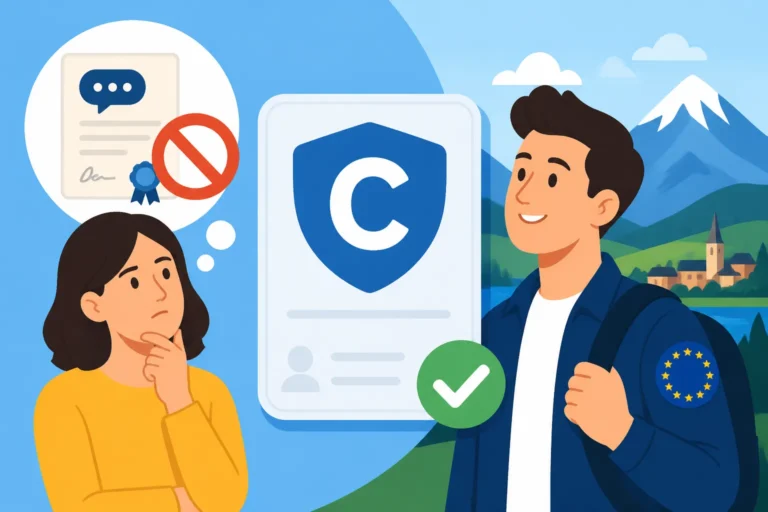
The Early C Permit (Permis C Anticipé): Qualifying After 5 Years
Getting stuck on a B permit for a decade feels like living in a beautiful waiting room where you aren't quite "in" yet. I remember checking my mailbox every day for years, hoping for more stability than a one-year renewal provides. This guide breaks down exactly how to fast-track your residency and secure the Early C Permit in just five years.
Understanding the Early C Permit vs Standard Permanent Residency
Living in Switzerland as a foreigner generally means navigating the tiered system of Residence Permits in Switzerland: L, B, C, and G Permits Explained. For most non-EU/EFTA citizens, the journey toward permanent residency—the "holy grail" known as the C Permit—is a long, ten-year marathon. This standard route is often a source of quiet frustration, especially when you’ve already integrated, paid your taxes, and started a life here. However, there is a legal shortcut available that many expats overlook until they are well past the eligibility window.
The "Permis C Anticipé" or Early C Permit is an acceleration mechanism introduced to reward what the Swiss authorities call "successful integration." It shifts the focus from a purely chronological requirement to a merit-based one. Instead of simply existing within Swiss borders for a decade, you can prove that you have actively joined the fabric of society. I’ve seen friends get their C permits in half the time just by being proactive with their paperwork and language skills, and the relief they feel is palpable.
The legal basis for this is found in Article 34 of the Federal Act on Foreign Nationals and Integration (AIG). It essentially states that the cantonal migration office can grant a settlement permit after five years if the applicant has successfully integrated. This includes respect for public safety and order, adherence to the values of the Federal Constitution, and, most crucially, proficiency in a national language. While it sounds straightforward, the interpretation of "successful integration" can vary slightly between a strict canton like Zurich and a more relaxed one, though the federal minimums remain the same.
Standard vs Early Routes
The standard route is passive; you wait ten years, and provided you haven't committed any crimes or relied on social assistance, the C permit is usually granted. The early route, however, is active. You must apply for it specifically—it is rarely handed out automatically just because you hit the five-year mark. If you are an EU/EFTA national, or a citizen of the US or Canada, you may have different bilateral agreements that make the C permit easier to get, but for "Third-Country Nationals" (TCNs) from places like India, Australia, or the UK, the early application is the only way to beat the ten-year clock.
The VINTA Acceleration Path
The term "VINTA" refers to the ordinance that governs these integration requirements. Under VINTA, the Swiss government looks for a "high degree of integration." This isn't just about having a job; it’s about showing that you don't need a translator at the grocery store and that you understand how the Swiss system works. During your first few years, keeping your Healthcare in Switzerland for Expats: The Complete System Overview (2027) documents and insurance records through providers like Cigna Global in order is part of showing that you are a responsible, self-sufficient resident who doesn't burden the state.
Legal Basis Article 34 AIG
Article 34 is the specific "cheat code" in the Swiss legal book. It allows the authorities to bypass the ten-year rule. However, they are not obligated to give it to you. It is a discretionary decision. This is why your application must be bulletproof. If there is even a hint that you haven't met the criteria—perhaps a forgotten bill that turned into a debt record—they will simply tell you to wait another five years. This is why understanding The Swiss C Permit (Permanent Residency): Fast-Track and Standard Routes is so vital before you even think about submitting your dossier.
Who Actually Qualifies for the Fast Track
Not everyone is eligible for the five-year jump, and this is where the frustration often begins. If you are a citizen of a country with a settlement treaty with Switzerland—such as Belgium, Germany, Italy, or the USA—the five-year rule is often the standard for you anyway. But for the rest of the world, you must prove your worth. The first hurdle is the "uninterrupted" residency requirement. You must have lived in Switzerland for five years on a B permit (or sometimes an L permit, though this is complicated) without long breaks.
If you have spent significant time outside the country—say, six months for a project abroad—the "clock" might reset. The Swiss are very literal about "domicile." Your center of life must be here. I remember a colleague who almost lost his eligibility because he kept his main residence in London for the first year while working in Basel. The authorities look at your Financial Independence Checks: Why Betreibungen (Debt) Stops Permit Renewals and your tax records to ensure you’ve been a fiscal resident the entire time.
Furthermore, the authorities look at your household. If you are applying for an early C permit but your spouse has no interest in learning the local language or participating in the community, it can sometimes reflect poorly on your own "integration" status. The Swiss view the family unit as a whole. You need to show that your move to Switzerland wasn't just a temporary career stop, but a permanent life choice.
EU EFTA National Privileges
If you hold a passport from an EU/EFTA country, the path to a C permit is generally smoother due to the Agreement on the Free Movement of Persons. For many of these nationalities, the C permit is granted after five years almost as a matter of course. However, even then, you must maintain a clean record. You still need to show that you are not a burden on the social system. While the language requirements are often more relaxed for EU citizens, they are increasingly being enforced even for them if they want the settlement permit early.
Third-Country Nationals and High Integration
For those of us from outside the EU (Third-Country Nationals), the "High Integration" label is our ticket. This means you must go above and beyond. It’s not just about the language certificate; it’s about having a clean [Strafregisterauszug] (criminal record) and showing that you are financially stable. If you have any foreign documents that need to be part of your file, such as marriage certificates or advanced degrees from back home, using a certified service like RushTranslate is essential. The Swiss authorities have zero patience for non-certified translations or "DIY" document versions.
The Five Year Continuous Residency Rule
"Continuous" is the keyword here. Generally, you cannot have been away for more than six months at a time. If you were on an L permit for the first two years and then switched to a B permit, whether those first two years count depends on the canton and your specific job contract. In many cases, years spent on an L permit can count toward the five-year total if the stay was intended to be permanent from the start. This is a nuance you should clarify with your local Migrationsamt early on to avoid a heartbreaking rejection later.
| Requirement | Standard C Permit | Early C Permit (VINTA) |
|---|---|---|
| Years of Residence | 10 years | 5 years |
| Language Level (Oral) | A2 | B1 |
| Language Level (Written) | A1 | A1 |
| Criminal Record | Clean | Absolutely Clean |
| Debt Record | Clean | Absolutely Clean |
| Social Assistance | None in last 3 years | None in last 5 years |
Proving Integration: The Language Barrier and Beyond
Let’s talk about the elephant in the room: the language. You cannot get an early C permit without proving you can speak the local language of your canton (German, French, or Italian). For the early route, the bar is set at B1 for oral skills and A1 for written skills. For many English speakers working in multinational companies in Zurich or Geneva, this is the biggest hurdle. You might have lived here five years only speaking English at work and "ordering-a-coffee" German in public. That won't cut it for the VINTA path.
Language is seen by the Swiss as the primary tool for integration. If you can’t talk to your neighbors or understand the local news, are you really integrated? I spent many Saturday mornings in intensive German classes, and while it was exhausting, it was the best investment I made for my residency. You should look into Language Requirements for Swiss Permits: A1 to B2 Standards Explained to see which certificates are accepted. Usually, the "fide" test is the most popular because it focuses on real-world Swiss scenarios rather than abstract grammar.
Beyond the certificate, the authorities might ask for proof of "social participation." This sounds vague, but in Switzerland, it means joining a "Verein" (club). Whether it’s a local football club, a choir, or a volunteer fire department, being a member of a local association proves you aren't just living in an expat bubble. I’ve known people who included a letter from their local tennis club president in their application, and the migration officers loved it. It shows you are contributing to the social fabric of your village or quartier.
Language Levels Required B1 Oral and A1 Written
To be clear, B1 is "intermediate" level. It means you can manage most situations while traveling in an area where the language is spoken, describe experiences, and give brief reasons for opinions. The A1 written requirement is much lower—you just need to be able to write simple sentences. If you’re worried about the testing process, I highly recommend reading up on C Permit Language Requirements: Do I Need A2 Written and B1 Oral? to understand exactly what the examiners are looking for. Don't leave this until the last minute; it takes time for certificates to be issued.
Vocational and Social Participation
Are you employed? Good. But are you stably employed? The authorities want to see that you have a consistent career path and that you aren't likely to end up on unemployment (RAV) the moment you get your C permit. If you have taken any professional courses in Switzerland or if your employer can write a letter praising your integration into the team, include it. Using a service like RushTranslate to ensure any international references or professional accolades are perfectly translated into the local language can add that extra layer of professionalism to your dossier.
The Role of Associations (Vereine)
The Swiss are obsessed with their clubs. There is a club for everything—from rabbit breeding to yodeling. While you don't need to join a yodeling group, being part of something local is a massive "integration" green flag. If you have kids in the local school system and you participate in the "Elternrat" (parents' council), mention it! This shows you are invested in the next generation of Swiss residents. This is often more persuasive than a simple language certificate because it shows the human side of your residency.
Financial Stability and the Debt Register
Switzerland is a country that runs on financial trust. If you want the privilege of permanent residency, you must prove that you are a "clean" citizen financially. This means two things: you must have never relied on social assistance, and you must have a clean debt register extract. In the Swiss system, if you fail to pay a bill and the creditor loses patience, they can initiate a "Betreibung" (debt enforcement). This stays on your record for years and is a total deal-breaker for the early C permit.
I once knew an expat who missed a minor medical bill because they moved apartments and the mail wasn't forwarded correctly. That 40-franc bill turned into a debt record that blocked their C permit application. It sounds harsh, but the Swiss see this as a test of responsibility. You should regularly check your record, especially before applying. You can learn how to do this in Checking Your Debt Register Extract (Betreibungsauszug) for Loans. If you do have an entry, you need to get it cleared and "extinguished" before you even think about the Migrationsamt.
Furthermore, you must prove you haven't received "Sozialhilfe" (social welfare). Note that this is different from "Arbeitslosengeld" (unemployment insurance), which you pay into via your salary. Receiving unemployment benefits usually doesn't count against you unless it's for a very long period, but social welfare is a major red flag. You can find more details on this in Social Welfare (Sozialhilfe) and Its Impact on C Permit Revocation. Essentially, you need to show that you are a net contributor to the Swiss economy.
Living Without Social Assistance
The rule is generally that you shouldn't have received social assistance in the five years preceding your application. If you have, you will almost certainly be told to wait for the ten-year mark, or your application might be rejected entirely. The authorities will check with your local commune to ensure your record is spotless. This is why having comprehensive health coverage, like the international plans offered by Cigna Global, is a good safety net—it ensures you are never in a position where an emergency leads to a financial collapse that forces you to seek state aid.
The Dreaded Betreibungsauszug
This document is a one-page summary of your financial sins in a specific canton. When you apply for the early C permit, you usually need to provide this extract for every canton you’ve lived in over the last five years. If you’ve moved around, this can be a bit of a logistical headache. It’s a transparent look at whether you pay your taxes, your health insurance premiums, and your rent on time. If you have a clean sheet, it’s a powerful testament to your "good standing" in Swiss society.
Employment Status and Future Outlook
The migration office isn't just looking at your past; they are looking at your future. Are you currently on a permanent contract (unbefristet)? If you are on a temporary contract or a freelance basis, they might be more skeptical of your long-term stability. They want to know that if they give you a settlement permit—which is very hard to take away—you won't become a burden on the state the following year. A steady job with a reputable company is the best evidence you can provide.
The Application Process Step-by-Step
Once you’ve hit your five-year anniversary and have your B1 language certificate in hand, the real work begins. You don't just "get" the permit; you have to build a case for yourself. The dossier you submit to the Cantonal Migration Office (or sometimes via your local Gemeinde/Commune) is essentially your "Swiss CV." It needs to be organized, professional, and persuasive. You are asking for a status that grants you almost all the same rights as a citizen, minus the voting.
The first step is usually to wait for your "Verfallanzeige" (the renewal notice for your B permit). When that arrives, instead of just ticking the box for a B permit renewal, you include a separate letter and your supporting documents requesting the Early C Permit under the VINTA rules. Some cantons have a specific form for this, while others expect a formal letter. This is where your attention to detail pays off. If you have kids, including their school reports showing they are doing well in the local language can be a huge bonus.
Be prepared for an interview. While not every canton does this, many will call you in to chat with a migration officer. They aren't looking to trip you up on grammar; they want to see if you can communicate effectively and if you seem genuinely integrated. They might ask about your hobbies, why you like living in Switzerland, or how you interact with your neighbors. It’s a vibe check as much as a legal one. If you’re nervous, remember that they want integrated people to stay.
Gathering the Documents
You will need: your current passport, your B permit, a clean criminal record extract, a debt register extract, a certificate from the social office, and your language certificates. If any of your supporting evidence—like a letter of recommendation from a previous employer abroad or a specialized diploma—is in a language other than the local one, get it translated by a professional like RushTranslate. Do not provide original documents unless asked; high-quality copies are usually fine, but bring the originals to your interview just in case.
Writing the Motivation Letter
This is your chance to shine. Don't just list facts; tell a story. Explain why you chose Switzerland, how you’ve contributed to your local community, and what your long-term plans are. Mentioning your participation in local events or your commitment to local customs (like the neighborhood Apéro) shows that you understand the culture. This letter should be written in the local language. If your language skills aren't quite there yet, have a Swiss friend check it for you—but make sure it still sounds like you.
The Interview with the Migration Office
If you are called for an interview, dress "Swiss business casual"—neat, modest, and professional. Arrive five minutes early (being late is an integration failure!). Answer questions honestly and try to use the local language as much as possible, even if you struggle. The effort to speak the language is often more important than perfect accuracy. They might ask about your knowledge of local geography or politics, so doing a little "citizenship prep" by reading Taking the fide Language Test in Zurich: Format and Passing Scores can give you a boost of confidence.
Life After the C Permit: Why It Changes Everything
Getting that C permit card in the mail is a life-changing moment for many expats. Suddenly, you aren't a guest anymore; you are a "settled" resident. The psychological weight that lifts is immense. No more annual renewals, no more worrying if a job loss means immediate deportation, and no more "tied" permits where your right to stay is linked to a specific employer. You are now free to work for any company, or even start your own business, without asking the migration office for permission.
There are also massive financial benefits. One of the most immediate changes is how you pay tax. Most B permit holders are taxed at source (Quellensteuer), meaning the tax is taken directly from their paycheck. Once you have a C permit, you move to "ordinary taxation." You receive your full salary and then file a tax return at the end of the year, just like a Swiss citizen. This often allows for more deductions—such as Withholding Tax (Quellensteuer) vs Standard Taxation for Foreigners—which can save you thousands of francs.
Finally, the C permit is the final gate before the big goal: the Swiss passport. In most cantons, you need to have a C permit before you can even apply for naturalization. By getting your C permit in five years instead of ten, you are potentially moving your citizenship date forward by five whole years. If you’re planning to buy a home, the C permit also makes you exempt from the Lex Koller: Can Non-EU B Permit Holders Buy Property in Switzerland? restrictions, meaning you can buy property just like a local.
Tax Benefits and Quellensteuer
Switching from tax-at-source to ordinary taxation is a double-edged sword. While you get more control and potential deductions for things like Pillar 3a contributions or commuting costs, you also have to be disciplined enough to save the money to pay your tax bill at the end of the year. I always tell new C permit holders to set up a separate "tax savings account" the day their permit arrives. It’s a small price to pay for the freedom that comes with being a "proper" Swiss taxpayer.
Real Estate and Lex Koller
For many TCNs, buying a house in Switzerland is a nightmare of red tape. The Lex Koller law limits how foreigners can buy property. However, once you have your C permit, those barriers largely vanish. You are treated the same as a Swiss citizen for real estate purposes. This is a massive advantage in a competitive market like Zurich or Geneva. Whether you’re looking for a chic apartment or a family home in the mountains, the C permit is your "all-access pass" to the Swiss property market.
Security of Residency
The greatest benefit is the peace of mind. A B permit is a "temporary" permit; it can be revoked if you lose your job or if the quota system changes. A C permit is much more robust. While it can be revoked for serious crimes or long-term reliance on welfare, it is generally yours for life as long as you live in Switzerland. If you want to leave for a few years and come back, you can even "freeze" your C permit for up to four years with permission. It truly makes Switzerland your permanent home.
Disclaimer
This guide is for informational purposes only and is based on general federal and cantonal practices in Switzerland as of 2026. Immigration laws and the interpretation of the VINTA/AIG regulations are subject to change and can vary significantly between cantons. Obtaining an Early C Permit is a discretionary decision made by the authorities. We highly recommend consulting with your local Migrationsamt or a qualified immigration lawyer before submitting your application. This content does not constitute legal advice.