The Swiss C Permit (Permanent Residency): Fast-Track and Standard Routes
The constant cycle of renewing a B permit feels like living on borrowed time, especially when your life, career, and family are now firmly rooted in the Helvetic soil. I remember the knot in my stomach every time that renewal letter arrived, wondering if a minor administrative hiccup would upend my life. This guide solves the mystery of the Swiss C Permit, providing the exact roadmap for both the standard ten-year path and the elusive five-year fast-track route.
Understanding the C Permit: More Than Just a Plastic Card
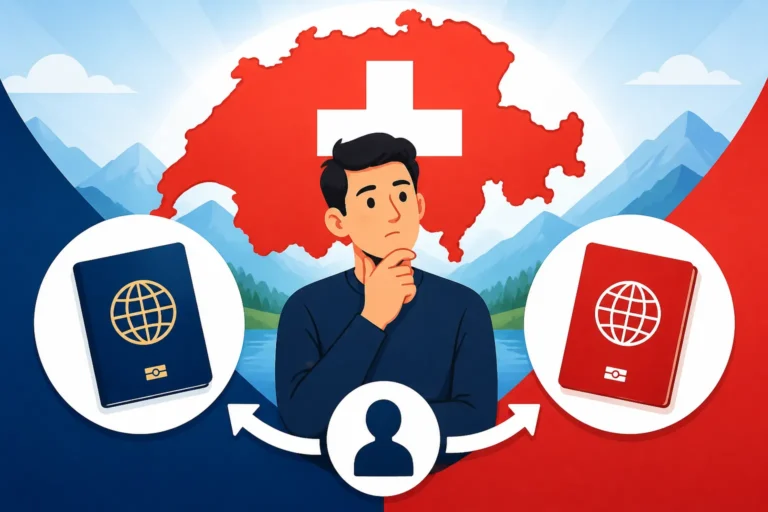
The Niederlassungsbewilligung, or C Permit, is the closest a foreigner can get to being Swiss without actually holding the red passport. Unlike the B permit, which is often tied to an employer or a specific purpose like study, the C permit is "unconditional." This means you are no longer tied to a job contract, and your right to remain in Switzerland is no longer subject to annual scrutiny. It is a profound shift in status that changes how you interact with the state and the economy.
One of the most immediate benefits is the move away from withholding tax. Most B permit holders have their taxes deducted directly from their salary. Once you receive your C permit, you transition to Withholding Tax (Quellensteuer) vs Standard Taxation for Foreigners where you file a tax return just like a Swiss citizen. This allows you to claim significantly more deductions for things like professional expenses, further education, and Pillar 3a contributions, often resulting in a lower overall tax burden.
Beyond the financial perks, the C permit offers unparalleled security. You have the right to change employers at will, move between cantons without seeking prior permission (though you still must register your move), and even become self-employed without the mountain of paperwork usually required for third-country nationals. It is the legal foundation upon which you can truly build a permanent life, knowing that your residency is secure even if you decide to take a sabbatical or switch careers.
The Standard Route: The Ten-Year Patience Game
For the majority of non-EU/EFTA nationals and even some EU citizens from specific member states, the standard path to permanent residency requires ten years of continuous residence. This sounds like a lifetime when you first arrive, but as anyone who has lived here knows, the years in Switzerland have a way of disappearing into a blur of fondue evenings and mountain hikes. The key word here is "continuous." The authorities look for a decade where Switzerland has been your clear center of life.
Eligibility for the 10-year path is generally straightforward but requires a clean administrative record. You must have held a B or L permit for the duration, though years spent on an L permit are often scrutinized more closely and may not always count toward the total if the stay was deemed temporary. If you are a third-country national, you should check How Employers Prove They Couldn't Find a Swiss/EU Worker (Inländervorrang) to understand how your initial entry might have been categorized. Generally, if you have lived here for ten years on a B permit without long gaps, you are a prime candidate for the standard C permit.
The "uninterrupted" rule is where many expats trip up. If you leave Switzerland for more than six months, the clock usually resets. I have seen friends lose years of progress because they took an extended project abroad or went home to care for a relative without realizing the implications for their residency. While short holidays and business trips are perfectly fine, your primary residence must remain in Switzerland. If you are planning a long absence, you must speak with the cantonal migration office to see if you can "freeze" your permit status.
Documenting a decade of life in Switzerland is an exercise in Swiss-style organization. You will need to provide proof that you haven't relied on social assistance, that your taxes are paid, and that you have no criminal record. This is where having a folder of your old Lohnausweise (salary certificates) and permit copies becomes invaluable. When you submit your application, the authorities will cross-reference your data with the central migration system, so ensure your Understanding Your Swiss Salary Certificate (Lohnausweis) for Tax Season knowledge is up to date to avoid any discrepancies in your financial declarations.
The Fast-Track Route: Qualifying for the Early C Permit
There is a way to bypass the ten-year wait, but it requires a high level of proactive integration. The "Early C Permit," often referred to as the Permis C Anticipé, allows residents to apply after just five years. This is primarily available to residents from countries with reciprocal agreements (like Germany, Austria, Italy, and France) or to any resident who can prove "successful integration." This second category is the golden ticket for many expats from the US, UK, Canada, and other non-EU nations.
The VINTA agreement specifically lists countries whose citizens are entitled to a C permit after five years. This is a matter of treaty law rather than discretionary integration. However, for everyone else, the "Integration" route is based on Art. 34 of the Foreign Nationals and Integration Act. To succeed here, you must demonstrate that you have gone above and beyond the average resident. This includes reaching a higher level of language proficiency—usually B1 oral and A2 written—and showing that you are professionally and socially woven into the fabric of your community.
Proving integration is subjective, which can be frustrating. The migration office wants to see that you don't just live in Switzerland, but that you live with Switzerland. This means having a stable job, being financially independent, and perhaps even being involved in local Vereine (clubs). Whether it’s the local fire brigade, a choir, or a sports club, these social connections carry weight. If you're aiming for this route, you should read up on The Early C Permit (Permis C Anticipé): Qualifying After 5 Years to understand the specific nuances your canton might look for.
When applying for the fast-track route, your documentation must be impeccable. Any certificates or diplomas from your home country should be professionally translated. I always recommend using a service like RushTranslate for this, as the Swiss authorities are incredibly picky about "certified" translations. If your marriage certificate or degree isn't in a national language (German, French, or Italian), a high-quality translation from RushTranslate ensures the clerk at the migration office has no reason to send your dossier back.
Language Requirements: Navigating the fide and Goethe Standards
The most significant hurdle for many seeking the C permit is the language requirement. Switzerland has significantly tightened these rules in recent years. For the standard 10-year route, most cantons now require at least an A2 level in the local language for speaking and A1 for writing. However, for the 5-year fast-track route, the bar is usually raised to B1 speaking and A1 or A2 writing. These levels are not just suggestions; they are hard requirements that must be proven with an accredited certificate.
The "fide" test is the Swiss-specific language assessment designed specifically for residency and citizenship. Unlike the Goethe or DELF exams, which are academic in nature, the fide test focuses on "life in Switzerland." You might be asked how to talk to a doctor, how to handle a parent-teacher meeting, or how to navigate a conversation at the Gemeinde. This makes it a much more practical option for expats. You can find more details in the guide C Permit Language Requirements: Do I Need A2 Written and B1 Oral? to see which exam fits your learning style best.
Exemptions do exist, but they are narrow. If you grew up speaking the local language, attended a Swiss school for at least three years, or graduated from a Swiss university, you are generally exempt. However, simply working in a local office where the language is spoken is not enough. You need the paper. If you are struggling with the language, I highly recommend looking into local integration courses which are often subsidized by the canton.
Navigating these requirements is stressful, and it's one of the reasons many expats choose to maintain international health insurance like Cigna Global during their transition years. While mandatory Swiss insurance is a given once you are resident, having a policy from Cigna Global can provide that extra layer of comfort if you are traveling frequently or if you find the local system's administrative requirements over the language barrier a bit overwhelming in the beginning.
| Requirement | Standard Route (10 Years) | Fast-Track (5 Years) |
|---|---|---|
| Residency Period | 10 continuous years | 5 continuous years |
| Language Level (Oral) | A2 (minimum) | B1 (minimum) |
| Language Level (Written) | A1 (minimum) | A2 (minimum) |
| Financial Status | No welfare in last 3 years | No welfare in last 5 years |
| Criminal Record | Clean extract | Clean extract |
| Integration Proof | Basic | High (Clubs, Professional) |
The Financial and Criminal Clean Slate Requirements
Switzerland is a country built on the concept of "good standing." To get your C permit, the state needs to be sure you are not a burden and that you respect the rule of law. This means two things: you must be debt-free and you must have a clean criminal record. The authorities will request a Betreibungsauszug (Debt Register Extract) from every commune you have lived in over the past few years. If you have unpaid bills or ongoing legal disputes over money, your C permit application will likely be denied or delayed.
The dreaded Betreibung can happen to anyone—sometimes it's just a forgotten medical bill or a dispute with a telecom provider. However, in the eyes of the migration office, it's a sign of poor integration. If you find yourself with an entry, you must resolve it immediately. It's often worth consulting the guide on Clearing an Unjustified Betreibung from the Swiss Debt Register to ensure your record is spotless before you even think about applying for permanent residency.
Social assistance is another "red flag." If you have received welfare payments (Sozialhilfe) in the three to five years preceding your application, you are generally ineligible for a C permit. This does not include unemployment benefits (RAV), as those are considered insurance payments you have contributed to. However, if you have fallen into the social safety net of the commune, the state will want to see that you have been financially independent for several years before granting permanent status.
Finally, the concept of "Public Order" is paramount. A clean criminal record (Strafregisterauszug) is mandatory. While a minor speeding ticket (the kind where you just pay a fine) usually won't sink your application, any offense that leads to a court appearance or a notation on your record is a serious problem. The Swiss authorities have the power to revoke even a B permit for serious offenses, so for a C permit, they expect a record that shows you are a law-abiding member of society.
Application Process: From the Verfallanzeige to the Biometric Appointment
The actual process of applying for the C permit often starts automatically. A few months before your B permit is set to expire, you will receive a Verfallanzeige (notice of expiration) in the mail. Usually, there is a box you can tick to indicate you would like to be considered for a C permit. However, if you are applying for the "Early C Permit," you will likely need to initiate the process yourself by contacting the cantonal migration office and requesting the specific application forms for integration-based residency.
Dealing with the cantonal migration offices (like the AWA in Zurich or the OCP in Geneva) requires patience and precision. They will provide you with a checklist of documents: your current permit, your passport, proof of language proficiency, debt register extracts, and often a letter from your employer confirming your current salary and contract status. If you are unsure about the timeline, check out Renewing Your Swiss Residence Permit: The Verfallanzeige Form Explained to ensure you don't miss any critical deadlines.
Once your documents are submitted and the fee is paid (which can range from CHF 100 to CHF 300 depending on the canton), you will be invited to a biometric appointment. This is a fairly routine procedure where they take your photo, fingerprints, and digital signature. It’s the same process you went through for your B permit, but this time, the card that arrives in the mail a few weeks later will have that beautiful "C" on the back.
Even after you receive your C permit, keeping your international affairs in order is vital. For those who frequently move or have families split between countries, keeping a global health plan like Cigna Global alongside your mandatory Swiss KVG insurance is a common strategy. It ensures that if you are outside Switzerland for an extended period, you still have high-end private coverage that isn't dependent on your local residency status.
Special Cases and Transitions
The path to a C permit isn't always a straight line. For those who arrived in Switzerland as students, the rules are slightly different. Years spent on a student permit generally only count toward a C permit if you immediately transitioned into a work-related B permit and have stayed in that status for a certain number of years. If you are currently a student, it's worth looking at Student Visas in Switzerland: From Application to Post-Graduation Work to plan your long-term residency strategy early.
Spouses of Swiss nationals or of people who already hold a C permit have a much easier path. They are often eligible for a C permit after five years of living together in Switzerland, provided they meet the language requirements. This is part of the "family reunification" principle, which aims to keep families together and stable. However, the integration requirements (no debt, no criminal record) still apply with full force.
What happens if you want to leave? This is a common question for C permit holders. One of the greatest "secret" benefits of the C permit is the ability to put it on "hold." If your employer sends you abroad for a few years, or if you want to try living in another country, you can apply to the migration office to "freeze" your C permit for up to four years. This allows you to return to Switzerland and resume your permanent residency without starting the clock over from zero. It is a powerful tool for the modern, mobile expat.
Finally, remember that the C permit is also the prerequisite for naturalization. If your ultimate goal is the Swiss passport, the C permit is the final gate you must pass. The years you spend on your C permit count toward the total years needed for citizenship, and the integration you prove now will be the same integration you prove during your The Swiss Citizenship Interview Questions: What the Commune Asks You later down the road.
Important Disclaimer
The information provided in this guide is for informational purposes only and does not constitute legal advice. Swiss immigration laws and cantonal practices are subject to frequent changes. Always verify requirements with your local Cantonal Migration Office or a qualified immigration lawyer before making any decisions regarding your residency status. Individual cases can vary significantly based on nationality, cantonal regulations, and personal circumstances.
Related Reference Topics
- Is Basic Health Insurance (KVG) Mandatory for Expats? A Plain-English Guide
- The Swiss C Permit (Permanent Residency): Fast-Track and Standard Routes
- C Permit Language Requirements: Do I Need A2 Written and B1 Oral?
- Clearing an Unjustified Betreibung from the Swiss Debt Register
- Withholding Tax (Quellensteuer) vs Standard Taxation for Foreigners
- Renewing Your Swiss Residence Permit: The Verfallanzeige Form Explained
- The Early C Permit (Permis C Anticipé): Qualifying After 5 Years
- How Employers Prove They Couldn't Find a Swiss/EU Worker (Inländervorrang)
- Student Visas in Switzerland: From Application to Post-Graduation Work
- The Swiss Citizenship Interview Questions: What the Commune Asks You