Language Requirements for Swiss Permits: A1 to B2 Standards Explained
Moving to Switzerland often feels like a series of boss-level administrative challenges, and nothing spikes an expat's heart rate quite like receiving a letter from the Migration Office asking for proof of language proficiency. I remember the sheer panic of realized my school-level German was nowhere near the required standard for my first permanent residency application. This guide solves that uncertainty by breaking down exactly which CEFR level you need for every permit type.
Why Language Proficiency is the Key to Your Swiss Future
The landscape of Swiss immigration changed significantly following the 2019 revision of the Foreign Nationals and Integration Act (AIG). Before this shift, language requirements were often seen as a secondary consideration, especially for those working in high-demand tech or finance sectors where English is the office lingua franca. However, the Federal Council has made it clear that integration is now a measurable metric, and the primary yardstick for that integration is your ability to communicate in a national language.
I have seen countless colleagues struggle because they assumed their professional success would exempt them from these rules. The reality is that the cantonal authorities view your linguistic ability as a sign of your commitment to the local community. If you cannot hold a basic conversation with your neighbors or understand the instructions at the local recycling center, the authorities may question your long-term suitability for residency. This is particularly true when you transition from short-term stays to more permanent solutions.
Beyond the legal requirements, the social reality of living in Switzerland is that life happens in German, French, or Italian. While you can survive in Zurich or Geneva with English alone, you will forever remain in the "expat bubble." Learning the language is the difference between feeling like a perpetual guest and finally feeling at home. It allows you to navigate the complexities of Residence Permits in Switzerland: L, B, C, and G Permits Explained without needing a translator for every document or phone call.
The Shift Toward Integration Based Immigration
Since the latest updates to the law, the "Integration Agreement" has become a standard part of the permit process for many third-country nationals. When you first arrive and complete The 14-Day Registration Rule: Signing Up at the Gemeinde/Commune, you might be asked to sign a document promising to reach a certain level of language proficiency within a specific timeframe. This isn't just a formality; failure to meet these goals can lead to your permit being issued with shorter validity periods or, in extreme cases, not being renewed at all.
For those of us who have lived through these changes, the message is clear: the Swiss government wants to see effort. They understand that not everyone will become fluent overnight, but they expect to see you enrolled in courses. I’ve known people who were granted extensions on their deadlines simply because they could prove they were attending classes at a local Migros Klubschule or similar institution.
The shift toward integration-based immigration also means that the "Standard" for what constitutes an integrated foreigner has risen. It is no longer enough to just pay your taxes and stay out of trouble. You are expected to participate in the local culture, and that starts with the tongue of the canton you reside in. This is why understanding The Swiss B Permit: Eligibility, Renewal, and Restrictions is so vital; the requirements for renewal often hinge on these linguistic milestones.
How Language Impacts Permit Renewals and Upgrades
If you are currently on a B permit and have your sights set on the coveted C permit, language is the single biggest gatekeeper you will face. While the B permit requirements are relatively low, the jump to a C permit—which offers permanent residency and nearly all the rights of a citizen—is significant. The authorities want to ensure that anyone holding a C permit can function independently in Swiss society without the need for state-supported translation services.
During my own permit upgrade, I realized that the "oral" versus "written" distinction is where many expats trip up. The Swiss system is surprisingly nuanced; they often require a higher level of speaking ability than writing ability. This makes sense from a practical standpoint—they want you to be able to talk to a doctor, a teacher, or a police officer, even if you can't write a perfect literary essay in the local language.
When preparing for these upgrades, you must also ensure all your supporting documentation is in order. If you have certificates or legal documents from your home country, using a service like RushTranslate can ensure that your paperwork meets the strict standards of the cantonal migration offices. They are notoriously picky about the quality of translations, and a professional service can prevent unnecessary delays in your permit processing.
The Social and Professional Reality of Speaking the Local Tongue
Professionally, even if your office uses English, having B1 or B2 German or French opens doors to leadership roles and client-facing positions that are otherwise closed to expats. In many Swiss companies, the "official" language might be English, but the "canteen language" and the "decision-making language" remain local. Being able to follow the conversation during an after-work apéro is often where the real networking happens.
Socially, the benefits are even more pronounced. Switzerland is a country of clubs (Vereine). Whether it is a local hiking group, a choir, or a volunteer fire department, these are the places where the Swiss actually make friends. Without at least an A2 or B1 level of the local language, joining these circles is incredibly difficult. You will find yourself stuck in a loop of meeting other expats who leave after two years, rather than building a stable local network.
Furthermore, being able to communicate with your insurance providers or local clinics is essential for your peace of mind. While many medical professionals speak English, having the ability to explain complex symptoms in the local language is invaluable. For many expats, having a comprehensive international plan like Cigna Global provides a safety net, but being able to talk to the local receptionist or pharmacist directly will make your daily life significantly smoother.
Decoding the CEFR Levels: From A1 to B2 in the Swiss Context
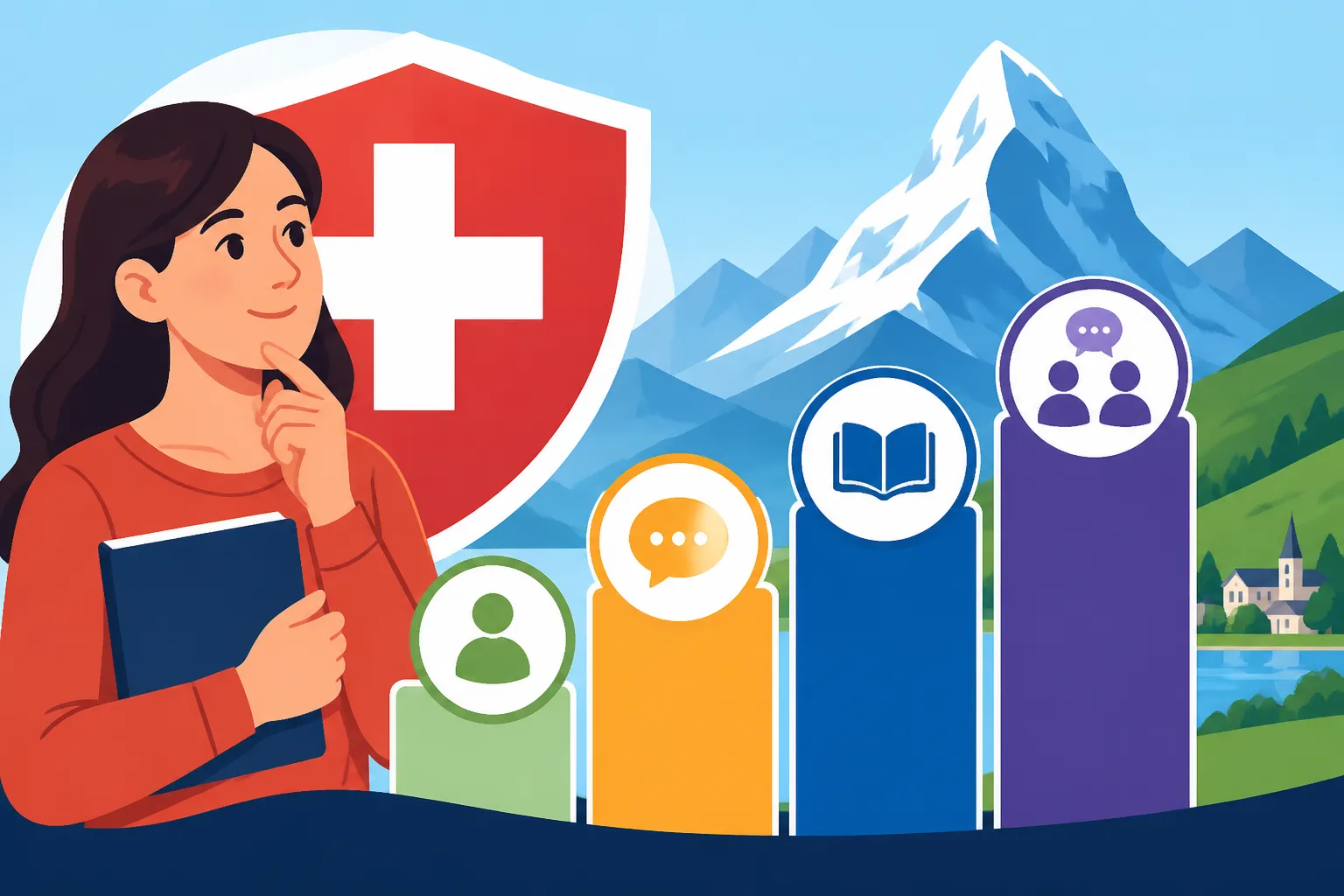
The Common European Framework of Reference for Languages (CEFR) is the gold standard used in Switzerland to measure your skills. It is divided into three broad categories: A (Basic User), B (Independent User), and C (Proficient User). For most residence permits, you will be focusing on the A and B levels. Understanding what these levels actually mean in a "Swiss" context is the first step toward a successful application.
It is important to remember that the Swiss authorities often use a "split" requirement. For example, they might ask for B1 Oral and A2 Written. This reflects the practical needs of integration. They want you to be able to speak more fluently than you can write. I found that focusing my studies on speaking and listening comprehension helped me pass my tests much faster than focusing on perfect grammar and spelling.
A1 and A2: The Foundation for Basic Residency
The A1 level is often described as "survival" language. At this level, you can understand and use familiar everyday expressions and very basic phrases. In the eyes of the Swiss migration office, an A1 certificate proves that you can at least introduce yourself, ask for directions, and handle very basic shopping interactions. For some family reunification visas, A1 is the minimum threshold required before you even arrive in the country.
The A2 level is a step up and is frequently required for the renewal of B permits for non-EU/EFTA nationals. At A2, you can communicate in simple and routine tasks requiring a simple and direct exchange of information. You should be able to describe your background, your immediate environment, and matters in areas of immediate need. This is the level where you start feeling like you can actually survive a brief conversation with a neighbor about the weather or the laundry schedule without sweating through your shirt.
In practical terms, reaching A2 is achievable for most people within six months of consistent study. If you are moving to a new canton, remember that requirements can vary slightly. You should check Changing Cantons on a B Permit: Notification and Reapplication Processes to see if your new location has stricter enforcement of these A-level requirements. Often, the more conservative cantons are more rigorous about checking these certificates during the renewal process.
B1 and B2: The Gatekeepers of Permanent Residency and Citizenship
The B1 level is where things get serious. This is the "Independent User" level. At B1, you can deal with most situations likely to arise while traveling in an area where the language is spoken. You can produce simple connected text on topics that are familiar or of personal interest. Most importantly for the Swiss, you can describe experiences, events, dreams, hopes, and ambitions and briefly give reasons and explanations for opinions and plans. This is typically the minimum requirement for the standard C permit.
B2 is a significantly higher bar. It implies a level of fluency where you can interact with native speakers with a degree of spontaneity and ease that makes regular interaction quite possible without strain for either party. You can understand the main ideas of complex text on both concrete and abstract topics, including technical discussions in your field of specialization. For many professional licenses in Switzerland—such as for doctors or lawyers—B2 or even C1 is the mandatory minimum.
Reaching B1 or B2 requires a dedicated commitment to language learning. It usually involves moving beyond simple apps like Duolingo and enrolling in intensive courses. When you apply for a C permit, you will need to provide an official certificate. If your original language test results or diplomas are not in a Swiss national language, you will likely need to have them professionally translated by a company like RushTranslate to ensure they are accepted by the authorities without question.
Which Language Should You Learn?
Switzerland has four national languages: German, French, Italian, and Romansh. The language you need to learn depends entirely on the canton where you reside. If you live in Zurich, you need German. If you live in Geneva or Lausanne, you need French. If you live in Lugano, you need Italian. This sounds obvious, but it gets complicated in bilingual cantons like Bern, Fribourg, or Valais.
In bilingual areas, you generally need to prove proficiency in the language spoken in the specific commune (municipality) where you are registered. I once knew a family who lived on the linguistic border; they moved just three kilometers down the road and suddenly had to switch their focus from French to German for their permit renewal. Always verify the local requirements at your Gemeinde before committing to a long-term language course.
| Permit Type | Oral Requirement | Written Requirement | Notes |
|---|---|---|---|
| B Permit (Renewal) | A1 / A2 | A1 | Varies by canton and nationality |
| C Permit (Standard – 10 years) | B1 | A2 | For most third-country nationals |
| C Permit (Fast-track – 5 years) | B1 | A1 | Varies by country of origin |
| Naturalization (Citizenship) | B1 | A2 | Some cantons require B2 oral |
| Family Reunification | A1 | N/A | Often required before entry |
Specific Language Requirements for the Swiss B Permit
The B permit is the most common residency permit for expats. For EU/EFTA citizens, getting and renewing a B permit is relatively straightforward and often doesn't require immediate proof of language skills. However, for third-country nationals (such as those from the US, UK, Canada, or India), the rules are much stricter. The authorities are increasingly using the B permit renewal process as a "check-in" on your integration progress.
If you are a non-EU citizen, you might find a "language requirement" clause written directly onto your permit or mentioned in your approval letter. This often states that you must reach A1 or A2 level within a certain period. Ignoring this is a mistake. I have seen B permits "downgraded" to L permits (short-term) because the holder failed to provide the necessary language certificates upon renewal.
Requirements for EU/EFTA vs. Third-Country Nationals
EU and EFTA nationals enjoy the benefits of the Agreement on the Free Movement of Persons. Generally, they are not required to provide language certificates for the initial issuance or renewal of a B permit. The assumption is that these individuals are integrated by virtue of their employment and their cultural proximity to Switzerland. However, even EU citizens will eventually hit the language wall if they wish to upgrade to a C permit or apply for citizenship.
Third-country nationals, on the other hand, are subject to the quota system and stricter integration criteria. For these residents, the B permit is often "tied" to their employer, and their right to stay is contingent on both their job and their integration. If you fall into this category, you should start your language journey as soon as you arrive. Proving your language skills early can make the process of Changing Cantons on a B Permit: Notification and Reapplication Processes much easier, as it shows your "integration baggage" is in good standing.
During this process, managing your administrative life is key. While you focus on language, ensure your other requirements are met, such as having valid health insurance. For many new arrivals, a flexible plan from Cigna Global can provide the necessary coverage while you navigate the local KVG/LAMal system. Having your healthcare sorted allows you to focus your mental energy on mastering the difference between "Der," "Die," and "Das."
The Role of the Integration Agreement
The Integration Agreement is a tool used by cantonal authorities to formalize your commitment to learning the language and understanding Swiss values. It is typically a signed contract between you and the Migration Office. It will specify the level you need to reach (usually A1 or A2) and the deadline for doing so. If you meet the terms, your permit renewal is usually guaranteed. If you don't, the authorities have the power to impose sanctions.
These agreements are not meant to be punitive, but rather a way to ensure that expats don't end up isolated. Many cantons even provide "language vouchers" to new arrivals that can be used to subsidize the cost of their first course. Make sure to ask about this at your local Kreisbüro or Gemeinde when you first register. It is one of the few "free" things you will find in Switzerland, and it is well worth taking advantage of.
If you are struggling to meet the requirements of your Integration Agreement due to work or family commitments, communication is vital. Don't wait until your permit is expiring to tell the Migration Office. If you can show that you have made a good-faith effort—such as receipts from a language school or a letter from your teacher—they are often willing to extend your deadline. They want you to succeed, but they need to see that you are taking the requirement seriously.
Exemptions from Language Evidence for B Permits
Not everyone has to sit for a language test. There are several categories of people who are exempt from providing evidence of language proficiency for a B permit. The most common exemption is for those whose native language is one of the Swiss national languages (e.g., people from Germany, Austria, France, or Italy). Additionally, if you have completed a degree or a high school diploma in a national language, you are usually exempt.
Another common exemption is for people with significant health issues or disabilities that make language learning impossible. However, these cases require extensive medical documentation. If your medical records are in English or another foreign language, you will absolutely need a certified translation from a service like RushTranslate for the Swiss authorities to even consider the exemption.
Finally, some high-level executives or specialized researchers might be granted temporary reprieves, though this is becoming rarer. The general trend in Switzerland is toward a "no exceptions" policy for long-term residents. Even if you are a world-class scientist, the local commune still expects you to be able to say "Grüezi" and understand your tax bill in the local language.
The Higher Bar: Language Requirements for the Swiss C Permit
The C permit (Niederlassungsbewilligung) is the ultimate goal for most expats who don't intend to naturalize immediately. It grants you the right to live and work in Switzerland indefinitely, change employers without permission, and even move cantons freely. However, the price for this freedom is a much higher language requirement. For most people, this means proving B1 level oral skills and A2 level written skills.
The application for a C permit is a thorough investigation into your life in Switzerland. The authorities will look at your criminal record, your debt history (Betreibungsauszug), and your language skills. If any of these are lacking, your application will be rejected, and you will remain on a B permit. This is why many people spend years preparing for their C permit application, often taking specific "German for C Permit" courses designed to help them pass the required tests.
The Standard 10-Year Route vs. the Fast-Track 5-Year Route
Most third-country nationals have to wait 10 years to apply for a C permit. During this decade, you are expected to gradually improve your language skills. By the time the 10-year mark hits, a B1/A2 requirement is usually seen as reasonable. However, there is a "fast-track" option known as the VBE (Vorzeitige Erteilung der Niederlassungsbewilligung) for those who are exceptionally well-integrated.
To get your C permit after only 5 years, the language requirements are significantly higher. In many cantons, you must prove B1 level in all four competencies (Speaking, Listening, Reading, and Writing) to qualify for the early upgrade. This is the route I took, and it was intense. I spent every Saturday for a year in a language school to ensure I hit those marks. The payoff, however, was immense, as it provided me with a level of security that the B permit simply couldn't offer.
You can read more about the nuances of this process in our guide on The Swiss C Permit (Permanent Residency): Fast-Track and Standard Routes. It is also worth noting that citizens of certain countries (like the US, Canada, and many EU nations) have bilateral agreements that allow them to get a C permit after 5 years with only the standard B1/A2 requirement. Check your specific nationality’s status, as it can save you years of waiting.
Language Tests for C Permit: fide vs. Goethe-Zertifikat Compared
When it comes to proving your skills, you have choices. The most common tests are the Goethe-Zertifikat (for German), the DELF (for French), and the fide test. The Goethe and DELF tests are academic and recognized internationally. They involve traditional grammar exercises, reading comprehension, and formal writing. If you plan to use your language certificate for university entrance or for jobs outside Switzerland, these are the best options.
The fide test, however, was developed specifically for the Swiss migration context. It is much more practical and focuses on scenarios you actually encounter in Switzerland, such as talking to a landlord, attending a parent-teacher conference, or dealing with a government office. Many expats find the fide test less intimidating because it doesn't penalize you as harshly for minor grammatical errors as long as your communication is clear and effective.
Deciding between these can be tough. We have a detailed comparison in our article Language Tests for C Permit: fide vs Goethe-Zertifikat Compared that breaks down the costs, difficulty levels, and pass rates. Whichever you choose, make sure you take the test at an accredited center. The Migration Office will not accept results from an uncertified school or an online-only platform that doesn't have a proctored exam.
Written vs. Oral Proficiency Ratios
One of the unique aspects of the Swiss system is the emphasis on oral communication. For a standard C permit, the requirement is often "B1 Oral, A2 Written." This recognizes that many people can speak quite well but struggle with the complex spelling and grammar of written German or French. If you are a native English speaker, the gap between your speaking and writing skills can be frustrating, especially with German cases and genders.
When you are studying, don't ignore the writing entirely. Even though the requirement is lower, an A2 writing test still requires you to be able to compose a short letter or an email. You need to know how to address someone formally (using "Sie" instead of "du") and how to structure a basic request. I found that practicing my writing by actually sending emails to my local commune helped me get used to the formal tone required for the test.
If you are worried about your writing skills, look for courses that specifically focus on "Email and Letter Writing for Expats." These classes are common in major cities like Zurich and Geneva and can give you the "scripts" you need to pass the A2 writing portion with ease. Remember, the goal isn't to be a poet; it's to be a functional member of Swiss society.
Naturalization and Citizenship: Reaching the B1/B2 Milestone
Applying for Swiss citizenship is the final step in the integration journey. It is a multi-year process that involves federal, cantonal, and communal levels of approval. The language requirements for citizenship are the highest you will encounter. While the federal minimum is B1 oral and A2 written, many cantons and communes have used their autonomy to raise these standards to B2 oral.
Citizenship is not a right in Switzerland; it is a privilege granted to those who can prove they are "Swiss in all but passport." This means you need to be able to discuss Swiss history, politics, and local traditions in the national language. During my naturalization interview, I was asked about the local geography and the specific voting system of my canton—all in German. Without a solid B1/B2 foundation, I would have failed within the first five minutes.
Federal vs. Cantonal Standards for Citizenship
While the Swiss Confederation sets the baseline, the real power in naturalization lies with the cantons. A canton like Zug might have different language expectations than a canton like Geneva. Some cantons are known for being "foreigner-friendly," while others have a reputation for being very strict. This is why Becoming Swiss: Naturalization and Citizenship Process in 2027 is such a complex topic; your experience will vary wildly depending on where you live.
In some smaller communes, the language "test" isn't a formal paper exam but a conversation with the local naturalization committee. These are often made up of local citizens who want to see if you can truly converse with them. They might ask you about your favorite local restaurant or what you think of the new construction project in the village. This "social" language proficiency is often harder to master than the academic version, as it requires an understanding of local slang and cultural references.
If you are planning to apply for citizenship, start preparing years in advance. Don't just study for a test; immerse yourself in the local news. Watch the "Tagesschau" in German or "Le Téléjournal" in French. Read the local newspapers. This will not only improve your language skills but also give you the cultural knowledge you need to impress the naturalization committee during your interview.
Proving Integration Beyond the Language Certificate
A language certificate is just the entry ticket for citizenship. To truly succeed, you need to prove you are integrated into the community. This often involves providing letters of recommendation from Swiss citizens, proving you don't have any outstanding debts, and showing that you have never relied on social welfare. In some cantons, if you have received social assistance in the last three to five years, your application will be automatically rejected.
Volunteering is one of the best ways to prove integration. Whether it's helping at a local sports club or participating in a neighborhood clean-up day, these activities show the authorities that you are a contributing member of society. When you can talk about these activities fluently in the local language, your "integration score" in the eyes of the officials skyrockets.
It is also worth noting that for those who are married to a Swiss citizen, there is a "facilitated" route. This process is handled entirely at the federal level and is generally faster and less demanding than the standard route. You can find more details in our guide on Facilitated Naturalization: Fast-Track Citizenship for Spouses of Swiss Nationals. Even in this process, however, you will still need to meet the B1/A2 language standards.
The Impact of Social Welfare and Debt on Your Permit
While we are focusing on language, it is important to remember that the Swiss system views integration as a holistic concept. You could have a C2 level in German, but if you have a history of unpaid bills or "Betreibungen," your permit renewal or citizenship application will be in jeopardy. The authorities want to see that you are financially self-sufficient and responsible.
If you are ever in a situation where you need to claim unemployment benefits (RAV), this generally doesn't affect your B or C permit, as you have paid into the system through your salary deductions. However, claiming "Sozialhilfe" (social welfare) is a different story. For third-country nationals, relying on social welfare can be a ground for permit revocation or the denial of a C permit.
This is where having robust insurance is crucial. Unexpected medical bills can easily spiral into debt if you aren't properly covered. While the mandatory KVG insurance is great, many expats choose to supplement it with international coverage from providers like Cigna Global to ensure they have access to private rooms and global specialists without the fear of massive out-of-pocket costs that could ruin their "Betreibungsauszug."
Approved Certificates and the fide Test System
Not all language certificates are created equal in the eyes of the Swiss government. If you show up at the migration office with a certificate from an unaccredited online school, it will be rejected. You must ensure that your certificate is recognized by the State Secretariat for Migration (SEM). The most widely accepted certificates are those from the "ALTE" (Association of Language Testers in Europe) members, such as Goethe, TELC, and DELF.
The most important development in recent years is the "fide" system. Fide was created by the Swiss government specifically for the integration of foreigners. It is not just a test; it is a whole pedagogical approach. The "fide language passport" is now the gold standard for residence and settlement permits in Switzerland. If you are unsure which test to take, fide is almost always the safest bet for permit-related purposes.
Understanding the fide Language Passport
The fide language passport is a document that records your language skills in the national languages of Switzerland. Unlike a traditional diploma, it doesn't give you a single grade. Instead, it assesses your "Speaking/Listening" and "Reading/Writing" separately. This is perfect for the Swiss requirements that often ask for different levels in different skills.
The fide test is broken down into "scenarios." Instead of a grammar test, you might be asked to "Listen to a message from a school and explain what the teacher wants" or "Read a job advertisement and write a short application." Because it mimics real life, many expats find it more relevant and less stressful than academic exams. You can take the speaking and writing portions on different days, which is a great way to manage the pressure.
If you have already reached a certain level of education in a Swiss language, you can apply for a fide language passport without taking the test. For example, if you have a degree from a Swiss university, you simply send your diploma to the fide secretariat, and they will issue you a language passport based on your degree. If your diploma is from abroad but in a national language, you might need a certified translation from RushTranslate to facilitate this recognition.
Other Recognized Certificates (TELC, DELF, CELI)
While fide is the local favorite, other international certificates are still widely accepted. For German, the TELC (The European Language Certificates) and the Goethe-Zertifikat are the most common. These are offered at many language schools throughout Switzerland and are held to a very high standard. If you already have one of these from a previous stint living in Germany or Austria, they are usually valid for Swiss permits, provided they were issued within the last few years.
For French-speaking Switzerland (Romandie), the DELF (Diplôme d'Etudes en Langue Française) and DALF are the standard. These are issued by the French Ministry of Education and are recognized globally. In Ticino, the CELI (Certificato di Conoscenza della Lingua Italiana) is the equivalent for Italian. These certificates are rigorous and highly respected by Swiss employers as well as the migration authorities.
When submitting these certificates, check the validity period. While the certificates themselves don't technically "expire," the Swiss migration offices often prefer results that are less than five or ten years old. If your certificate is very old, they might ask you to sit for a quick assessment to prove you haven't lost your skills. This is particularly common during the naturalization process.
Translation and Apostille Requirements for Marriage Certificates
When you are applying for a permit based on family reunification or marriage, the language requirement for the "sponsoring" spouse is often overlooked. However, the authorities will need to verify your marital status, and this requires official documents. If you were married abroad, your marriage certificate must be translated into the national language of your canton.
This is not a task for a friend or a basic translation app. The Swiss authorities require "certified" or "notarized" translations. Using a specialist service like RushTranslate ensures that your documents come with the necessary certificates of accuracy that the Migration Office demands. In many cases, you might also need an "Apostille"—an international legalization of the document—before the translation can even be performed.
Navigating these requirements is a major part of the Translation and Apostille Requirements for Marriage Certificates process. I’ve seen permit applications delayed for months simply because a translation was missing a stamp or was not performed by a recognized professional. Don't let a $50 translation be the reason your residency is delayed.
Practical Tips for Mastering Your Local Swiss Language
Mastering a language while working full-time in an English-speaking office is a Herculean task. The "Swiss German" factor adds another layer of complexity. In the German-speaking part of Switzerland, people speak a dialect (Mundart) in daily life but write and use "High German" (Hochdeutsch) for formal communication and the language tests. This "diglossia" is often the most frustrating part for expats.
My advice is to focus on High German for your exams but try to learn some basic Swiss German phrases for social integration. The Swiss really appreciate it when you try to say "Grüezi" or "En Guete" instead of the standard German versions. It shows that you are paying attention to the local culture. However, for your permit, only your proficiency in High German (or standard French/Italian) counts.
Finding the Right Language School and Course Format
The "best" school depends on your learning style. If you need structure, schools like the Migros Klubschule or Benedict are reliable and offer levels from A1 to C1. For those who need more flexibility, online platforms like Lingoda or private tutors can be more effective. I personally found that intensive "Saturday Schools" were the only way to make progress while working a 100% workload in Zurich.
Many employers in Switzerland will subsidize your language courses. It is always worth asking your HR department if there is a budget for "Integration and Language Training." Some companies even host language lunches where you can practice with your local colleagues in an informal setting. If your company doesn't offer this, you can still deduct the cost of your language courses from your taxes in many cantons, as they are considered "professional development."
If you are bringing a spouse or partner who isn't working yet, look for "Integration Courses" offered by the city. These are often much cheaper than private schools and include modules on "Living in Switzerland," which can be incredibly helpful for navigating Health Insurance Requirements for Sponsoring a Tourist Visa Letter and other administrative hurdles. These courses are also a great place to meet other expats in the same boat.
Leveraging Daily Life: From Grocery Shopping to Local Clubs
The secret to language learning isn't just in the classroom; it's in the supermarket. Force yourself to use the local language at the checkout or when asking a staff member for help. I used to practice my numbers by listening to the price at the Coop and trying to visualize the digits before looking at the screen. These tiny interactions build the "muscle memory" you need for the oral exams.
Joining a local club (Verein) is the ultimate "cheat code" for integration. Whether it's a sports team, a hobby group, or the local neighborhood association (Quartierverein), these groups are where the local language is spoken naturally. You will hear the dialect, but people will usually switch to High German to help you out. This is the best way to move from A2 to B1 without feeling like you are constantly studying.
Socializing with neighbors is also vital. In Switzerland, there are strict "quiet hours" and recycling rules. Instead of reading the pamphlet in English, try to talk to your neighbor about when the "Karton" (cardboard) collection is. Not only will you learn useful vocabulary, but you will also build the social capital that is so important for Becoming Swiss: Naturalization and Citizenship Process in 2027.
Dealing with Swiss Dialects vs. High Language
In the beginning, Swiss German can sound like a completely different language. Don't be discouraged. Even Germans struggle to understand Swiss dialects at first. The key is to remember that all your official business—your taxes, your permit, your bank, and your tests—will be in High German. If you can master High German, you have fulfilled your legal obligations.
In Romandie (the French-speaking part), the situation is much simpler. While there are some regional accents and a few different words (like "septante" instead of "soixante-dix" for seventy), the language used in daily life is essentially the same as the one used in the exams. This makes the linguistic integration in Geneva or Lausanne significantly smoother for many expats compared to Zurich or Basel.
In Ticino, the Italian spoken is very close to standard Italian, though there are some local influences. Regardless of the region, the most important thing is to start. The longer you wait, the more of a "mountain" the language requirement will become. Start at A1, celebrate the small wins, and eventually, the B2 level for citizenship won't seem so impossible.
Navigating the Administrative Hurdles and Paperwork
Once you have your certificate, the job isn't finished. You have to submit it to the right people in the right format. The Swiss bureaucracy is efficient, but it is also inflexible. If you miss a deadline or submit the wrong form, the process starts over. I always recommend keeping a digital and physical folder of all your language-related documents, including course certificates, test results, and even your receipts for the classes.
When you receive your permit renewal notice (Verfallanzeige), it will tell you which documents you need to attach. If you have recently reached a new language milestone, attach the certificate even if they didn't explicitly ask for it. It updates your file in the system and can speed up future applications for a C permit or citizenship.
Submitting Proof to the Cantonal Migration Office
Most cantons now allow you to submit your permit renewal documents by mail or through an online portal. Ensure that your language certificate is a high-quality copy. Never send your original certificate through the mail; keep it safe in your home "Swiss folder." If the authorities need to see the original, they will ask you to bring it to an in-person appointment.
If you are moving between cantons, be aware that your language proficiency "status" might not transfer automatically in the way you expect. For example, if you move from Geneva to Zurich, your French B2 won't help you with the German requirements in your new home. You can read more about this in Changing Cantons on a B Permit: Notification and Reapplication Processes. Each canton is its own little world when it comes to immigration.
Finally, ensure that all your other "integration" proofs are ready. This includes your latest payslips, your "Betreibungsauszug" (debt register extract), and proof of your health insurance. For those using international plans, having a clear certificate of coverage from Cigna Global that demonstrates it meets the Swiss legal requirements is essential for a smooth submission.
What Happens if You Fail to Meet the Language Deadlines?
If you miss a deadline set in your Integration Agreement, the first thing that will happen is usually a formal warning or a "reminder" letter. This is your cue to act immediately. If you ignore these, the Migration Office can refuse to renew your B permit or grant you only a short-term L permit. In extreme cases, they can even start the process of revoking your right to stay.
However, the Swiss authorities are generally pragmatic. If you can provide a valid reason for the delay—such as a serious illness, a family emergency, or even an intense period of work travel—they will often grant an extension. The key is to be proactive. Send a letter (in the local language, if possible!) explaining the situation and providing a plan for how you will meet the requirement in the next six months.
If you find yourself in a dispute with the migration office, it may be worth consulting an immigration lawyer. However, for most people, simply showing that you have enrolled in a new course and are making an effort is enough to satisfy the officials. They aren't looking to deport productive, law-abiding residents; they just want to ensure that everyone is doing their part to integrate into the community.
Disclaimer
The information provided in this article is for general informational purposes only and does not constitute legal or professional advice. Swiss immigration laws and cantonal requirements are subject to frequent changes. Always verify the latest regulations with the State Secretariat for Migration (SEM) or your local cantonal migration office before making any permit-related decisions.