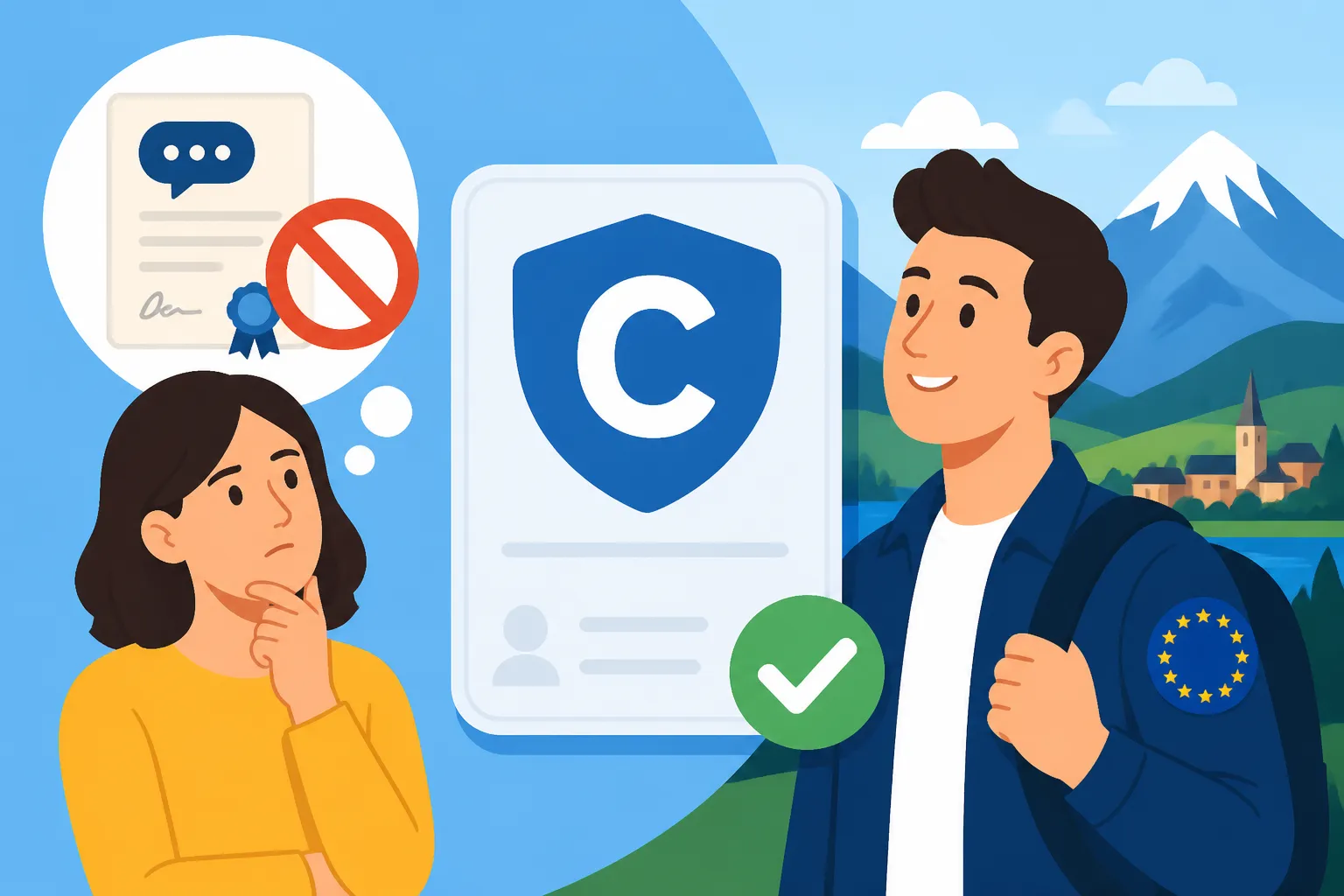
Are Language Certificates Required for EU Citizens Getting a C Permit?
One morning you open your mailbox to find a thick envelope from the Cantonal Migration Office, and suddenly, the "automatic" transition to permanent residency feels a lot less certain. I remember that exact knot in my stomach when I realized my EU passport wasn't a magic wand for bypassing the new integration laws. This guide solves the confusion around whether EU citizens truly need language certificates for a C Permit.
The Shifting Landscape of the Swiss C Permit
For decades, EU and EFTA citizens lived under the impression that the C Permit was a guaranteed prize for surviving five years on a B Permit. While the bilateral treaties still offer a smoother path than what third-country nationals face, the Swiss government has significantly tightened the definition of "integration." Since the implementation of the Federal Act on Foreign Nationals and Integration (FNIA), the "automatic" C permit is largely a thing of the past. Nowadays, proving you can actually converse with your neighbors and understand your local tax bill is a core requirement.
I’ve seen many friends from the EU get caught off guard by this. They assumed that because they worked for a multinational in Basel or Zurich where English is the lingua franca, the authorities would look the other way. They don't. The migration offices in cantons like Zurich and Zug have become meticulous. When you go for your appointment at the local Migrationsamt, they aren't just looking at your passport; they are looking for a specific piece of paper that validates your linguistic capability in the local national language.
This shift isn't just about bureaucracy; it's about a political push to ensure that permanent residents can participate in the social fabric of Switzerland. While your EU status grants you many privileges, The Swiss C Permit (Permanent Residency): Fast-Track and Standard Routes now almost always involves a stop at a language testing center unless you fall into a very specific set of exempt categories.
The Treaty Factor: Who Actually Needs a Certificate
Whether or not you need to sit for a test often comes down to the specific "Settlement Agreement" your home country has with Switzerland. Switzerland has bilateral treaties with several EU/EFTA nations that pre-date current integration laws. These treaties often dictate that a C permit should be granted after five years of residency without "onerous" conditions. However, the interpretation of these treaties has evolved.
Countries with Historic Language Exemptions
Currently, citizens of Germany, Austria, Italy, France, and Liechtenstein are generally exempt from providing a language certificate. Why? Because their national languages are also official Swiss languages. If you are a German citizen living in Zurich, the authorities logically assume you speak German. If you are a French citizen in Geneva, your mother tongue is already the local language.
However, even this has a catch. If you are a French citizen living in the German-speaking canton of Schwyz, the authorities might still ask for proof of German proficiency, or at the very least, they will scrutinize your integration more closely. I’ve known an Italian expat in Bern who was asked to prove their German skills because they weren't living in an Italian-speaking region. Always check the specific requirements for Registering at the Kreisbüro: What Documents Do Expats Need to Bring as local interpretations can vary wildly.
The Standard Path for Other EU Nationals
If you are from a country like Spain, Portugal, Greece, or Belgium, you also benefit from a five-year path to a C permit under bilateral agreements. However, these countries are now increasingly subject to the A2 oral and A1 written proficiency requirement. For citizens of newer EU member states or those without specific settlement treaties, such as Poland, Hungary, or Ireland, the requirement for a certificate is almost universally applied.
When you start gathering your dossier, you might find that old university diplomas aren't enough. If your degree wasn't taught in a Swiss national language, you will likely need a certified translation. In my experience, using a service like RushTranslate to handle these documents ensures they meet the strict standards of the cantonal offices. They need to see a clear, official link between your education and your language ability if you're trying to avoid the test.
Required Language Levels: A1, A2, or B1
The "level" you need depends on how quickly you are trying to get that permit and which canton you call home. The standard requirement for a regular C permit after five or ten years is usually A2 for oral skills and A1 for written skills. This is what we call the "Level of Integration." It means you can handle basic daily tasks—buying groceries, talking to a doctor, or understanding a Healthcare in Switzerland for Expats: The Complete System Overview (2027) brochure.
Understanding the Fide, DELF, and Goethe Standards
Switzerland has its own language passport called "fide." It was developed specifically for the Swiss context, focusing on real-life scenarios like dealing with a landlord or attending a parent-teacher meeting. Many expats find the fide test more "practical" than the more academic Goethe or DELF exams.
If you are aiming for The Early C Permit (Permis C Anticipé): Qualifying After 5 Years, the bar is set higher. To get your permanent residency early through "extraordinary integration," you typically need B1 oral and A1 written proficiency. This is a common path for high-achieving EU expats who want to secure their status quickly.
| Requirement Type | Standard C Permit (EU) | Early C Permit (VINTA) | Naturalization (Citizenship) |
|---|---|---|---|
| Oral Level | A2 | B1 | B1 |
| Written Level | A1 | A1 | A2 |
| Typical Timing | 5 Years | 5 Years (with honors) | 10 Years |
| Accepted Tests | fide, Goethe, DELF, TELC | fide, Goethe, DELF, TELC | fide, Goethe, DELF, TELC |
I personally recommend taking the fide test if you are nervous. When Taking the fide Language Test in Zurich: Format and Passing Scores, the atmosphere is generally more supportive for expats than the rigid Goethe-Institut environment. The assessors are looking for your ability to communicate, not just your perfect command of the Dative case.
The Early C Permit for EU Citizens
Many EU citizens don't realize they can apply for the "VINTA" C permit—a fast-track version based on successful integration. While EU nationals from the "original" 15 member states plus EFTA countries usually get a C permit after five years anyway, those from other EU countries often have to wait ten. For them, the language certificate is the golden ticket to cutting that wait time in half.
To qualify for this "fast track," you cannot have any Financial Independence Checks: Why Betreibungen (Debt) Stops Permit Renewals hanging over your head. The authorities will look at your tax records and your debt register extract. If you've been relying on private international health insurance like Cigna Global, you'll need to ensure your coverage was always compliant with Swiss law, as gaps in mandatory coverage can sometimes be flagged as a lack of "legal integration."
The language certificate for the early C permit must be current. If your certificate is more than a few years old, some cantons (looking at you, Zurich and Basel-Stadt) might ask you to re-verify your skills. It feels unfair, I know—I’ve been through the "but I’ve lived here for five years!" argument—but the law is the law. They want proof that your skills haven't regressed into an English-only bubble.
Practical Steps and Local Nuances
The most important thing to understand is that Switzerland is a confederation of 26 cantons, and each one can be a little bit "special" in how they apply federal rules. While the federal government sets the baseline for Language Requirements for Swiss Permits: A1 to B2 Standards Explained, the cantonal migration office (Migrationamt or Office de la population) has the final say.
Dealing with the Cantonal Migration Office
In Geneva or Vaud, the tone is often a bit more relaxed about the specific format of the certificate, as long as the level is met. In the German-speaking heartland, precision is everything. If the form asks for a "recognized certificate," they mean exactly that. Don't try to send a printout from a Duolingo streak or a letter from your German-speaking spouse.
If you are unsure whether your specific situation requires a test, I always suggest sending a polite email to your commune’s residency department. They are surprisingly helpful when you ask proactive questions. If you do end up in a dispute over your language requirements, it’s worth knowing about the Dealing with Permit Denials and the SEM Appeal Process, though most language issues are solved by simply taking the exam.
Documents and Deadlines
When your B permit is about three months away from expiring, you will receive a "Verfallanzeige" (notice of expiration). This is your window. If you want to move to a C permit, you must submit your language certificate along with your renewal application. If you don't have the certificate ready, they will simply renew your B permit for another five years.
For many of my fellow expats, the stress isn't the language itself—it's the paperwork. If you have a degree from back home that you think might exempt you, get it translated immediately. Using a professional service like RushTranslate can save you weeks of back-and-forth with a skeptical case officer. They want to see that you are taking the process seriously. Also, remember that Can I Use a Goethe B1 Certificate Instead of fide for Naturalization? is a different question entirely, so if your long-term goal is a Swiss passport, aim for the B1 level now to save yourself a second test later.
Final Expert Advice for EU Applicants
If I could go back and tell my younger expat self one thing, it would be this: don't wait until the fourth year and 11th month to start thinking about your language certificate. Even if you think you are exempt under a treaty, the rules are in constant flux. The peace of mind that comes with having a fide or Goethe certificate in your drawer is worth the few hundred francs and the weekend of studying.
Switzerland is a beautiful place to live, but it rewards those who respect its rules. By securing your language credentials, you aren't just ticking a box for a C permit; you are opening doors to better jobs, deeper friendships, and a much smoother integration into your local "Gemeinde." Whether you need to find Translation and Apostille Requirements for Marriage Certificates or simply prove you can order a "Stange" of beer and a "Bratwurst" in the local dialect, the effort pays off.
Disclaimer on Migration Advice
This guide is intended for informational purposes only and is based on personal experience and general interpretations of Swiss migration practices. Immigration laws and cantonal requirements in Switzerland are subject to frequent changes. We are not qualified legal professionals or migration agents. Always consult with your local Cantonal Migration Office or a certified Swiss immigration lawyer before making legal decisions or submitting permit applications. Consistent compliance with Swiss law is the responsibility of the permit holder.