Does Basic Swiss Insurance Cover Ambulance Rides? The 50% Rule Explained
Nothing stings quite like receiving a three-digit bill for a five-minute drive after you have already paid your hefty monthly health insurance premiums. When I first moved to Zurich, I assumed that "mandatory insurance" meant "comprehensive emergency coverage," but I quickly learned that the Swiss system operates on a very different logic. This guide explains the nuances of ambulance coverage in Switzerland to help you avoid the same financial shock I experienced during my first winter here.
The Financial Reality of Emergency Transport in Switzerland
When you dial 144 in Switzerland, you are initiating a high-quality but high-cost medical intervention. Many expats arrive with the assumption that emergency services are a public utility funded entirely by taxes, similar to the NHS in the UK or various systems in Northern Europe. In Switzerland, however, ambulances are frequently operated by hospitals, private organizations, or rescue federations, and they bill for their services just like any other medical provider.
A standard ambulance call-out in a major city like Geneva or Zurich typically starts at around CHF 700 and can easily climb to CHF 1,200 or more depending on the medical equipment used, the duration of the transport, and whether a specialized emergency doctor (Notarzt) had to be dispatched in a separate vehicle. I remember talking to a colleague who was billed nearly CHF 1,500 for a transport during a heavy snowstorm because of the extra staffing required. This is where Understanding KVG/LAMal: Mandatory Basic Health Insurance Explained becomes vital, as your basic insurance is the first line of defense, even if that defense has some significant gaps.
The complexity of these costs often stems from the cantonal level. Each canton has its own fee structure for rescue services. For instance, the price for an ambulance in the Canton of Vaud might differ significantly from the rates in Appenzell Innerrhoden. Regardless of the location, the bill will eventually find its way to your mailbox. If you are covered by an international plan like Cigna Global, your reimbursement process might look different, but for those on the local system, the "50% rule" is the law of the land.
Understanding the 50% Rule: Transport vs. Rescue
The most critical distinction you need to understand is how Swiss law differentiates between "Medical Transport" and "Rescue." These two categories are treated differently under the KVG (the Federal Health Insurance Act), and the difference can cost you thousands of francs.
Medical Transport (Verlegung/Transport)
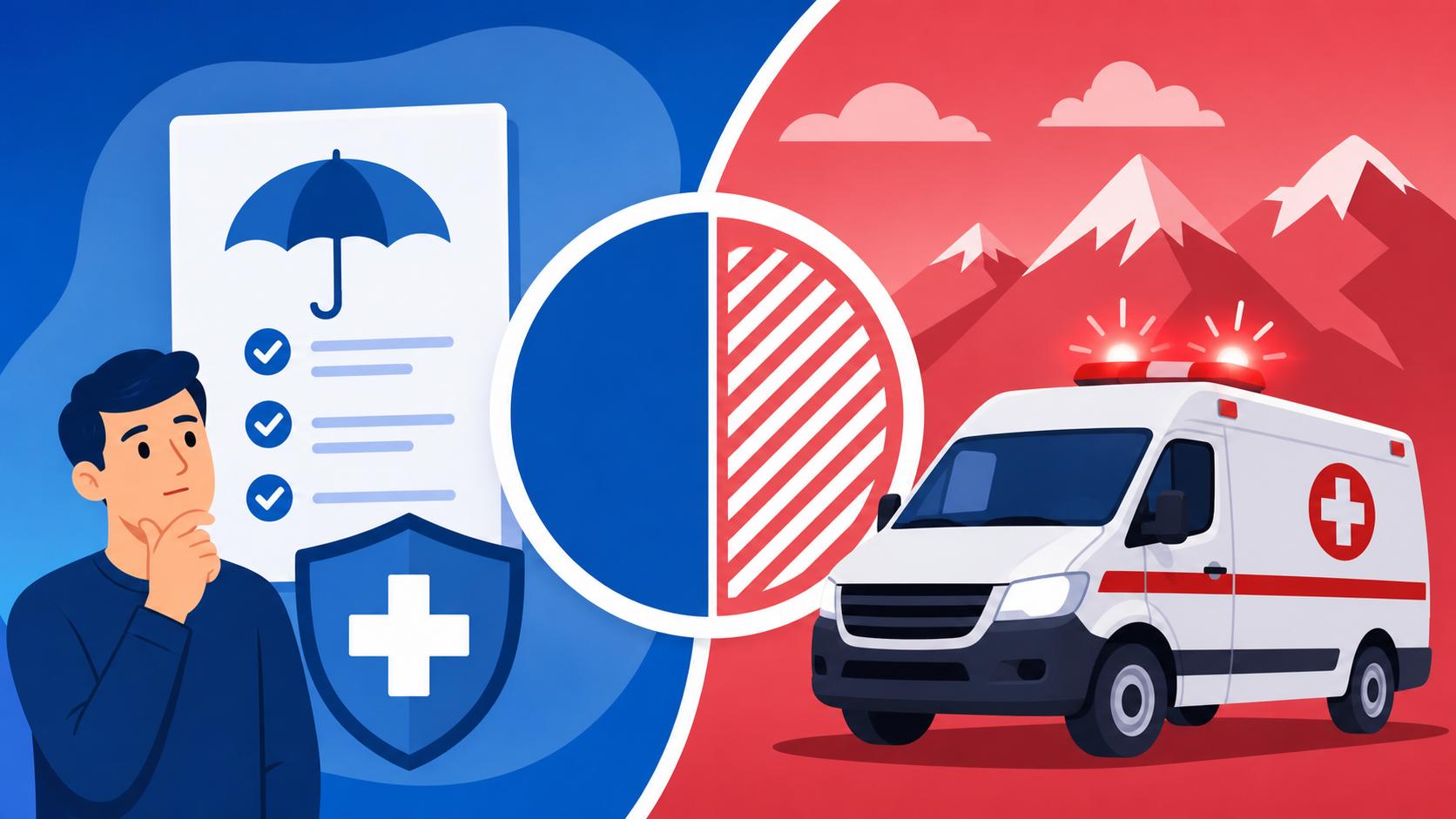
Medical transport refers to situations where a patient's health condition does not allow them to use a private car or public transport, but their life is not in immediate danger. For example, if you need to be moved from one hospital to another for a specific scan, or if you have a broken leg and cannot physically get into a taxi. In these cases, the basic insurance (KVG) covers 50% of the cost, but only up to a maximum of CHF 500 per calendar year.
Rescue (Rettung)
Rescue is defined as a situation where the patient’s life is in imminent danger, or they are in a situation where they must be extracted to prevent further harm (e.g., being stuck on a mountain face or trapped in a car). For rescue operations, the KVG also covers 50% of the costs, but the annual cap is significantly higher at CHF 5,000 per year. While CHF 5,000 sounds like a lot, a helicopter rescue in the Alps can easily exceed this amount in a matter of minutes. This is why many veterans of the Swiss system insist on REGA Membership: Why Expats Need Air Rescue Insurance in the Alps as a necessary safety net.
| Category | Definition | KVG Coverage | Annual Cap |
|---|---|---|---|
| Medical Transport | Non-life-threatening but medically necessary | 50% of the bill | CHF 500 |
| Rescue | Life-threatening emergency or extraction | 50% of the bill | CHF 5,000 |
| Transfer | Moving between hospitals for treatment | Usually 50% (unless pre-approved) | CHF 500 |
| Accident | Transport due to a non-illness injury | Covered by UVG (Accident Insurance) | Often 100% |
It is also worth noting that these caps are "per year," not "per incident." If you have the misfortune of requiring two medical transports in one year, and the first one already used up your CHF 500 limit, you will be responsible for 100% of the second bill. This is one of the many Out-of-Pocket Maximums: Calculating Your True Annual Healthcare Costs that expats often overlook when budgeting for their first year in Switzerland.
Why Basic KVG Insurance Leaves You Exposed
The "50% rule" is a core component of the Swiss philosophy of individual responsibility. The idea is that by making the patient pay a portion of the transport cost, it discourages the use of ambulances for non-emergencies (like a minor flu or a small cut). However, for an expat who might be struggling with the Cost of Living in Switzerland 2026: Budgeting for Singles and Families, a CHF 600 surprise bill is a significant burden.
Another layer of the "exposure" is the franchise system. Even the 50% that the insurance does cover is subject to your annual deductible. If you have a CHF 2,500 franchise and you haven't reached it yet, the insurance company won't actually pay their 50% share to the ambulance company. Instead, they will credit it toward your deductible, and you will be stuck paying 100% of the bill out of pocket. To understand how this works in practice, you should review The Swiss Franchise System: How Deductibles and Copays Work.
For those who want to avoid these gaps, looking into Supplementary Health Insurance (VVG): What It Covers and When to Buy It is highly recommended. Most "Ambulatory" supplementary plans will cover the remaining 50% of ambulance costs and often remove the low annual caps entirely. If you are frequently traveling or prefer a more "all-in" style of coverage, an international provider like Cigna Global can often provide plans that treat emergency transport with fewer restrictions than the local basic KVG.
Strategies to Avoid Out-of-Pocket Disasters
The best way to handle a Swiss ambulance bill is to ensure you never have to pay the full amount yourself. Beyond the basic KVG, there are several "Swiss hacks" that I’ve learned over the years to manage these costs.
First, always verify if your situation was an "accident" or an "illness." In Switzerland, these are handled by different insurance streams. If you are employed more than 8 hours a week for a single employer, you are covered by mandatory accident insurance (UVG) through your workplace. Accidents are typically covered at 100%, including the ambulance ride. If you trip while hiking and break your ankle, make sure the transport is billed as an accident. For more on this, check out Accident Insurance (UVG): Occupational vs. Non-Occupational Coverage.
Second, consider your lifestyle. If you spend any time in the mountains—hiking, skiing, or even just taking cable cars—REGA is a non-negotiable. For a small annual contribution (usually around CHF 40 for an individual), REGA can waive the costs of search and rescue that exceed what your insurance covers. It is perhaps the best value-for-money "insurance" (technically a patronage) in the country.
Third, keep a well-stocked home pharmacy for non-emergencies. Many minor issues can be managed at home or by visiting a local pharmacy rather than calling for help. I always keep my medicine cabinet stocked with basics from iHerb, which often carries international brands I'm familiar with, to avoid the high costs of Swiss OTC medications for minor ailments. Having magnesium, electrolytes, and basic first-aid supplies on hand can prevent a panic-induced call to 144 for something that isn't a true emergency.
Finally, when the bill does arrive, don't panic. You will need to know How to Read a Swiss Medical Bill (Rückforderungsbeleg) and Claim Refunds. Most ambulance services operate on the "Tiers Garant" system, meaning they bill you directly, and you must pay them before seeking reimbursement from your insurer. If the bill is particularly large, most Swiss providers are open to payment plans (Abzahlungsvertrag) if you contact them immediately. To understand the different ways these invoices are processed, see How to Pay Medical Bills: Tiers Garant vs. Tiers Payant Billing Systems.
Navigating the 144 vs 112 Dilemma
In a crisis, your brain might freeze on which number to call. In Switzerland, 144 is the specific number for medical emergencies. While the pan-European 112 will work, it routes you to a general police dispatcher who then transfers you to the medical desk. For the fastest response, 144 is the way to go.
During the call, the dispatcher will perform a triage. If they determine that your life is not in danger, they might suggest you take a taxi to the nearest "Permanence" (walk-in clinic) or call a "Notfallarzt" (on-call doctor) who can visit your home in a regular car. These options are significantly cheaper than a full ambulance dispatch. I once had a high fever and considered an ambulance, but the dispatcher sent a local doctor instead; the bill was CHF 150 instead of CHF 900. For more context on these services, refer to Emergency Medical Services: Ambulances, REGA, and Crisis Protocols and Emergency Numbers 144 vs 112: Which to Call in a Swiss Medical Crisis.
If you find yourself in a state of recovery after a medical event, don't forget the importance of self-care. I often order specialized supplements and recovery balms from iHerb, as the selection of natural recovery aids is often broader than what you'll find in a local Apotheke. Just remember to check Bringing Prescription Medication into Switzerland: Customs and Legal Limits if you are ordering anything beyond basic vitamins.
Living in Switzerland requires a shift in how you view "emergency" services. It is a system built on precision and high-level care, but it assumes you are an active participant in managing the costs. By understanding the 50% rule, the caps on transport vs. rescue, and the value of supplementary coverage, you can ensure that a medical crisis doesn't turn into a financial one.
Disclaimer
The information provided in this guide is for general informational purposes only and does not constitute legal or professional medical advice. Swiss healthcare laws and insurance regulations are subject to change. Always consult with your insurance provider or a qualified legal advisor regarding your specific coverage and obligations. The author is an expat sharing personal experiences and research, not a licensed insurance broker.