Where to Live in Switzerland: Cantons, Cities, and Commuter Zones
Choosing where to put down roots in Switzerland often feels like a high-stakes puzzle where one wrong move across a cantonal border can cost you thousands in taxes or change your language environment entirely. When I first arrived, I naively picked a spot based on a pretty lake view, only to realize later my tax bill was 5% higher than the town five minutes down the road. This guide breaks down the complex landscape of Swiss cantons, cities, and commuter zones to help you find your ideal home.
Understanding the Cantonal System and the Micro-State Reality
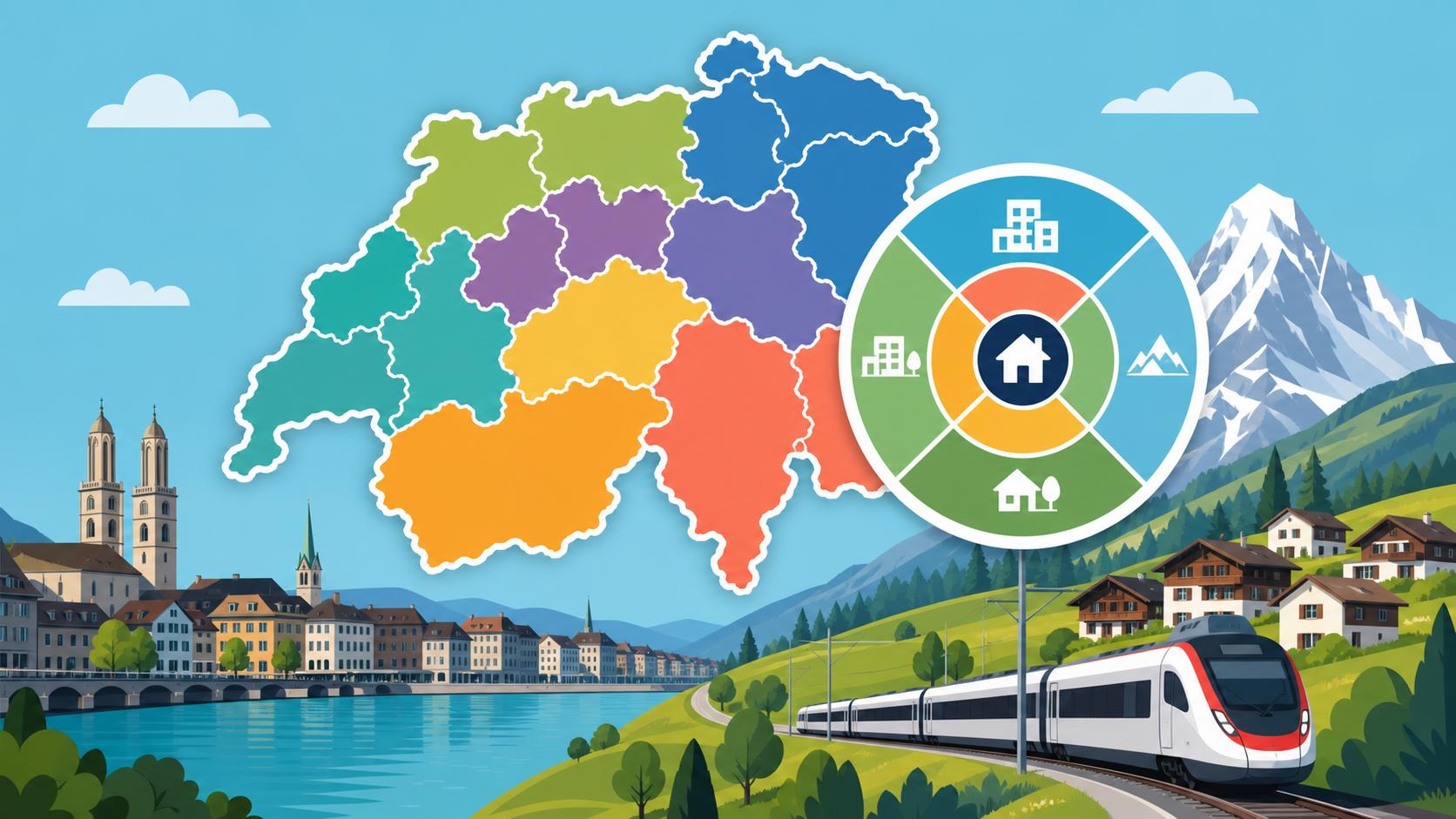
Switzerland is not a monolith; it is a confederation of 26 cantons, each behaving like a semi-autonomous micro-state. For a newly arrived expat, this means that your rights, your taxes, your school system, and even the "vibe" of your community are dictated by the specific canton you choose. Unlike many countries where the capital city sets the tone for the nation, Switzerland is deeply decentralized. A move from Zurich to Zug, though only 25 minutes by train, can feel like moving to a different country in terms of administrative paperwork and financial implications.
The first thing you must grasp is the concept of tax competition. Cantons compete to attract residents and businesses by adjusting their tax rates. This creates "tax islands" like Zug or Schwyz, where the wealthy flock to keep more of their income. However, these areas often come with significantly higher rental prices. Conversely, cantons like Neuchâtel or Jura might offer much lower rents but will take a larger bite out of your monthly paycheck. It is a balancing act that requires a spreadsheet and a clear understanding of your household budget.
Beyond the finances, the cantonal system affects how you interact with the government. Each canton has its own migration office and its own interpretation of federal rules. If you are moving here for work, you will quickly learn that Working in Switzerland as an Expat: Jobs, Culture, and Employment Laws varies slightly depending on whether you are in a business-heavy canton like Zurich or a more traditional one like Appenzell Innerrhoden. Your integration requirements, including language level expectations for permit renewals, are also cantonal mandates.
Finally, the cantonal border often marks the "Röstigraben"—the invisible cultural and linguistic line between German-speaking and French-speaking Switzerland. While most expats gravitate toward the international hubs, choosing which side of this divide to live on will dictate everything from the brand of butter in your grocery store to the social etiquette of your neighbors. Understanding this decentralization is the foundational step in deciding where to live.
The Impact of Language Regions on Daily Life
Language is perhaps the most significant factor in your Swiss experience. If you live in the "Romandie" (the French-speaking west), your daily life will be conducted in French. If you choose the "Deutschschweiz" (the German-speaking center and east), you will encounter High German in formal settings and Swiss German (Schwiizertüütsch) in the streets. While English is widely spoken in corporate environments, your ability to integrate depends heavily on your choice of region.
Living in a German-speaking canton like Zurich or Basel means navigating a dual-language reality. You will likely study High German, but your neighbors will speak a dialect that sounds nothing like what you learned in school. In contrast, the French-speaking cantons like Geneva or Vaud are often seen as more accessible for those who already have a baseline in French, as the spoken language is closer to the standard version. For those who want a true challenge or a Mediterranean flair, Ticino offers an Italian-speaking lifestyle that feels worlds away from the snowy peaks of the north.
Tax Jurisdictions and the Cost of Residency
As mentioned, the tax burden fluctuates wildly. In Zurich, you might pay a moderate rate, but move across the lake to Pfäffikon in Canton Schwyz, and your tax bill could drop by nearly half. However, you must factor in the "commuter tax" on your time and the increased cost of local services. Some cantons also offer specific Cantonal Premium Reductions (Prämienverbilligung) for Low-Income Households, but the eligibility criteria differ.
When looking at a map, don't just look at the city center. Look at the municipal boundaries. Two neighboring towns might be in different cantons, or even within the same canton, they may have different "Steuerfuss" (tax multipliers). This granular level of financial planning is what separates a successful expat move from a stressful one.
The Major Hubs: Where Most Expats Land
For the vast majority of expats, the journey begins in one of the big five: Zurich, Geneva, Basel, Lausanne, or Bern. These cities are the engines of the Swiss economy and offer the most robust support systems for foreigners. However, each has a distinct personality and caters to different professional industries.
Zurich is the undisputed heavyweight. It is the financial center, a burgeoning tech hub (home to Google’s largest engineering office outside the US), and a lifestyle destination. Life in Zurich is fast-paced by Swiss standards but idyllic by international ones. You can finish a day at a high-pressure banking job and be swimming in Lake Zurich or the Limmat River within fifteen minutes. The city is divided into "Kreis" (districts), each with its own character. Kreis 1 is the historic heart, while Kreis 4 and 5 are the trendy, gritty-turned-gentrified areas full of nightlife and startups.
Geneva, on the other hand, is the most international city in the world. It is the seat of the United Nations, the Red Cross, and countless NGOs. Living here feels like being in a global diplomatic bubble. It is physically stunning, nestled between the Jura mountains and the Alps, but it is also one of the most expensive and tightest housing markets in Europe. Finding a flat in Geneva is notoriously difficult, and many people end up looking across the border in France, though this introduces the complexities of French Cross-Border Commuters: Choosing Between CMU and Swiss KVG.
Zurich: The Financial and Tech Powerhouse
Zurich is often ranked as one of the world's most liveable cities, and for good reason. The infrastructure is flawless, and the proximity to nature is unparalleled. However, the cost of living is legendary. If you are moving here, you need to be prepared for the competitive rental market. Using a service like HousingAnywhere can be a great way to secure a furnished apartment for your first few months while you navigate the local "Wohnungsbesichtigungen" (apartment viewings).
The "Gold Coast" (the sun-drenched northern shore of Lake Zurich) includes towns like Meilen and Küsnacht, which are famous for their high concentration of wealth and low taxes. On the opposite side is the "Silver Coast," which is slightly more affordable but still offers incredible views and easy access to the city via the S-Bahn. For those who prefer an urban vibe, the western part of the city (Zürich West) offers industrial-chic lofts and a vibrant arts scene. To navigate the medical landscape here, checking the Zurich Expat Healthcare Guide: Hospitals, Clinics, and Emergency Contacts is essential.
Geneva: Diplomacy and Lakeside Elegance
Geneva’s atmosphere is more formal and cosmopolitan than Zurich’s. It feels smaller and more walkable, but the "Régies" (property management companies) that control the housing market are notoriously traditional and demanding. You will likely need a thick "dossier" to even be considered for a rental. The Pâquis district is lively and diverse, while Champel and Florissant offer quiet, upscale residential living.
The proximity to the French border creates a unique dynamic. Many residents shop in France to save on groceries, though you must be careful with Meat Import Limits: Why You Can Only Bring 1kg Across the Border. Culturally, Geneva is a gateway to the French Alps, making it a dream for skiers and hikers. If you are settling here with a family, you will find a wealth of international schools, though the waiting lists can be as long as those for apartments. For specialized needs, many expats rely on Finding an English-Speaking Gynecologist in Geneva to bridge the language gap in healthcare.
The Secondary Cities: Quality of Life vs. Cost
If the intensity of Zurich or Geneva isn't for you, Switzerland’s secondary cities offer a compelling alternative. Basel, Bern, and Lausanne are powerhouses in their own right, often providing a better balance between high salaries and slightly more manageable living costs.
Basel is the cultural heart of the country and the center of the global pharmaceutical industry. Home to giants like Roche and Novartis, it attracts a highly educated, international workforce. Basel sits on the "Dreiländereck," where Switzerland, Germany, and France meet. This unique geography allows residents to live in Basel but hop over to Lörrach (Germany) or Saint-Louis (France) for a change of pace or cheaper shopping. The city is famous for its museums and its world-class carnival (Fasnacht).
Bern, the federal capital, is surprisingly relaxed. It lacks the corporate sheen of Zurich but makes up for it with historic charm and a high quality of life. The Aare river, which loops around the Old Town (a UNESCO World Heritage site), is the center of social life in the summer. Bern is an excellent choice for those working in government, telecommunications, or for those who want a central base to explore the Bernese Oberland. It is also a city where Finding an English-Speaking Therapist in Bern is relatively straightforward due to the diplomatic presence.
Basel: The Life Sciences Hub
Basel's housing market is somewhat more relaxed than Zurich’s, but don't expect bargains. The Grossbasel side (the left bank of the Rhine) is the historic and commercial center, while Kleinbasel (the right bank) has evolved into a trendy, multicultural neighborhood with excellent bars and restaurants. The city is very bike-friendly, and the public transport system is integrated with the neighboring countries.
For those moving with families, Basel offers excellent public schools and several international options. The city’s medical infrastructure is also top-tier. When you first arrive, it is wise to start Finding an English-Speaking Dentist in Basel City early, as the best clinics often have full patient lists. Basel is also a great place to order from Amazon Germany, as you can often use "pick-up points" just across the border to avoid Swiss shipping fees, provided you follow the rules for Receiving Packages from Amazon DE/FR: Swiss Customs Fees and VAT.
Lausanne and the Lake Geneva Riviera
Lausanne is the "San Francisco of Switzerland"—built on three hills with steep streets and a young, vibrant population thanks to the EPFL and UNIL universities. It is the headquarters of the International Olympic Committee and a major hub for tech startups. The vibe here is noticeably more "chill" than in Geneva, but the views across the lake to the French Alps are even more dramatic.
The Lavaux wine region, just outside Lausanne, offers some of the most beautiful living environments in the country, with vineyards terraced into the hillsides. However, living in the "Riviera" (the stretch from Lausanne to Montreux) comes with a premium. If you are struggling with the local bureaucracy or the pace of life, Finding an English-Speaking Psychiatrist in Lausanne can help you find a professional who understands the expat transition.
Low-Tax Havens: Strategic Living for High Earners
For those whose primary goal is wealth preservation, two cantons stand above the rest: Zug and Schwyz. These are the "tax boutiques" of Switzerland. If your income is above a certain threshold, the savings from living in these cantons can effectively pay for your rent.
Zug is the smallest canton, but it punches far above its weight. Known as "Crypto Valley," it has become a global center for blockchain and commodity trading. The city of Zug is clean, safe, and incredibly efficient. However, because so many high-earners want to live there, the competition for housing is fierce. It is common for apartments to be rented out before they even hit the public market. Life in Zug is very international, and you will find that Finding an English-Speaking Family Doctor in Zug is easier than in many larger cities because the medical community is accustomed to expats.
Schwyz, particularly the towns of Wollerau and Feusisberg, is another favorite for the global elite. These towns are perched on the hills overlooking Lake Zurich, offering privacy and some of the lowest tax rates in the world. However, these are not "walking cities." You will likely need a car, and the social life is much more private and decentralized than in Zurich or Basel.
The Trade-offs of Living in Zug
While the tax benefits are clear, the "social tax" in Zug can be high. The city can feel a bit like a corporate campus, and it lacks the deep cultural layers of Basel or Bern. Many expats find they spend their workdays in Zug but head to Zurich for culture and nightlife. That said, for families, the safety and the quality of the international schools in the area are major draws.
If you are considering Zug, be sure to use an e-SIM from Airalo as soon as you land. Having data immediately allows you to use the SBB app to check the frequent "InterRegio" trains that connect Zug to Zurich in just 21 minutes. This connectivity makes Zug a viable living option even if your office is in downtown Zurich.
Schwyz: Lakeside Luxury with a Discount
Living in Canton Schwyz requires a strategic approach. If you work in Zurich, the commute from the "outer" parts of Schwyz can be long. However, if you find a spot in Pfäffikon, you are at a major railway junction. The lifestyle here is focused on the outdoors—hiking in the summer and skiing in the nearby Hoch-Ybrig in the winter. It’s a place for people who value quiet and financial efficiency over urban buzz.
Commuter Zones and the Art of the S-Bahn Life
Many savvy expats choose to live in the "in-between" spaces. Switzerland’s rail network is so efficient that living 30 or 40 kilometers from your workplace is entirely feasible. This allows you to trade the high rents of the city centers for a garden, more square footage, or a quieter environment for children.
For those working in Zurich, the Canton of Aargau is a popular choice. Cities like Baden or Lenzburg offer a historic feel and much more affordable housing, with a train commute of only 15 to 20 minutes to Zurich HB. Aargau is often called the "commuter canton," and while its taxes are higher than Zug’s, its rents are significantly lower.
For those in Geneva, the "La Côte" region in Canton Vaud (towns like Nyon, Rolle, and Morges) is the go-to commuter belt. These towns offer a high quality of life, lake access, and a more relaxed pace than Geneva, while still being connected by frequent "RegioExpress" trains.
Navigating the SBB for Commuters
If you choose the commuter life, your best friend will be the SBB. The precision of the Swiss trains is not a myth, but the cost can add up. Most residents find that The Half-Fare Travelcard (Halbtax): The Must-Have Pass for Swiss Residents is an absolute necessity. It pays for itself within a few trips and makes the commuter lifestyle financially viable.
Living further out also means you’ll need to be more organized with your logistics. Since you might not have a massive Migros or Coop on every corner, many commuters rely on online shopping. Ordering through Amazon Germany and having items delivered to your Swiss address (or a German pickup point) is a common way to manage household costs, though you should always be mindful of Receiving Packages from Amazon DE/FR: Swiss Customs Fees and VAT to avoid surprise customs bills at the door.
Finding a Balance in the Suburbs
The suburbs in Switzerland are rarely "sprawl." Most are self-contained villages with their own bakeries, post offices, and community centers. Integration in these smaller towns often requires more effort in terms of language. While you can get by with English in Zurich West, you will find that a basic level of German or French is essential for chatting with neighbors in an Aargau village or a Vaud hamlet. Joining a local "Verein" (club) is the fastest way to turn a commuter town into a home.
Comparison of Major Living Areas in Switzerland
| City/Region | Primary Industry | Tax Level | Rental Cost | Language | Vibe |
|---|---|---|---|---|---|
| Zurich | Finance / Tech | Moderate | Very High | German | Fast-paced, Global |
| Geneva | NGOs / Luxury | High | Extreme | French | Diplomatic, Elegant |
| Basel | Pharma / Art | Moderate | High | German | Cultural, Academic |
| Zug | Crypto / Trading | Very Low | Very High | German | Wealthy, Efficient |
| Lausanne | Tech / Education | High | High | French | Young, Hilly |
| Bern | Government | High | Moderate | German | Relaxed, Historic |
| Aargau (Commuter) | Manufacturing | Moderate | Moderate | German | Family-oriented |
| Schwyz (Lake) | Private Wealth | Very Low | High | German | Exclusive, Quiet |
Practical Considerations: Renting, Connectivity, and Setup
Once you’ve narrowed down a canton or city, the real work begins. The Swiss rental market moves fast, and you need to be prepared. One of the biggest hurdles is the "Bewerbungsmappe"—the application dossier. Landlords will expect to see your work contract, your last three payslips, and a "Betreibungsauszug" (debt register extract).
If you are applying from abroad, the process is even harder. This is where HousingAnywhere becomes a vital tool. It allows you to book mid-term housing safely, giving you a local address which is required for Mandatory Registration: How to Sign Up for Health Insurance Within 90 Days. Without a registered address, you cannot open a bank account or get a phone contract, making it the first and most important piece of the relocation puzzle.
Connectivity and the Digital Move
Being offline is not an option. From the moment you land at Zurich or Geneva airport, you will need GPS to find your temporary housing and the SBB app to buy your first train ticket. Traditional Swiss mobile contracts can be difficult to get without a long-term permit. Using an e-SIM from Airalo is the smartest way to bridge this gap. You can download a data plan before you even leave your home country, ensuring you have 5G connectivity the second you touch down.
This digital connectivity is also crucial for managing your "Nebenkosten" (ancillary costs). Most Swiss apartments have a base rent and a separate charge for heating and water. You will need to manage these accounts online, and having a reliable data connection ensures you don't miss any of the strict deadlines for utility registration.
Logistics and Setting Up Your Home
Once you have your keys, you will realize that Switzerland is expensive. Whether it’s a toaster or a set of bed linens, the "Swiss Premium" is real. This is why many expats look to Amazon Germany for their initial setup. While there are local giants like Galaxus (the "Amazon of Switzerland"), the selection and pricing on the German site are often better for international brands.
However, a veteran tip: always keep an eye on the "Import VAT." If your order is over a certain amount, you will be charged 8.1% Swiss VAT and a processing fee by the Swiss Post. To minimize these costs, keep your orders frequent and small, or use a package service in a border town like Konstanz or Weil am Rhein if you have a car. This is a common part of the Swiss lifestyle—being strategically "cross-border" to keep your budget in check.
Final Verdict: Finding Your Perfect Swiss Home
There is no single "best" place to live in Switzerland; there is only the place that fits your specific priorities. If you are a high-earner looking to maximize your take-home pay, Zug or Schwyz are the clear winners. If you want a vibrant, world-class city with endless career opportunities in tech or finance, Zurich is unmatched. For those who want to be at the center of global diplomacy and don't mind a tight housing market, Geneva offers a lifestyle like no other.
For families, the commuter towns of Aargau or the lakeside villages of Vaud offer a "soft landing" with more space and a slower pace. Basel remains the best choice for those in the sciences, while Bern is for the person who wants to swim in a river at lunch and work in a medieval palace in the afternoon.
My biggest piece of advice? Don't rush the decision. Spend your first few months in a furnished rental, travel to different cantons on the weekends, and feel the "energy" of each place. Pay attention to the language, the taxes, and the proximity to the things that make you happy—whether that’s a mountain peak or a Michelin-starred restaurant. Switzerland is a country of small details; finding the right one will make all the difference in your expat journey.
Disclaimer
The information provided in this guide is for informational purposes only and does not constitute legal, financial, or professional advice. Tax rates, rental regulations, and immigration policies in Switzerland are subject to change and vary significantly by canton and commune. Always consult with official government sources or qualified professionals before making significant financial or residency decisions.