Renting in Switzerland: The Complete 2027 Guide for Expats
Finding an apartment in Zurich or Geneva often feels like competing in an Olympic sport where the prize is a 40-square-meter studio and the entry fee is your sanity. I remember standing in a rain-soaked queue in Wiedikon with sixty other hopefuls, clutching a folder of documents like it was a golden ticket. This guide solves the mystery of the Swiss rental market, providing the strategy you need to actually secure a home in 2026.
Understanding the Swiss Rental Market Landscape
The Swiss housing market is a peculiar beast, characterized by extremely high demand and a surprisingly low home-ownership rate. Most people here rent for their entire lives, which means the "rental" market isn't just for students or transient workers—it is the backbone of Swiss society. In 2026, the vacancy rate in major hubs like Zurich, Basel, and Geneva remains below 1%, creating a landscape where landlords hold significant power. You aren't just looking for a flat; you are auditioning for a spot in a community.
The Scarcity Reality in Major Cities
If you are looking in the "Big Five" (Zurich, Geneva, Basel, Lausanne, Bern), you must prepare for a wait. In neighborhoods like Seefeld in Zurich or Plainpalais in Geneva, apartments often disappear within hours of being posted. I’ve seen listings go live at 9:00 AM and be deactivated by noon because the landlord received 200 applications. This scarcity means you cannot afford to be "picky" in the traditional sense. You need to focus on what is available and be ready to compromise on your "dream" features for the sake of a signed lease.
The scarcity also drives a secondary market of temporary housing. Many expats find their feet by using services like HousingAnywhere to secure a mid-term stay while they navigate the local viewing schedules. This takes the immediate pressure off and prevents you from signing a long-term lease on a place you haven't seen in person. Having a base also allows you to set up a local SIM card—I recommend getting an eSIM from Airalo the moment you land so you can stay connected to apartment alerts without hunting for a local shop.
Decoding Swiss Apartment Ads
Swiss real estate listings use a specific language that can be baffling to newcomers. When you see a "3.5 room apartment," you might assume that means three bedrooms. It does not. In Switzerland, the living room is counted as a room. A "3.5 room" flat usually consists of two bedrooms, one living room, and a "half-room" which is typically a dining nook or a large entrance hall. Understanding this is crucial; otherwise, you will waste time visiting places that are far too small for your needs. For a deeper dive into this, check out Does a 3.5 Room Apartment Include a Kitchen? Swiss Room Counting.
Bathrooms and kitchens are generally not counted in the room tally, though they are always present. Many newer "Neubau" apartments feature open-plan living and kitchen areas, whereas older "Altbau" buildings often have a door separating the kitchen from the rest of the house. Pay close attention to the floor level as well; "EG" (Erdgeschoss) means ground floor, which in some Swiss cities can feel a bit exposed to street noise, while "Dachgeschoss" refers to the top floor, often with beautiful views but potentially higher temperatures in the summer.
Rent Control and the Reference Interest Rate
Switzerland has a unique system where rents are tied to a national "Reference Interest Rate" (Referenzzinssatz). In 2026, after several years of fluctuations, this rate heavily dictates whether your landlord can legally increase your rent. When the rate goes up, landlords are entitled to hike the monthly cost; when it goes down, you are actually entitled to ask for a rent reduction. Most expats don't realize they have this power, and I certainly didn't during my first three years in Zug.
It is also important to understand the "initial rent" protection. In many cantons, the landlord is required to disclose what the previous tenant paid. If the new rent is significantly higher (usually more than 10%) without a valid reason like a major renovation, you can contest it within the first 30 days of moving in. This is one of the many reasons why The ASLOCA / Mieterverband: Why Every Swiss Tenant Must Join is the single best piece of advice I can give you. They provide legal protection and advice for a small annual fee, which can save you thousands in the long run.
| Terminology | Local Name | What it Means for You |
|---|---|---|
| Living Room | Wohnzimmer | Counted as 1 full room in the total. |
| Half Room | Halbes Zimmer | Usually a dining area or large hall; often >10sqm. |
| Ancillary Costs | Nebenkosten | Extra monthly fees for heating, water, and janitorial services. |
| Deposit | Kaution | Usually 2 to 3 months of "cold" rent. |
| Inventory | Inventar | List of items included (rare in long-term rentals). |
The Apartment Search Strategy
In a market this competitive, "browsing" is a recipe for failure. You need a tactical approach that mimics a high-frequency trading desk. You should have accounts on all major platforms—Homegate, ImmoScout24, and Flatfox—with push notifications turned on for your specific criteria. However, the best deals often never make it to these sites. They are passed through internal company boards or "Genossenschaften" (housing cooperatives) that have years-long waiting lists.
Where to Look Online and Offline
While the big portals are essential, don't overlook local social media groups. Facebook groups like "Apartments in Zurich" or "Geneva Housing" can be goldmines for "Nachmieter" (replacement tenant) situations. This is where a current tenant is moving out early and needs to find someone to take over their lease to avoid paying a penalty. If you can impress the outgoing tenant, they might recommend you to the landlord, which effectively bypasses the 100-person public viewing.
Another "pro tip" is to look at the websites of the big "Liegenschaften" (property management companies) directly. Companies like Wincasa, Livit, and Privera manage thousands of units across the country. Sometimes they list vacancies on their own sites a day or two before they push them to the aggregators. If you are struggling with the digital noise, you might consider Finding an Apartment in Zurich: Relocation Agents vs Flatfox vs Homegate to see if professional help is worth the investment for your specific situation.
Working with Relocation Agents
If your company offers a relocation budget, use it on a local agent. These professionals have "off-market" connections and, more importantly, they know how to navigate the regional bureaucracy. In Geneva, for example, the market is dominated by "Régies" (management agencies) that have very specific, often old-school ways of working. An agent who knows the person sitting at the desk at the Régie can often get your application to the top of the pile.
For those moving to Switzerland without corporate backing, a relocation agent might feel like an expensive luxury. However, consider the cost of staying in a hotel or temporary Airbnb for three months because you can't find a flat. Often, the agent's fee (usually one month's rent) pays for itself in the time and stress saved. They will also help you with Registering Your Address at the Kreisbüro Within 14 Days of Moving, which is a mandatory step that you cannot overlook.
The Importance of Speed and Alert Systems
When a notification pops up on your phone for a new listing, you have about fifteen minutes to respond. Have a template message ready in the local language (German, French, or Italian depending on the canton). It should be polite, concise, and state clearly that you have all your documents ready. Don't ask too many questions at this stage; your only goal is to secure a viewing slot.
I always suggest having your "Bewerbungsmappe" (application dossier) saved as a single PDF on your phone and in the cloud. If you view an apartment and like it, send your application while you are still standing in the building. I’m not joking—I once lost a flat in Winterthur because I waited until I got home to email the landlord. The person who emailed him from the staircase got the lease. In this high-speed environment, having a reliable internet connection is vital; if your home fiber isn't set up yet, Swiss Mobile Plans: Best Subscriptions and Prepaid eSIMs for Expats will help you stay online.
Mastering the Application Dossier
In Switzerland, the "Bewerbungsmappe" is your resume for living. Landlords are risk-averse; they want to see stability, high income, and a clean history. If your dossier is incomplete, it goes straight into the recycling bin. They won't call you to ask for a missing document; they will simply move on to the next of the fifty applicants who provided everything.
Essential Documents You Need Ready
Your dossier needs to be professional and organized. At a minimum, you need a copy of your residence permit (or your work contract and visa confirmation if the permit is still pending), your last three salary slips, and a copy of your passport. If you are new to the country, a copy of your signed employment contract showing your gross annual salary is the most important document you possess.
Landlords generally follow the "one-third rule," meaning your gross monthly rent should not exceed 33% of your gross monthly income. If you are applying for a place that costs CHF 3,000 and you earn CHF 7,000, you will likely be rejected for "financial overextension." It’s also wise to include proof of Private Liability Insurance (Privathaftpflicht): Why Expats Need It, as almost every landlord in 2026 requires this to cover potential damage to the parquet floors or kitchen appliances.
The Debt Register Extract (Betreibungsauszug)
This is the document that trips up most expats. The "Betreibungsauszug" is an official document from the local debt collection office stating that you have no outstanding debts or legal proceedings against you in Switzerland. If you have just arrived, your extract will be "clean" (empty), but you still need to provide it. You can order this online or pick it up in person at the "Betreibungsamt" of your current place of residence.
If you have never lived in Switzerland before, you should provide a similar credit report from your home country (like an Experian or Schufa report). It won't have the same legal weight as the Swiss version, but it shows "good faith." The moment you move into your first temporary flat, go to the local office and get your Swiss extract. It costs about CHF 20 and is valid for three to six months. Landlords in 2026 are increasingly picky, so ensure your extract is no older than one month when you apply.
Writing a Winning Cover Letter
Don't just send a pile of forms. Include a personal cover letter with a photo of yourself (and your family/pet if applicable). Swiss landlords often value "quiet" and "uncomplicated" tenants. Mention that you are a non-smoker, that you don't play the drums, and that you intend to stay long-term. If you speak a bit of the local language, write the letter in that language—it shows a commitment to integration.
If you are moving from abroad and need to furnish your new place quickly once you get the keys, remember that Amazon Germany delivers to Switzerland, which can be a lifesaver for getting essentials like towels, kitchenware, and basic tools without navigating the high prices of local specialty shops. Mentioning in your cover letter that you are already prepared for the move-in can sometimes signal to a landlord that you are an organized and reliable person.
Financial Commitments and Security Deposits
Renting in Switzerland requires significant upfront capital. Between the first month's rent and the security deposit, you could easily need CHF 10,000+ in liquid cash the week you sign the lease. Understanding how this money is handled is vital to ensure you don't get scammed and that you get your money back when you eventually leave.
The Rental Deposit Account (Mietkautionskonto)
By law, your security deposit (usually 2-3 months of rent) cannot just be handed over to the landlord in cash or transferred to their private bank account. It must be placed in a "Mietkautionskonto"—a blocked savings account in your name, but which requires both your signature and the landlord's signature to release funds. This protects you from the landlord "disappearing" with your money.
Opening this account is usually one of the first things you do after signing the lease. Most major banks like UBS or ZKB offer these. For a comparison of your options, read Swiss Rental Deposits: Traditional Bank Accounts vs Guarantee Insurances. Be aware that these accounts earn almost zero interest, so it is purely a security measure. The money can stay blocked for up to a year after you move out if there is a dispute over damages or final utility bills.
Rental Deposit Insurance
If you don't want to tie up CHF 9,000 in a blocked account, you can use a deposit insurance service like SwissCaution or Firstcaution. Instead of paying the full deposit, you pay an annual premium (usually around 4-5% of the deposit amount). The insurance company provides a guarantee to the landlord that they will cover any damages.
While this is great for your cash flow, remember that it is an "insurance," not a "savings" plan. You don't get the premiums back at the end of the lease. In the long run, it is much cheaper to use a traditional blocked account. However, for many new expats who are already dealing with relocation costs, the insurance route is a very popular "bridge" for the first year or two.
Understanding Nebenkosten (Ancillary Costs)
The rent price you see in ads is often the "Bruttomiete" (gross rent), which includes the "Nettomiete" (net rent) plus "Nebenkosten" (ancillary costs). These costs cover communal expenses like heating, hot water, the "Hauswart" (caretaker), and snow removal in the winter. Usually, you pay a fixed monthly "Akonto" (advance payment) for these.
At the end of the year, the landlord calculates the actual costs. If you used more heating than expected during a particularly cold Swiss winter, you will receive a "Nachzahlung"—a bill for the difference. Conversely, if you were frugal, you might get a small refund. Always check if the Nebenkosten are "pauschal" (flat rate) or "akonto" (subject to year-end adjustment) before you sign, as this can affect your monthly budgeting.
The Handover Process (Wohnungsübergabe)
The day you get your keys is one of the most important days of your tenancy. In Switzerland, this is a formal process. You don't just pick up the keys from a mailbox; you meet the landlord or an agent for a "Wohnungsübergabe" (apartment handover). This is your chance to document every single scratch, scuff, and chipped tile to ensure you aren't charged for them when you move out.
The Move-In Inspection and Protocol
During the handover, the landlord will walk through the flat with a "Protokoll" (inspection report). They will check that the stove works, the shutters move correctly, and the parquet floors are in the condition promised. You must be extremely diligent here. Open every cupboard, flush every toilet, and check the inside of the oven.
If you see a scratch on the wall, make sure it is written down in the protocol. If the landlord says, "Oh, don't worry about that, I know it's there," insist that it be documented anyway. Once that document is signed, it is the legally binding record of the apartment's state. If a scratch isn't on the move-in protocol, the landlord can claim you caused it when you move out three years later.
Documenting Pre-existing Damage
In addition to the written protocol, I highly recommend taking a high-resolution video of the entire apartment on your phone. Focus on the floors, the windowsills, and the bathroom fixtures. Save this video in your cloud storage. If a dispute arises later, having a time-stamped video from your move-in day is invaluable evidence.
Swiss landlords are famously meticulous about "small" things. A tiny chip in a ceramic sink can result in the entire sink being replaced at your expense. This is why having that Private Liability Insurance (Privathaftpflicht): Why Expats Need It is so critical—it often covers "tenant damage" which can save you from a CHF 2,000 bill for a dropped perfume bottle in the bathroom.
Getting Keys and Setting Up Utilities
You will usually receive several sets of keys, including a "master key" that opens the front door of the building, your apartment, your mailbox, and your cellar storage unit. Do not lose these! Many Swiss buildings use high-security locking systems where replacing a single lost key requires replacing the locks for the entire building, a cost that can run into the thousands of francs.
Once you have the keys, you need to set up your electricity and internet. In most cantons, the electricity is a monopoly, so you just need to notify the local provider (like EWZ in Zurich or SIG in Geneva) that you have moved in. For internet, the lead times can be 2-3 weeks, so I suggest starting this process the moment you sign your lease. You will also need to prepare for The Serafe Fee 2026: Paying the Mandatory CHF 335 Media Tax, which is a mandatory fee for every household in Switzerland that supports public broadcasting.
Rights and Responsibilities as a Tenant
Once you are settled, you have both rights that protect you and responsibilities that you must follow to maintain a good relationship with your neighbors and landlord. The Swiss "house rules" (Hausordnung) are often stricter than what you might be used to in the UK, US, or elsewhere in Europe.
The Role of ASLOCA / Mieterverband
I cannot stress this enough: join the Mieterverband (in German-speaking cantons) or ASLOCA (in French-speaking ones) immediately. They are the tenants' association. For a small annual fee, you get access to legal experts who can review your lease, help you contest unfair rent increases, and represent you in disputes with your landlord.
The Swiss legal system for housing is designed to be fair, but it is bureaucratic and conducted in the local language. Having an expert on your side who can write a formal letter on your behalf is a massive advantage. They also provide templates for things like requesting a rent reduction or notifying a landlord of a defect that needs fixing.
Quiet Hours and House Rules
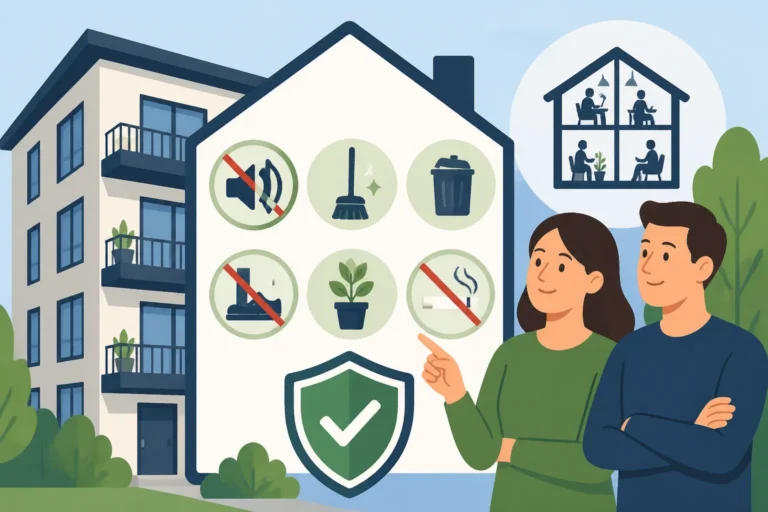
The "Quiet Hours" (Ruhezeiten) in Switzerland are legendary and largely true. Generally, you are expected to be quiet between 10:00 PM and 7:00 AM, and all day on Sundays. This means no laundry, no loud music, and no vacuuming. Some older buildings even have rules about flushing toilets or taking showers late at night, though these are increasingly rare.
Sunday is a day of rest. You shouldn't be mowing the lawn or doing loud DIY projects. If you have a balcony, be mindful of "visual" peace as well—don't hang your laundry over the railing where everyone can see it, as this is often forbidden in the house rules. Respecting these rules is the fastest way to integrate into a Swiss neighborhood and avoid complaints from your neighbors.
Maintenance and Small Repairs
In Switzerland, tenants are responsible for "small repairs" (kleiner Unterhalt). This generally includes anything that costs less than CHF 150 to CHF 200 (depending on your contract) and doesn't require a specialist. Examples include replacing a shower hose, changing light bulbs, or unblocking a sink with a plunger.
If something larger breaks, like the dishwasher or a heating pipe, it is the landlord's responsibility. However, you must notify them immediately. If you notice a small leak and don't report it, and it eventually causes major water damage, you could be held partially liable for the repair costs because you failed in your "duty of care."
Moving Out and Termination Rules
Leaving a Swiss apartment is almost as complex as finding one. The process is governed by strict notice periods and an "end-of-tenancy" cleaning standard that would satisfy a surgical theater.
Official Moving Dates and Notice Periods
Most Swiss leases have specific "official" termination dates, often at the end of March, June, and September. You usually need to give three months' notice. If you want to move out on December 31st but your contract only allows for March and September, you might be technically liable for the rent until March.
However, there is a loophole: if you find a "solvent replacement tenant" (zumutbarer Nachmieter) who is willing to take over your lease on exactly the same terms, the landlord must release you from your contract early. This is a very common practice, but it requires you to do the "marketing" work of finding someone to take your place. For more on the timing, see Official Moving Dates: Why March 31 and September 30 Matter So Much.
Finding a Replacement Tenant (Nachmieter)
When looking for a Nachmieter, you should hold viewings just like a landlord would. Collect the applications and send the top 2-3 candidates to the landlord. The candidates must be financially stable (the one-third rule applies) and willing to take the flat as-is.
Once the landlord accepts one of your candidates, you will receive a document releasing you from your lease. Until that document is signed, you are still on the hook for the rent. This is why most people start looking for a replacement tenant at least two months before they intend to move.
The Final Cleaning (Endreinigung)
In Switzerland, "clean" isn't just "vacuumed." The apartment must be returned in "pristine" condition. This includes cleaning inside the window tracks, descaling every tap, scrubbing the oven until it looks new, and cleaning the cellar floor.
I strongly recommend hiring a professional cleaning company that offers an "Abgabegarantie" (handover guarantee). This means the cleaning company will be present during the handover, and if the landlord finds a speck of dust, the cleaners will fix it on the spot at no extra cost. For more on this, check out End-of-Tenancy Cleaning Companies: Getting a Passed Inspection Guarantee. It might cost CHF 800-1,200, but it is the only way to ensure you get your full deposit back without a fight.
Local Living Essentials
Once the boxes are unpacked and the lease is signed, the daily reality of Swiss living begins. From managing the laundry room to understanding the colorful garbage bags, there are a few "hidden" rules that every expat needs to know.
Recycling and Garbage Rules
Waste management in Switzerland is a masterclass in organization. You cannot just put your trash in any bag. Most cantons use "taxed" garbage bags (like the Züri-Sack in Zurich). These bags are expensive because the price includes the cost of waste disposal. If you use a regular black bag, the "garbage police" (yes, they exist) may open it to find a letter with your address and fine you heavily.
Recycling is equally strict. Paper and cardboard must be bundled and tied with string (not tape!) and put out on specific days. Glass and aluminum must be taken to local collection points. It feels like a chore at first, but after a few months, it becomes second nature. I actually miss the Swiss recycling system whenever I travel abroad now—it’s just so efficient.
Laundry Room Etiquette
Most Swiss apartments have a shared laundry room in the basement. This is often the primary source of neighborly friction. You will likely have a "wash day" assigned to you, or a sign-up sheet. You must stick to your time slot exactly. When you are finished, you are expected to clean the lint filter and wipe down the machines. For a full breakdown of the "unwritten rules," read Managing the Shared Waschküche: Wash Calendars and Cleaning the Lint Filter.
In newer, high-end apartments, you might have your own washing machine and dryer in the flat. This is a huge luxury and worth paying a bit extra for if you have a busy schedule. If you have a shared room, just be polite, follow the rules, and you’ll find that it’s a great place to pick up local neighborhood gossip.
Connectivity and Media Fees
Once you have your fiber optic internet running, you'll find that Switzerland has some of the fastest speeds in the world. However, don't forget the administrative side. You must register for the Serafe media fee, which is a mandatory tax for public broadcasting. It doesn't matter if you don't own a TV; if you have a smartphone or an internet connection, you have to pay.
Also, be aware of the "Quiet Hours" regarding your internet usage—not the data, but the noise! If your router is near a shared wall and you're having loud gaming sessions at 2:00 AM, the sound can travel. Being a good neighbor in a Swiss apartment building is all about "minimal impact." The less your neighbors notice you, the more they will like you.
Disclaimer
This guide is intended for informational purposes only and does not constitute legal or professional real estate advice. Rental laws and market conditions in Switzerland are subject to change, and specific cantonal regulations may apply. Always consult with a qualified legal professional or the local tenants' association (Mieterverband/ASLOCA) before signing any contracts or taking legal action.