Robo-Advisors in Switzerland: True Wealth vs Selma vs Findependent
Moving to Switzerland often feels like a series of financial shocks, from the price of a humble coffee to the eye-watering management fees traditional banks charge just to hold your money. If you have realized your savings are sitting idle in a 0.01% interest account while inflation bites, this guide explores how Swiss robo-advisors offer a modern, low-cost path to growing your wealth without the administrative headache.
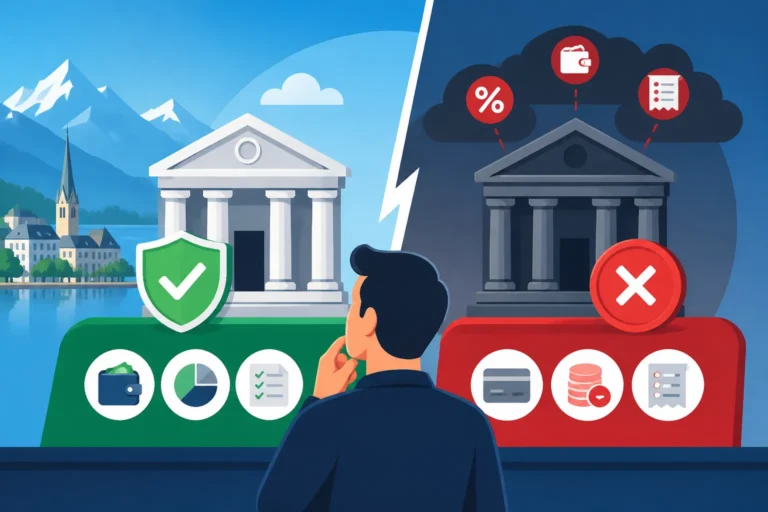
Why Traditional Swiss Banks Are a Trap for Expats
When you first arrive and go through the process of Opening a Swiss Bank Account: UBS, ZKB, PostFinance, and Neobanks, you are often funneled toward their "investment advisory" services. For a newcomer, these services sound prestigious. However, the reality for most expats is a fee structure that aggressively eats into potential returns. Traditional Swiss banks frequently charge a "custody fee" just for holding your stocks, followed by a "management fee," and then often place you in high-cost in-house funds that kick back commissions to the bank.
The complexity of these fees is designed to be opaque. You might see a 1% management fee and think it sounds reasonable, but when you add the underlying fund costs (TER), transaction stamps, and exchange rate markups, you could be losing 2.5% of your portfolio value every year. In a market that returns 5% to 7% on average, giving away nearly half of your gains to a guy in a suit at Paradeplatz is a strategic mistake. This is why the Cost of Living in Switzerland 2026: Budgeting for Singles and Families requires not just smart spending, but also smart, passive investing.
Robo-advisors have disrupted this cozy arrangement by using algorithms to manage diversified portfolios of Exchange Traded Funds (ETFs). By removing the human advisor and the marble-floored office, they pass those savings on to you. For an expat, the benefit is twofold: you get a professional investment strategy that adheres to the latest financial theory, and you get a digital-first interface that usually speaks much better English than the local cantonal bank's legacy portal.
The Contenders: True Wealth vs Selma vs Findependent
Choosing between the top three players in the Swiss market depends largely on your starting capital and how much "hand-holding" you desire. Each of these platforms is regulated and partners with established Swiss banks to keep your assets safe (the "custodian bank" model), meaning even if the robo-advisor went bankrupt, your investments remain in your name at a major institution.
True Wealth: The Veteran for Serious Portfolios
True Wealth was the first major robo-advisor in the Swiss market and remains the "gold standard" for those who want a clinical, highly efficient investment engine. Founded by a physicist and an e-commerce pioneer, the platform is built on the principles of Modern Portfolio Theory. It doesn't try to be your "friend"; it tries to be the most efficient way to capture global market growth.
The interface is incredibly detailed. It allows you to see exactly which ETFs are being used and even allows for a degree of customization—such as tilting your portfolio toward sustainable investments or specific regions. However, True Wealth has historically maintained a higher barrier to entry, requiring a minimum investment of 8,500 CHF. This makes it less accessible for someone just starting their first job in Zurich but very attractive for established professionals who have already navigated Withholding Tax (Quellensteuer) vs Standard Taxation for Foreigners and have significant liquid savings.
One of the standout features of True Wealth is its transparent fee of 0.50%. There are no hidden tiers or complicated loyalty programs. You pay half a percent, and they manage the rebalancing, the tax reporting, and the dividend reinvestment. For those who want a "set it and forget it" system that feels like a professional brokerage tool rather than a colorful app, True Wealth is usually the winner.
Selma Finance: The Friendly Assistant for Beginners
Selma Finance takes a diametrically opposite approach to True Wealth. Selma positions itself as your "personal investment assistant." When you sign up, you don't just pick a risk level; you have a "conversation" with a bot that asks about your income, your debts, your goals, and even your "buffer" for emergencies. Selma looks at your whole financial life, not just the money you give them to invest.
This holistic approach is perfect for expats who are still trying to understand the Three-Pillar Pension System: AHV, BVG, and Private Savings. Selma actually tells you if you are investing too much and should keep more cash aside for your tax bill. Their entry point is much lower at 2,000 CHF, making it a favorite for young professionals or those who want to test the waters of the Swiss market before committing six figures.
Selma’s fee structure is tiered, starting around 0.68% and dropping as your portfolio grows. While slightly more expensive than True Wealth at lower amounts, the "peace of mind" and the user-friendly English interface often justify the extra 0.18%. They also offer a seamlessly integrated Pillar 3a, which is a massive advantage for anyone looking to maximize Pillar 3a in 2026: Tax Deductions, Limits, and Investment Options.
Findependent: The Local Challenger with Low Entry Barriers
Findependent is the newest of the "Big Three" and is rapidly gaining ground due to its extreme simplicity and the lowest entry barrier in the country. You can start investing with as little as 500 CHF. In a country where everything feels like it costs 1,000 CHF just to walk through the door, Findependent’s approach is incredibly refreshing for the "everyday" investor.
Findependent uses a curated list of around 30 ETFs, focusing on broad market exposure. Their fees are among the lowest in the market, often hovering around 0.40% for the management component. Because they are a smaller, leaner team, they pass those savings directly to the user. The app is sleek, mobile-first, and stripped of the "financial jargon" that makes many expats shy away from investing.
If you are a student or a newcomer who hasn't yet reached a high-salary bracket, Findependent allows you to start the habit of monthly investing. It is also an excellent choice for parents looking to set up a small investment account for their children’s future education. It pairs perfectly with the low-cost ecosystem of Best Neobanks in Switzerland: Neon, Yuh, and Zak Compared, as they share a similar philosophy of transparency and digital ease.
Fee Comparison and Value for Money
When comparing these three, you have to look at more than just the "management fee." You must also consider the "product costs" (the fees the ETF providers like BlackRock or Vanguard charge) and the "custody fees" charged by the partner banks. Fortunately, all three robos have negotiated these down to institutional levels.
| Feature | True Wealth | Selma Finance | Findependent |
|---|---|---|---|
| Minimum Investment | 8,500 CHF | 2,000 CHF | 500 CHF |
| Base Management Fee | 0.50% | 0.68% (drops with volume) | 0.40% – 0.44% |
| Pillar 3a Integration | Yes | Yes (Excellent) | Yes |
| Language Support | DE, EN, FR | DE, EN | DE, EN, FR |
| Custodian Bank | BLKB / Saxo | Saxo Bank | Hypothekarbank Lenzburg |
| Ideal For | High Net Worth / Tech-Savvy | Beginners / Holistic View | Small Budgets / Simplicity |
The Expat Tax Advantage: Capital Gains and Reporting
One of the most pleasant surprises for foreigners living in Switzerland is the Capital Gains Tax in Switzerland: The Tax-Free Stock Market Rule. Unlike the US, UK, or Germany, private individuals generally do not pay tax on the profit made from selling stocks held for a certain period. This makes robo-advisors incredibly tax-efficient. You only pay tax on the dividends and the Wealth Tax in Switzerland: How Global Assets Are Assessed.
All three robo-advisors mentioned provide an "Automatic Tax Report" at the end of the year. This is a PDF that you simply attach to your Swiss tax return. For anyone who has tried to manually calculate dividend yields across 15 different ETFs for a cantonal tax office, this feature alone is worth the management fee. It ensures you remain compliant without having to hire an expensive consultant.
However, if you are a US citizen, things get complicated due to FATCA and PFIC rules. Most Swiss robo-advisors are wary of "US Persons" because the reporting requirements for the IRS are so burdensome. If you fall into this category, you may need specialist help from a firm like Taxes for Expats to ensure your Swiss investments don't trigger massive penalties back home. While Selma and True Wealth have experimented with US-client onboarding, the rules change frequently, so always verify their current status before sending funds.
Funding Your Account: Currency and Efficiency
A common mistake expats make is funding their Swiss robo-advisor from a foreign bank account using a traditional wire transfer. Your home bank will likely charge a poor exchange rate and a "convenience fee" for the pleasure. To maximize your investment, you should always fund your accounts in CHF.
If you still have savings in EUR, GBP, or USD, using a service like Wise is the most efficient way to bring that money into the Swiss ecosystem. By using Wise, you get the mid-market exchange rate and can then send the CHF directly to your robo-advisor's custodian bank account via a local Swiss IBAN. This ensures that every cent of your hard-earned money goes toward buying ETF shares rather than lining the pockets of intermediary banks.
Once your account is funded, these platforms generally perform "fractional investing." This means if an ETF share costs 400 CHF and you only have 200 CHF in cash, the robo-advisor buys you exactly 0.5 shares. This keeps your money 100% invested and prevents "cash drag," where small amounts of money sit idle and uninvested.
Choosing the Right Strategy for Your Life Stage
Ultimately, the "best" robo-advisor is the one you will actually use. If you are intimidated by the setup process, the friendly interface of Selma Finance will help you get over the initial hurdle. If you are mathematically inclined and want the lowest possible "tracking error" on your global portfolio, True Wealth’s scientific approach is superior. If you are budget-conscious and want to invest the 500 CHF you saved by not eating out this month, Findependent is your best friend.
Don't forget to align your choice with your broader residency goals. If you are planning to stay long-term and eventually apply for a Swiss C Permit (Permanent Residency): Fast-Track and Standard Routes, demonstrating financial stability and a solid pension plan is crucial. Using a robo-advisor for your Pillar 3a not only lowers your tax bill today but builds the "financial integration" that Swiss authorities like to see.
Lastly, keep an eye on your Understanding Your Swiss Salary Certificate (Lohnausweis) for Tax Season. The amount you contribute to these platforms is often reflected in your net wealth, which is taxed at a very low rate but must still be declared. By using a robo-advisor, you ensure that your wealth is growing in a way that is visible, legal, and optimized for the unique Swiss tax environment.
Taxes for Expats and Cross-Border Realities
For those who are cross-border commuters, the financial picture is slightly different. If you live in France but work in Basel, you need to be aware of how your investments are taxed in your country of residence. While the Swiss capital gains rule is amazing for residents, it doesn't always apply if you live across the border. In these cases, consulting with Taxes for Expats or a local tax fiduciary is essential to avoid double taxation.
Investing in Switzerland as a foreigner doesn't have to be a daunting task involving expensive wealth managers. By leveraging the technology of True Wealth, Selma, or Findependent, and using tools like Wise for currency management, you can build a robust financial future in the Alps. The key is to start early, keep your fees low, and let the power of global markets do the heavy lifting while you enjoy the mountain views.
Disclaimer
The information provided in this guide is for informational purposes only and does not constitute financial, investment, or tax advice. Investing in the stock market involves risks, including the potential loss of principal. While robo-advisors aim to mitigate risk through diversification, past performance is not indicative of future results. Always conduct your own research or consult with a qualified professional before making significant financial decisions. The author and this website are not responsible for any financial losses incurred through the use of the platforms mentioned.