Saving for a House Down Payment in Switzerland: Realistic Timelines
If you have spent more than five minutes scrolling through property listings in Zurich, Geneva, or Zug, you have likely experienced that specific type of "Swiss sticker shock." The dream of homeownership in the Alps often feels like a moving target, especially when faced with the steep 20% down payment requirement. This guide breaks down the realistic timelines and financial hurdles of saving for your first Swiss home, moving beyond the spreadsheets to give you the veteran expat's view of how to actually get the keys.
The 20 Percent Rule and the Swiss Mortgage Reality
When I first arrived in Switzerland, I assumed that a 5% or 10% deposit—common in the UK or the US—would be enough to get my foot in the door. I was wrong. The Swiss financial system is built on stability, which means the "Holy Grail" of buying property is the 20% down payment. However, there is a nuance that most newcomers miss: you don’t necessarily need all of that 20% in cold, hard cash sitting in a bank account.
The 10 Percent Hard Cash Requirement
Under Swiss law, at least 10% of the purchase price must come from "real" equity that is not your occupational pension. This can be personal savings, a gift from family, or funds from your private 3a pension. If you are looking at a modest 1 million CHF apartment—which, let's be honest, is a standard starting point in major cities—you need at least 100,000 CHF in liquid assets just to satisfy this first half of the requirement. This is often the biggest hurdle for expats who are still paying off student loans or who are used to a lower cost of living.
Leveraging the Second Pillar
The remaining 10% of your down payment can be sourced from your occupational pension, also known as the 2nd Pillar. You have two main options here: withdrawing the funds or pledging them. Withdrawing means taking the money out to use as cash, which triggers an immediate tax event and reduces your future retirement benefits. Pledging, or "Verpfändung," allows the funds to stay in the pension fund, continuing to earn interest, while the bank uses them as collateral. This can lead to a higher mortgage but keeps your retirement pot intact. Understanding how Pillar 2 (BVG): Understanding Your Swiss Occupational Pension works is absolutely critical before you sign any purchase agreement.
The Impact of Closing Costs
One thing that catches many of us off guard is that the 20% down payment does not include closing costs. Depending on the canton, you need to budget an additional 2% to 5% of the purchase price for notary fees, land registry entries, and property transfer taxes. In Bern or Lausanne, these fees can be significant. If you are aiming for a 1.2 million CHF home, you actually need to be saving for 20% plus roughly 40,000 CHF in fees. This often extends the savings timeline by another year or two.
Realistic Timelines for the Modern Expat
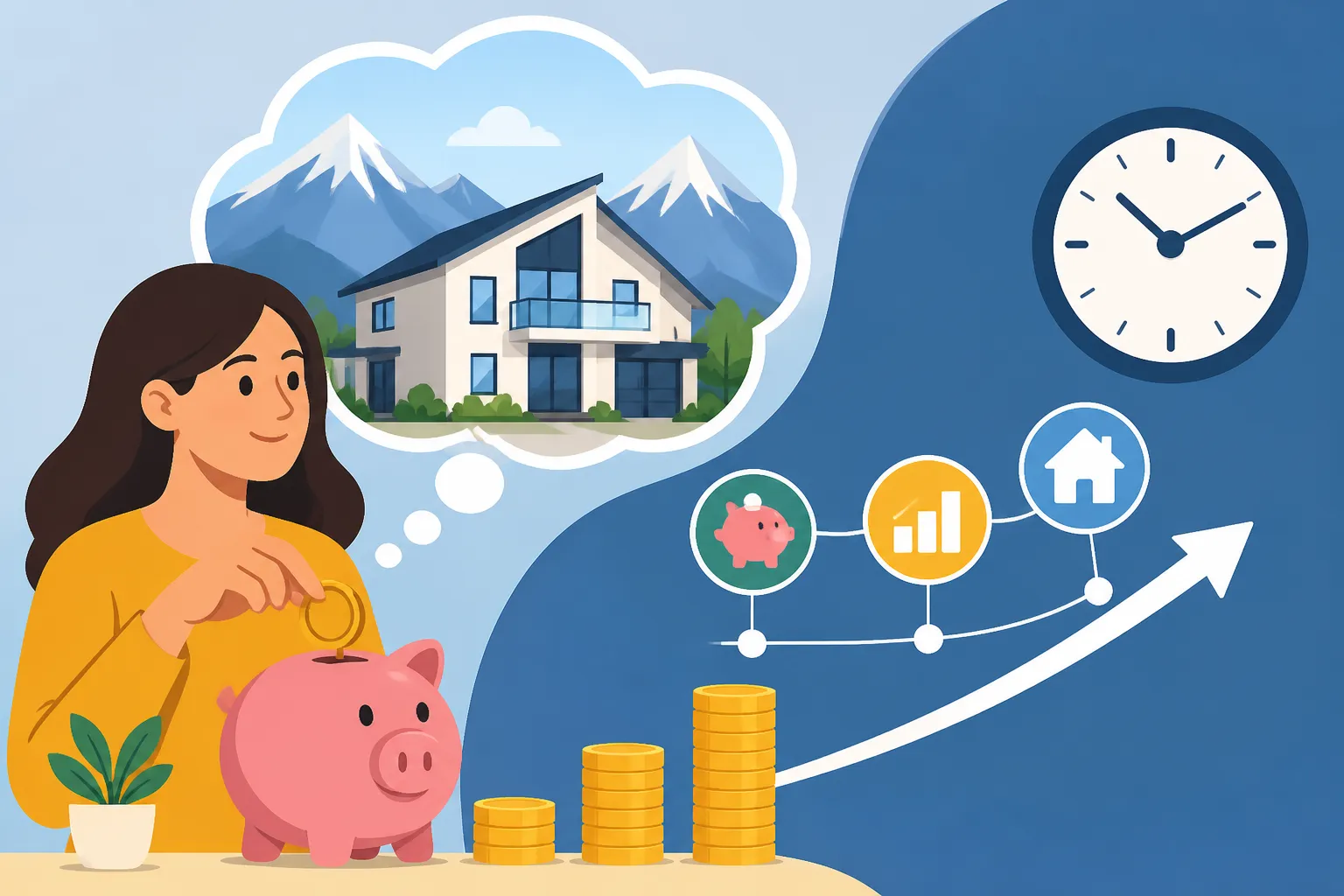
How long does it actually take to save 200,000 to 300,000 CHF? For most of us, this isn't a sprint; it's a marathon. The timeline depends heavily on your household income and your ability to navigate the Cost of Living in Switzerland 2026: Budgeting for Singles and Families.
The Dual-Income Power Couple
If you are part of a DINK (Double Income, No Kids) household, your timeline is significantly shorter. If both partners are working in high-demand sectors, perhaps earning an Average Salary for Software Engineers in Zurich (2026 Benchmarks) or working in finance, you might be looking at a household income of 250,000 CHF or more. In this scenario, saving 4,000 to 6,000 CHF per month is realistic if you live modestly. At that rate, you could hit a 200,000 CHF goal in about three to four years. This is often the "sweet spot" where expats decide to commit to Switzerland long-term.
The Single Expat Journey
For a single person, the timeline is inevitably longer. Saving 2,000 CHF a month on a single 120,000 CHF salary is a disciplined feat, given the prices of rent and health insurance. It may take seven to ten years to reach the required deposit for a city-center apartment. Many single expats choose to look at Commuter Towns Around Zurich: Cheaper Rent Within 30 Minutes to lower their monthly expenses and accelerate their savings. It’s a trade-off: a longer commute now for a shorter path to homeownership later.
Factoring in Salary Growth and Bonuses
Your timeline isn't static. In Switzerland, seniority often brings significant salary bumps and annual bonuses. Many expats use their "13th-month" salary specifically for their house fund. If you are consistently hitting your KPIs, your savings rate might double between year two and year five of your residency. It is also worth considering how Salary and Compensation: Navigating Swiss Pay, Bonuses, and Deductions affects your take-home pay, as your tax bracket will shift as your savings grow.
| Target Property Price | 20% Down Payment | Closing Costs (Est. 3%) | Total Cash Needed | Monthly Savings (Couple – 5k) | Monthly Savings (Single – 2k) |
|---|---|---|---|---|---|
| 800,000 CHF | 160,000 CHF | 24,000 CHF | 184,000 CHF | ~3.1 Years | ~7.6 Years |
| 1,000,000 CHF | 200,000 CHF | 30,000 CHF | 230,000 CHF | ~3.8 Years | ~9.5 Years |
| 1,200,000 CHF | 240,000 CHF | 36,000 CHF | 276,000 CHF | ~4.6 Years | ~11.5 Years |
| 1,500,000 CHF | 300,000 CHF | 45,000 CHF | 345,000 CHF | ~5.7 Years | ~14.3 Years |
Financial Strategies to Accelerate Your Savings
Waiting ten years to buy a house feels like an eternity. To shorten the timeline, you need to be strategic about where you put every franc. The Swiss system offers a few "hacks" that can significantly boost your progress if used correctly.
Maximizing the 3rd Pillar
The 3rd Pillar is your best friend when saving for a house. Not only can you use the funds for your down payment, but the contributions are tax-deductible. In 2026, the limit is 7,258 CHF for employees. By contributing the maximum, you reduce your taxable income, potentially saving you 1,500 to 2,500 CHF in taxes annually depending on your canton. That tax refund should go straight back into your house fund. For more on how to set this up, look into Opening Multiple Pillar 3a Accounts for Staggered Tax-Free Withdrawals. This allows you to close accounts in different years to manage the tax hit when you eventually withdraw the money for your property.
Handling Foreign Assets and Currency
Many of us come to Switzerland with savings in other currencies—USD, GBP, or EUR. If you are moving large sums of money into Switzerland for a down payment, the exchange rates and bank fees can eat thousands of francs. Using a service like Wise is often much more cost-effective than a traditional bank transfer. I’ve seen people lose nearly 1% of their deposit just by using a standard wire transfer. When you are talking about 100,000 CHF, that’s 1,000 CHF that could have paid for your move-in cleaning.
The Tax Implications for US Expats
If you are an American, the strategy becomes more complex due to FATCA and FBAR requirements. You must be careful about investing your house savings in Swiss mutual funds or certain "PFIC" structures, which can lead to punitive taxes in the US. This is where a specialized service like Taxes for Expats becomes invaluable. They can help you navigate the reporting requirements so that your "home fund" doesn't become a "tax nightmare." Always ensure you understand the Double Taxation Agreements: Filing US Taxes While Living in Switzerland before you start moving large sums into Swiss-specific investment vehicles.
Navigating the Emotional and Cultural Hurdles
Saving for a house in Switzerland isn't just a financial challenge; it's a lifestyle choice. You are essentially choosing to forgo luxury holidays and frequent dining out for several years to join the roughly 40% of people in Switzerland who actually own their homes.
The "Rental Trap" vs. Long-term Vision
It is easy to get comfortable Renting in Switzerland: The Complete 2027 Guide for Expats. The rental protections are excellent, and the quality of apartments is high. However, as rents continue to rise, the "forced savings" aspect of a mortgage becomes more attractive. The psychological shift happens when you realize that your monthly mortgage payment might actually be lower than your rent, provided you can just clear that 20% hurdle.
Why Location Flexibility Matters
Many expats get stuck trying to buy in the center of Zurich or Geneva. If you widen your search by just 15 minutes on the train, the property prices can drop by 20%. For example, looking at Vaud Expat Healthcare Guide: CHUV and Riviera Medical Centers areas might reveal that living in the Riviera is more affordable than central Lausanne. Flexibility on location can shave two to three years off your savings timeline.
Staying Disciplined in a High-Consumption Environment
Switzerland is a land of temptation—fancy skis, designer watches, and expensive weekend trips to Italy. To reach a 200,000 CHF goal, you have to learn to say "no" more often than your peers might. I recommend automating your savings the day your salary hits your account. If you don't see the money, you won't spend it. Use tools like Best Neobanks in Switzerland: Neon, Yuh, and Zak Compared to set up sub-accounts or "pots" specifically for your house fund.
Planning for the Long Term (Pillar 3b and Investing)
If your timeline is longer than five years, simply keeping your money in a savings account will result in it losing value to inflation. Consider a more aggressive investment strategy for the portion of your savings that isn't in your 3rd Pillar. However, be mindful of the Capital Gains Tax in Switzerland: The Tax-Free Stock Market Rule. While gains are generally tax-free for private investors, you need to ensure you aren't classified as a "professional investor" by trading too frequently, which would suddenly make your house fund taxable.
Final Steps Before You Buy
As you approach your savings goal, the work isn't over. You need to prepare your "Bewerbungsmappe" or application dossier, which is just as important for buying as it is for Renting a Flat: The Bewerbungsmappe (Application Dossier) Essentials.
- Get a Pre-Approval: Don't even start viewing houses until you have a "Finanzierungsbestätigung" (financing confirmation) from a bank. In a competitive market, sellers won't even talk to you without one.
- Check Your Debt Record: Ensure your Betreibungsauszug is clean. Any unpaid bills or disputes can tank a mortgage application instantly.
- Understand the Theoretical Interest Rate: Banks will test your affordability based on a 5% "theoretical" interest rate, not the current market rate. This ensures you can still pay if rates spike. Read more on the Swiss Mortgage Affordability Test: Passing the 5% Theoretical Interest Rate to see if you actually qualify for the amount you've saved for.
Buying a home in Switzerland is a slow process, but it is one of the most stable investments you can make. By understanding the 10/10 split, maximizing your 3rd Pillar, and staying disciplined with your monthly budget, you can turn that "realistic timeline" into a reality.
Disclaimer
This guide is provided for informational purposes only and does not constitute professional financial, legal, or tax advice. Real estate laws and mortgage regulations in Switzerland are subject to change and can vary significantly by canton. Always consult with a certified Swiss financial advisor, tax specialist, or mortgage broker before making significant financial decisions or signing property contracts. External services mentioned are for contextual reference and should be evaluated independently.