Transport in Switzerland: SBB, GA, Half-Fare Cards, and Commuting
I remember standing on the platform at Zurich HB, paralyzed by a ticket machine demanding 80 francs for a simple trip to Bern, wondering if I’d have to sell a kidney just to commute. You are likely facing that same "Swiss price shock" right now as you navigate your first weeks. This guide deciphers the SBB system and the essential travelcards to save you thousands.
The Backbone of the Swiss Experience SBB CFF FFS
The first thing you’ll notice about Switzerland isn’t the chocolate or the mountains; it’s the ticking of the SBB clocks. These clocks are iconic for a reason—they don’t just tell time; they dictate the rhythm of the entire country. The federal railway system, known as SBB in German, CFF in French, and FFS in Italian, is arguably the most efficient transit network in the world. But for a newcomer, the sheer density of the schedule can be overwhelming. I spent my first month accidentally boarding the "fast" train that skipped my stop entirely, simply because I didn't understand the difference between an S-Bahn and an InterCity.
Navigating the system starts with the SBB Mobile app. This is not just a "nice-to-have" tool; it is your lifeline. You can buy tickets, check real-time delays (which are rare, but do happen during heavy snow), and even see how crowded a specific train carriage will be. When you are still in the process of Where to Live in Switzerland: Cantons, Cities, and Commuter Zones, the app’s "door-to-door" search function is invaluable. It doesn't just show train times; it calculates the walk from your potential front door to the bus stop, the bus to the train, and the train to your office.
Platform etiquette is the unwritten law of the land. You will notice that the Swiss wait in a very specific, orderly fashion. When the train arrives, let everyone off before you even think about stepping forward. Once inside, the "Silent Zone" (Ruhezone) in first class and certain second-class carriages is sacred. I once saw a man get a stern "shushing" from three different commuters for taking a brief phone call. If you’re used to the loud, chaotic commutes of London or New York, the pin-drop silence of a Swiss commuter train at 7:00 AM will be a cultural adjustment.
Cracking the Swiss Travelcard Code
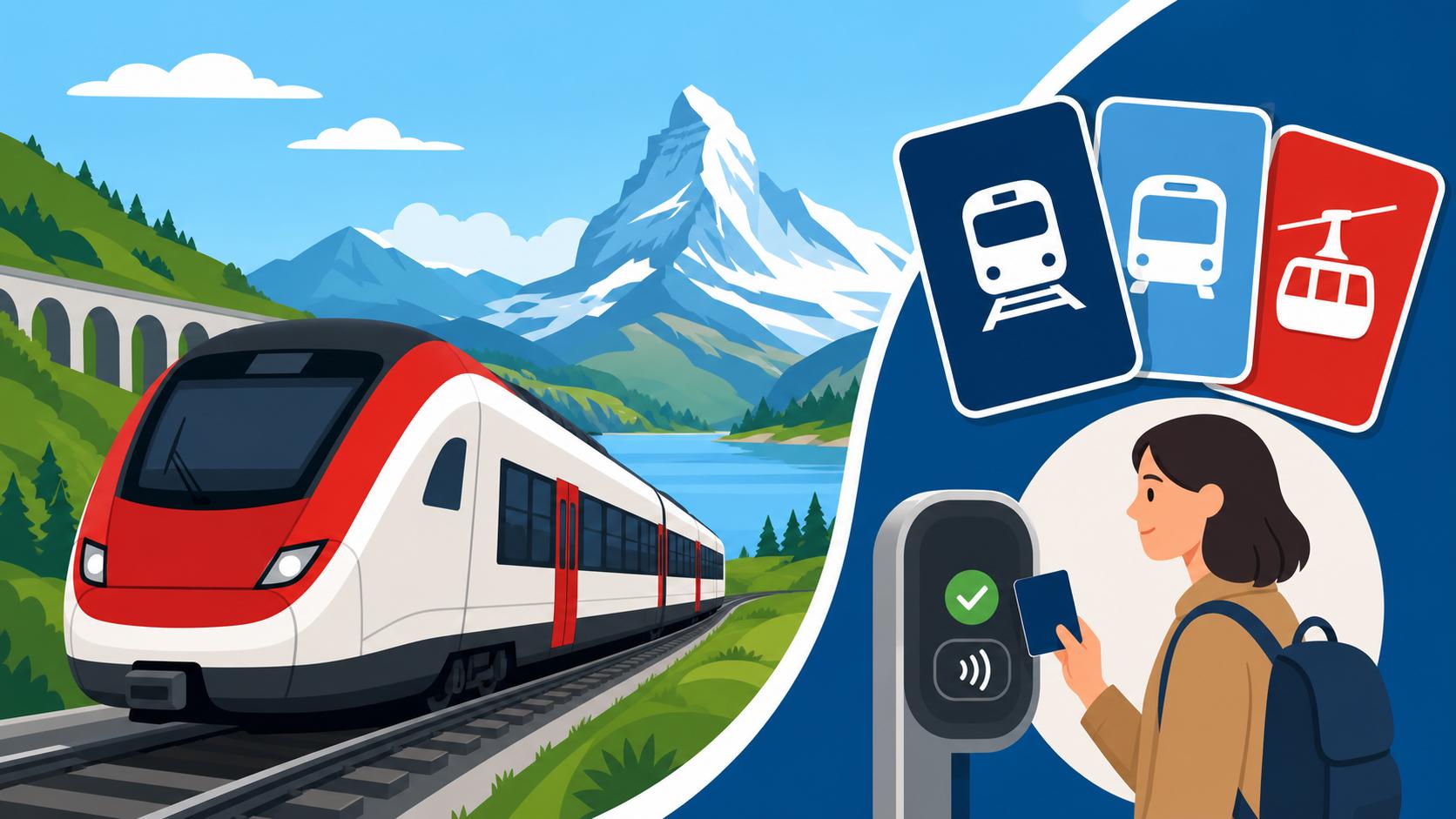
The most expensive mistake any expat can make is paying full price for a train ticket. In Switzerland, only tourists pay the "sticker price" shown on the machine. As a resident, your first administrative task after Registering Your Address at the Kreisbüro Within 14 Days of Moving should be getting your SwissPass. This is a red plastic card that holds all your digital subscriptions. It is the key to unlocking a lifestyle where transport feels like a utility rather than a luxury.
The first card you must buy is The Half-Fare Travelcard (Halbtax): The Must-Have Pass for Swiss Residents. For a small annual fee—usually around CHF 190—every single train, bus, boat, and tram ticket you buy becomes 50% cheaper. It pays for itself in roughly three or four trips between major cities. I’ve lived here for years, and I still find it the most logical investment for anyone who isn't commuting long distances every single day. It simplifies your life because you stop worrying about whether a weekend trip to Lugano is "too expensive."
For the hardcore commuters or those who want total geographic freedom, there is the Generalabonnement. Often referred to as the "GA," this is the "golden ticket" of Switzerland. When you are Purchasing a GA (Generalabonnement) on a Monthly Swisspass Subscription, you are essentially buying unlimited travel across the entire country. This includes almost all trains, most postbuses, lake steamers, and even some cable cars. While the price tag of nearly CHF 4,000 per year for second class seems astronomical, you have to weigh it against the cost of Buying a Car: Leasing, Autoscout24, and Mandatory Auto Insurance. In many cases, the GA is cheaper and significantly less stressful than navigating Swiss traffic and parking fees.
If you aren't ready to commit to a GA but find the Half-Fare isn't quite enough, the SBB recently introduced a hybrid model. I highly recommend looking into Halbtax Plus: How the New Prepaid Discount System Works for SBB. This allows you to deposit a lump sum of credit and receive a bonus amount on top of it, which acts as a middle ground for people who travel frequently but not enough to justify the full GA price. It’s perfect for the "hybrid" worker who only goes into the office two or three days a week.
Mastering the Daily Commute
Commuting in Switzerland is a masterclass in "multimodal" transport. It is rarely just a train ride. Most expats will start their journey on a local tram or a bus. The beauty of the Swiss system is the "Taktfahrplan" or integrated fixed-interval timetable. This means the bus is timed specifically to arrive at the train station three to five minutes before the train departs. It feels like magic until you realize it’s just very expensive engineering.
One of the quirks of Swiss living that impacts your commute is the local neighborhood rules. For instance, if you are Managing the Shared Waschküche: Wash Calendars and Cleaning the Lint Filter, you might find yourself rushing home on a specific Tuesday just to finish your laundry before the next person's slot starts at 6:00 PM. The reliability of the SBB allows you to plan your life down to the minute. If the app says you will be home at 5:42 PM, you can bet your laundry that you will be opening your front door by 5:50 PM.
The concept of "Zones" is also vital for your daily commute. Cities like Zurich and Geneva are divided into fare zones. If you only travel within the city, you don’t buy a ticket from "Point A to Point B," but rather a local pass for "Zone 110" or "Zone 10." These local passes are often significantly cheaper if bought as a monthly subscription. When you are browsing for temporary housing on HousingAnywhere, pay close attention to which zones the property sits in. Crossing a zone boundary can sometimes double your monthly transport costs, even if the physical distance is short.
Traveling with Family and Specialized Transit
If you have children, the Swiss transport system becomes surprisingly affordable. The focus on family integration is one of the "hidden" perks of the high cost of living here. One of the most important documents you can get for your household is Traveling with Children: The SBB Junior Travelcard for CHF 30/Year. This card allows any child between the ages of 6 and 16 to travel for free anywhere in Switzerland, provided they are accompanied by a parent who has a valid ticket. It is one of the few true bargains in the country.
For the active expat, the challenge often becomes moving gear. Switzerland is a nation of cyclists and hikers, but the trains have specific rules. I learned the hard way that you can’t just roll your mountain bike onto any carriage during rush hour. You need to understand the nuances of Taking Bicycles on Swiss Trains: Mandatory Reservations and Velo Tickets. During the summer months, many InterCity lines require a bike reservation made via the app. If you show up without one, the conductor has every right to leave you on the platform, and they usually will.
Winter transit is another beast entirely. The SBB offers "Snow'n'Rail" packages, which combine your train fare with a ski pass for specific resorts. This is the ultimate "veteran expat" move. Instead of driving up a winding mountain road and fighting for a 30-franc parking spot, you take the train directly to the base of the gondola, often at a 20% discount. The trains are equipped with special racks for skis and snowboards, making the transition from the city to the slopes seamless.
Connectivity and the Digital Commuter
Staying connected during your commute is essential, especially if you are using your travel time to catch up on emails or work. While most modern Swiss trains offer free Wi-Fi via the "SBB Free" service, it requires a Swiss phone number to register. If you have just arrived and haven't set up your local SIM yet, this can be a catch-22. I always suggest using a digital eSIM from Airalo to ensure you have data the moment you cross the border. It allows you to use the SBB app and Google Maps without hunting for a signal or a registration code.
For those who spend hours on the train, the environment is quite conducive to productivity. The "Business Zones" in first class offer power outlets and folding tables that are large enough for a laptop. If you are a second-class traveler, the newer "Twindexx" (double-decker) trains also have power outlets under the seats or between the headrests. I eventually ordered a high-quality pair of noise-canceling headphones from Amazon Germany to survive the morning commute, as even the "quiet" carriages can have the occasional hum of a ventilation system or a neighbor's heavy breathing.
Managing your tickets digitally is the standard now. While you can still use the physical SwissPass card, most of us just "load" the card into the SBB app. When the conductor comes by, you simply show a QR code. This digital integration extends to other services too. Your SwissPass can act as your membership card for "Mobility" (the national car-sharing scheme), your ski pass for various resorts, and even your entry card for some public libraries.
Transport Costs and Tax Deductions
The financial aspect of Swiss transport isn't just about what you spend; it's also about what you can get back. The Swiss tax system recognizes that commuting is an essential expense. Depending on your canton, you can often deduct a significant portion of your travel costs. For example, if you have a GA, you should look into Deducting SBB GA or Half-Fare Travelcards on Your Swiss Tax Return. The rules vary—some cantons allow a flat deduction, while others require you to prove the distance from your home to your workplace.
When you are budgeting for your first year, it is helpful to compare the various options side-by-side. The following table provides a realistic look at the 2026 pricing for the most common transport investments for an adult resident.
| Product | Annual Cost (Approx) | Best For | Main Benefit |
|---|---|---|---|
| Half-Fare (Halbtax) | CHF 190 | Everyone | 50% off all tickets |
| Generalabonnement (2nd Class) | CHF 3,995 | Daily long-distance commuters | Unlimited travel nationwide |
| Local City Pass (e.g., Zurich) | CHF 800 – 1,200 | Urban dwellers | Unlimited travel within city zones |
| Junior Travelcard | CHF 30 | Families | Kids travel free with parents |
| Seven25 Travelcard | CHF 390 | Youth (under 25) | Unlimited travel after 7:00 PM |
One thing to keep in mind is the "Point-to-Point" season ticket. If you live in Winterthur but work in Zurich, you might not need a full GA, but a Half-Fare might still be too expensive for a daily commute. A Point-to-Point ticket allows unlimited travel between two specific stations. It’s often the sweet spot for expats who have a very fixed routine and don't plan on exploring the rest of the country every weekend.
Beyond the Rails PostBuses and Boats
Public transport in Switzerland doesn't end where the tracks do. The yellow "PostAuto" (PostBus) is a national icon. These buses are designed to handle the most terrifying Alpine switchbacks with ease. If you are heading to a remote village for a hike or a viewing, you will likely end up on one. They follow the same integrated timetable as the trains, and yes, your Half-Fare or GA works on them too. The distinct three-tone horn they use in the mountains is actually a signal to oncoming traffic that the bus is taking the right-of-way on a narrow turn.
Then there are the lake steamers. In cities like Lucerne, Zurich, or Geneva, the boats are part of the public transport network, not just for tourists. Commuting by boat across Lake Zurich is one of those "I actually live here" moments that never gets old. If you have a local zone pass or a GA, you can simply hop on. It’s significantly slower than the train, but on a sunny Friday afternoon, there is no better way to head home.
Lastly, the cable cars. While most of the "big" mountain gondolas (like the one to the Jungfraujoch) are private and only offer a discount with the Half-Fare, many smaller cable cars serve as the primary link for mountain villages. In these cases, they are often fully integrated into the SBB network. Always check the app before you pay full price at a ticket window; you might find that your daily commute pass already covers the "ride to the sky."
Disclaimer
The information provided in this guide is for general informational purposes only and reflects the author's personal experiences and research as of 2026. While every effort has been made to ensure accuracy, Swiss transport prices, regulations, and tax laws are subject to frequent changes. Always consult the official SBB website or a qualified tax professional for the most current and binding information regarding your specific situation.