Travel Insurance vs Credit Card Coverage for Swiss Residents
Living in Switzerland often gives us a false sense of security. We are used to things working, being on time, and having the best healthcare in the world. However, the moment you cross the border into France, Italy, or fly across the Atlantic, that "Swiss bubble" can pop unexpectedly. Many expats find themselves stranded after a flight cancellation or facing a massive bill for a minor ER visit abroad, wrongly assuming their Swiss health card or their shiny gold credit card had them covered. This guide solves the confusion by dissecting exactly where Swiss credit card perks end and where standalone travel insurance must begin to protect your finances and your health.
The Myth of Universal Protection for Swiss Expats
When you first arrive in Switzerland and receive your insurance card, you’ll notice the blue side—the European Health Insurance Card (EHIC) Equivalent for Swiss Residents. It feels like a golden ticket to medical care across the continent. But here is the cold, hard reality: that card only covers you for "necessary" medical treatment in EU/EFTA countries at the same rate as a local resident. If you are in a country where the public system is struggling, or if you need to be airlifted back to Zurich, that blue card is essentially a piece of plastic.
The frustration for many of us comes when we realize that "basic" doesn't mean "comprehensive." Your mandatory Swiss health insurance (KVG/LAMal) typically only covers up to double the cost of what the same treatment would have cost in your home canton. While that sounds generous, it is peanuts if you are admitted to a private hospital in the United States or undergo emergency surgery in Singapore. I’ve seen expats hit with five-figure bills because they assumed their Swiss Healthcare in Switzerland for Expats: The Complete System Overview (2027) would simply foot the bill regardless of the destination.
Furthermore, there is the issue of "Search and Rescue." Switzerland is the land of mountains, and we are used to the idea that help is just a helicopter ride away. However, unless you have specific REGA Membership: Why Expats Need Air Rescue Insurance in the Alps, you might find that neither your basic health insurance nor your standard credit card will pay for a helicopter to pluck you off a mountain in the Dolomites or the Pyrenees.
Standing Strong: The Perks of Standalone Travel Insurance
Standalone travel insurance is a dedicated product designed to fill the gaping holes left by your primary insurance and your credit card. For a veteran expat, the biggest draw here is "Repatriation." If you fall seriously ill, you don't just want good care; you want to get back to the Swiss medical system where you have your Finding Medical Care in Switzerland: Doctors, Specialists, and Referrals and your family.
Standalone policies almost always offer unlimited or very high-limit Repatriation Coverage: Why Expats Add International Health Insurance in Switzerland. This is the difference between being stuck in a provincial hospital in a developing country for three weeks or being flown back to a university hospital in Geneva or Zurich on a specialized medical jet.
Beyond health, standalone insurance excels in "Cancel for Any Reason" or broadly defined "Interruption" coverage. Life happens. Maybe your project at work in Zug gets extended, or a family emergency arises in your home country. Most dedicated travel insurance providers offer more flexibility than a credit card. While you are planning these trips, you might be using Wise to manage your multi-currency spending, but the insurance should be the backbone of your trip planning.
Why the "Annulated" Trip Coverage Matters
In Switzerland, we are used to strict contracts. Standalone insurance often includes:
- Detailed Search and Rescue: Not just medical transport, but the actual cost of finding you if you go missing while hiking.
- Legal Assistance Abroad: If you are involved in a car accident in a foreign country, having a policy that pays for a local lawyer can save you from a bureaucratic nightmare.
- Baggage and Gadget Protection: Higher limits for those expensive MacBooks and DSLRs we all seem to carry.
Credit Card Coverage: Convenience vs Compliance
Most Swiss "Gold" or "Platinum" credit cards from banks like UBS, Credit Suisse, or even neobanks like Is Neon Bank Safe? Swiss Deposit Protection up to CHF 100,000 come with some form of travel insurance. It feels like a "free" win, but the traps are hidden in the fine print. The most critical factor is the "Usage Requirement."
Almost every Swiss credit card requires you to have paid for at least 50% to 100% of the trip (transport and/or accommodation) using that specific card to trigger the insurance. If you used Wise to pay for your Airbnb in London to save on exchange fees, but your insurance is tied to your Swisscard Amex, you might have effectively voided your coverage without realizing it. This is a common pitfall for savvy expats trying to optimize every cent.
Moreover, the limits on credit card insurance are often much lower. A standard Swiss credit card might offer up to CHF 50,000 for emergency medical expenses. In many parts of the world, that won't even cover the deposit for a major surgery. You should always check Travel Health Insurance for Trips Outside Switzerland: What KVG Covers Abroad to see how much your base insurance covers before relying on the "top-up" from a credit card.
The Problem of the "Deductible"
Even when a credit card insurance policy kicks in, the deductibles (the amount you pay out of pocket) can be surprisingly high. While your Private Liability Insurance (Privathaftpflicht): Why Expats Need It might cover damages you cause to others, the travel-specific portion of a credit card often requires you to pay the first CHF 200 or 500 of any claim. If you travel frequently, those "small" administrative fees add up.
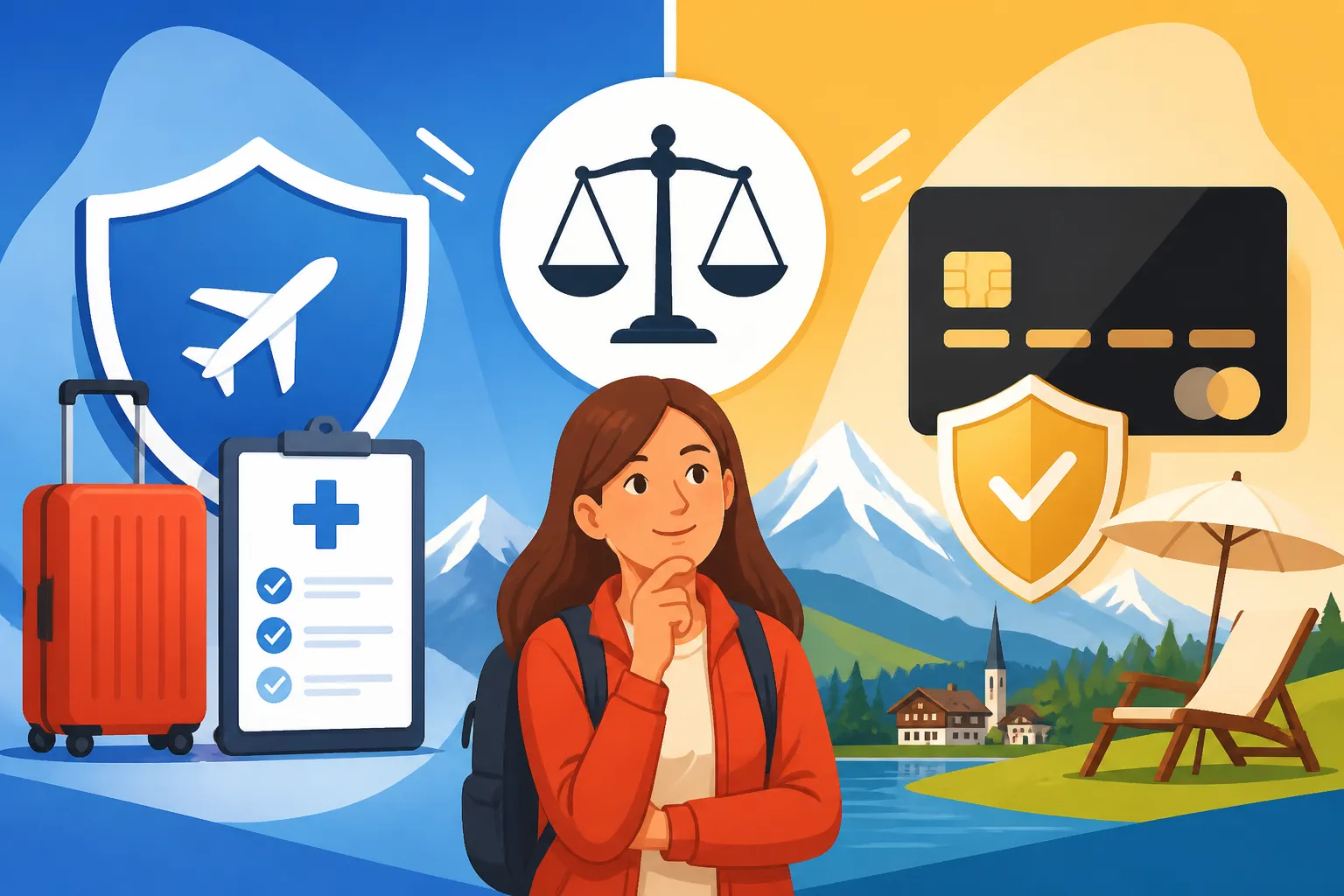
Comparison Table: Standalone vs Credit Card Coverage
| Feature | Standalone Travel Insurance | Swiss Credit Card Insurance |
|---|---|---|
| Medical Limit | Often Unlimited or >CHF 1 Million | Typically CHF 25,000 – CHF 250,000 |
| Activation Rule | Active upon payment of premium | Requires 50-100% of trip paid via card |
| Repatriation | Usually fully covered to Switzerland | Limited or capped amounts |
| Search & Rescue | High limits (often includes REGA-like) | Low limits or excluded |
| Trip Cancellation | Broad reasons accepted | Very restrictive (death/severe illness only) |
| Duration of Trip | Can be tailored (up to 365 days) | Usually limited to 30-90 days per trip |
| Cost | CHF 150 – 400 per year | Included in annual card fee (CHF 100 – 500) |
Making the Choice: Which One Do You Actually Need
Deciding between the two depends heavily on your travel profile and your tolerance for administrative headaches. If you only travel once or twice a year to neighboring countries like Germany or France, the "free" insurance on a premium Swiss credit card might be sufficient—provided you actually use that card to book your SBB tickets and hotels.
However, if you are a "global citizen" expat who frequently flies back to the US, Asia, or South Africa, relying on a credit card is a massive gamble. The complexity of international healthcare means you need a dedicated team that answers the phone 24/7 in English, French, or German to guarantee payment to a hospital. In a crisis, you don't want to be calling a generic bank hotline; you want an insurance coordinator who knows the difference between Emergency Numbers 144 vs 112: Which to Call in a Swiss Medical Crisis and the local equivalent in Thailand.
Real-Life Scenario: The Extended Stay
Imagine you are on a trip and a volcano eruption or a pandemic-style lockdown occurs. If you stay beyond the 30-day limit of your credit card's coverage, you are suddenly uninsured. Standalone policies are much easier to extend while you are on the road. Also, if an emergency keeps you out of Switzerland for months, Taxes for Expats can help you navigate the tricky residency and tax implications of an extended absence, but they can't help you with the hospital bills that put you there.
For those who are self-employed or freelancers, the stakes are even higher. A single lost suitcase or a week-long hospitalization without proper coverage can wipe out months of profit. I always recommend that new arrivals in Switzerland take out a year-long standalone policy for their first 24 months. It gives you one less thing to worry about while you are still figuring out how the Swiss "Franchise" system works.
Ultimately, think of credit card insurance as a "backup of a backup." It's great for getting CHF 100 back for a delayed flight, but it's not a safety net for your life. For true peace of mind, especially when traveling with family, a dedicated policy is the only way to ensure that a bad day abroad doesn't become a financial catastrophe back home in Switzerland.
Disclaimer
This guide is for informational purposes only and does not constitute financial or legal advice. Insurance regulations and credit card terms in Switzerland change frequently. Always read the General Terms and Conditions (GTC/AVB) of your specific policy or credit card contract before traveling. The authors are not responsible for any claims denied by insurance providers.