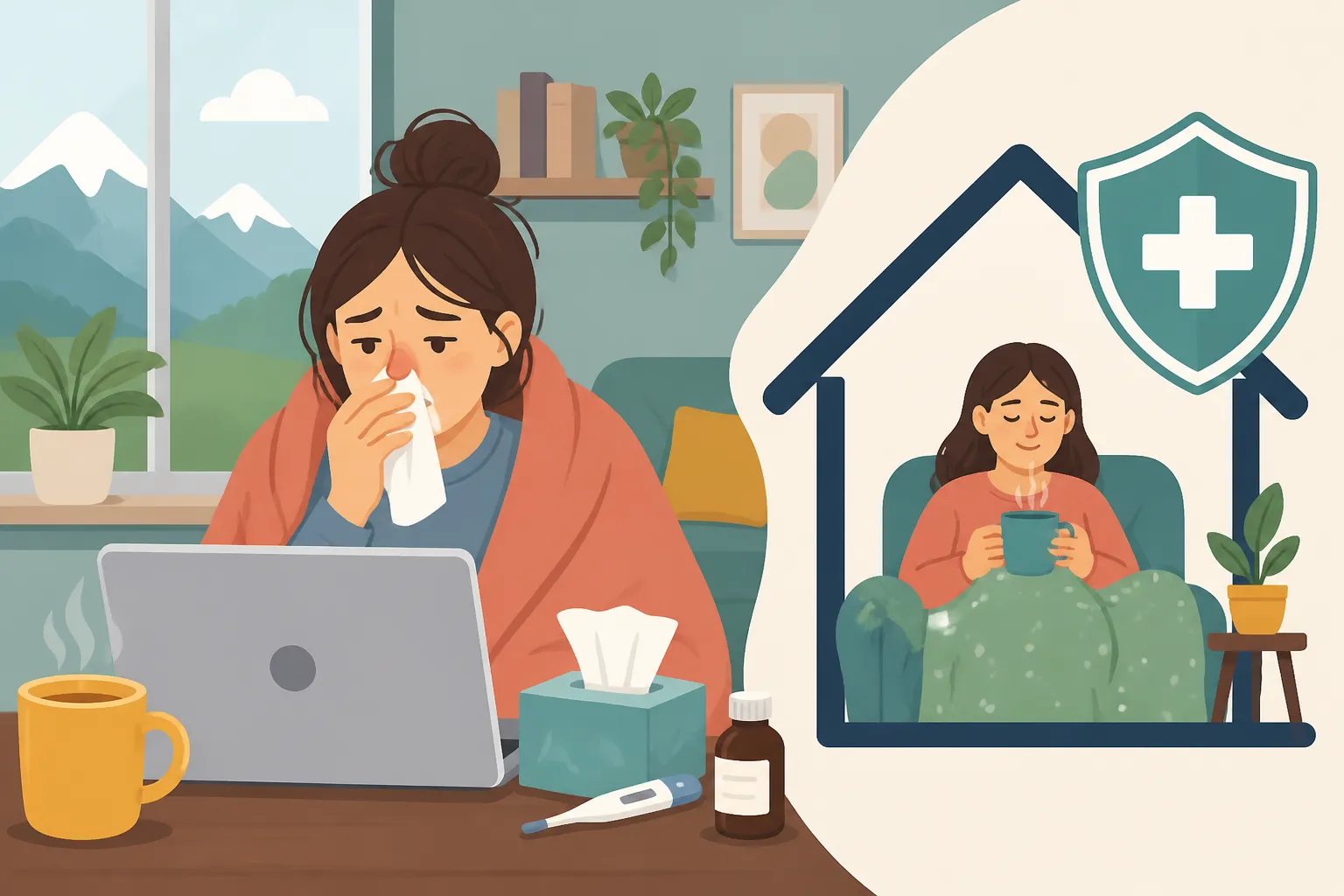
Working While Sick in Switzerland: When You Must Stay Home
Navigating the rules around sick leave in Switzerland can feel like walking through a minefield, especially when you're already feeling under the weather and the administrative jargon is in a language that isn't your native tongue. Many expats arrive here with expectations based on their home countries, only to find the Swiss system has its own distinct protocols. This guide aims to clear up the confusion, outlining exactly when you should stay home, what steps to take, and what your rights are when illness strikes while you're working in Switzerland.
The Swiss Sick Leave System: An Overview for Expats
The Swiss approach to sick leave is generally quite structured and places a high value on both the employer-employee relationship and the individual's recovery. It's not just about a legal obligation; there's a strong cultural expectation that if you are genuinely unwell, you should stay home to prevent spreading illness and to properly recuperate. This isn't a place where "working through it" is necessarily seen as heroic; often, it's considered irresponsible.
Understanding Your Rights and Responsibilities
As an expat, your sick leave rights are primarily governed by the Swiss Code of Obligations (Obligationenrecht, OR) and potentially by a Collective Bargaining Agreement (Gesamtarbeitsvertrag, GAV) if your industry or company is covered by one. These legal frameworks outline how long your employer must continue to pay your salary during illness. Generally, after a certain period of employment (usually three months), you're entitled to salary continuation for a limited time, which increases with your years of service. It’s a protection designed to give you peace of mind while you're recovering.
However, with these rights come responsibilities. The most crucial one is communication. You are expected to inform your employer as soon as possible that you are unable to come to work due to illness. This isn't just a courtesy; it's a fundamental part of the employment contract. Failing to notify your employer promptly can be a serious breach of your duties. Furthermore, while the Swiss system is trusting, it also requires official documentation, primarily in the form of a doctor's note, to validate your absence, especially if it extends beyond a very short period.
The Doctor's Note (Arztzeugnis): When it's Needed
This is where many expats often get tripped up. In many countries, a doctor's note might only be required after three or even five days of illness. In Switzerland, the "third day rule" is a common guideline, but it's not universal. Many companies, especially smaller ones or those with specific internal policies, might require an Arztzeugnis (doctor's note) from the first day of absence, or at least if your absence extends beyond one or two days. It is absolutely crucial to clarify your company's specific policy on this as soon as you start your job, ideally during onboarding. Don't wait until you're sick to find out!
When you do need a doctor's note, it must be from a licensed medical professional. A simple email or phone call from you stating you're sick won't cut it for prolonged absences. The Arztzeugnis will typically state the start date of your illness and the expected return-to-work date. It won't usually go into detail about your specific ailment due to medical confidentiality, but it will confirm your incapacitation for work. Make sure to get this note promptly and submit it to your employer as soon as it's available. Remember, the clock starts ticking the moment you report sick, and your employer will be expecting that document.
What to Do When You Wake Up Sick: A Step-by-Step Guide
Waking up with a splitting headache or a nasty flu can throw anyone off, but as an expat in Switzerland, knowing the exact steps to take can alleviate a lot of stress. It’s about following a clear protocol to ensure you meet your obligations and protect your rights.
Informing Your Employer Promptly
The very first thing you need to do, even before you've had your first cup of tea or decided whether you'll manage to drag yourself to a doctor, is to inform your employer. This should happen as early as possible on your first day of sickness, ideally before your usual working hours begin. Pick up the phone or send an email. If you're working in a German-speaking part of Switzerland, a quick "Guten Morgen, ich kann heute leider nicht zur Arbeit kommen, da ich krank bin" (Good morning, unfortunately, I can't come to work today as I am sick) is generally sufficient for the initial notification.
Always follow your company's prescribed method of communication. Some prefer a phone call to your direct manager, others an email to HR, or a message in a team chat. If you can't reach your direct manager, try a colleague or HR. The key is to ensure your absence is registered. If your illness is likely to extend beyond a day, you should also mention that you'll be seeking medical advice. This sets the expectation that an Arztzeugnis might be coming.
Seeking Medical Attention
If your illness is severe enough to warrant staying home for more than a day, or if your company policy dictates it, you'll need to visit a doctor to obtain that all-important Arztzeugnis. Don't delay this. Many Swiss doctors operate on an appointment-only basis, but for acute illnesses, most will have emergency slots or walk-in hours. In larger cities like Zurich or Geneva, you'll find "Permanence" clinics or specific walk-in medical centers, often at train stations, which are perfect for same-day urgent care. For minor ailments that require confirmation, your Finding an English-Speaking Family Doctor (Hausarzt) in Major Cantons will be your first point of contact.
When you see the doctor, clearly state that you need an Arztzeugnis for your employer. They are very familiar with this request. If you have any language barriers, consider bringing a friend, using a translation app, or preparing key phrases in the local language. Improving your language skills, even for basic medical interactions, can be incredibly helpful – resources like iTalki can connect you with tutors for German, French, or Italian, making future doctor visits much smoother. Once you have the note, promptly forward it to your employer. A scanned copy by email is usually acceptable, followed by the original in the mail if requested.
Managing Your Recovery and Return to Work
During your sick leave, your primary focus should be on recovery. While there’s no specific "sick leave police," the expectation is that you are not engaging in activities that would hinder your recovery or are clearly incompatible with your stated illness (e.g., attending a party if you claimed to have the flu). Keep your employer informed if your condition changes or if you anticipate needing more time off than initially stated on your Arztzeugnis.
Before you return, ensure you are genuinely well enough. Coming back too soon only to relapse is unproductive and can reflect poorly. On your final day of sick leave, or the day before your planned return, it’s good practice to send a brief message to your manager confirming your return the following day. This shows professionalism and allows them to plan for your reintegration. If you've been on a longer sick leave, your doctor might provide a "fit for work" note or even a plan for a gradual return to work, which is also standard practice.
Salary Continuation (Lohnfortzahlung) and Accident Insurance (UVG)
Understanding how your salary is handled when you're sick or injured is crucial for financial stability as an expat. The Swiss system distinguishes between illness and accidents, and different insurance mechanisms kick in depending on the cause of your incapacitation.
KTG and BVG: Your Financial Safety Net
When you're ill, your salary continuation is generally covered by either your employer directly (as per the OR or GAV) or by a collective sickness daily allowance insurance, known as Krankentaggeldversicherung (KTG). Many employers opt for a KTG insurance, which typically provides 80% of your salary for an extended period, often up to 720 days within a 900-day period, after a waiting period (typically 1-3 days, for which the employer usually still pays 100% of your salary). This KTG insurance is a fantastic safety net that many expats find incredibly reassuring. It's often deducted directly from your salary, so it's a benefit you're already contributing to.
Your occupational pension scheme, Pillar 2 or Berufliche Vorsorge (BVG), also plays a role in long-term illness. If you become permanently incapacitated for work due to illness, the BVG provides a disability pension. This is why it's so important to understand Pillar 2 (BVG): Understanding Your Swiss Occupational Pension and ensure your contributions are always up to date. While it's hopefully something you'll never need, knowing it's there offers significant long-term protection. When it comes to understanding how these benefits might impact your earnings and, subsequently, your yearly tax return, services like Taxes for Expats can be incredibly useful to ensure you're compliant with Swiss regulations.
The Overlap with Accident Insurance (UVG)
Here's a critical distinction: Illness is covered by KTG (or direct employer salary continuation), but accidents are covered by Unfallversicherung (UVG), or Accident Insurance. In Switzerland, accident insurance is mandatory for all employees. It covers both occupational accidents (those that happen at work) and non-occupational accidents (those that happen outside of work, like a ski injury on your day off). If you work less than 8 hours a week for the same employer, you are only covered for occupational accidents.
The key difference for you as an employee is that UVG benefits typically cover 80% of your salary from the first day of the accident, with no waiting period, and cover 100% of medical treatment costs (after your The Swiss Franchise System: How Deductibles and Copays Work from basic health insurance, of course). This is usually more generous than KTG for illness. Therefore, when you report an absence, it's vital to clarify whether it's due to illness or an accident, as the correct insurance pathway needs to be activated. If you get into an accident, your employer will typically provide you with a specific form to fill out for the UVG insurer. For instance, if you Occupational Accident Insurance (UVG): What Happens When You Ski and Crash?, your UVG will kick in.
Common Expat Concerns and Misunderstandings
Moving to Switzerland means adapting to new cultural norms, and sick leave is no exception. Expats often grapple with unique questions and misconceptions.
"Can I Work From Home While Sick?": The Grey Area
This is a frequently asked question, and the answer is nuanced. Culturally, if you're truly sick, the expectation in Switzerland is that you are resting and recuperating, not working, even remotely. The purpose of sick leave is to recover fully and avoid spreading illness. Trying to "power through" from your couch might be seen as commendable in some cultures, but here, it can raise eyebrows. It implies you weren't truly sick enough to be off work, or that you're not taking your health seriously.
Legally, if a doctor issues an Arztzeugnis stating you are 100% incapacitated for work, you are legally not allowed to work, even from home. Doing so could invalidate your sick leave, potentially affecting your salary continuation from KTG or your employer. If you're feeling a bit under the weather but genuinely able to perform light duties from home without hindering your recovery or infecting others, you should discuss this proactively with your manager. Do not just assume. The general rule of thumb is: if you're sick enough for an Arztzeugnis, you're sick enough to rest.
Dealing with Long-Term Illness and Burnout
Long-term illness, including mental health issues like burnout, is a serious matter in Switzerland. The system provides robust support, but navigating it can be complex. If your illness extends for several weeks or months, your KTG insurance will continue to pay out, but you'll also enter a more structured phase of medical and potentially occupational rehabilitation. Employers are legally obligated to consider reasonable adjustments to facilitate your return to work, though there are limits.
It’s crucial to maintain open communication with your doctor and, with their consent, your employer. Your doctor will be key in managing your recovery and potentially recommending therapies or a phased return to work. For severe mental health issues, remember that Mental Health in Switzerland: Accessing Therapists and Psychiatric Care is available, and basic health insurance (KVG) covers psychotherapy under certain conditions. Don't suffer in silence; seek professional help early.
Language Barriers in Medical Consultations
One of the most frustrating aspects for many non-German, French, or Italian speaking expats is the language barrier during medical consultations. While many doctors, especially in international cities, do speak English, you can't always guarantee it, particularly in an emergency or with specialists. This can lead to miscommunication, anxiety, and a feeling of not being fully understood or understanding your diagnosis and treatment plan.
To mitigate this, always try to find an English-speaking doctor if possible. Directories from expat groups, your health insurance provider, or international clinics are good starting points. Prepare key phrases in the local language, or use translation apps on your phone. If you anticipate a complex discussion, asking a trusted, fluent friend to accompany you can be invaluable. Proactively learning some basic medical vocabulary in the local language can also make a huge difference, and platforms like iTalki can be excellent for focused language practice with native speakers. The more you can communicate your symptoms accurately, the better care you'll receive.
Swiss Sick Leave Checklist
| Action | When to Do It | Who to Contact | Important Note |
|---|---|---|---|
| Notify Employer | First thing on the first day of illness | Direct Manager, HR, or designated contact | Follow company policy (phone, email, chat). Be prompt. |
| Seek Medical Attention | If unwell for more than 1-2 days (or as per policy) | Family Doctor (Hausarzt) or Permanence Clinic | Get an Arztzeugnis (doctor's note) if required by your employer. |
| Submit Arztzeugnis | As soon as you receive it | Direct Manager and/or HR | Scan/email copy first, then send original by post if requested. |
| Communicate Changes | If illness prolongs or condition worsens | Direct Manager | Keep them updated on your estimated return or need for a new Arztzeugnis. |
| Confirm Return to Work | Day before returning from sick leave | Direct Manager | Reassures them of your readiness to resume duties. |
| Understand Salary & Insurance | Ongoing, especially for longer absences | HR, KTG insurer, UVG insurer (for accidents) | Distinguish between illness (KTG/employer) and accident (UVG) coverage. |
For further reading on related topics, you might find our guides on Mandatory Registration: How to Sign Up for Health Insurance Within 90 Days, The Swiss Franchise System: How Deductibles and Copays Work, or Accident Insurance (UVG): Occupational vs. Non-Occupational Coverage particularly helpful in understanding the broader Swiss healthcare and insurance landscape. If you're wondering about your financial safety net, delve into Sickness Benefits Insurance (KTG): Why It’s Crucial for Expats to get a clearer picture. And for those trying to get by day-to-day, understanding Pharmacies and Medication: Prescriptions, Costs, and OTC Regulations can be a lifesaver.
Disclaimer
Please remember that this guide provides general information based on typical scenarios in Switzerland. Individual situations can vary greatly depending on your specific employment contract, collective bargaining agreements, and cantonal regulations. While we strive to provide accurate and up-to-date information, this should not be considered legal or medical advice. Always consult with your employer, a legal professional, or a medical doctor for personalized guidance related to your specific circumstances.