Do You Need to Speak Swiss German (Mundart) in Meetings?
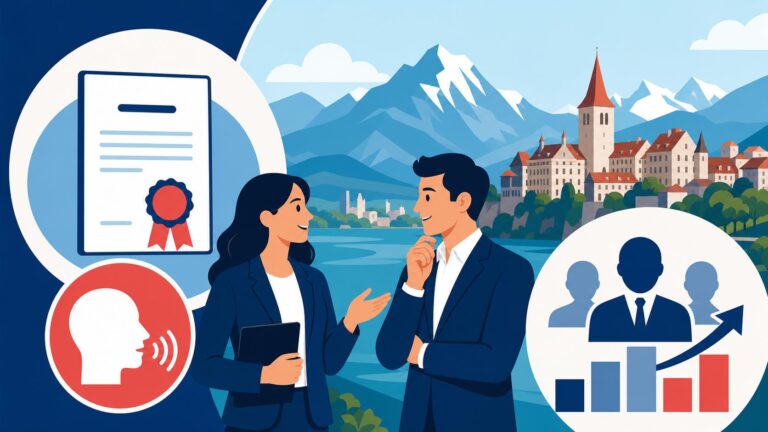
Walking into a Zurich conference room only to realize the agenda is High German but the discussion sounds like a secret code is a rite of passage. I spent my first six months nodding while sweating through my shirt, completely lost in the dialect. This guide clarifies when you need Mundart, when High German suffices, and how to navigate office linguistics.
The Reality of Mundart vs. High German in the Workplace
In Switzerland, particularly in the German-speaking cantons, the linguistic landscape is defined by "diglossia." This means two distinct versions of a language exist side-by-side but serve different functions. High German (Hochdeutsch) is the language of the pen; it is what you read in newspapers, what children learn in school, and what is used for official government documents. However, Swiss German (Mundart) is the language of the heart. It is what people speak at home, with friends, and—crucially—in the office.
When you join a Swiss company, you will likely find that the official meeting invite is written in perfect High German. You might even have internal documentation that looks exactly like something from Berlin or Munich. But the moment the meeting starts, the "language switch" often stays firmly in the Mundart position. For a newcomer, this creates a massive cognitive load. You are not just translating a foreign language; you are trying to map a spoken dialect that has no standardized spelling onto the "official" German you learned in your language app.
The first thing to understand is that your Swiss colleagues are not trying to exclude you. To them, Mundart is natural and comfortable. Speaking High German often feels formal, stiff, or even "foreign" to a Swiss person. They might feel they cannot express their personality or humor as effectively in High German. This is a critical piece of The Swiss Corporate Culture: Meetings, Hierarchy, and Professional Etiquette that every expat must grasp early on. If you expect a meeting to be in High German just because the company is in Switzerland, you are setting yourself up for a shock.
When Do They Switch to High German
The general rule of thumb in most Swiss offices is that the language of the meeting is determined by the "lowest common denominator." If there is one person in the room who does not understand Swiss German, the group should, in theory, switch to High German or English. However, "in theory" is doing a lot of heavy lifting here. In reality, the switch often depends on the seniority of the non-speaker and the specific canton you are in.
In a formal setting, such as a presentation to the board or a client-facing pitch, High German is almost always the standard. It signals professionalism and ensures that there is no ambiguity in technical details. But in internal team meetings, "Mundart-creep" is common. A colleague might start a sentence in High German, get excited about a project, and inadvertently slide back into their local dialect. As an expat, you have to decide when to speak up. I found that in my early days, admitting I was lost was better than nodding along and failing a task later. You can learn more about these nuances in our guide on High German vs Swiss German in the Workplace: What You Must Learn.
The Passive Fluency Expectation
While you are rarely expected to speak Swiss German—in fact, many Swiss people find it cringeworthy when foreigners try to mimic the dialect too early—there is a very strong expectation of "passive fluency." This means that over time, your colleagues will expect you to understand the dialect even if you respond in High German or English.
This middle-ground approach is the secret to integration. If you can follow a conversation in Mundart and contribute your points in High German, you have achieved the Swiss "Gold Standard" of workplace communication. It keeps the workflow efficient because the Swiss can stay in their comfort zone while you stay in yours. However, reaching this level of comprehension takes time. I personally relied on tools like GermanPod101 to get used to the specific vowel shifts and rhythmic patterns of the Swiss dialect, which are vastly different from the staccato nature of Standard German.
Sector-Specific Linguistic Expectations
The answer to whether you need Mundart in meetings depends heavily on your industry and the size of your company. Not all Swiss workplaces are created equal. If you are Working in Zurich: Finance, Tech, and Salary Expectations, you might go your entire career speaking nothing but English. Global giants like Google, UBS, or Novartis have English as their primary corporate language, meaning Mundart is relegated to the cafeteria and the hallways.
However, if you move into the "Mittelstand"—the small to medium-sized enterprises that form the backbone of the Swiss economy—Mundart is king. In these environments, if you do not understand the local dialect, you will miss out on 80% of the context. It’s not just about the work; it’s about the "Zwischentöne" or the nuances between the lines. Without understanding the dialect, you are essentially a visitor in your own office.
Finance and Global Tech Hubs
In the international hubs of Zurich, Basel, and Geneva, the pressure to speak Mundart in meetings is significantly lower. In fact, in many teams, the "team language" is English by default. This is particularly true for English-Speaking Jobs in Switzerland: Top Industries and Cantons. In these settings, meetings are conducted in English to accommodate a diverse workforce.
However, don't let the English-only environment fool you. Even in an English-speaking office, the "pre-meeting" and "post-meeting" talk often happens in Swiss German. This is where the real decisions are sometimes made, or where the social bonding occurs. If you want to move into leadership, having a solid grasp of Language Skills for the Workplace: German, French, and English Demands becomes a strategic advantage. It allows you to bridge the gap between the international "front office" and the local "back office" staff who may prefer the dialect.
SMEs and Local Administration
If your workplace is a local architecture firm in Lucerne or a manufacturing plant in the Bernese Oberland, the meeting language will be Swiss German. In these sectors, High German is reserved for emails and the annual report. If you insist on High German in every interaction, you may be viewed as someone who isn't willing to integrate.
In these traditional sectors, your success depends on your ability to decode regionalisms. A colleague from Bern speaks significantly slower than someone from Zurich, and the vocabulary can change drastically. To build a foundation for this, I highly recommend using a platform like Lingoda to master your High German first. You cannot understand the "deviation" (Mundart) until you know the "standard" (High German). Once you have that foundation, the dialect starts to make sense as a series of consistent phonetic shifts.
Strategies for Survival and Integration
Surviving your first year of Swiss meetings requires a mix of humility and strategy. You cannot learn Swiss German in a weekend, but you can change how you react to it. I spent months pretending I understood, only to realize I had missed key deadlines because I didn't want to seem "difficult." Don't be that expat. The Swiss respect directness and honesty regarding your linguistic limits.
The key is to manage expectations. At the start of a meeting, it is perfectly acceptable to say, "I am still learning the dialect, so if the conversation gets technical, could we briefly switch to High German?" Most colleagues will be happy to accommodate. They are often proud of their dialect and are aware that it is difficult for outsiders. For more on how to handle these social interactions, see our post on High German in Zurich Offices: Etiquette and Misunderstandings.
The Importance of the Coffee Machine
In Switzerland, the "unofficial" meeting is just as important as the one in the conference room. This usually happens at the coffee machine (Kaffeemaschine) or during the Apéro Culture: Socializing with Coworkers After Work. These are 100% Mundart zones. This is where you learn who is frustrated with a project, who is getting promoted, and what the boss really thinks of the new strategy.
If you are a total beginner, these social moments can be incredibly isolating. It feels like you are watching a movie without subtitles. To bridge this gap, focus on learning "social Swiss German." This includes greetings, common interjections like "Genau" (exactly) or "Merci vielmal" (thank you very much), and the specific rules of Addressing Colleagues in German: Du vs Sie in Swiss Corporates. Even if you speak High German, using a few Swiss-specific phrases shows that you are making an effort to fit into the local culture.
| Scenario | Primary Language | Expat Strategy |
|---|---|---|
| Formal Board Meeting | High German / English | Use High German; ensure technical accuracy. |
| Daily Team Stand-up | Swiss German (Mundart) | Listen for keywords; ask for "Hochdeutsch" summaries of tasks. |
| Client Pitch (Local) | High German | Standard German is expected for professionalism. |
| Informal Coffee Break | Swiss German (Mundart) | Practice passive listening; use Swiss greetings. |
| Email / Documentation | High German | Always write in Standard German. |
Regional Variations: Beyond Zurich
While much of the expat focus is on Zurich, the linguistic pressure changes as you move across the "Röstigraben" (the invisible border between German and French-speaking Switzerland). If you are Working in Basel: The Pharma Hub and Expat Opportunities, you will encounter "Baseldeutsch," which has its own unique flavor and distinct vocabulary influenced by its proximity to France and Germany.
If your career takes you to the Romandie (the French-speaking part), the dialect pressure disappears. There is no "Swiss French" dialect in the same way there is "Swiss German." Instead, they speak Standard French with a slightly different accent and a few different numbers (e.g., "septante" instead of "soixante-dix"). For those in this region, tools like FrenchPod101 are fantastic for picking up the local pace of speech. But for those of us in the German-speaking cantons, the challenge remains the dual-track system of Mundart and Hochdeutsch.
Taking the Leap into Learning
Ultimately, if you plan to stay in Switzerland for more than three years, learning to understand the dialect is non-negotiable for your career growth. You don't have to speak it fluently, but you must be able to sit in a meeting and follow the flow of conversation without a translator.
Start by perfecting your High German. This is the version of the language that gives you professional credibility. Programs like Lingoda are excellent because they offer small group classes that focus on speaking, which is exactly what you need for the office environment. Once you reach a B1 or B2 level in High German, the Swiss dialect will naturally start to "unlock." You will begin to hear the patterns—the way "ei" becomes "ii" or how "st" becomes "scht." It’s a rewarding process that changes your status from "the foreign worker" to "the integrated colleague."
Important Disclaimer
The linguistic landscape of Switzerland is highly varied and subject to the specific internal culture of each company. While the advice provided here is based on general trends and personal experience in Swiss professional environments, you should always observe the specific norms of your workplace. Language policies can change, and what applies in a multinational tech firm may not apply in a local cantonal office. Always consult with your HR department or a local integration coach for advice tailored to your specific situation.