What Happens if You Lose Your Swiss Residence Card (Ausländerausweis)
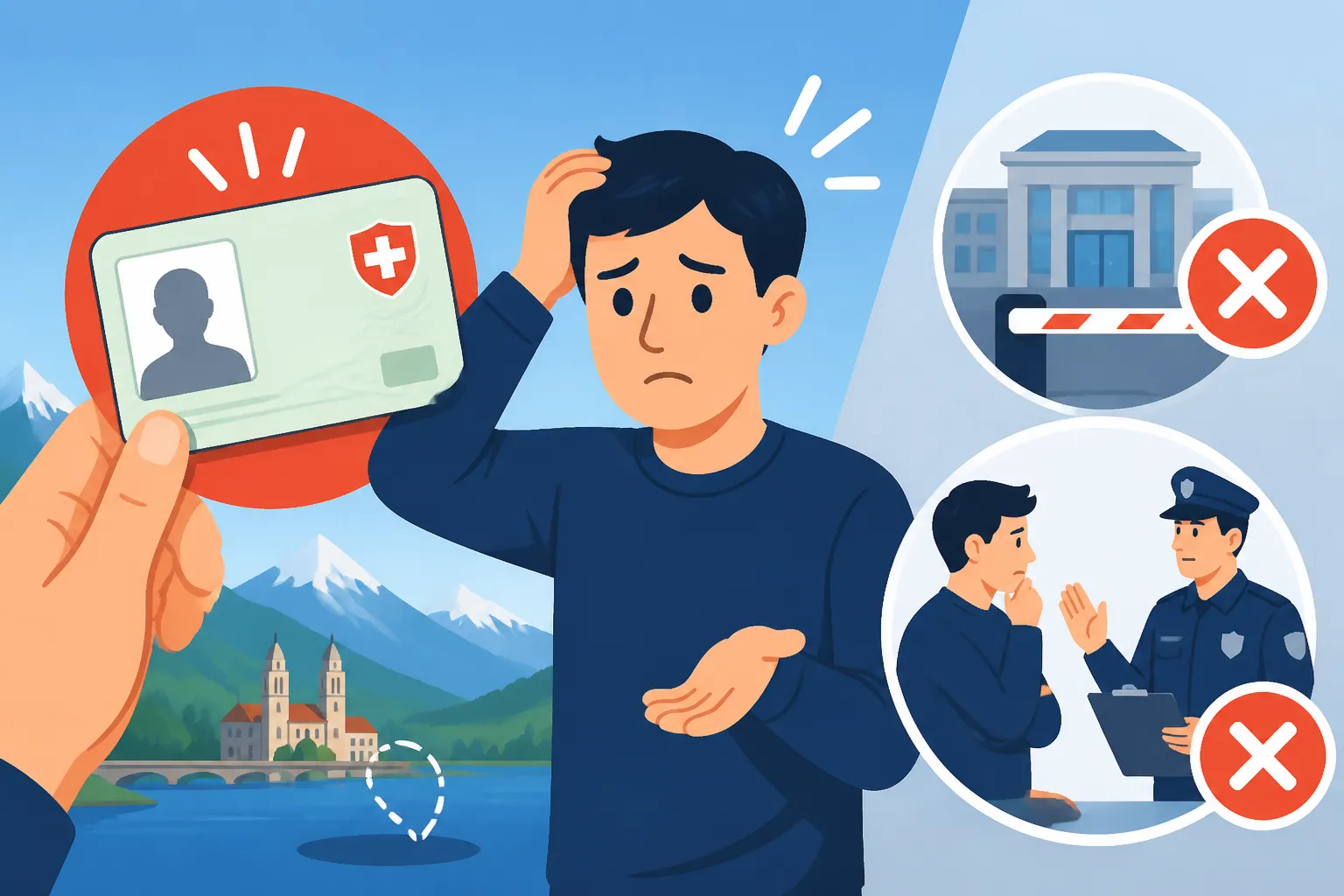
Standing at the bus stop in Oerlikon, you reach for your wallet and realize with a jolt of pure adrenaline that your Swiss residence card is gone. I remember that sickening feeling vividly when I realized my B Permit had slipped out of my pocket during a hike in Lauterbrunnen. This guide explains exactly how to navigate the bureaucratic maze of replacing your Ausländerausweis.
The Immediate Response: Reporting the Loss
The very first thing you must do—before you even call your mother to vent—is to accept that this is now a formal administrative matter. In Switzerland, your residence permit is not just a piece of plastic; it is your legal proof of existence within the federal system. If it is lost or stolen, the clock starts ticking on your responsibility to report it.
Obtaining a Formal Police Report (Verlustanzeige)
You cannot simply walk into a migration office and ask for a new card. The Swiss system requires a "Verlustanzeige," which is an official report of loss. You need to visit the nearest police station (Polizeiposten). In major cities like Zurich or Geneva, you can often find these at the main train stations, which are open 24/7.
When you arrive, tell the officer you need to report a lost "Ausländerausweis." They will ask for the circumstances of the loss. If it was stolen, they will file a theft report; if you simply misplaced it, it is a report of loss. This document is the golden ticket that allows the migration office to trigger a replacement. Expect to pay a small administrative fee for this report, usually between CHF 20 and CHF 40 depending on the canton.
Notifying the Cantonal Migration Office
Once you have the police report in hand, your next stop is the Migrationsamt (Migration Office) of your specific canton. It is a common mistake to think that notifying the police is enough. It isn't. The police and the migration office operate on different databases, though they do talk to each other eventually.
You must notify the migration office within a few days of the loss. If you are on a The Swiss B Permit: Eligibility, Renewal, and Restrictions, the office will need to verify your current employment status before issuing a replacement. If you are a long-term resident holding The Swiss C Permit (Permanent Residency): Fast-Track and Standard Routes, the process is slightly more streamlined but no less formal. In Zurich, you would typically handle this through your local Registering Your Address at the Kreisbüro Within 14 Days of Moving, whereas in smaller cantons, you go directly to the cantonal headquarters.
Checking with the Lost and Found (Fundbüro)
Before you pay for a new card, check the "Easyfind" system, which is the national online database for lost property in Switzerland. Swiss people are famously honest, and there is a very high probability that someone found your card and dropped it into a yellow Swiss Post mailbox. The Post then delivers these to the local "Fundbüro."
Wait at least 48 hours before starting the expensive replacement process. Check the local city lost and found office and the SBB (Swiss Federal Railways) lost and found if you were traveling by train. If your card was found, you can reclaim it for a small fee, which is significantly cheaper than the CHF 100+ you will spend on a replacement.
The Replacement Process: Documentation and Fees
Once you have confirmed the card is truly gone and the police report is filed, you enter the replacement phase. This is essentially a mini-version of your initial permit application.
Required Paperwork and Biometrics
To get a new card, you will need to provide several documents. Even though the state already has your data, they require "fresh" proof of your situation. You will typically need:
- The original police report (Verlustanzeige).
- A valid passport or national ID card.
- A recent passport-sized photo (though many cantons now take this digitally on-site).
- Proof of residence (Wohnsitzbestätigung), which you can get from your Gemeinde.
If your original documents, such as marriage certificates or birth certificates, are in a language not recognized by your canton (usually German, French, Italian, or Romansh), you might need professional translations. I’ve found that using a service like RushTranslate is the most efficient way to get these documents into a format the Swiss authorities will accept without question. They understand the "Apostille" and certification requirements that Swiss bureaucrats are so fond of.
Understanding the 2026 Fee Structure
Replacing a lost permit is not cheap. The Swiss government views the loss of an official document as a lapse in your "duty of care," and the fees reflect that. You are looking at two separate costs: the cantonal administrative fee and the federal card fee.
| Canton | Administrative Fee (Approx.) | Card Fee (Federal) | Total Estimated Cost |
|---|---|---|---|
| Zurich | CHF 80 | CHF 22 | CHF 102 |
| Geneva | CHF 100 | CHF 22 | CHF 122 |
| Vaud | CHF 90 | CHF 22 | CHF 112 |
| Zug | CHF 70 | CHF 22 | CHF 92 |
These fees must usually be paid upfront at the counter via TWINT, debit card, or credit card. Cash is increasingly discouraged in administrative offices across the "Big Four" cantons.
Re-capturing Biometric Data
Since 2021, all Swiss residence permits for non-EU/EFTA citizens (and many for EU citizens) are biometric. Even if you just had your biometrics taken a year ago, the canton may require you to visit a biometric center again to capture your fingerprints and a new facial scan.
This is particularly true if your card was an older "paper" version or if you have recently moved cantons. You will receive an appointment via mail or email after you submit your replacement application. This appointment is mandatory and usually happens at a central cantonal facility, such as the one at Rietbachstrasse in Schlieren for Zurich residents.
Losing Your Card Outside Switzerland
This is the true nightmare scenario. I’ve helped friends through this, and it requires patience and a very specific set of steps to get back into the country legally.
Obtaining a Return Visa (Rückreisevisum)
If you are in Spain, the USA, or Thailand and realize your Swiss permit is gone, do not try to board a plane back to Switzerland with just a police report. Airlines are strictly liable for bringing improperly documented passengers into the Schengen area and will likely deny you boarding.
You must contact the nearest Swiss Embassy or Consulate. You will need to apply for a Getting a 'Return Visa' (Rückreisevisum) When Traveling with an Expired Card. This is a temporary visa pasted into your passport that authorizes you to re-enter Switzerland. To get this, you will need to provide the local police report from the country where you lost the card. If that report is not in a Swiss national language or English, RushTranslate can again be a lifesaver for a 24-hour turnaround so you can get to the embassy quickly.
Dealing with Local Authorities Abroad
When reporting the loss to police in a foreign country, ensure they include the words "Residence Permit" and your permit number (if you have a scan of it on your phone) in the report. Swiss authorities are much more helpful when the foreign report is specific.
Keep in mind that some countries have very slow police bureaucracies. If you are in a pinch and need to prove your residency for medical reasons while abroad, having a global health plan like Cigna Global can be helpful. They often have your residency details on file and can provide proof of insurance which, while not a travel document, helps establish your identity and status to local hospitals or officials if your wallet was stolen alongside your permit.
Communication with Your Employer
If you are stuck abroad waiting for a return visa, you must notify your employer immediately. Your right to work in Switzerland is tied to that permit. While your status remains legal even if the card is lost, the physical absence of the card can cause issues with HR audits. Most employers are understanding, but providing them with the "visa application receipt" from the Swiss embassy shows you are taking the necessary steps to rectify the situation.
Life in Limbo: Travel and Work While Waiting
It usually takes between 10 and 20 business days for a new biometric card to arrive in your mailbox. During this period, you are effectively in "administrative limbo."
Travel Restrictions and the Visa-Free Myth
Many expats from "visa-free" countries (like the US, UK, or Canada) think they can just travel within Schengen using their passport while waiting for their new card. This is technically illegal. Your 90-day tourist allowance is "consumed" by your residency. Without your permit, you cannot prove you are a resident and not a tourist who has overstayed.
If you must travel outside Switzerland during the replacement window, you need to go to the Migrationsamt and request a physical "Visa Extension" or a "Re-entry Visa" in your passport. This costs roughly CHF 95 and is done on the spot. It is the only way to ensure Biometrics and Airport Immigration: What Happens at Swiss Border Control goes smoothly upon your return to Kloten or Cointrin.
Proving Your Right to Work
If you are starting a new job while your card is lost, you will face hurdles. Most Swiss employers will not allow you to sign a contract or start your first day without seeing the physical card. In this case, you can request an "Attestation" from the Migrationsamt. This is an official letter (for a fee of about CHF 30) stating that you have a valid permit and a replacement is in process.
This document is legally binding for employers and banks. If you are dealing with a particularly stubborn HR department, you might need to point them toward the cantonal guidelines regarding Dealing with Permit Denials and the SEM Appeal Process, which clarify that the status exists independently of the physical card.
Impact on Contracts and Subscriptions
In Switzerland, your residence card is often used to sign up for mobile phone plans, gym memberships, or to lease an apartment. If you lose your card during a move, it can be a disaster. Landlords will rarely hand over keys without seeing a valid Ausländerausweis.
If you are in the middle of a rental application, you must be proactive. Provide the police report and the "replacement in progress" receipt. Swiss landlords are risk-averse, so any gap in your documentation can lead to your application being tossed. Having a robust Private Liability Insurance (Privathaftpflicht): Why Expats Need It is also a requirement for most leases, and your insurance provider will also need your updated permit info once the new card arrives.
Regional Nuances: Zurich vs. Geneva vs. Basel
Switzerland is a confederation of 26 cantons, and each one has a slightly different "flavor" of bureaucracy.
Zurich’s Efficient but Rigid System
In Canton Zurich, the process is highly decentralized. You don't go to the main Migrationsamt at Berninastrasse for a lost card; you go to your local Gemeindehaus or, if you live in the city, the Kreisbüro. The officials here are generally efficient but will not bend the rules. If you don't have the police report, they will send you away. No exceptions.
Zurich also has a very high rate of "found" cards. Always check the Stadt Zürich online Fundbüro before paying the fees. If you have Healthcare in Switzerland for Expats: The Complete System Overview (2027) managed through a Zurich-based provider, ensure your address is updated so your new card doesn't get lost in the mail—a common occurrence in the high-turnover apartment market of the city.
Geneva’s OCPM and the Language Barrier
Geneva’s Office Cantonal de la Population et des Migrations (OCPM) is notorious for long wait times. Unlike Zurich, where you can often walk in, Geneva frequently requires appointments for almost everything. The OCPM website is your primary tool here.
Be prepared for most communication to be in French. If your French isn't up to par, consider bringing a friend or using a translation service for your correspondence. If you are an international staff member, you might be holding a "Carte de Légitimation" instead of a standard permit, which involves the Federal Department of Foreign Affairs (FDFA) rather than the OCPM.
Basel’s Cross-Border Complexity
Basel is unique because so many people live in Germany or France but work in the city. If you lose a "G Permit" (cross-border commuter), the process involves proving your continued employment in Basel-Stadt or Basel-Landschaft. The Migrationsamt in Basel-Stadt is located near Spiegelgasse and is quite used to English speakers, given the massive pharma presence of Roche and Novartis.
Preventive Strategies for the Future
After you’ve gone through the stress and expense of replacing a card, you’ll want to make sure it never happens again—or at least that it’s less painful next time.
Digital Copies and the Cloud
The moment your new card arrives, scan both sides. Store these scans in a secure, encrypted cloud service. Having a high-quality PDF of your card can speed up the "Return Visa" process at an embassy and allows you to provide proof of residency for most non-governmental services (like picking up a package at the Post office) while you wait for a replacement.
The Role of Personal Insurance
Did you know that some high-end Private Liability Insurance (Privathaftpflicht): Why Expats Need It policies or "Household Contents" (Hausratversicherung) policies actually cover the cost of replacing official documents? If your wallet was stolen, your insurance might reimburse the CHF 100+ fee for the new permit and the police report costs. It is worth checking your policy or asking your broker.
Using a Dedicated Travel Wallet
Most expats lose their cards because they carry them in their daily wallets, which are pulled out frequently for coffee, groceries, or trams. In Switzerland, you are legally required to be "able to identify yourself," but you don't necessarily have to carry your original residence permit 24/7 for a trip to the supermarket if you have a Swiss driver's license or a copy of your permit on your phone. Save the original card for travel, bank visits, and official appointments.
If you are an expat on a high-stakes assignment, having a comprehensive support network is key. Services like Cigna Global provide that extra layer of security for your health needs, while RushTranslate ensures your paperwork keeps up with the speed of Swiss life. Losing your card is a headache, but in the land of precision and order, there is always a process to fix it. Follow the steps, pay the fees, and you'll be back to enjoying the Alps in no time.
Disclaimer
This guide is for informational purposes only and does not constitute legal advice. Swiss immigration laws and cantonal fees are subject to change. Always verify the latest requirements with your local Cantonal Migration Office or the State Secretariat for Migration (SEM). Regardless of your insurance coverage with providers like Cigna Global, the legal responsibility to maintain a valid permit rests solely with the holder.