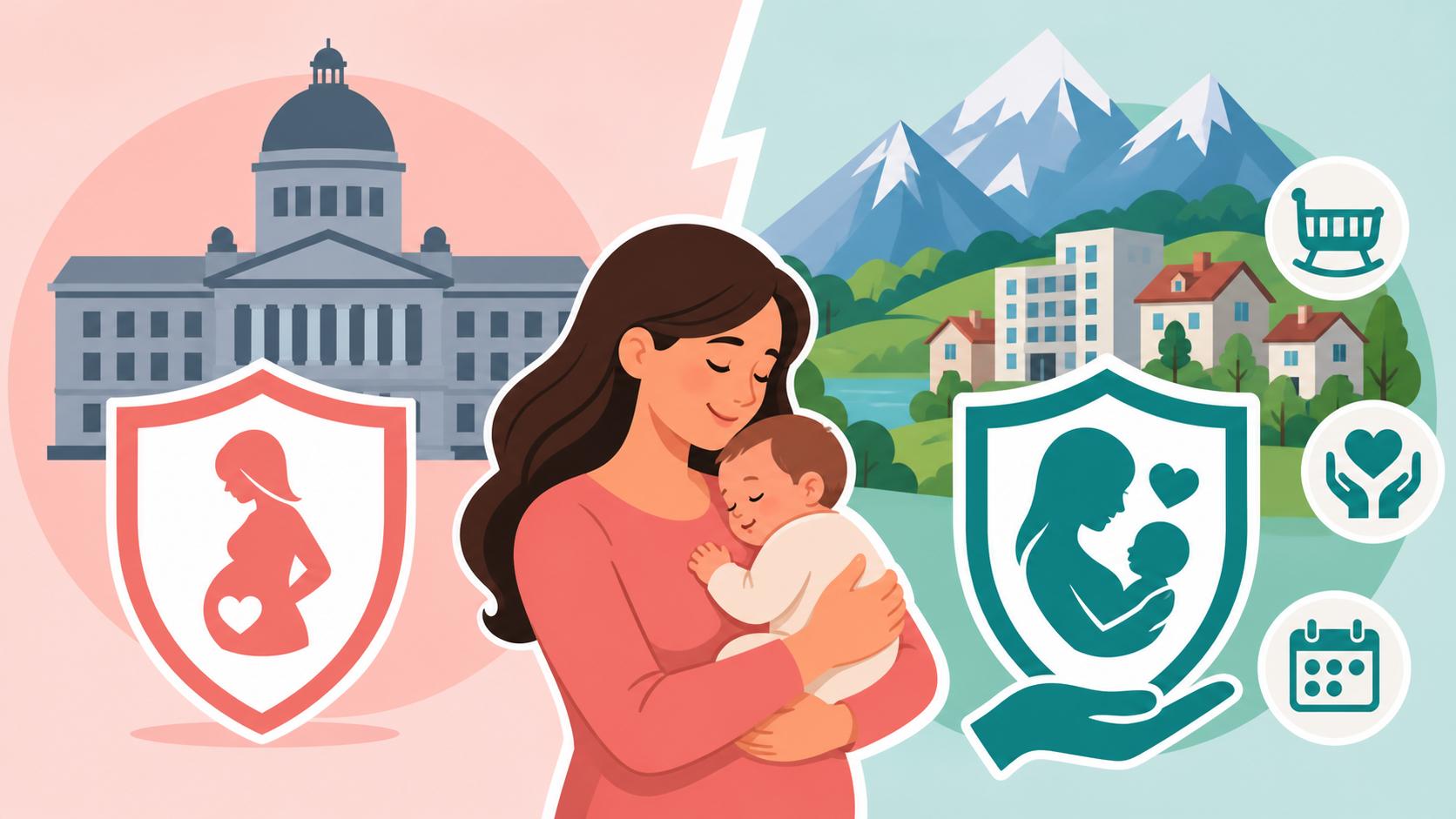
Maternity Leave in Switzerland: 14 Weeks Federal Law vs Cantonal Upgrades
Navigating the arrival of a new family member while working in Switzerland can feel like trying to solve a complex puzzle where the pieces are written in three different languages and the rules change depending on which side of a bridge you work on. I remember the frantic calls to HR when I first realized the federal minimum leave was significantly shorter than what my friends back home were receiving. This guide solves that confusion by detailing the 14-week federal mandate, explaining the generous cantonal upgrades in places like Geneva, and outlining the legal protections you need to know.
The Federal Foundation: 14 Weeks and the 80 Percent Rule
In Switzerland, the baseline for maternity leave is governed by federal law, providing a minimum of 14 weeks (98 days) of leave. This begins the moment the child is born. Unlike some other European nations, there is no legal provision for "pre-natal" maternity leave under the federal insurance scheme; if you need to stop working before the birth due to health reasons, that is typically handled through your employer's sick leave policy or a separate loss-of-earnings insurance. During these 14 weeks, you are entitled to a maternity allowance (Mutterschaftsentschädigung) which covers 80% of your previous average daily income.
However, there is a catch that catches many high-earning expats off guard: the daily allowance is capped. As of 2026, the maximum federal daily allowance is CHF 220 per day. If your 80% salary calculation exceeds this amount, you will only receive the capped amount unless your employment contract specifically states that the employer will "top up" the difference to your full salary or a higher percentage. I have seen many colleagues in the finance and tech sectors shocked to find their income slashed by half during leave because they didn't scrutinize the "Loss of Earnings" clause in their Swiss Work Contracts and Labor Law: Notice Periods, Leave, and Rights. It is vital to check if your company is more generous than the law requires.
To qualify for this federal allowance, you must meet specific social security criteria. You need to have been insured under the Swiss AHV (OASI) for at least nine months before the birth and have worked for at least five months during the pregnancy. This is particularly important for recent arrivals. If you moved to Switzerland in your second trimester, you might find yourself ineligible for the federal payment. In such cases, checking your eligibility for Cantonal Premium Reductions (Prämienverbilligung) for Low-Income Households or other local social aids becomes a necessary backup plan.
Understanding the Mandatory Work Ban
One aspect of the federal law that surprises many is the mandatory work ban. By law, a mother is prohibited from working during the first eight weeks following childbirth. Even if you feel like a "super-parent" and want to jump back into your startup or project, your employer is legally barred from letting you return to the office. This is a health protection measure, and even if you decide to return between week 9 and week 14, you effectively waive the remainder of your maternity allowance for the weeks you choose to work.
During this time, your focus should be entirely on recovery and your newborn. I often suggest to new parents that they use these early weeks to coordinate their future care. This is the time to look into Pediatric Care: Checkups, Vaccination Schedules, and School Health to ensure your baby is on the right track with the Swiss medical system. The administrative load in the first two months is heavy, from registering the birth at the civil registry office to ensuring the baby is added to a health insurance policy.
Eligibility for Self-Employed and Unemployed Mothers
The federal system is relatively inclusive. If you are self-employed, you are still entitled to the maternity allowance, provided you have been paying into the AHV system. You will need to apply through your compensation office (Ausgleichskasse). For those who are unemployed or on disability at the time of birth, you generally remain eligible for the allowance if you were receiving unemployment benefits or met the insurance periods previously.
The application for the allowance isn't automatic. Your employer usually handles the paperwork if you are salaried, but you must provide the birth certificate. If you are a freelancer, you'll be doing the heavy lifting yourself. This is where having a good grasp of the local language helps immensely. If you're in a German-speaking canton, using a resource like GermanPod101 can help you understand the terminology used in those dense government forms.
Cantonal Upgrades: The Geneva and Jura Exceptions
While the federal law sets the floor, Swiss cantons have the right to be more generous. If you are working in Geneva, you are in what many consider the "maternity leave gold mine" of Switzerland. Geneva provides 16 weeks (112 days) of maternity leave. This is funded through a specific cantonal insurance fund (MatE). This extra two weeks can make a world of difference when you are navigating the sleep deprivation of the fourth month.
The eligibility for the Geneva upgrade is similar to the federal rules, but the key is that you must be working in the Canton of Geneva. If you live in Vaud but commute to a job in Geneva, you get the 16 weeks. However, if you live in Geneva but work in a Lausanne-based company, you are typically stuck with the federal 14 weeks unless your employer has a private policy. It is one of those quirks of the Swiss system where your "place of work" dictates your family life more than your "place of residence." Jura has also implemented similar extensions, reflecting a growing trend in the French-speaking regions to provide more robust family support.
The Impact of the Canton of Employment
It is important to understand that these cantonal benefits are linked to the cantonal social insurance contributions (LAPG/MatE) deducted from your monthly payslip. You can see these deductions on your Understanding Swiss Payslips: Deductions for AHV, ALV, and NBU document. If you see a deduction for "Assurance maternité," you are contributing to a fund that likely offers more than the bare federal minimum.
For those residing in the Romandie region, the cultural approach to maternity is often slightly more expansive than in the Swiss-German cantons. If you are looking for medical support during this time, finding a practitioner who understands these cantonal nuances is key. For instance, Finding an English-Speaking Gynecologist in Geneva can provide you with a doctor who is well-versed in the specific paperwork required for the Geneva cantonal allowance.
Comparing Federal vs. Cantonal Benefits
To visualize the differences, let's look at how the mandatory minimums compare across different jurisdictions and common corporate standards in Switzerland.
| Benefit Type | Federal Minimum | Geneva Cantonal Law | Typical Multinational (e.g., Novartis/Google) |
|---|---|---|---|
| Duration | 14 Weeks (98 days) | 16 Weeks (112 days) | 18 – 26 Weeks |
| Salary % | 80% | 80% | 100% |
| Daily Cap | CHF 220 | CHF 329.60 (Variable) | Often no cap for full salary |
| Paternity | 2 Weeks | 2 Weeks (plus private) | 4 – 12 Weeks |
The Move Toward Equality in Jura and Beyond
Jura has been a pioneer in advocating for longer leave, often pushing for 20 weeks in political discussions. While the current mandate sits closer to Geneva's, the political climate in these cantons is much more favorable to parental leave extensions. If you are considering a move for a job, these "hidden" benefits are worth calculating into your total compensation package. A few extra weeks of 80% pay is a significant financial asset when you consider the high cost of Maternity and Child Healthcare in Switzerland: From Pregnancy to Pediatrics.
Returning to Work: Rights and Part-Time Realities
One of the greatest fears for expat mothers is the "return to office" conversation. Swiss law provides a protective period where you cannot be terminated. Specifically, an employer cannot give you notice of termination during your pregnancy and for 16 weeks after you give birth. This protection is absolute, meaning even if the company is restructuring, your position is legally shielded during this window.
When the 14 or 16 weeks are up, many mothers choose not to return at "100% workload." In Switzerland, working 60% or 80% is incredibly common and culturally accepted. However, you do not have a legal right to demand a reduction in your percentage unless your contract or a collective labor agreement (GAV) specifies it. You must negotiate this. I recommend starting this conversation early—usually in the second trimester. For a deep dive into how these workloads function, see our guide on Working Models: Part-Time Percentages (e.g., 80% Workload) Explained.
Breastfeeding Protections in the Workplace
If you return to work while still breastfeeding, Swiss law is surprisingly supportive. During the first year of your child's life, the time you spend breastfeeding or pumping during the workday is counted as paid working time, up to certain limits. For a workday of up to 4 hours, you get 30 minutes of paid time. For more than 4 hours, you get 60 minutes, and for a full day (over 7 hours), you get 90 minutes.
Your employer must also provide a "suitable room" for pumping—it cannot be a bathroom stall. It should be a private, lockable space with a comfortable chair. In my experience, smaller Swiss "KMUs" (small businesses) might be unaware of these rules, so you may need to gently point them to the Federal Labor Act. Knowing how to express these needs professionally is vital; if you're in a French-speaking canton, practicing your phrasing with FrenchPod101 can give you the confidence to stand up for these rights.
Financial Planning for the Gap
If you decide to take an extra few months of unpaid leave (which many Swiss employers allow), you must plan for the social security gap. When you are on unpaid leave, you are not contributing to your pension (Pillar 2). You might want to look into making voluntary contributions or utilizing your Pillar 3a in 2026: Tax Deductions, Limits, and Investment Options to bridge the retirement savings gap.
Additionally, remember that while you are on maternity leave, your health insurance situation remains active. A great relief for many is that maternity-related medical costs (from the 13th week of pregnancy through to 10 weeks post-birth) are exempt from the franchise and the 10% copay. This means your checkups, the birth itself, and postpartum care are essentially "free" at the point of service. To understand why this is such a big deal, read about The Swiss Franchise System: How Deductibles and Copays Work.
Health, Language, and Administrative Milestones
The period of maternity leave is also the window where you must finalize your child's legal status in Switzerland. You have a maximum of 90 days to register your newborn for health insurance. This is a non-negotiable deadline. If you miss it, you may face fines and a gap in coverage. Many parents choose the same provider as their own for ease, but you are free to shop around. Check our checklist on Mandatory Registration: How to Sign Up for Health Insurance Within 90 Days to ensure you don't miss a beat.
During your leave, you might also find that your social circle shifts. Joining local "Mutter-Kind-Turnen" (mother-child gymnastics) or local meetups is the best way to integrate. However, these are almost exclusively conducted in the local language. If you've been relying on English at your multinational job, now is the time to bridge the gap. Programs like Lingoda offer online classes that you can take during the baby's nap time, allowing you to improve your German or French without leaving the house.
Finding Support at Home
The "Hebamme" (midwife) system in Switzerland is a lifesaver. You are entitled to a certain number of home visits from a midwife after the birth, covered by your basic insurance. They help with everything from breastfeeding support to checking the baby's weight and your physical recovery. If you are in the Neuchâtel area, for example, you should start Finding an English-Speaking Midwife in Neuchâtel as early as your 20th week of pregnancy, as they book up incredibly fast.
These midwives also help you navigate the "Mütter- und Väterberatung" (Mother and Father Advisory Services), which are free clinics offered by the communes for regular weight checks and developmental advice. It’s a wonderful way to meet other parents in your neighborhood. If your German is still a work in progress, having a few phrases ready from a tool like GermanPod101 can make those first few visits much less stressful.
Summary of Actionable Steps for Expecting Parents
- Review your employment contract for "Daily Allowance" caps and "Top-up" policies.
- If working in Geneva, confirm your eligibility for the 112-day cantonal benefit.
- Apply for the maternity allowance through your HR department or compensation office immediately after birth.
- Secure a midwife (Hebamme) at least 4-5 months before your due date.
- Register your child for health insurance within the 90-day window.
- Discuss "Return to Work" percentages (e.g., 60% or 80%) before you go on leave.
Switzerland's maternity system is a blend of rigid federal rules and flexible cantonal and corporate additions. By understanding where you stand in this hierarchy, you can focus on what truly matters: your new baby and your own recovery.
Disclaimer
This article is for informational purposes only and does not constitute legal or financial advice. Swiss laws and cantonal regulations regarding maternity leave and insurance are subject to change. Always consult with your HR department, the official cantonal social security office (SVA/OCAS), or a qualified legal professional regarding your specific situation.