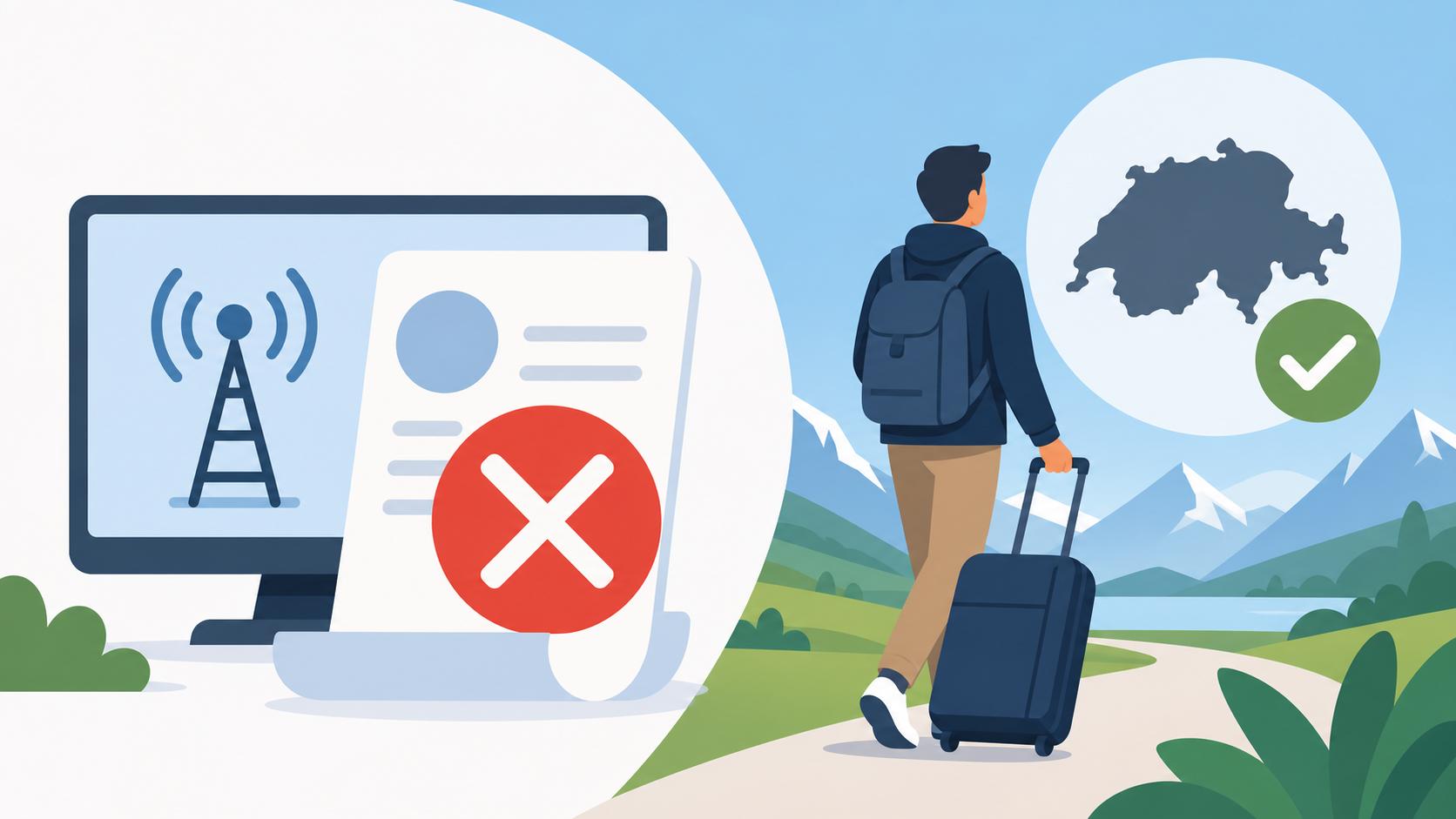
How to Cancel the Serafe Fee When Leaving Switzerland Permanently
Leaving Switzerland is an emotional rollercoaster, but the paperwork is a full-blown marathon. I remember the frantic final weeks in Zurich, balancing a high-pressure cleaning inspection with a mountain of cancellation letters. The Serafe fee—that mandatory media tax—often catches expats off guard because it follows you unless you proactively cut the cord. This guide provides the exact steps to cancel your Serafe obligation so you don't leave a trail of debt behind you.
Understanding the Serafe Mandate for Departing Residents
The Swiss radio and television fee, managed by Serafe AG, is a mandatory household tax that every resident is required to pay, regardless of whether you actually own a television or listen to the radio. As of 2026, the fee stands at CHF 335 per year. The most important thing to realize is that Serafe does not operate on a subscription model where you can simply "log in" and click a cancel button. Instead, their system is inextricably linked to the municipal population registers.
When you first arrived, you likely didn't even "sign up" for Serafe; the billing started because your local Registering Your Address at the Kreisbüro Within 14 Days of Moving triggered a notification to the billing office. Consequently, the only way to stop the billing is to reverse that official status. If you simply move out of your apartment and hop on a plane, the bills will continue to accrue at your old address, eventually leading to legal complications and entries in the Swiss debt register, which can haunt you if you ever decide to return to the Schengen area.
The fee is billed per household, not per person. This nuance is critical if you are living in a WG (shared apartment). In a shared living situation, one person is designated as the "head of household" for billing purposes. If that person is you, and you are the one leaving, you cannot simply cancel the fee; you must ensure the obligation is transferred to a remaining flatmate. Understanding these distinctions is the first step toward a clean break from the Swiss administrative system.
The Official Abmeldung and Its Impact on Media Fees
The linchpin of your exit strategy is the Abmeldung (de-registration) process at your local commune or city hall. In Switzerland, you cannot officially "leave" without telling the authorities exactly where you are going. This process usually happens within 30 days of your departure date. When you visit the Leaving Switzerland Permanently: The Abmeldung Process at City Hall, you will receive a document known as the Abmeldebestätigung (confirmation of de-registration).
This piece of paper is your "golden ticket." It is the legal proof that you no longer reside in Switzerland. Once the municipality updates your status to "moved abroad," this data is electronically transmitted to Serafe AG. In theory, the cancellation should happen automatically based on this data exchange. However, Swiss bureaucracy, while efficient, is not infallible. I have seen cases where the data link fails, and the expat receives a bill at their new international address months later.
To prevent this, you should keep a digital scan of your de-registration confirmation. If a bill arrives after your departure, you will need to email a copy of this document to Serafe’s customer service. They are generally quite reasonable once they see the official stamp from the Einwohneramt. Keep in mind that your liability for the fee ends exactly on the day your residency officially terminates. If you leave on the 15th of the month, you are only liable for the pro-rata portion of the year up to that date.
Handling the Final Pro-Rata Bill
Since Serafe bills annually, you have likely already paid for a full twelve months at some point during the year. When you de-register, Serafe will calculate exactly how many days you were a resident during the current billing period. If you have overpaid, you are entitled to a refund. If you have underpaid, they will send a final pro-rata invoice to your last known address or your new address abroad.
Managing these final Swiss franc payments can be a headache once you have closed your local bank account. This is where using a service like Wise becomes invaluable. Many expats rush to close their UBS or Credit Suisse accounts the moment they leave, only to realize they still have a final Serafe bill or a Nebenkostenabrechnung: Why You Might Owe Extra Heating Costs arriving weeks later. By keeping a multi-currency account with Wise, you can maintain a CHF balance and pay these final bills via QR-slip without incurring massive international transfer fees or currency exchange markups.
If you are expecting a refund from Serafe, you must provide them with an IBAN. While they prefer a Swiss bank account, they can often transfer to international accounts, though the fees might eat up a portion of your refund. Providing a Wise IBAN is often the smoothest path, as it looks like a local transaction to their system. Ensuring your final financial footprint is clean is essential for maintaining a good Betreibungsauszug: Checking Your Debt Register Extract for the future.
| Scenario | Action Required | Expected Outcome |
|---|---|---|
| Leaving Switzerland alone | Complete Abmeldung at City Hall | Automatic cancellation; final pro-rata bill or refund |
| Leaving a shared flat (WG) | Notify Serafe to change the billing name | Liability transfers to remaining flatmates |
| Moving to another Swiss Canton | Update address at the new Kreisbüro | Billing continues seamlessly at the new address |
| Temporary departure (Sabbatical) | Check "Freezing" options for permits | Usually, the fee remains mandatory if residency is kept |
Managing Assets and Investments During the Move
As you prepare to cancel your local services, you should also be looking at your broader financial exit strategy. Leaving Switzerland often means moving significant amounts of savings. If you have been investing while living in the Alps, you might be considering where to park your capital once your Swiss brokerage accounts are closed. For those moving back to the EU, platforms like Trade Republic offer a great way to continue investing with low fees and competitive interest rates on uninvested cash, which is a significant step up from the near-zero rates at many traditional Swiss cantonal banks.
For the more technologically inclined expat, moving assets through Binance can be a method to handle cross-border wealth transfer, provided you are fully aware of the Crypto Taxation in Switzerland: Declaring Bitcoin and Staking Rewards rules before you lose your Swiss tax residency status. Switzerland is famously crypto-friendly, but once you move to a country with more stringent capital gains taxes, the timing of your "exit" from these assets becomes a major tax planning point.
Remember that your tax liability doesn't just end with Serafe. You will likely need to deal with Filing a Swiss Tax Return (C Permit or High Earners on B Permit) for the partial year you were resident. This final tax "rectification" will look at your total income and assets up to the day you left. Clear documentation of your final Serafe payment and other Cost of Living Realities: Groceries, Telecoms, and Household Expenses can sometimes be relevant if you are claiming specific deductions for the year.
Common Complications with Shared Households and eBills
One of the most frequent points of confusion occurs when an expat lives in a household where multiple people are listed on the lease, but only one receives the Serafe bill. If the person whose name is on the bill leaves, but others stay, the household is still liable. In this case, you must contact Serafe to "transfer" the account to one of the remaining residents. If you don't do this, the bill will continue to be generated in your name, and when it goes unpaid, the legal reminders will be issued against you personally, not the apartment.
Another pitfall is the Swiss eBill system. Many of us set up eBills to avoid the paper clutter of QR-slips. When you prepare to leave, remember that your eBill access is tied to your Swiss bank account. If you close your bank account before the final Serafe invoice is issued, you might never see the bill. It won't arrive in the mail, and it won't be in your inbox—it will just sit in a "pending" state in a closed banking portal until it turns into a legal demand.
I highly recommend switching your Serafe delivery method back to "paper" or "email" at least two months before you leave. This ensures that the final bill follows you correctly. Dealing with a Betreibung: How an Unpaid Bill Ruins Your Swiss Credit Score from abroad is a nightmare of international phone calls and registered letters. It’s far better to spend ten minutes now updating your communication preferences than ten hours later trying to clear your name from a debt register.
Final Steps for a Clean Administrative Exit
Before you hand over your keys and complete the Apartment Handovers (Wohnungsübergabe): Protocols and Deposits, do a final sweep of your digital life. Check your Serafe account balance one last time. If you have been paying via standing order or Lastschriftverfahren (LSV), cancel those authorizations through your bank. While the Abmeldung should stop the billing, an active LSV can sometimes trigger a final, incorrect payment that you then have to fight to get back.
As you navigate these final weeks, keep in mind that the Swiss system relies heavily on the "last known address." If you haven't yet secured a permanent home in your destination country, use the address of a trusted family member or a virtual mailbox service. This ensures that the Swiss Everyday Rules: Recycling, Quiet Hours, and Neighborhood Etiquette and administrative finalities—including your final tax assessment and Serafe settlement—actually reach you.
Expat life in Switzerland is defined by its rules, and the exit is no different. By being meticulous with your de-registration and proactive with your final payments via Wise, you can ensure that your memories of the mountains aren't soured by a lingering dispute over a media tax. If you are moving long-distance, you might also want to look into Leaving Switzerland: Freezing Your C Permit (Aufrechterhaltung) for 4 Years if you think there is even a small chance you might return, as it keeps your residency options open while you settle elsewhere.
Leaving the Church and Other "Hidden" Taxes
While you are focused on Serafe, don't forget the other municipality-linked "subscription" that many expats inadvertently join: the church tax. If you declared a religion when you first registered at the Kreisbüro, a portion of your income tax has been going to the local parish. Unlike Serafe, which is a federal mandate, the church tax is cantonal, and simply leaving the country doesn't always automatically "cancel" your membership in the eyes of the church authorities.
You should consider How to Officially Leave the Church in Switzerland to Stop Kirchensteuer as a separate but parallel task to your Serafe cancellation. Much like the media fee, the church tax is calculated pro-rata. Ensuring you have officially "resigned" before your Abmeldung date can save you a surprising amount of money in your final tax bill. Switzerland is a country where every detail of your civil status has a financial implication, and the "exit" phase is the time to tighten every loose screw.
Finally, keep a folder (physical or digital) containing your final Serafe receipt, your de-registration confirmation, and your final Swiss bank statement. In five years, if you apply for a new Swiss work permit or a Schengen Visa (Type C): Tourist and Short-Business Rules for TCNs, having proof that you settled all your "public debts" will make the process infinitely smoother. The peace of mind of knowing you owe nothing to the Swiss Confederation is the best souvenir you can take with you.
Disclaimer
This guide is provided for informational purposes only and does not constitute legal or financial advice. Swiss administrative procedures and fees, such as those managed by Serafe AG, are subject to change by federal or cantonal authorities. Always verify the current requirements with your local Einwohneramt or the official Serafe website before finalizing your departure. The author is not responsible for any legal repercussions or debts incurred due to a failure to follow official de-registration protocols.