Claiming AHV Refunds for US and Indian Citizens: Bilateral Agreements
Leaving Switzerland often feels like a mix of bittersweet goodbyes and a mountain of paperwork that never seems to end. I remember the sheer confusion of my last few months in Zurich, staring at my pay slips and wondering if the thousands of francs I’d contributed to the state pension system would simply vanish into the Alpine air once I boarded my flight. This guide settles that anxiety by detailing exactly how US and Indian citizens can navigate bilateral social security agreements to reclaim or utilize their AHV contributions.
The Reality of the Swiss First Pillar for Expats
When you look at your monthly pay slip, that deduction labeled AHV (Alters- und Hinterlassenenversicherung) or AVS in French is your contribution to the Swiss Old-Age and Survivors' Insurance. It is the mandatory 1st pillar of the Swiss social security system. For many expats, this feels like a "black hole" tax because the benefits often seem tied to a retirement age that feels decades away in a country you might only inhabit for a few years.
However, Switzerland has entered into specific social security agreements with various countries to ensure that workers do not lose their contributions when they move across borders. These agreements are designed to prevent "double dipping" or, more importantly, to ensure you aren't paying into two systems simultaneously without receiving the full benefit of either. While you might be focused on the immediate Cost of Living in Switzerland 2026: Budgeting for Singles and Families, understanding these long-term assets is vital for your global net worth.
The rules for US and Indian citizens are distinct from those governing EU/EFTA nationals. Because these two countries have comprehensive bilateral agreements with the Swiss Confederation, the process isn't a simple "cash out" in every scenario. Instead, it’s a structured legal pathway that requires specific documentation and a lot of patience with the Swiss Compensation Office (SAK) in Geneva.
US-Swiss Bilateral Agreement: The Totalization Principle
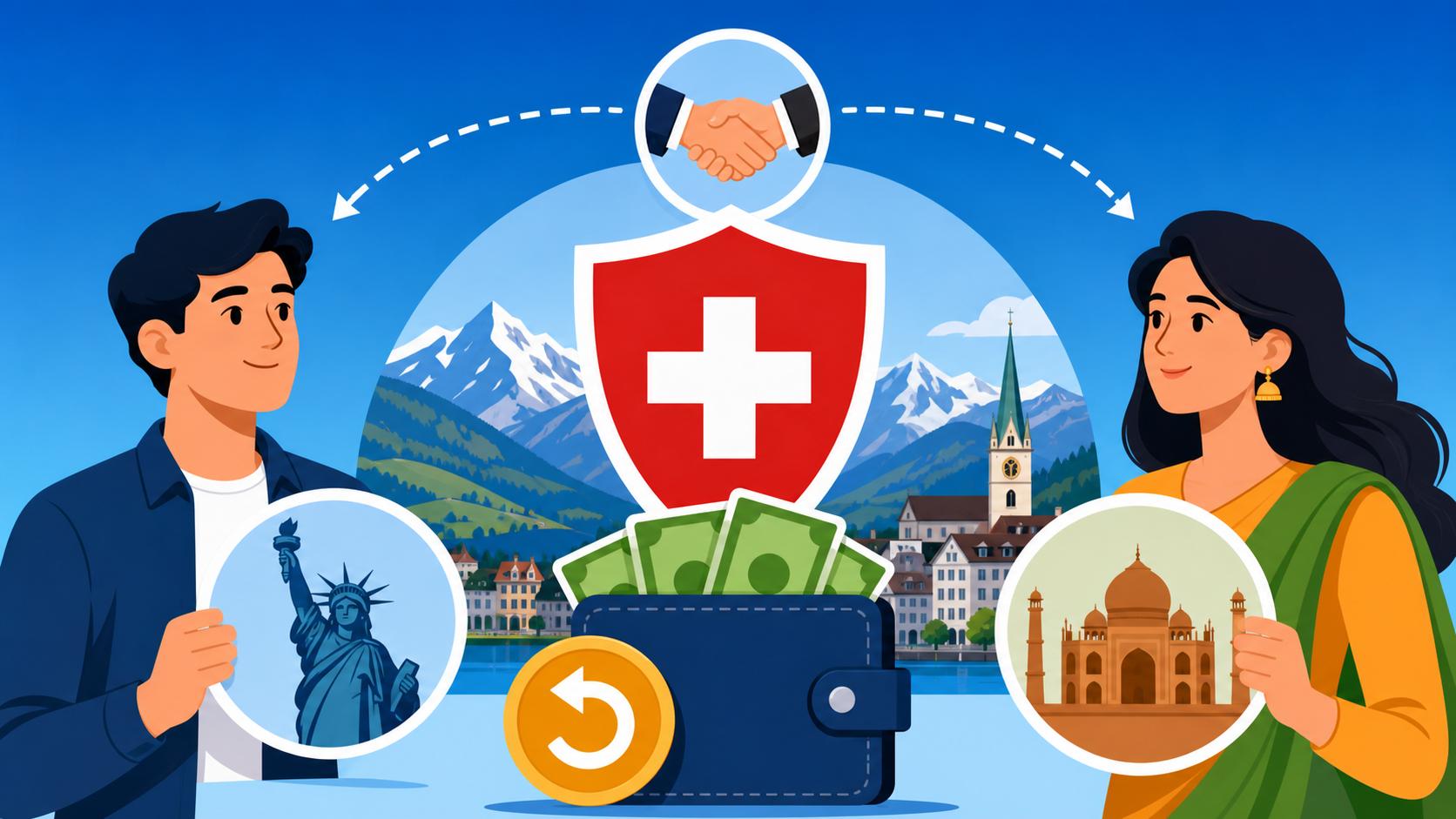
For Americans living in Switzerland, the term you need to memorize is "Totalization." The United States and Switzerland signed an agreement to ensure that workers who split their careers between the two countries don't end up with gaps in their social security coverage. If you are a US citizen, you generally cannot get a cash refund of your AHV contributions. This is a point of major frustration for many, but it is actually designed to protect your retirement.
Instead of a lump-sum check, your Swiss "insurance years" are credited toward your US Social Security record. If you haven't worked enough years in the US to qualify for Social Security (usually 40 quarters or 10 years), your Swiss years can be "totalized" to help you meet that threshold. Conversely, if you retire in the US, you can actually draw a partial Swiss pension even while living in the States, provided you contributed for at least one full year.
Understanding this is crucial when you are reviewing your Understanding Your Swiss Salary Certificate (Lohnausweis) for Tax Season. The AHV amounts listed there aren't just lost taxes; they are future credits. To claim these benefits later in life, you don't deal with the Swiss authorities directly during your departure; instead, you apply through the US Social Security Administration when you reach retirement age, and they coordinate the "totalization" with the SAK in Geneva.
Indian-Swiss Bilateral Agreement: A Different Path
The situation for Indian citizens changed significantly with the 2011 social security agreement between India and Switzerland. Unlike the American system, Indian nationals who leave Switzerland permanently often have the option to apply for a cash refund of their AHV contributions. This makes the departure process for Indian tech professionals and specialists quite different from their American counterparts.
To qualify for a refund, you must definitively leave Switzerland and be a resident of India. You also cannot have already started receiving a Swiss pension. This refund consists of the "employee share" of the contributions you paid during your tenure. It is a significant financial injection that many use to jumpstart their lives back home or invest in the Indian market. Many Indian expats choose to move their refunded Swiss francs using services like Wise to ensure they get a fair exchange rate when converting to INR, rather than letting traditional banks take a heavy commission.
However, there is a catch. If you take the cash refund, you effectively "wipe out" those insurance years in Switzerland. You cannot later use those years to claim a Swiss pension, nor will they count toward your Indian social security records in most cases. It is a one-time exit strategy. I’ve seen many friends from Bangalore agonize over this decision—take the cash now or wait for a small monthly pension in thirty years? Most choose the cash, but it’s a decision that requires looking at your long-term retirement goals.
The 5-Year Rule and Minimum Contribution Periods
Regardless of whether you are from Chicago or Chennai, Switzerland generally requires a minimum of one full year of contributions to even enter the conversation about benefits or refunds. If you worked a summer job for three months and left, those contributions are likely gone.
For many non-EU/EFTA citizens, there is also the concept of The 5-Year Rule: Claiming an AHV Refund for Non-EU/EFTA Citizens. This rule often acts as a threshold for how the Swiss authorities view your "integration" into the social system. If you stay longer than five years, the administrative path can sometimes shift, especially regarding your eligibility for a C permit or how your 2nd pillar (LPP/BVG) is handled.
While the 1st pillar (AHV) is dictated by bilateral agreements, your 2nd pillar (company pension) is much more flexible. When you leave Switzerland for a non-EU country like the US or India, you can usually cash out the entire "extra-mandatory" and "mandatory" portion of your 2nd pillar. This is often a much larger sum of money than the AHV refund. Many expats take this lump sum and reinvest it into diverse portfolios, using platforms like Trade Republic for European equities or Binance for digital assets, depending on their risk tolerance and local tax laws.
Step-by-Step Guide to the Application Process
If you are an Indian citizen eligible for a refund, or a US citizen preparing your records for future totalization, the process begins months before you actually leave. You cannot simply walk into an office and demand your money.
- De-registration (Abmeldung): You must officially de-register from your local Gemeinde (municipality). You will receive a document (Abmeldebescheinigung) which is the "golden ticket" for all your financial exits. You can't get your AHV refund without it.
- The SAK Application: You will need to fill out Form E-202 (for the US) or the specific refund application for India. This form asks for your AHV number (the 13-digit number on your insurance card) and your employment history.
- Bank Details: You need to provide a bank account where the funds can be sent. I always recommend having a multi-currency account ready. Using a service like Wise can save you hundreds of francs in "receiving fees" that traditional Swiss or Indian banks might charge for large international transfers.
- The Waiting Game: Once you submit your application to the Swiss Compensation Office in Geneva, expect to wait anywhere from 4 to 9 months. The Swiss are thorough, and they will verify every month of contribution with your former employers.
| Feature | US Citizens (Bilateral Agreement) | Indian Citizens (Bilateral Agreement) |
|---|---|---|
| Cash Refund Possible? | Generally No | Yes, upon permanent departure |
| Minimum Contribution | 1 Year | 1 Year |
| Benefit Type | Totalization (Credits to US SS) | Cash Refund or Future Pension |
| Where to Apply? | US Social Security Admin | SAK Geneva (via Form) |
| Impact on Retirement | Years count toward US record | Refund wipes out Swiss record |
Common Pitfalls and "Veteran" Tips
One thing no one tells you is that your AHV refund (for Indians) or the eventual pension draw (for Americans) is subject to "Withholding Tax" (Quellensteuer) depending on the canton where your last employer was based. You don't get 100% of the nominal value; the Swiss government takes a slice before it leaves the country. However, depending on the Double Taxation Agreement (DTA) between Switzerland and your home country, you might be able to claim some of that tax back.
Another hurdle is the Leaving Switzerland Financially: Closing Accounts and Pension Payouts process. Do not close your Swiss bank account the day you leave. Keep it open for at least six months. While some institutions like PostFinance: The Best Option if Traditional Banks Reject You are more expat-friendly for those living abroad, having a local account makes the final salary payments and minor utility refunds much smoother. If you must close it, ensure your Opening a Swiss Bank Account: UBS, ZKB, PostFinance, and Neobanks replacement in your home country can accept CHF transfers without converting them at a terrible rate.
For Americans, the "Windfall Elimination Provision" (WEP) is something to watch out for. If you receive a pension from a job where you didn't pay US Social Security taxes (like your Swiss job), it could reduce your US Social Security benefits. This is why totalization is so important—it helps mitigate the impact of the WEP by proving you were part of a coordinated international system.
Reinvesting Your Exit Capital
Once the funds finally hit your account, the temptation is to let them sit in a savings account. However, if you've been living in Switzerland, you've likely become accustomed to a high-inflation-resistant currency. Moving that money into a volatile environment requires a plan. Many savvy expats use a portion of their Cashing Out Pillar 2 Completely When Moving to a Non-EU Country funds to diversify.
If you are moving back to the US, you might look at IRA contributions. If you are heading to India, the NRE/NRO account system is your primary tool. Regardless of your destination, using a neobank can help manage the transition. Many people compare Best Neobanks in Switzerland: Neon, Yuh, and Zak Compared but find that once they are outside the borders, they need a truly global platform like Wise to bridge the gap between their Swiss past and their international future.
For those interested in more modern assets, some choose to allocate a small percentage of their refund into crypto via Binance to maintain a high-growth "bucket" in their portfolio. Others prefer the steady hand of Trade Republic for automated savings plans in ETFs. The key is not to let the "found money" of a pension refund disappear into lifestyle inflation. Treat it as the retirement capital it was always meant to be.
Final Administrative Checks
Before you board that flight from Zurich or Geneva, make sure you have physical and digital copies of your AHV card and every single Lohnausweis from your time in the country. If there is a discrepancy in your contribution record five years from now, having that paper trail is the only way to resolve it with the SAK.
The Swiss system is remarkably fair, but it is also remarkably rigid. They won't "forget" to pay you, but they also won't chase you down to give you your money. The burden of application is entirely on you. By understanding the nuances of the US and Indian bilateral agreements, you can ensure that your years of hard work in the shadows of the Alps continue to pay dividends long after you've said your last "Grüezi."
Disclaimer
This article is for informational purposes only and does not constitute official legal, financial, or tax advice. Social security regulations and bilateral agreements are subject to change. Always consult with the Swiss Compensation Office (SAK), the US Social Security Administration, or a qualified tax professional specializing in cross-border transitions before making decisions regarding your pension funds.