Converting a US Driver’s License in Switzerland: Test Flights and Deadlines
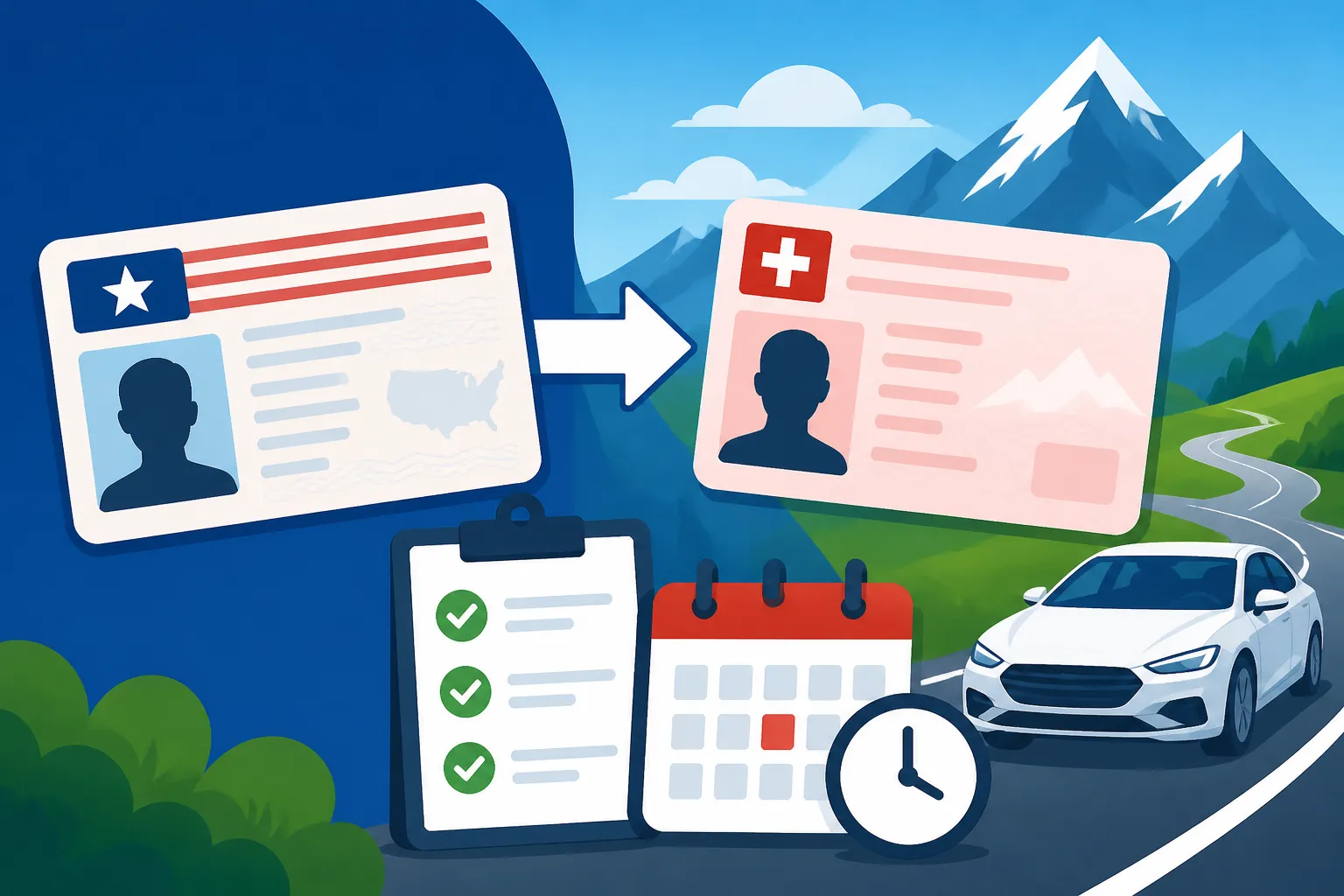
The clock starts ticking the moment you register your residency in Switzerland, and for many Americans, the realization that their US driver’s license has an expiration date on Swiss soil is a major source of anxiety. I remember staring at my California license during my first month in Zurich, thinking I had all the time in the world, only to realize that the "one-year rule" is one of the strictest administrative deadlines you will face. This guide breaks down exactly how to navigate the conversion process, survive the dreaded practical test, and ensure you don’t lose your right to hit the Autobahn.
The 12-Month Grace Period and Why the Deadline is Dangerous
When you first arrive, Switzerland is incredibly generous. You can drive on your valid US license for exactly 12 months from your date of entry, provided you are at least 18 years old. However, this generosity is a double-edged sword. Many expats get lulled into a false sense of security, enjoying the efficiency of the SBB trains and only realizing in month 11 that they need to swap their license.
If you miss this 12-month window, you cannot simply "exchange" your license anymore. You might be forced to go through the entire Swiss driving school process from scratch, which includes first-aid courses, theory exams, and dozens of expensive driving lessons. This is particularly relevant if you are here on certain Residence Permits in Switzerland: L, B, C, and G Permits Explained because the authorities will track your arrival date via your registration.
The danger of waiting until the last minute is the "Kontrollfahrt" or control drive. Because the US does not have a federal reciprocity agreement with Switzerland (unlike most EU countries), American drivers are usually required to pass a 30-45 minute practical driving test to prove they can handle Swiss roads. If you schedule this test in your 11th month and fail, you are immediately banned from driving in Switzerland. There are no second chances for the Kontrollfahrt. If you fail, your US license is no longer recognized for driving here, and you must start the full Swiss licensing process as if you were a teenager.
Gathering Your Paperwork and Navigating the Strassenverkehrsamt
Before you even think about getting behind the wheel for a test, you need to tackle the bureaucracy. Each canton has its own Road Traffic Office, known as the Strassenverkehrsamt in German-speaking areas or the Office cantonal des véhicules in French-speaking regions. If you are living in Zurich, you’ll likely head to the massive Albisgütli office; in Geneva, it’s the office in Carouge.
You must apply in person, and the list of requirements is specific. You cannot just mail this in. You will need:
- The official application form (available on your canton’s website).
- Your original US driver's license.
- A certified translation if your license doesn't clearly state the vehicle categories in a way the Swiss recognize (though most modern US licenses are accepted as-is).
- Your Swiss residence permit.
- Two passport-sized color photos that meet the high-quality biometric standards.
- A professional eye test.
The eye test is a mandatory step that often surprises newcomers. You can’t just use a result from an American doctor. You must go to a certified Swiss optician—names like Fielmann or Visilab are everywhere—and tell them you need a "Sehtest" for a driver's license. They will perform a quick exam, stamp your application form, and charge you around CHF 20. This must be done within 24 months of your application. You should handle this shortly after Registering Your Address at the Kreisbüro Within 14 Days of Moving to get the ball rolling early.
The Kontrollfahrt: The Most Stressful 45 Minutes of Your Move
For Americans, the Converting Your Foreign Driver's License to a Swiss Fahrausweis process is rarely a simple "paper swap." Unless you are very lucky or in a specific category, you will be summoned for a Kontrollfahrt. Do not let the "Control Drive" name fool you; it is a rigorous practical exam with a Swiss expert sitting next to you, judging your every move.
The most common reason Americans fail this test is not because they are bad drivers, but because they drive like Americans. In the US, we are used to wide roads, rolling stops, and a general lack of aggressive "priority from the right" rules. In Switzerland, the rules are clinical. One of the biggest hurdles is the "Rechtsvortritt" (priority from the right). In any residential area without stop signs or traffic lights, the car coming from the right always has the right of way. If you breeze past a side street on your right without visibly turning your head to check for oncoming traffic, you will fail instantly.
Another common pitfall is the roundabout. Swiss roundabouts are tight and require precise signaling. You do not signal when entering, but you must signal right the moment you pass the exit before the one you intend to take. If your signaling is sloppy, the examiner will mark it as a safety violation. During my own test in Zurich, the examiner was silent for 40 minutes, only speaking to tell me to turn. The pressure is immense because, as mentioned, failing means you lose your driving privileges on the spot.
Preparing for the Test: Why You Must Hire an Instructor
I cannot stress this enough: do not attempt the Kontrollfahrt without at least two or three private lessons with a local Swiss driving instructor. Even if you have been driving for 30 years in Chicago or Los Angeles, you are not prepared for the nuances of Driving in Switzerland: Licenses, Buying Cars, and Strict Traffic Laws.
A local instructor knows the exact routes the examiners at the Strassenverkehrsamt use. They will take you through the tricky intersections, the hidden 30 km/h zones, and the tram-heavy streets where one wrong move across a yellow line can end your session. They will teach you the "shoulder check" (Schulterblick), which must be exaggerated and frequent. In Switzerland, if you change lanes or turn without a visible, dramatic look over your shoulder, you are considered a hazard.
Instructors usually charge between CHF 90 and CHF 120 per hour. It is a steep price, but compared to the cost of SBB Travelcards: Is the Generalabonnement (GA) Worth the CHF 4000+ Cost? or the thousands of francs required to take the full Swiss driving course, it is a mandatory investment. Many instructors speak English, especially in expat hubs like Zug or Basel. When you are searching for housing on platforms like HousingAnywhere, consider looking for areas with easy access to driving schools so you can practice in the environment where you will actually be tested.
Administrative Costs and Practical Comparisons
Converting your license isn't just mentally taxing; it’s a financial commitment. Between the application fees, the eye test, the lessons, and the issuance of the actual credit-card-sized Swiss license, you should budget at least CHF 500 to CHF 800.
| Item | Estimated Cost (CHF) | Frequency/Notes |
|---|---|---|
| Eye Test (Optician) | 20 – 30 | Mandatory for all applicants |
| Passport Photos | 15 – 25 | Must meet biometric standards |
| Application/Exchange Fee | 100 – 150 | Varies by Canton (e.g., Zurich vs Geneva) |
| Driving Lessons (Recommended) | 100 per hour | At least 2-3 lessons are advised |
| Kontrollfahrt (Test Fee) | 120 – 180 | The official examiner's fee |
| Final Swiss License Card | 50 – 80 | Mailed to your home after passing |
While you wait for your test date, make sure your phone is equipped with a local data plan or an eSIM from Airalo so you can use GPS during your practice sessions. Note, however, that you are absolutely forbidden from using a handheld phone or even a poorly placed GPS unit during the actual Kontrollfahrt. Everything must be hands-free and compliant with local regulations.
Life After the Conversion: Buying a Car and Staying Legal
Once you pass your test and receive that beautiful Swiss license, the real fun begins. You can now legally drive any vehicle in the category you were granted (usually Category B for passenger cars). This opens up the possibility of Buying a Car: Leasing, Autoscout24, and Mandatory Auto Insurance. Remember that Swiss car ownership comes with its own set of rules, including the mandatory Swiss Autobahn Vignette: E-Vignette vs Physical Sticker for 2026 which you need to drive on the national highways.
Having a Swiss license also changes your relationship with the law. You are now fully integrated into the Swiss system, meaning any Speeding Tickets in Switzerland: Income-Based Fines and Strict Radars will be linked directly to your Swiss record. Unlike in many US states, speeding here is treated with extreme severity, and fines are often calculated based on your income if you are caught significantly over the limit.
If you decide not to buy a car immediately, having the license is still vital for car-sharing services like Mobility or for renting vehicles when you need to pick up furniture from Amazon Germany or local stores. It also serves as an official form of ID within the country, though it does not replace your residence permit.
Staying Insured and Avoiding Liability Traps
One of the most overlooked aspects of the 12-month transition is insurance. If you are driving on your US license in month 13 without having initiated the conversion, your Private Liability Insurance (Privathaftpflicht): Why Expats Need It may refuse to cover you in the event of an accident. They will argue that you were driving without a valid permit, which is a breach of contract.
This is a nightmare scenario. Swiss medical and repair costs are astronomical. If you cause an accident while "unlicensed" due to a missed deadline, you could be personally liable for hundreds of thousands of francs. This is why following the Swiss Everyday Rules: Recycling, Quiet Hours, and Neighborhood Etiquette and administrative timelines is so crucial for your financial health.
Essential Tips for the Day of Your Test
When your test day finally arrives, show up early at the Strassenverkehrsamt. Ensure the car you are using—whether it's your own or your instructor's—is impeccably clean and meets all safety requirements. The examiner will check your lights, tires, and mirrors before you even leave the parking lot.
Wear comfortable shoes and try to stay calm. The examiners aren't there to trick you, but they are there to ensure you won't be a danger to the many pedestrians and cyclists who share the Swiss roads. Remember that pedestrians always have the absolute right of way at yellow "Zebras" (crosswalks). If a pedestrian even looks like they are thinking about stepping onto the crosswalk and you don't slow down to a crawl or stop, you will fail.
After you pass, the examiner will usually give you a temporary paper permit on the spot, and your permanent credit-card-style license will arrive in the mail within a week. It’s a moment of massive relief—one of those "I finally made it" milestones in the expat journey.
Legal Disclaimer
The information provided in this guide is for informational purposes only and does not constitute legal advice. While every effort has been made to ensure accuracy, Swiss driving regulations and cantonal requirements are subject to change. Always verify specific deadlines, fees, and application procedures with your local Strassenverkehrsamt (Road Traffic Office) before taking action. Driving without a valid permit in Switzerland is a serious offense that can lead to heavy fines, deportation, or criminal charges.