Speeding Tickets in Switzerland: Income-Based Fines and Strict Radars
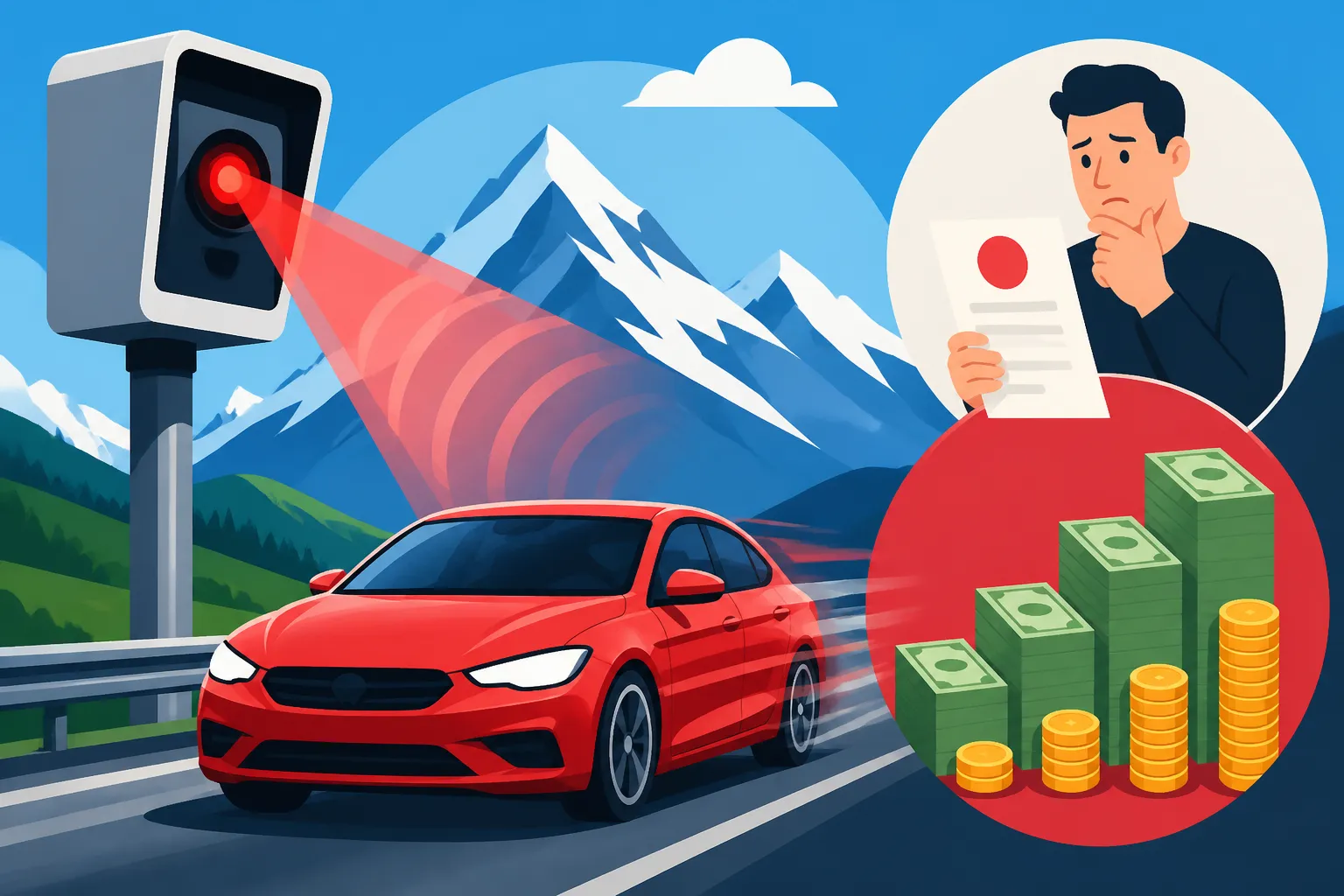
Driving through the Swiss Alps or along the pristine shores of Lake Zurich feels like a dream until a blinding red flash erupts from a grey box on the roadside. I remember my first time; I was only 4 km/h over the limit, but the sinking feeling in my stomach was immediate. This guide demystifies the terrifying world of Swiss speeding penalties.
The Culture of Compliance: Why Swiss Speeding Tickets Hit Different
In many countries, speed limits are treated as polite suggestions, and a few kilometers over is often ignored by the police. In Switzerland, the philosophy is fundamentally different. Precision is the national brand, and that applies to the asphalt as much as it does to luxury watches. The Swiss authorities view speed as a primary threat to public safety, and they have implemented one of the most sophisticated and unforgiving surveillance networks in the world.
Precision over Lenience
The Swiss legal framework for road traffic, known as Via Sicura, was designed to drastically reduce road fatalities. This means that "tolerance" is a technical term, not a gesture of goodwill. If the sign says 50 km/h, the system expects exactly that. When you are caught, the debate isn't about whether you were "flowing with traffic"; it’s about the raw data recorded by the sensor. For many of us arriving from the US, UK, or even neighboring Germany, the lack of a "buffer zone" is the first major cultural hurdle. Understanding Driving in Switzerland: Licenses, Buying Cars, and Strict Radars is essential because the rules you learned back home rarely apply here.
The Hidden Network of Radars
Switzerland uses a variety of radar technologies that are often nearly invisible. You have the classic fixed "storks" on the side of the motorway, but you also have semi-mobile units that look like small trailers. These can be moved overnight, meaning a route that was "safe" yesterday might have a radar today. There are also laser systems hidden in tunnels and even infra-red cameras that don't produce a visible flash, meaning you only find out you were speeding when the letter arrives in your mailbox two weeks later. This level of surveillance is a significant factor in the overall Cost of Living in Switzerland 2026: Budgeting for Singles and Families, as a single heavy foot can wipe out your monthly grocery budget.
How Speeding Affects Your Residence Permit
For expats, a speeding ticket isn't just a financial nuisance; it can be a direct threat to your right to stay in the country. Minor fines (Ordnungsbussen) are usually anonymous and don't go on your record. However, once you enter the territory of a "serious" infraction, the incident is reported to the migration office. If you are applying for a C permit or naturalization, a criminal record for speeding can lead to a rejection or a significant delay. This is why understanding the nuances of Residence Permits in Switzerland: L, B, C, and G Permits Explained is so vital; your behavior on the A1 motorway is directly linked to your status as a resident.
Understanding the Fine Structure: From Administrative Fees to Income-Based Penalties
The most shocking aspect of the Swiss system for high-earners is that fines are not always a flat rate. While minor offenses have a fixed price, major violations are calculated based on your "daily income." This ensures that a fine is a genuine deterrent for a CEO just as much as it is for a student.
Minor Infractions: The Ordnungsbussen System
For low-level speeding—typically up to 15 km/h over in town or 20 km/h on the motorway—you will receive an Ordnungsbusse. This is an administrative fine that you pay, and the matter is settled. There is no entry in the Swiss criminal register, and your name isn't associated with the ticket in a way that affects your future. Most people simply pay these via a QR code. To avoid the stress of these frequent small hits, many newcomers use HousingAnywhere to find apartments in areas with excellent public transport links, reducing their reliance on cars entirely.
Major Infractions: The Day-Fine System (Tagessätze)
Once you exceed the limits of a minor infraction, you are no longer just paying a fine; you are being prosecuted. This is where the "Day-Fine" system kicks in. The court determines a "day-rate" based on your net income, assets, and family obligations. A typical sentence might be "20 day-fines of CHF 150." If you earn a high salary, those daily rates can skyrocket. I have seen expats in Zurich hit with fines totaling over CHF 10,000 for a single lapse in judgment on the highway. This is a primary reason why many choose to invest in SBB Travelcards: Is the Generalabonnement (GA) Worth the CHF 4000+ Cost? rather than risking the financial volatility of driving.
Administrative Fees: The Sting in the Tail
Even if your fine is relatively low, the "procedural costs" (Verfahrenskosten) will surprise you. Every time the police or the cantonal court has to open a file, they charge you for the privilege. It is common for a CHF 400 fine to be accompanied by CHF 500 in administrative fees. These fees are non-negotiable and cover everything from the postage of the letter to the time spent by the clerk processing your file. When budgeting, always assume the total cost will be double the base fine mentioned in the initial police report.
| Speed Over Limit (After Deduction) | Built-up Area (50 km/h) | Outside Built-up (80 km/h) | Motorway (120 km/h) |
|---|---|---|---|
| 1-5 km/h | CHF 40 | CHF 40 | CHF 20 |
| 6-10 km/h | CHF 120 | CHF 100 | CHF 60 |
| 11-15 km/h | CHF 250 | CHF 160 | CHF 120 |
| 16-17 km/h | Court (Report) | CHF 240 | CHF 180 |
| 18-20 km/h | Court (Report) | CHF 240 | CHF 180 |
| 21-24 km/h | Court (Report) | Court (Report) | CHF 260 |
| 25+ km/h | Court (Report) | Court (Report) | Court (Report) |
Swiss Speed Limits and Tolerance Margins
One of the most confusing things for new drivers is the "technical margin." You might think you were doing 124 km/h in a 120 km/h zone and that you should be safe. However, the margin of error the police deduct is very small and depends entirely on the technology used to catch you.
Urban vs. Motorway Limits
In Switzerland, the standard limits are 50 km/h in built-up areas, 80 km/h on country roads, and 120 km/h on the motorway. However, "Zone 30" areas are becoming increasingly common in residential parts of cities like Zurich and Geneva. Speeding in a Zone 30 is treated with extreme severity because these areas usually contain schools or high pedestrian traffic. If you are caught doing 50 km/h in a 30 km/h zone, you are looking at an immediate license suspension. If you are still navigating your move, check Where to Live in Switzerland: Cantons, Cities, and Commuter Zones to understand how different neighborhood layouts might affect your daily commute.
Deduction of Technical Margin (Sicherheitsmarge)
When you receive your ticket, you will see two numbers: the measured speed and the "corrected" speed. The authorities deduct a small margin to account for technical inaccuracies. For fixed radars using radar technology, the deduction is usually 5 km/h (up to 100 km/h). If they used laser technology, the deduction is often only 3 km/h. This means if you are measured at 54 km/h in a 50 km/h zone, after the laser deduction, you are at 51 km/h—and you will receive a CHF 40 fine. There is no "10% rule" here; even 1 km/h over the corrected limit is a violation.
The Dreaded Red Flash: What Happens Next
If you see the flash, the process is automated. The camera captures your license plate, and the system queries the federal vehicle database. If the car is registered to you, the bill is sent to your home. If it’s a rental, the company will provide your details to the police (and charge you an admin fee of around CHF 50 for doing so). If the speed was high enough for a court report, you won't get a bill immediately. Instead, you'll receive a form asking you to identify the driver. Never ignore this; the penalties for failing to cooperate are often worse than the speeding fine itself. If you've just moved and haven't updated your address, you might miss these letters, leading to a Betreibung (debt enforcement) against you.
Serious Consequences: License Revocation and Criminal Records
In Switzerland, driving is considered a privilege, not a right. The "three-strike" system (though it’s often more like a two-strike system) is designed to remove dangerous drivers from the road quickly.
The Three Categories: Light, Medium, and Serious
Infractions are categorized by their severity. A "light" case might be doing 16-20 km/h over in a 50 zone. This usually results in a warning (Verwarnung) if you have a clean record. A "medium" case (e.g., 21-24 km/h over in a 50 zone) leads to a mandatory license suspension of at least one month. A "serious" case (e.g., 25+ km/h over in a 50 zone) is a criminal offense that results in a minimum three-month suspension and a heavy income-based fine. If you are a new resident, you should prioritize Converting Your Foreign Driver's License to a Swiss Fahrausweis within the first 12 months to ensure your paperwork is in order before any of these issues arise.
The Warning System (Verwarnung)
If you commit a medium or serious offense, the administrative authority (Strassenverkehrsamt) will issue a formal warning that stays on your record for two years. If you commit another offense during this period, the penalties are compounded. For example, a second "medium" offense within the two-year window could result in a four-month or even a year-long suspension. The Swiss are very good at keeping these records, and they do not "expire" or get "wiped" just because you moved cantons.
Permanent Impact on Your Betreibungsauszug and Future
A criminal conviction for speeding (which happens at higher speeds) can appear on your criminal record extract. This can be devastating when looking for a new job or a new apartment. Landlords almost always ask for a Checking Your Debt Register Extract (Betreibungsauszug) for Loans and sometimes a criminal record check. If you have a history of unpaid fines or criminal traffic violations, your chances of securing a competitive flat in Zurich drop to nearly zero. Furthermore, you may face questions when trying to prove you are a person of good character during the naturalization process. Can You Be Deported for Having a Betreibung (Debt Register Entry)? is a common question among expats, and while a single speeding fine won't get you deported, a pattern of law-breaking certainly puts your permit at risk.
Practical Survival Guide for Drivers in Switzerland
The best way to deal with Swiss speeding tickets is, quite simply, to never get one. But since we are all human, here is how to navigate the reality of Swiss roads.
Staying Connected and Navigating Legally
Using a GPS is essential, but be careful: in Switzerland, it is strictly illegal to use apps or devices that specifically warn you about the location of police radars. Apps like Waze are technically prohibited if they have the "police alert" function active. However, having a reliable data connection ensures your GPS (like Google Maps) is updated with the latest speed limits, which change frequently due to construction. I always recommend using an Airalo eSIM for visitors or new expats to ensure they have high-speed data from the moment they cross the border. Having accurate maps can prevent the "accidental" speeding that occurs when you miss a sign.
Contesting a Fine: Is It Worth the Risk?
Unless you have definitive proof that the radar was malfunctioning or that it wasn't your car, contesting a ticket in Switzerland is usually a bad idea. The legal fees are immense, and if you lose, the court will add "administration costs" that can easily quintuple the original fine. If you feel you have a genuine case, check if you have Legal Expenses Insurance (Rechtsschutzversicherung) in Switzerland. This insurance can cover the costs of a lawyer to review your case, which is much safer than trying to argue with a Swiss prosecutor on your own.
Managing Payments and Payment Plans
If you receive a massive income-based fine that you cannot pay all at once, you can sometimes request a payment plan (Ratenzahlung). You must do this immediately upon receiving the bill. The Swiss authorities are generally willing to work with you if you are proactive, but they have zero tolerance for people who simply ignore the deadline. If you have Public Liability Insurance (Privathaftpflicht): Why Expats Need It, note that it generally does not cover fines or penalties, as these are considered personal criminal or administrative liabilities.
For those who find the Swiss driving environment too stressful, remember that you can order many car accessories or high-quality dashboard cameras from Amazon Germany to help monitor your own driving habits—though remember that dashcam footage has very strict privacy rules in Switzerland regarding its use in court.
Summary Table of Speeding Fine Procedures
| Infraction Level | Typical Speed Over (Motorway) | Penalty Type | Criminal Record? | License Impact |
|---|---|---|---|---|
| Minor | 1 – 20 km/h | Fixed Fine | No | None |
| Light | 21 – 25 km/h | Fine + Admin Fees | No | Warning |
| Medium | 26 – 30 km/h | Income-based Fine | No | 1 Month Suspension |
| Serious | 31+ km/h | Income-based + Prison* | Yes | 3+ Months Suspension |
Note: Prison sentences are typically suspended for first-time offenders but remain on the criminal record.
Disclaimer
This guide is intended for informational purposes only and does not constitute legal advice. Swiss traffic laws, including the Via Sicura program and cantonal administrative procedures, are subject to change. Penalties and fines can vary significantly based on individual circumstances, local cantonal regulations, and the specific technology used by the police. While every effort has been made to ensure accuracy as of 2026, you should always consult with a qualified legal professional or the relevant Cantonal Strassenverkehrsamt for specific legal concerns. Driving in Switzerland requires strict adherence to local laws to ensure both safety and the preservation of your residency status.