Converting Your Foreign Driver’s License to a Swiss Fahrausweis
Navigating the Swiss administrative maze is hard enough, but realizing your foreign driver's license expires exactly one year after your arrival can induce a special kind of panic. I remember the frantic scramble to find an optician in Zurich just days before my deadline, terrified I’d have to start from scratch. This guide simplifies the conversion process, ensuring you keep your mobility without the stress of a full retake.
The 12-Month Rule: Why You Can't Afford to Procrastinate
In Switzerland, the authorities are quite generous at first—you can drive on your foreign license for exactly 365 days from the date of your arrival. However, this grace period is a double-edged sword. Many expats get comfortable, navigate the roads for months, and then realize at month eleven that the conversion process isn't instantaneous. I’ve seen fellow expats forced to stop driving entirely because they didn't account for the processing time at the Strassenverkehrsamt (Road Traffic Office).
Understanding the One-Year Grace Period
The clock starts ticking the moment you register your residency. Even if you don't own a car or plan to drive immediately, that one-year countdown is non-negotiable. During this time, your foreign license is valid provided it is written in a language the Swiss authorities recognize (German, French, Italian, or English). If your license is in a different language, such as Thai or Arabic, you must carry an International Driving Permit or a certified translation from the moment you arrive.
Many people moving into temporary housing found through HousingAnywhere overlook this detail while focusing on their Registering Your Address at the Kreisbüro Within 14 Days of Moving. It is vital to remember that your entry date on your residence permit is the legal anchor for your driving privileges. If you are caught driving on a foreign license after that 366th day, you aren't just facing a fine; you are technically driving without a valid permit, which can lead to complications with Driving in Switzerland: Licenses, Buying Cars, and Strict Traffic Laws.
Consequences of Missing the Deadline
If you miss the one-year window, the "conversion" (Umtausch) often turns into a "re-qualification." For citizens of many countries, this means you lose the right to a simplified exchange and must undergo the entire Swiss driving school process. This includes mandatory first-aid courses, "sensitization" theory lessons, a theory exam, and a full practical test. The cost for this can easily soar above CHF 3,000, not to mention the dozens of hours required.
I once knew a colleague who missed his deadline by just two weeks. Despite having fifteen years of clean driving experience in his home country, the Strassenverkehrsamt was unyielding. He had to take the full test like a teenager. To avoid this, mark your calendar for the six-month mark after your move. That is the "sweet spot" to start the paperwork, ensuring you have a cushion for any administrative delays or the need to schedule a Failing the Control Drive (Kontrollfahrt): Losing Your License in Switzerland retake if applicable.
The Exchange Process: EU/EFTA vs. Third-Country Nationals
The complexity of your conversion depends entirely on where your original license was issued. Switzerland has bilateral agreements with most European nations, making the process a simple administrative swap. However, for those coming from outside the EU/EFTA zone—referred to as Third-Country Nationals—the path often involves a practical "control drive" to prove you can handle Swiss road nuances.
The Simple Swap for EU/EFTA Citizens
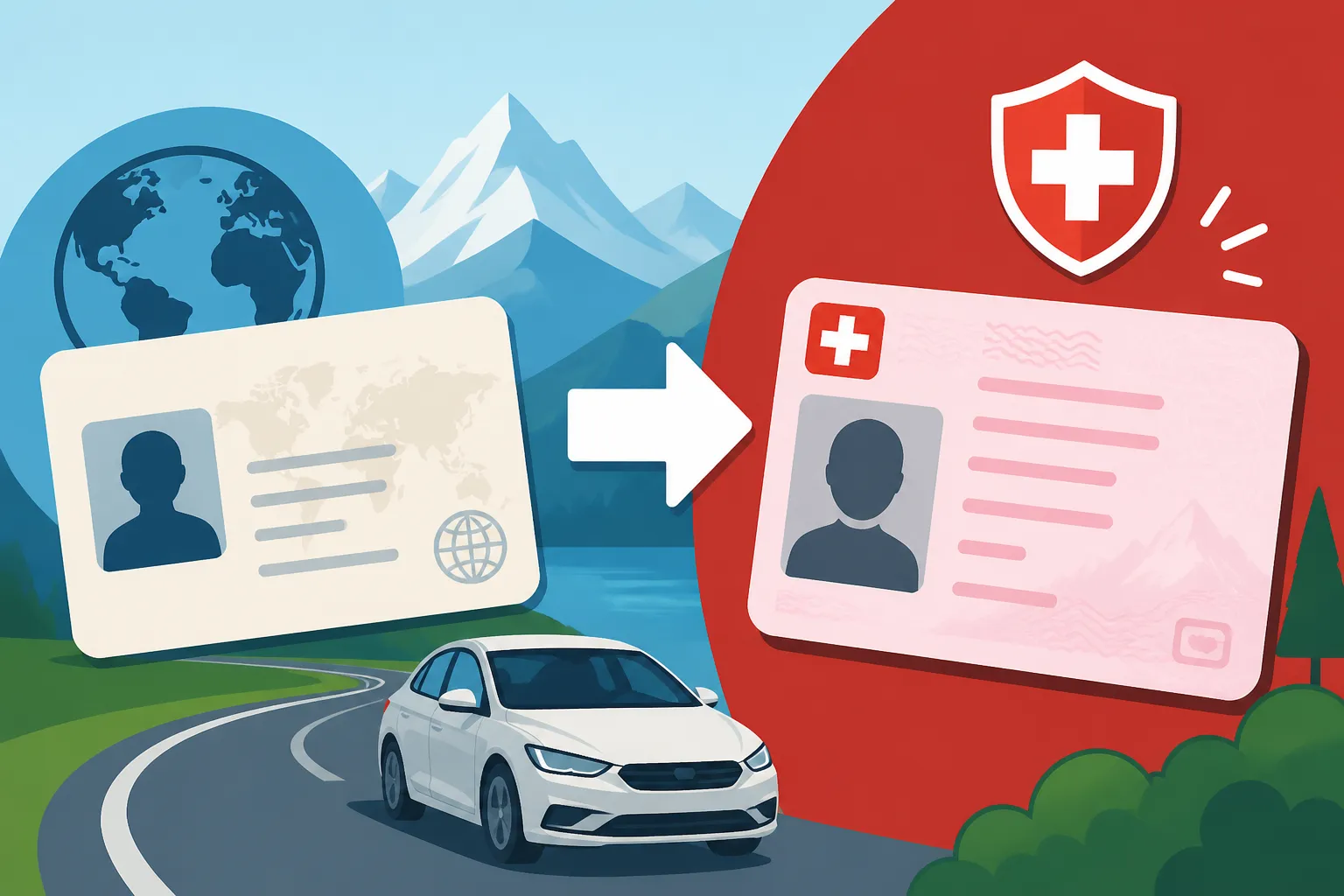
If you hold a license from an EU or EFTA country, you are in luck. The process is almost entirely clerical. You essentially hand over your foreign card, pay a fee, and receive your Swiss Fahrausweis in the mail a few days later. You won't need to take any tests, as the Swiss government recognizes your home country’s training standards as equivalent to their own. This is part of why Converting an EU Driver's License: The Simple Exchange Process is so straightforward.
Even for this simple swap, you still need to visit the local road office or a municipal office in person. You’ll need to bring your original license, your residence permit (B or C), and a passport-sized photo that meets the strict Swiss biometric standards. Don't try to use a casual selfie; the Swiss are meticulous about these photos. If you’ve just moved and are using Airalo to stay connected while searching for a permanent home, make sure you have a stable local mailing address before you apply, as your new license will be sent via post.
The Dreaded Kontrollfahrt for Everyone Else
For expats from countries like the USA, Canada, Australia, or Japan, the rules are slightly different. While you generally don't have to retake the theory exam, you are often required to pass a Kontrollfahrt (Control Drive). This is a 30-to-45-minute practical evaluation with a Swiss examiner. It is not a "test" in the sense that they are teaching you to drive, but rather a check to ensure you follow Swiss safety protocols, such as the "look-over-the-shoulder" (toter Winkel) and "priority to the right."
It is important to note that you only get one shot at the Kontrollfahrt. If you fail, your foreign license is immediately declared invalid for use in Switzerland, and you must go through the full learner’s permit process. I cannot emphasize enough how important it is to take at least two or three private lessons with a local instructor before your appointment. They will point out the specific "Swiss ways" that differ from your home country, especially regarding Speeding Tickets in Switzerland: Income-Based Fines and Strict Radars. Many experienced drivers fail simply because they are too "relaxed" or don't understand the hierarchy of trams and pedestrians.
Essential Paperwork and the Eye Test
Before you even step foot in the Strassenverkehrsamt, you need to clear the first hurdle: the professional eye test. The Swiss take road safety seriously, and ensuring your vision is up to par is the very first step of the application. You cannot simply use a prescription from your home country; it must be a fresh test performed by a certified Swiss optician.
Finding a Certified Optician
Most high-street opticians in Switzerland are authorized to perform the "Sehtest für den Führerausweis." You don't usually need an appointment; you can just walk in, tell them you need the test for your license exchange, and pay the standard fee (usually around CHF 20). They will test your visual acuity, field of vision, and color recognition.
Once you pass, the optician will stamp your application form directly. Make sure you bring the official "Gesuch um Umtausch eines ausländischen Führerausweises" (Application for exchange of a foreign driving license) with you. You can download this from your canton’s Strassenverkehrsamt website. If you're still getting your life organized and need tools for your new home, checking Amazon Germany for high-quality stationary or a good file organizer can help keep these important documents safe during the transition.
Compiling Your Application Dossier
The Swiss love their dossiers. To ensure your application isn't rejected, you need to gather a specific set of documents. Each canton has slight variations, but the core list remains the same across the country. Missing even one document can result in your application being sent back, which wastes valuable time during your first year.
| Document | Requirement | Notes |
|---|---|---|
| Application Form | Signed and stamped by an optician | Must be the cantonal version |
| Original Foreign License | Physical card | They will keep this during processing |
| Residence Permit | Original B, L, or C permit | Must be valid |
| Passport Photo | Biometric standard | 35mm x 45mm, high resolution |
| Translation | If license is not in DE, FR, IT, or EN | Must be a certified translation |
| Fee | CHF 80 – CHF 150 | Varies by canton |
When you submit your original license, the authorities will often provide you with a temporary paper permit that allows you to drive within Switzerland while they process your new card. However, this paper permit is usually not valid for driving abroad. If you plan to travel to France or Germany during this window, you might be grounded until your Swiss Fahrausweis arrives in the mail.
Mastering the Swiss Road Rules for Your Control Drive
If you are required to take the Kontrollfahrt, your driving experience is actually your biggest enemy. Bad habits developed over decades—like palming the steering wheel or rolling through stop signs—will lead to an instant fail in the eyes of a Swiss examiner. You need to drive like a "perfect student" for those forty minutes.
Priority to the Right and Tram Etiquette
The "Rechtsvortritt" (Priority to the Right) is the most common reason expats fail their driving assessment. In most residential areas (30 km/h zones), there are no stop signs or yield markings at intersections. In these cases, the vehicle coming from the right always has the right of way. You must visibly slow down and look into every side street on your right, even if it looks like a small driveway. If you breeze past a right-hand junction without looking, the examiner will mark it as a major safety violation.
Then there are the trams. In cities like Zurich, Basel, and Geneva, trams are the kings of the road. They always have priority unless a traffic light says otherwise. Never attempt to overtake a tram while it is stopping to let passengers off, as people will be stepping directly onto the road. Understanding these nuances is a key part of Driving in Switzerland: Licenses, Buying Cars, and Strict Traffic Laws. If you are nervous, spend an afternoon as a passenger on a tram just to observe how the cars interact with them at junctions.
Speeding and Roundabout Logic
Swiss speed limits are not "suggestions." In the US or UK, doing 5 km/h over the limit is often ignored; in Switzerland, it is a recorded violation. During your Kontrollfahrt, you must stay exactly at or slightly below the limit. If the sign says 50 km/h, doing 52 km/h is a mistake. Conversely, driving too slowly (e.g., 40 km/h in a 50 km/h zone) without a valid reason like heavy rain can also be seen as a lack of confidence, which could lead to a fail.
Roundabouts also have a specific logic here. You do not signal when entering the roundabout, but you must signal right immediately after passing the exit before the one you intend to take. If you are going straight, you don't signal at all until you are exiting. Also, be extremely wary of cyclists in roundabouts. In Switzerland, cyclists have the right to take the middle of the lane in a roundabout for their safety, and you must give them plenty of space. For more on the financial side of driving, such as insurance, check out Buying a Car: Leasing, Autoscout24, and Mandatory Auto Insurance.
Costs and Administrative Fees
Switzerland is famously expensive, and the driver's license conversion is no exception. However, the costs are predictable if you know what to look for. Each canton sets its own fees, so moving from Zurich to Zug might actually save you a few francs on your administrative processing.
Breakdown of Fees by Canton
The "Base Fee" covers the administrative work of verifying your foreign license and issuing the new plastic card. In Canton Zurich, this is roughly CHF 150. In more "tax-friendly" cantons like Zug, it might be closer to CHF 100. If you are required to take a Kontrollfahrt, there is an additional fee for the examiner’s time, usually around CHF 120 to CHF 160 per attempt.
Keep in mind that if you fail the control drive and have to start the full process, your costs will skyrocket. You’ll be looking at Swiss Autobahn Vignette: E-Vignette vs Physical Sticker for 2026 costs for your car, plus insurance, plus hundreds in mandatory courses. It is far cheaper to spend CHF 200 on two preparatory lessons with a professional instructor than to fail and start from zero.
Hidden Costs of Professional Driving Lessons
Most expats balk at the price of driving lessons in Switzerland, which can range from CHF 90 to CHF 120 per 45-minute session. However, these are not just "lessons." A local instructor knows the exact routes the examiners use. They know which intersections have "trick" priority-to-the-right rules and which hills require a perfect handbrake start.
Furthermore, if you don't own a car yet, you will need to rent the instructor’s car for the actual Kontrollfahrt. The examiner will not let you use a car that doesn't have dual controls (pedals on the passenger side) unless it is your own registered vehicle, and even then, it’s often discouraged for the test. Factoring these "hidden" costs into your first-year budget is essential. If you’re still budgeting for your move, tools like Airalo can help you keep your international roaming costs down while you spend your money on these essential local services.
Practical Tips for a Smooth Transition
Once you have your Swiss license in hand, a whole new world of convenience opens up. You can easily rent cars for weekend trips to the Alps, join car-sharing services like Mobility, and navigate your new home with total confidence. But getting to that point requires a bit of logistical finesse.
Temporary Transportation and Logistics
While your license is being processed, you might feel a bit stranded. If you’ve already handed over your foreign card and are waiting for the Swiss one, use that time to master the world-class public transport system. Getting a SBB Travelcards: Is the Generalabonnement (GA) Worth the CHF 4000+ Cost? or at least a Half-Fare card is a rite of passage for every expat.
If you are living in a temporary apartment found via HousingAnywhere, you might not have a dedicated parking spot yet. In Switzerland, parking is a science. You'll need to learn about the "Blue Zones" and how to use a parking disc. Once you have your Swiss license, you can apply for a resident parking permit (Anwohnerparkkarte) from your local city office, which allows you to park in your neighborhood’s blue zones for a flat annual fee.
Insurance and Vehicle Registration
The moment your Swiss license arrives, it’s time to think about your own set of wheels. You cannot register a car in Switzerland without a valid Swiss-recognized license and, more importantly, a Swiss insurance policy. The insurance company will ask for your "License Date," and for the Swiss, this is often the date you passed your test in your original country, not the date your Swiss card was issued.
Make sure you get a "Claims-Free Statement" (No-Claims Bonus) from your previous insurer back home, translated into English or a Swiss national language. This can save you thousands of francs on your premium. Swiss insurers are often skeptical of foreign driving history, but a formal letter from a reputable company like Geico, Allianz, or AXA from your home country can be a powerful tool for negotiation. Once your car is ready, don't forget to buy your Swiss Autobahn Vignette: E-Vignette vs Physical Sticker for 2026 to avoid heavy fines on the highway.
Important Disclaimer
The information provided in this guide is for general informational purposes only and does not constitute legal advice. While every effort has been made to ensure accuracy, Swiss immigration and traffic laws are subject to change at the federal and cantonal levels. Always verify requirements with your local Strassenverkehrsamt (Road Traffic Office) before submitting an application. The author and publisher are not responsible for any consequences arising from the use of this information, including permit denials or driving violations.