Monthly Budget Breakdown for a Family of Four in Geneva (2026)
Moving to Geneva with a family is a dream for many, but the financial reality often hits like a cold gust of the Föhn wind coming off the lake. Families often struggle to reconcile their high Swiss salaries with the startlingly high costs of housing, mandatory insurance, and childcare. This guide solves that confusion by providing a granular, realistic monthly budget breakdown for a family of four living in Geneva.
The Geneva Reality Check: Why the Budgeting Game is Different Here
Geneva is consistently ranked as one of the most expensive cities in the world, and for good reason. Unlike many other global hubs, the cost of living in Geneva isn't just about high-end luxury; it is the "floor" of basic expenses that catches expats off guard. Whether you are working for a multinational in Plan-les-Ouates or an international organization near the Place des Nations, your budget needs to be built with precision.
We are seeing the continued impact of rising healthcare premiums and a tight housing market. You aren't just paying for a roof over your head; you are paying for the safety, the world-class public transport, and the proximity to the French Alps. To live comfortably here, a family of four typically needs a combined gross income that exceeds what would be considered "wealthy" in almost any other European city.
One of the first hurdles you will face is the sheer administrative volume of life here. From the moment you land, you'll be navigating the complexities of the Cost of Living in Switzerland 2026: Budgeting for Singles and Families guidelines. It is not just about having the money; it is about knowing where it goes every month before you even see your "disposable" income.
Housing: The Foundation of Your Monthly Expenses
For a family of four, finding a home in Geneva is less of a shopping trip and more of a competitive sport. To accommodate two adults and two children, you are realistically looking at a 4.5 to 5.5-room apartment (remember, in Geneva, the kitchen is often counted as a room, though practices vary slightly by canton). You should expect to spend between CHF 3,800 and CHF 5,500 per month for a decent family flat in neighborhoods like Champel, Florissant, or Eaux-Vives.
The Search and the Dossier
The vacancy rate in Geneva hovers near zero, meaning when a family apartment hits the market, there are dozens of applicants within hours. You will need a perfect "Bewerbungsmappe" or application dossier. If you are just arriving, the process is even more daunting because you lack a local credit history. Landlords will prioritize those with stable Swiss contracts and a clean debt register extract. For more on navigating this, see Renting in Switzerland: The Complete 2027 Guide for Expats.
Utilities and Nebenkosten
Your rent isn't the final number. You must account for "Nebenkosten"—the ancillary costs for heating, hot water, and building maintenance. In 2026, with energy prices stabilized but higher than pre-2020 levels, a family should budget around CHF 300 to CHF 500 for these. Additionally, your electricity bill (via SIG in Geneva) and the mandatory Serafe media tax (roughly CHF 335 per year) add to the monthly drain.
Home Insurance and Small Costs
Don't forget that almost every landlord requires you to have private liability and household insurance. This is a non-negotiable part of the Swiss system that protects you if your child accidentally breaks a neighbor's window or leaks water into the flat below. While not a massive monthly cost, it is another line item in the Mandatory and Optional Insurance: Liability, Legal, and Household category that adds up.
Health Insurance: The Mandatory Monthly Bite
If housing is the largest expense, health insurance is the most relentless. In Switzerland, health insurance is private but mandatory. For a family of four, the premiums for the basic KVG/LAMal coverage have continued to climb. You are looking at approximately CHF 500-600 per adult and CHF 120-180 per child, depending on your chosen deductible (franchise).
Choosing the Right Model
For a family, the "Telmed" or "Family Doctor" models are popular because they offer a slight discount on premiums by requiring you to call a medical hotline or visit a specific GP first. However, the out-of-pocket costs can still sting. You have to pay 10% of every medical bill up to a certain cap, even after you’ve met your deductible. To understand the nuances of how this works, check out Healthcare in Switzerland for Expats: The Complete System Overview (2027).
Supplementary Insurance
Many expats also opt for supplementary insurance (VVG) to cover things like dental, semi-private hospital rooms, or alternative medicine. For a family, dental coverage for children is almost a necessity since basic insurance covers very little in the way of orthodontics or routine cleanings. Adding these extras can easily push your family’s total monthly insurance bill toward the CHF 1,500 mark.
Education and Childcare: Public vs. Private
The cost of raising children in Geneva depends heavily on your choice of schooling. The local public system (Ecole Primaire) is excellent and technically "free," but the hidden costs—lunches (parascolaire), after-school care (maison de quartier), and school trips—can add CHF 200-400 per month per child.
International Schools
If you choose the international route, such as the International School of Geneva (LGB/Ecolint), the costs move into a different stratosphere. Tuition can range from CHF 25,000 to CHF 38,000 per child, per year. Unless your employer is footing the bill, this often becomes the single largest expense for expat families, necessitating a very high gross salary to sustain.
The Kita/Crèche Struggle
For those with toddlers, the "Kita" (daycare) costs are famously high. A full-time spot for one child in a private nursery can cost between CHF 2,500 and CHF 3,500 per month. Even with cantonal subsidies, which are based on your income, many middle-to-high-earning expat families find themselves paying the maximum rate. For a family of four where both parents work, this can be a major financial bottleneck.
Groceries and Daily Living: The Art of the Cross-Border Shop
Feeding a family of four in Geneva requires a strategic approach. If you shop exclusively at Coop or Globus, your monthly grocery bill will easily exceed CHF 2,000. Most savvy expats mix their shopping between the "big two" (Migros and Coop) and budget retailers like Aldi and Lidl.
The Frontalier Strategy
Living in Geneva gives you a unique advantage: the French border is only 15 minutes away. Many families spend their Saturdays in Annemasse, Ferney-Voltaire, or St. Julien to stock up on meat, cheese, and pantry staples, which are significantly cheaper in France. When doing this, many residents use Wise to handle the currency exchange from CHF to EUR at the mid-market rate, avoiding the hidden fees charged by traditional banks at the checkout counter.
Household Expenses
Beyond food, you have "daily life" costs: cleaning supplies, toiletries, and that inevitable monthly trip to IKEA or Galaxus for household items. You should also budget for high-speed internet and mobile plans. While prices have become more competitive, a family package from a provider like Swisscom or Sunrise will still run you CHF 150-200. You can compare options in our guide on Swiss Mobile Plans: Best Subscriptions and Prepaid eSIMs for Expats.
Transport and Mobility: Navigating the Canton
One of the perks of Geneva is the TPG (Transports Publics Genevois). The network of trams and buses is so efficient that many families choose not to own a car, which is a massive budget-saver. A monthly "Unireso" pass for the Geneva zone costs about CHF 70 for adults and is cheaper for children.
The SBB and Travelcards
For weekend trips to the mountains or visits to other cities like Zurich or Lausanne, the Half-Fare Travelcard is a mandatory investment. It costs CHF 190 per year for adults and immediately cuts the cost of train travel in half. If you find yourself commuting between cantons, you might even consider if SBB Travelcards: Is the Generalabonnement (GA) Worth the CHF 4000+ Cost? makes sense for your family.
Owning a Car
If you do decide to keep a car, be prepared for the "Geneva Tax" on parking. A monthly spot in a garage can cost CHF 250-400. Add in the high price of petrol, annual road tax, and mandatory insurance, and your mobility budget could easily triple. For many, The Half-Fare Travelcard (Halbtax): The Must-Have Pass for Swiss Residents remains the most economical way to see the country.
Taxes and Financial Planning: The Silent Expense
In Geneva, taxes are not deducted "at source" (Quellensteuer) for everyone. If you have a C Permit or earn above a certain threshold on a B Permit, you are responsible for filing a return and paying your bill in installments. Geneva has some of the highest cantonal taxes in Switzerland, and it is vital to set aside 20-25% of your gross income every month to avoid a massive shock at the end of the year.
Professional Assistance
Navigating the deductions for commuting, childcare, and international assets can be overwhelming. Many Americans and high-earning expats use specialized services like Taxes for Expats to ensure they aren't double-taxed and are taking advantage of all Swiss-US treaties. This is especially important for the Swiss Taxes Explained: Federal, Cantonal, and Municipal Rates that vary so significantly between communes.
Pillar 3a and Savings
To lower your tax burden, contributing to a Pillar 3a private pension is highly recommended. For 2026, the maximum contribution is approximately CHF 7,258 for employees. This amount is fully deductible from your taxable income, providing a rare and welcome "discount" from the tax office. Managing these funds through a provider like Wise for international transfers or using Best Neobanks in Switzerland: Neon, Yuh, and Zak Compared to keep fees low is a smart move for any expat family.
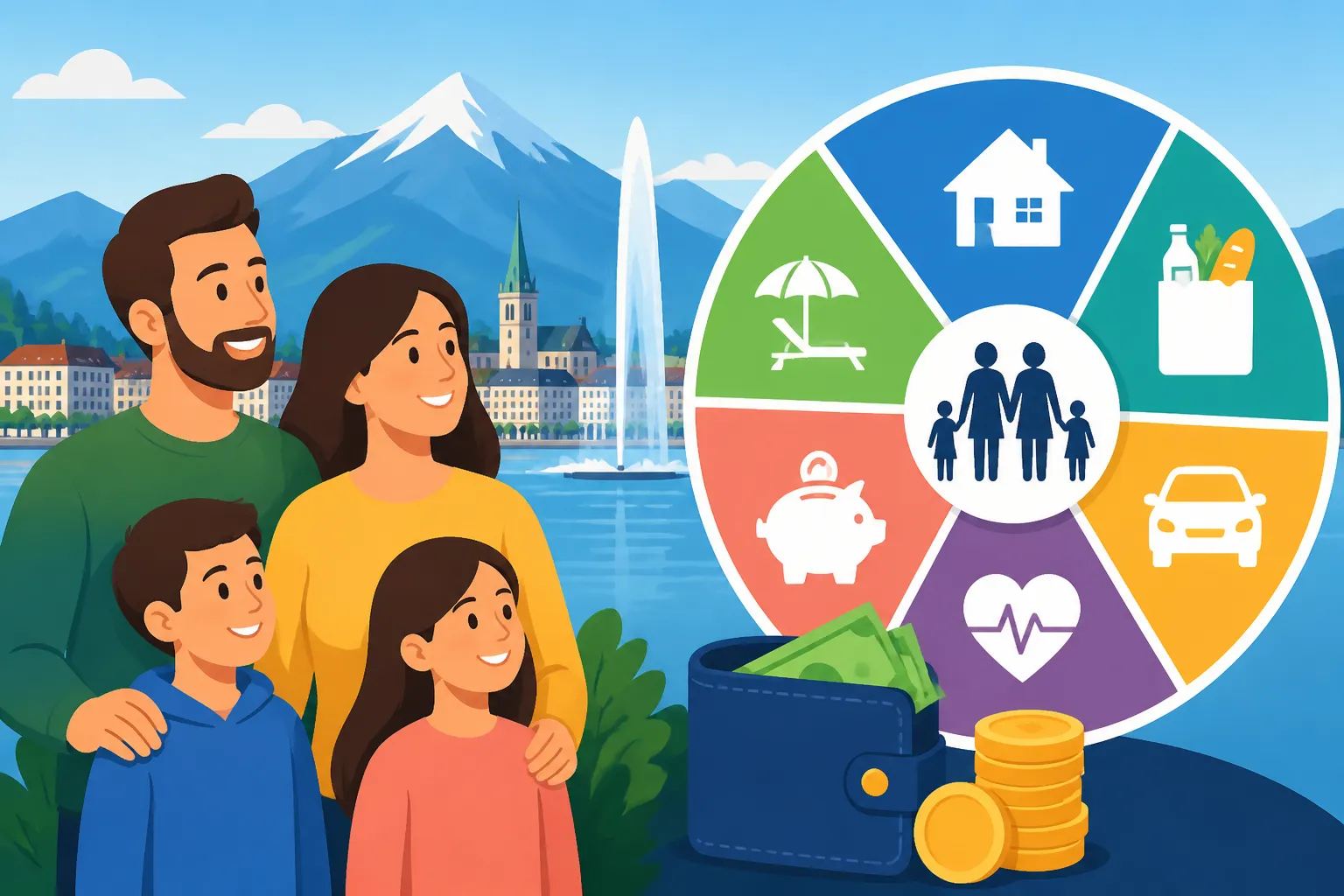
Monthly Budget Summary Table: Family of Four (Geneva)
| Category | Estimated Monthly Cost (CHF) | Notes |
|---|---|---|
| Rent (4.5 – 5.5 Rooms) | 4,200 | Average for Eaux-Vives/Champel |
| Utilities (Heating/Elec/Serafe) | 450 | Including "Nebenkosten" |
| Health Insurance | 1,400 | 2 Adults, 2 Kids (Standard Model) |
| Groceries & Household | 1,600 | Mix of Migros and French border shops |
| Public Transport | 200 | TPG monthly passes + Half-Fare cards |
| Phone / Internet / TV | 180 | Family bundle |
| Leisure & Eating Out | 600 | 1-2 modest family dinners out |
| Schooling (Public) / Extras | 400 | After-school care and lunches |
| Insurance (Liability/Household) | 60 | Mandatory for most leases |
| Total Basic Monthly Outgoings | 9,090 | Excludes Taxes & Private Schooling |
Leisure and the "Swiss Lifestyle" Tax
Life in Geneva isn't just about paying bills; it's about enjoying the highest quality of life on the planet. However, entertainment is where many family budgets go to die. A simple cinema trip for four, including popcorn and drinks, can easily top CHF 120. A "cheap" pizza night out will likely cost CHF 150.
Outdoor Fun
The good news is that nature is free. In the summer, the "Bains des Pâquis" offers affordable swimming and the best value fondue in the city. In the winter, many families take advantage of regional ski passes. While the upfront cost of gear is high, the "Magic Pass" offers incredible value for families who want to hit the slopes every weekend without paying CHF 80 per day for lift tickets.
Managing Cash Flow
To keep leisure costs from spiraling, many expats use Wise to manage their multi-currency spending. If you're heading to Chamonix for the weekend or taking a trip to Italy, being able to spend in Euros without the predatory exchange rates of local Swiss banks can save a family several hundred francs over a year. Additionally, consulting with Taxes for Expats can help you understand if your international travel or remote work days might impact your tax residency status.
Final Thoughts for the New Arrival
Budgeting for Geneva requires a shift in mindset. You have to stop comparing prices to your home country and start thinking in "Swiss Francs and Swiss Realities." While the numbers on the total line can look terrifying, the stability, the safety, and the incredible environment for children often make the financial stretch worthwhile.
Remember that your first six months will be the most expensive as you pay rental deposits (often three months' rent), furnish a home from scratch, and navigate the initial registration fees. Use tools like Wise to bring your initial capital into the country and keep an eye on your Swiss Taxes Explained: Federal, Cantonal, and Municipal Rates to ensure you are saving enough for the taxman. With a bit of discipline and a few trips across the border to France, your family can not only survive but thrive in the "Capital of Peace."
Disclaimer
This guide is intended for informational purposes only and does not constitute financial, legal, or tax advice. Cost of living estimates for 2026 are based on current inflationary trends and historical data and are subject to change based on market conditions, cantonal policy shifts, and individual lifestyle choices. Always consult with a certified Swiss tax professional or financial advisor before making significant investment or relocation decisions. For US citizens, consulting with Taxes for Expats is recommended to handle complex FATCA and IRS reporting requirements.