The Swiss Citizenship Interview Questions: What the Commune Asks You
After a decade of living in the shadow of the Alps, the transition from being a resident to a citizen is the most nerve-wracking hurdle you will face. I remember the cold sweat on my palms as I walked into my local Stadthaus, clutching a folder of documents and desperately trying to remember the names of the seven Federal Councilors. This guide solves the mystery of the commune interview by breaking down exactly what the committee wants to hear and how to survive the "integration chat."
The Three-Tiered Reality of Swiss Naturalization
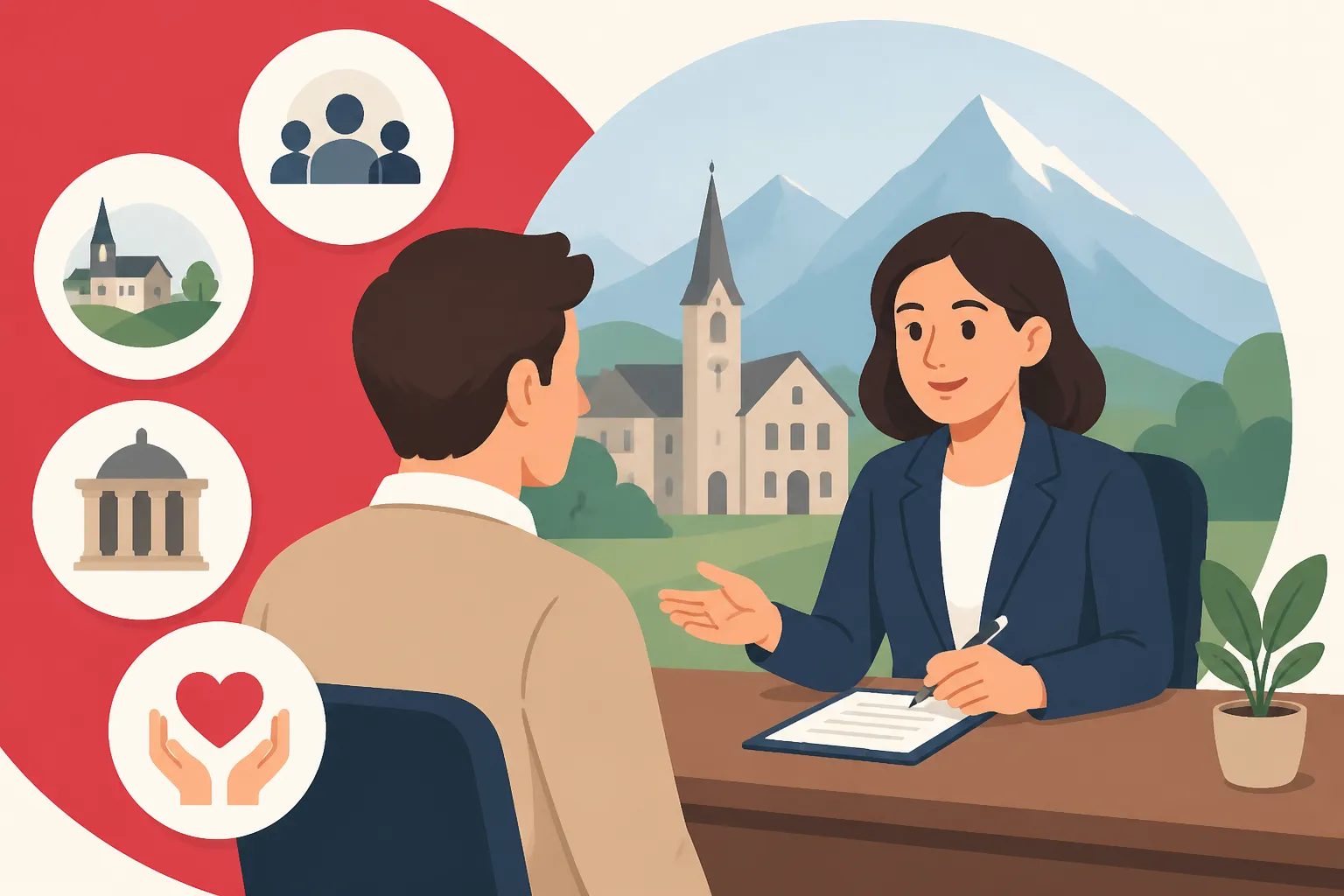
Switzerland is likely the only country in the world where your neighbors—or at least the local representatives of your village—have a direct say in whether you get a passport. To understand the interview questions, you first have to understand that you are being vetted on three distinct levels: federal, cantonal, and municipal. Each level has a different focus, and the commune interview is where these three worlds collide in a small room with a panel of locals who may have lived in that same zip code for sixty years.
The federal level focuses on the "big picture" facts, like the Swiss Constitution and the three-pillar pension system. The cantonal level looks at your broader regional integration. However, the commune interview is where things get granular. This is where they ask about your involvement in the local community. If you haven't yet explored the Cantonal vs Federal Citizenship: Understanding the Three-Tier Integration Process, you should realize that the commune is often the hardest gatekeeper. They aren't just looking for a "good resident"; they are looking for a "good neighbor."
This decentralized approach means that an interview in a cosmopolitan hub like Zurich will feel worlds apart from one in a rural village in Appenzell. In the cities, the panel might be more professional and focus on your career and civil knowledge. In a village, they might ask you which local "Verein" you belong to or whether you know the name of the local stream that floods every spring. It is a deeply personal, sometimes eccentric process that requires a high level of cultural empathy.
Geography Questions: Beyond the Matterhorn
You might think you know Swiss geography because you’ve spent your weekends skiing in Valais or hiking in the Berner Oberland. However, the commune interviewers expect you to have a hyper-local mental map. They will start with the broad strokes—naming the neighboring countries and the main mountain ranges—but they will quickly zoom in on your front door. I have seen candidates fail because they couldn't name the three closest neighboring communes or the direction the local river flows.
Expect questions like "Which mountains can you see from our village?" or "What are the names of the lakes in our canton?" You should also be prepared to discuss the "Grenzgemeinden"—the specific towns that share a border with yours. This isn't just a memory test; it’s a way for the panel to see if you actually navigate the local landscape or if you simply live in an expat bubble, moving only between your apartment and the office.
To prepare for this, spend a few Saturday mornings walking the perimeter of your town. Look at the trail markers (the famous yellow signs) and note the names of the surrounding peaks. If you have moved around, be aware that you might be asked about the geography of your previous cantons as well. Before you submit your final application, ensure your documents, including birth certificates and previous residency proofs, are professionally translated. Using a service like RushTranslate can ensure that your dossier looks impeccable, which sets a tone of respect and diligence before you even sit down for the interview.
Politics and the Magic Formula
Swiss politics is famously stable, but its "Magic Formula" (Zauberformel) is a frequent topic of interview questions. You will almost certainly be asked to name the seven members of the Federal Council and their respective political parties. But don't stop there. The commune panel will want to know if you understand how a law is actually made in Switzerland. They will ask about "Direct Democracy," specifically the difference between an "Initiative" and a "Referendum."
A common hypothetical scenario they might throw at you is: "If you wanted to change the speed limit on our main street, how would you go about it?" They want to see if you understand the local legislative process—from gathering signatures to the municipal assembly (Gemeindeversammlung). If you are aiming for citizenship, you should have already mastered the Understanding Swiss History and Politics for the Naturalization Test to avoid being caught off guard by questions about the 1848 Constitution.
Moreover, they will likely ask about your local executive. Who is the "Gemeindepräsident" or the Mayor? How many people sit on the local council? These are the people who run your daily life, and the panel expects you to know them. Politics in Switzerland is bottom-up, not top-down. If you can't name your local representatives but can name the US President or the UK Prime Minister, it sends a signal that your heart—and your attention—is still elsewhere.
Local Traditions and Cultural Integration
This is the section where the "I've-been-there" reality of Swiss life truly kicks in. The panel wants to know if you participate in the "Brauchtum"—the local customs. In some regions, this might be the "Fasnacht" (carnival); in others, it could be the "Alpabzug" (the descent of the cows from the mountains). They might ask you what people eat during certain festivals or what the significance of a specific local holiday is. This is a subtle way of checking if you have "Swissified" your lifestyle.
I remember a candidate being asked about the local "Wappen" (coat of arms). Do you know what the symbols on your commune's flag represent? Do you know the history of the local church or the oldest building in town? These details matter immensely because they show a sense of belonging. If you haven't yet, you should read about Volunteering and Local Clubs (Vereine): The Best Way to Meet Swiss People, as mentioning your membership in a local choir, fire brigade, or sports club is the ultimate "Integration Gold Card" during an interview.
The panel will also ask about your social circle. "Are your friends Swiss or mostly from your home country?" is a classic, albeit controversial, question. They are looking for evidence that you have broken out of the expat circle. If your children go to local schools, this is a huge plus. Be prepared to talk about their school system, their teachers, and their local friends. The more you can demonstrate that your family’s life is deeply rooted in the local soil, the easier the interview becomes.
Personal Finance and Professional Life
Switzerland wants citizens who are self-sufficient. You will be asked about your job, your career path, and your financial stability. While they won't usually ask for your bank balance in the room (they’ve already seen your tax returns), they will ask how you contribute to the Swiss economy. A very common question is: "What would happen to you if you lost your job tomorrow?" They want to hear that you understand the "RAV" (unemployment insurance) system but that you have the skills and drive to find new employment.
Financial "cleanliness" is paramount. If you have any "Betreibungen" (debt register entries), your application is likely dead on arrival. Make sure you have reviewed the Financial Independence Checks: Why Betreibungen (Debt) Stops Permit Renewals before even starting the process. The panel might also ask about your insurance situation. Having a robust health plan is a sign of a responsible resident. For expats who have transitioned through various permits, showing that you've maintained high-quality coverage through providers like Cigna Global can be part of the narrative of your long-term stability and planning in the country.
Language and Communication Nuances
While the formal language requirement is checked via certificates like the fide or Goethe-Zertifikat, the commune interview is the "real" language test. If you are in the German-speaking part of Switzerland, the panel will likely speak "Schwiizertüütsch" (Swiss German) to you, at least at the beginning. Even if you respond in High German, your ability to understand the local dialect is a major integration marker. For a deep dive into these requirements, see Language Requirements for Swiss Permits: A1 to B2 Standards Explained.
If you struggle with the language during the interview, don't panic. The panel is looking for effort and the ability to communicate your ideas. However, if you have lived in a commune for twelve years and still need an interpreter, the panel will view this as a significant failure of integration. It’s about the "Wille"—the will to integrate. If you've been using Language Tests for C Permit: fide vs Goethe-Zertifikat Compared to get your papers in order, make sure you continue practicing the spoken word in your local bakery or at the "Stammtisch" of the local pub.
| Question Category | Typical Focus Level | Example Question |
|---|---|---|
| Geography | Local | Name the three neighboring communes to our north. |
| Politics | Federal | How many members are in the National Council? |
| Culture | Municipal | What happens in our village on the first Sunday of December? |
| Personal | Individual | Why do you want to be Swiss specifically, and not just a resident? |
| History | National | In what year did women get the right to vote federally? |
| Economy | Individual | Explain the 'Three Pillar' pension system in your own words. |
The "Why Switzerland?" Question
The most important question, and usually the one that closes the interview, is some variation of: "Why do you want to become Swiss?" This is not the time for a generic answer about the high salaries or the punctuality of the trains. The panel has heard those a thousand times. They want a "heart" answer. Talk about the safety your children feel walking to school alone. Talk about the "Feierabend" culture or the way the community comes together for a local vote.
You need to prove that you aren't just seeking a powerful passport for easier travel. You need to show that you identify with Swiss values—neutrality, "Milizsystem" (the militia principle of public service), and "Subsidiarität" (solving problems at the lowest possible level). If you haven't yet received your "C Permit," which is usually the prerequisite, read up on The Swiss C Permit (Permanent Residency): Fast-Track and Standard Routes to ensure you are on the right timeline.
During the interview, your attire also speaks volumes. You don't need a tuxedo, but showing up in "hiking chic" might be seen as disrespectful in more traditional communes. I highly recommend checking out the Interview Wardrobe: What to Wear to Your Swiss Citizenship Meeting to strike the right balance between professional and approachable.
Handling the Nerves and Unexpected Questions
Sometimes, the panel will throw a "curveball" question just to see how you react under pressure. I know someone who was asked: "What would you do if your neighbor was washing their car on a Sunday?" (Hint: Sunday is a day of rest, and loud or messy work is often frowned upon or legally restricted). These questions test your cultural "instincts." They want to see if you have absorbed the unwritten rules of Swiss life.
If you don't know an answer, be honest. "I'm not sure of the exact date, but I know it happened in the 19th century" is better than a wild guess. The panel appreciates humility and a willingness to learn. They aren't expecting a walking encyclopedia; they are expecting a human being who cares about their home. If you've spent years preparing and have tracked your Naturalization Timeline: How Long It Actually Takes After Applying, you’ve already shown the persistence that the Swiss value so highly.
Before you go, ensure all your supporting documents are translated by certified professionals. If you need to translate your original home country diplomas or marriage certificates, RushTranslate is a reliable option for Swiss authorities. Additionally, as you move toward citizenship, ensure your "protection net" is secure. While you’ll be on the mandatory Swiss system, many expats keep international health options like Cigna Global for travel or specialized care, which demonstrates a high level of personal responsibility.
The commune interview is the final peak before the summit. It’s the moment where "they" become "we." Approach it with respect, a bit of local trivia, and a genuine love for your village, and you’ll find that the panel isn't there to trip you up—they’re there to welcome you home.
Important Legal Disclaimer
The information provided in this guide is for informational purposes only and does not constitute legal advice. Swiss naturalization laws and municipal requirements are subject to frequent change and vary significantly by canton and commune. Always consult with your local migration office (Migrationsamt) or a qualified legal professional regarding your specific naturalization application. For official documentation and certified translations, always use recognized providers like RushTranslate to ensure compliance with Swiss administrative standards. Be aware that being Denied Swiss Citizenship for Not Knowing Local Geography: Real Case Examples is a real possibility, so verify all local facts with your specific Gemeinde.