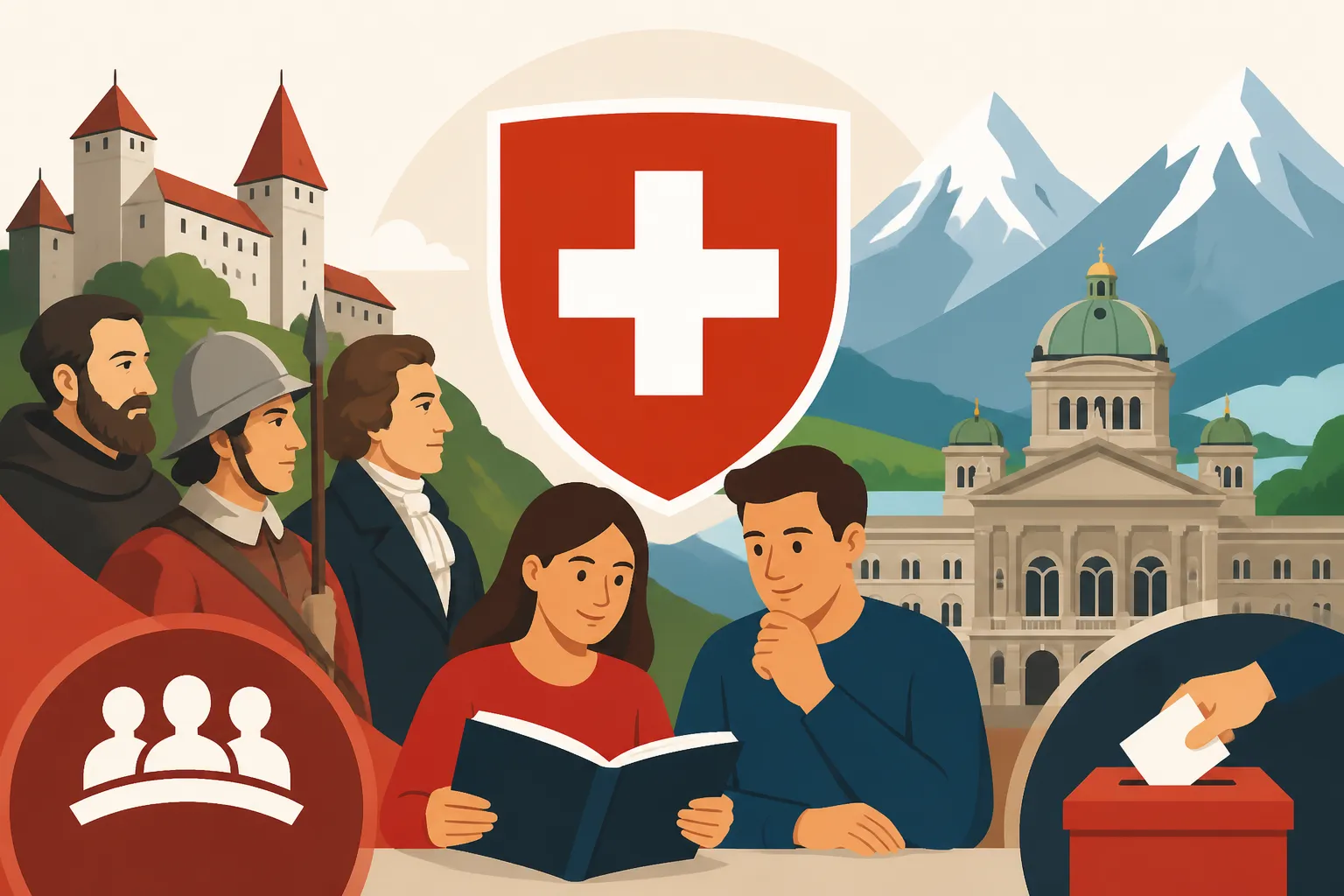
Understanding Swiss History and Politics for the Naturalization Test
Trying to memorize the name of every local river and the exact year a random mountain village joined the Confederation can feel like an exercise in madness. I remember staring at my study guide for weeks, convinced that my entire future in this beautiful country hinged on knowing the difference between a half-canton and a full one. This guide breaks down the essential Swiss history and politics you must master for the naturalization test while validating the sheer exhaustion of the process.
The Daunting Reality of the Three Tier System
The first thing every expat realizes—usually with a sigh of disbelief—is that Switzerland doesn't have just one naturalization process. It has three. You are applying for citizenship at the federal, cantonal, and communal levels simultaneously. This means that while you are studying the history of the Swiss Confederation, you also need to know who the local mayor is and which forest in your specific village is the largest.
This "bottom-up" approach is the bedrock of Swiss identity. The federal government only handles what the cantons cannot, and the cantons only handle what the communes cannot. When you sit for your test or interview, the panel isn't just checking if you are "Swiss" in a general sense; they are checking if you have integrated into your specific neighborhood. Understanding Cantonal vs Federal Citizenship: Understanding the Three-Tier Integration Process is vital because your local commune often holds the most power over your approval.
If you find yourself overwhelmed by the paperwork required to prove your residency history, you aren't alone. I’ve seen friends struggle with documents from back home that aren't in a national language. In these cases, using a service like RushTranslate can be a lifesaver for getting birth certificates or marriage licenses officially recognized by the migration office. It’s one less thing to worry about when you’re already trying to memorize the seven members of the Federal Council.
Critical Eras in Swiss History Every Applicant Must Know
To pass the test, you don’t need to be a historian, but you do need to understand the narrative of how a group of mountain valleys became a global financial and diplomatic hub. The Swiss are incredibly proud of their longevity and their ability to remain a "Willensnation"—a nation created by the will of its people rather than by shared language or ethnicity.
The Federal Charter of 1291 and the Rütli Oath
Everything starts in late summer 1291. According to legend, representatives from the three "forest cantons"—Uri, Schwyz, and Unterwalden—met on the Rütli meadow overlooking Lake Lucerne. They swore an oath of eternal alliance to defend themselves against the Habsburgs. This is why Swiss National Day is August 1st.
In your test, you might be asked which cantons were the "Founding Three." Just remember "USU" (Uri, Schwyz, Unterwalden). This era established the Swiss penchant for independence and their deep-seated distrust of foreign "judges" or overlords, a theme that still resonates in modern Swiss-EU relations.
The Impact of Napoleon and the Helvetic Republic
Foreigners often forget that Switzerland was briefly a centralized state under Napoleon Bonaparte. Between 1798 and 1803, the French invaded and established the Helvetic Republic. It was a disaster for the Swiss, who hated being told what to do by a central authority in Aarau or Paris.
However, this period was crucial because it introduced modern concepts like equality before the law and the abolition of feudalism. When Napoleon realized the centralized model wouldn't work, he issued the Act of Mediation in 1803, which restored much of the cantonal sovereignty. This is a common "trick" question on tests: knowing that Switzerland was once a centralized state helps prove you understand why they fight so hard to remain a federalist one today.
1848 The Birth of the Modern Federal State
If 1291 is the legendary birth, 1848 is the practical one. After a brief civil war known as the Sonderbund War—which was remarkably short and had very few casualties compared to other European conflicts—the Swiss drafted the Federal Constitution.
This turned Switzerland from a loose confederation of independent states into a single federal state with a central government, a national currency, and no internal customs. If you are aiming for The Swiss C Permit (Permanent Residency): Fast-Track and Standard Routes, you’ll notice that many of the rights established in 1848 are what make your current residency so stable. This constitution balanced the power between the victorious Protestant cantons and the defeated Catholic ones, creating the "consensus" culture that defines the country today.
Navigating the Swiss Political Machinery
Swiss politics is unique because it is designed to be slow, boring, and stable. There is no "President" in the way the US or France has one. Instead, the country is led by the Federal Council, a group of seven individuals who represent the major political parties.
The Principle of Collegiality and the Magic Formula
The seven members of the Federal Council must act as a single unit. Even if a member personally hates a law that was passed, they must defend it in public as if it were their own idea. This is called the "principle of collegiality."
Since 1959, the council has generally followed the "Magic Formula" (Zauberformel), which distributes the seats among the largest parties to ensure everyone has a seat at the table. On your naturalization test, you may be asked to name the current President of the Confederation. Remember: the position rotates every year among the seven members, and the President is simply "primus inter pares"—first among equals. They have no more power than the other six.
Direct Democracy Initiatives and Referendums
This is the part of the test where you need to show you understand that the "People" are the highest political authority. In Switzerland, if you can gather 100,000 signatures in 18 months, you can propose a change to the Federal Constitution. This is called a Popular Initiative.
If the Parliament passes a law you don't like, you can gather 50,000 signatures in 100 days to force a nationwide vote on that law. This is an Optional Referendum. Because of this, the Swiss vote about four times a year on everything from fighter jets to the length of maternity leave. Demonstrating knowledge of this system shows the interviewers that you are ready to take on the responsibility of a citizen.
The Bicameral Parliament
The Federal Assembly is made up of two chambers:
- The National Council: Represents the people (200 seats), with cantons having seats based on their population.
- The Council of States: Represents the cantons (46 seats). Each full canton gets two seats, and each half-canton gets one, regardless of size.
This ensures that a tiny canton like Appenzell Innerrhoden isn't completely steamrolled by a massive canton like Zurich. It’s the Swiss version of checks and balances.
| Government Level | Responsibilities | Key Focus for Test |
|---|---|---|
| Federal | Defense, Foreign Policy, Customs, Currency | The Constitution and the 7-Member Council |
| Cantonal | Education, Police, Healthcare, Taxation | The Cantonal Capital and Constitution |
| Communal | Waste Management, Local Roads, Naturalization | The Mayor and Local Landmarks |
Practical Tips for the Exam and Interview
Studying the facts is only half the battle. You also have to navigate the cultural expectations of the interviewers. I’ve heard countless stories of people who knew the history perfectly but failed because they couldn't name three local cheeses or didn't know the names of the neighboring communes.
Local Knowledge vs National Facts
In many communes, the interviewers are your neighbors. They want to see that you shop at the local Volg or Coop, that you participate in the village "Apéro," and that you understand the local geography. Before your test, go for long walks. Read the local newspaper. Find out if there are any English-Speaking Notaries for Visa Documents in Switzerland who can help you verify your local integration efforts if the commune asks for extra proof.
You should also be aware of your Naturalization Timeline: How Long It Actually Takes After Applying, as the wait times can vary wildly between a place like Geneva and a small village in Schwyz. Use that time to immerse yourself in the local dialect if you are in a German-speaking area. While the test is in High German, French, or Italian, showing a bit of local "Mundart" goes a long way toward proving you are "one of them."
Language and Cultural Integration
You cannot escape the language requirements. Depending on your canton, you will need to prove a certain level of proficiency. Generally, this means B1 oral and A2 written. Make sure you have your certificates ready, as C permit Language Requirements: Do I Need A2 Written and B1 Oral? often set the baseline for what is expected during naturalization.
Beyond the language, understand the "Swiss way." This means being quiet after 10 PM, recycling your PET bottles with religious fervor, and understanding that punctuality isn't a suggestion—it's a moral obligation. If you show up five minutes late to your naturalization interview, you’ve already lost.
The Cultural "Trap" Questions
Sometimes, the panel will throw a curveball. They might ask you about your hobbies or why you want to be Swiss. Don't just say "for the passport" or "for the tax benefits." Talk about the stability, the direct democracy, and the way the mountains make you feel at home.
Be careful with questions regarding religion. While Switzerland is secular, your tax records will show if you pay church tax. If you are asked about your community involvement, be prepared to discuss Registering Your Religion on Your Residency Form: Tax Implications if it comes up in the context of communal contributions.
There have been famous Denied Swiss Citizenship for Not Knowing Local Geography: Real Case Examples where applicants were rejected because they didn't know where a local bakery was or because they complained about cowbells. These stories are meant to intimidate, but they also serve as a reminder: the Swiss value "Zugehörigkeit"—the feeling of belonging.
Preparing for the Long Haul
The naturalization process is a marathon, not a sprint. From the moment you decide to apply to the day you receive your red passport, it can take anywhere from 18 months to three years. During this time, you must maintain your health insurance and residency status without interruption.
For expats who move frequently for work but want to settle in Switzerland, keeping a global health plan like Cigna Global can provide a safety net while you navigate the mandatory KVG requirements of the various cantons. Having continuous, high-quality coverage ensures that a medical emergency doesn't derail your financial stability, which is a key factor the authorities check when reviewing your application.
If you are married to a Swiss citizen, the path is slightly different. Look into Facilitated Naturalization: Fast-Track Citizenship for Spouses of Swiss Nationals to see if you qualify for a shorter residency requirement. Regardless of the path, the history and politics remain the core of the evaluation.
Essential Study Checklist for the Big Day
To make your life easier, here is a list of things you should be able to recite in your sleep before you walk into that Gemeinde office:
- The date of the national holiday and why it is celebrated.
- The names of the four national languages.
- The capital of your canton and the capital of Switzerland (Bern).
- The names of at least three members of the current Federal Council.
- The names of the two chambers of Parliament.
- The number of cantons (26) and how many are considered "half-cantons."
- The major rivers or mountains in your immediate vicinity.
- A basic understanding of Language Requirements for Swiss Permits: A1 to B2 Standards Explained and how you meet them.
- The names of the neighboring communes to your own.
- The name of your local Mayor or President of the Commune.
Remember, the interviewers aren't usually looking for a reason to fail you; they are looking for a reason to welcome you. If you show respect for the history, an understanding of the political nuances, and a genuine love for your local area, you will find that the "final boss" of the Swiss expat journey is much more manageable than it first appears.
Disclaimer
This guide is intended for informational purposes only and based on personal expat experiences and general Swiss administrative guidelines as of 2026. Naturalization requirements and test formats vary significantly by canton and commune. Always consult your local migration office or a qualified legal expert for the most current and specific advice regarding your citizenship application.