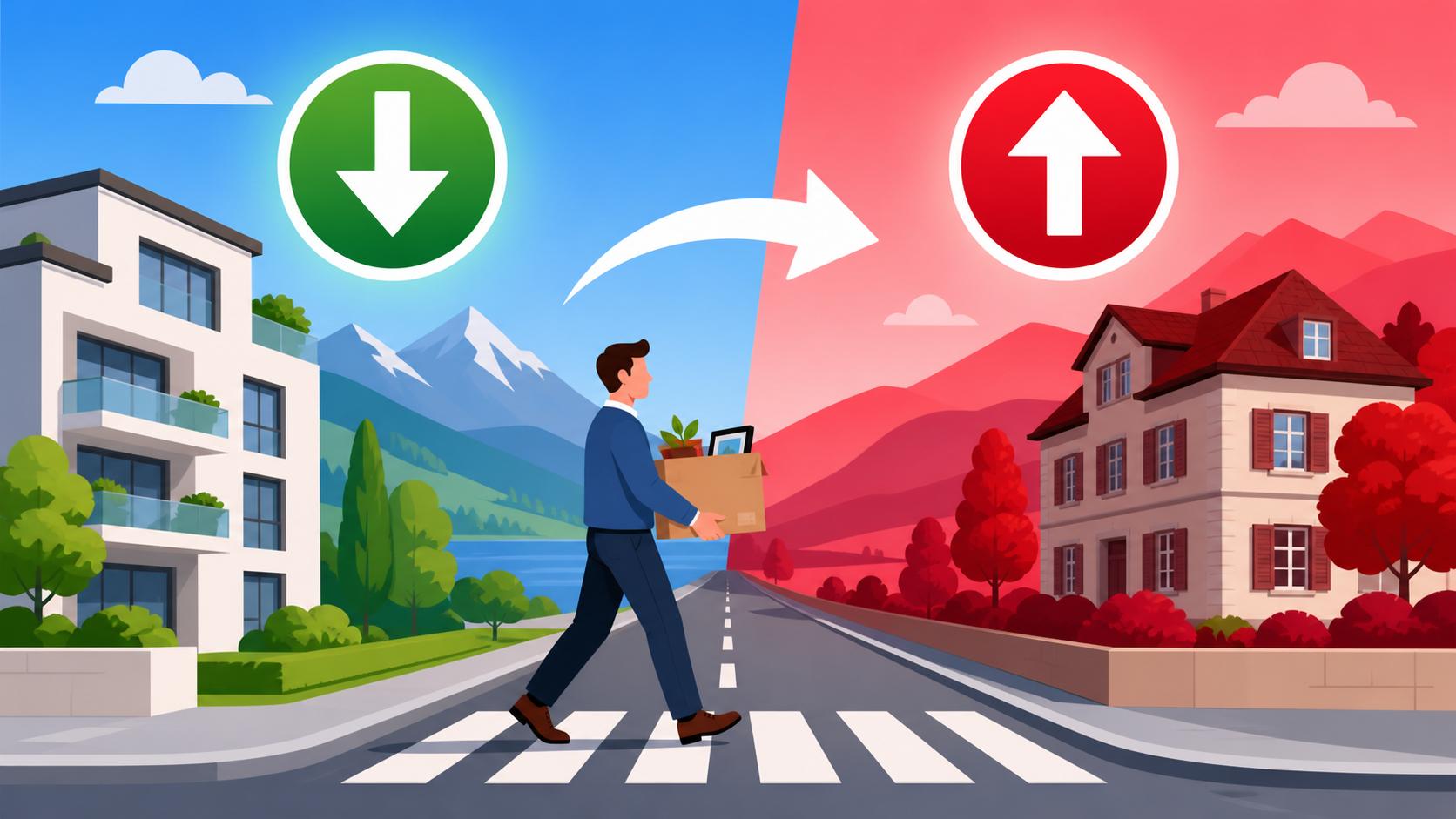
Why Moving Across the Street Can Drastically Change Your Swiss Tax Rate
You finally found a stunning apartment just ten minutes away from your current place, only to realize your monthly take-home pay has suddenly dropped by CHF 400. I once made the mistake of moving across a municipal border without checking the tax multiplier, and the financial sting was immediate. This guide explains exactly why moving across the street in Switzerland can drastically change your tax rate.
The Swiss Tax Architecture: Why Geography Equals Money
In most countries, moving from one side of a city to another is a matter of lifestyle choice, commute times, or school districts. In Switzerland, it is a significant financial decision. This is due to the country’s decentralized fiscal system, where tax sovereignty is split between three distinct levels: the federal government, the canton, and the municipality (the Gemeinde or Commune). While federal tax remains consistent regardless of where you live, the other two tiers vary wildly based on your specific address.
When we talk about the Swiss Taxes Explained: Federal, Cantonal, and Municipal Rates, we are looking at a system where each of the 26 cantons sets its own tax laws and rates. Below that, each of the roughly 2,000 municipalities sets its own "tax multiplier" (Steuerfuss). This multiplier is a percentage applied to the base cantonal tax. If you live in a municipality with a low multiplier, you pay less; if you move one street over into a municipality with a high multiplier, your bill goes up.
Imagine two identical professionals earning CHF 120,000. One lives in the city of Zurich, while the other lives in Kilchberg, a municipality just a few kilometers south. Because Kilchberg has a lower tax multiplier, the person living there might save thousands of francs every year compared to their colleague in the city center. This is a primary driver behind the Cost of Living in Switzerland 2026: Budgeting for Singles and Families, as rent prices often correlate inversely with tax rates. High-tax areas might have slightly lower rents, while "tax havens" like Wollerau or Zug command a premium on housing because the tax savings are so substantial.
The Importance of the December 31st Rule
One of the most surprising—and sometimes frustrating—aspects of the Swiss system is the "cutoff date" for tax residency. In almost all cantons, you are taxed for the entire calendar year based on where you are officially registered on December 31st. This is a detail that catches many expats off guard.
If you live in a high-tax canton like Neuchâtel for eleven months and move to a low-tax canton like Zug on December 20th, you will theoretically be taxed by Zug for the entire year. Conversely, if you move from Zug to Neuchâtel on New Year's Eve, you could find yourself owing the higher Neuchâtel rate for the full twelve months you actually spent in Zug. I’ve seen friends lose out on thousands because they didn't time their relocation to align with Filing a Swiss Tax Return (C Permit or High Earners on B Permit) requirements.
How Municipal Multipliers Work in Practice
The municipal tax multiplier is the reason two neighbors separated by a single road can have different financial realities. Municipalities use these rates to fund local infrastructure, schools, and services. A wealthy municipality with many high-income residents can afford to keep its multiplier low while still providing excellent services. A struggling municipality might be forced to raise its multiplier to cover its budget.
When you are looking at potential apartments, you should always check the "Steuerfuss" of the specific Gemeinde. Most cantons provide online calculators where you can input your salary and see the difference between various towns. Understanding this is a core part of Lowest Tax Cantons: Moving to Zug, Schwyz, or Nidwalden for Tax Benefits, but even within those "cheap" cantons, the specific town matters.
| Canton | Municipality | Estimated Annual Tax (Single, 100k Income) | Tax Multiplier (Example) |
|---|---|---|---|
| Zug | Zug | ~CHF 4,500 | 54% |
| Zurich | Zurich City | ~CHF 8,200 | 119% |
| Zurich | Kilchberg | ~CHF 6,800 | 72% |
| Geneva | Geneva City | ~CHF 12,500 | 45% (of cantonal base) |
| Schwyz | Wollerau | ~CHF 3,800 | 60% |
Tax Competition and the Golden Ticket Cantons
Switzerland intentionally fosters tax competition between its cantons and municipalities. The idea is that lower taxes attract residents and businesses, which in turn grows the local economy. For an expat, this creates a "menu" of options where you can trade off commute time for tax savings. This is why you will see thousands of people commuting into Zurich or Geneva from neighboring cantons or lower-tax suburbs.
Cantons like Zug, Schwyz, and Nidwalden are famous for their aggressive tax-friendly policies. However, the benefits are most pronounced for high earners. If you are earning a more modest salary, the difference between a high-tax and low-tax area might be overshadowed by the increase in rent you would pay to live in a low-tax zone. It is a balancing act that requires deep research into the Understanding Withholding Tax (Quellensteuer) vs Standard Taxation for Foreigners rules, especially if you are on a B permit.
The Impact on Withholding Tax (Quellensteuer)
If you are an expat on a B permit (and earn below CHF 120,000 in most cantons), your tax is deducted directly from your salary every month. This is known as Quellensteuer. Many people assume that because this is a flat rate calculated by the canton, moving between municipalities doesn't matter. This is a common misconception.
While the monthly deduction is based on a cantonal average, your final tax liability can still be affected by where you live, especially if you qualify for or are required to file a Tax Corrections (Tarifkorrektur): Claiming Deductions on Withholding Tax or a full tax return. If you live in a very expensive municipality but are taxed at the cantonal average via Quellensteuer, you might actually be getting a "deal" until you switch to a C permit. Once you have a C permit, you shift to the standard declaration system, and the municipal multiplier hits your wallet in full force. This is one of the reasons Why Quellensteuer is Deducted Monthly from B Permit Holders can actually be a simpler, albeit less transparent, experience for newcomers.
Managing Global Assets and Wealth Tax
Switzerland is one of the few countries that still imposes a wealth tax (Vermögenssteuer). This is a small percentage charged on your total global net worth, including bank accounts, properties abroad, and investments. Just like income tax, wealth tax rates are determined by your canton and municipality.
If you have significant savings or investments, moving across the street could change the rate at which your global wealth is taxed. For those holding assets on platforms like Binance for crypto or Trade Republic for stocks, these must be declared annually. A move to a different municipality might change your wealth tax bill from a few hundred francs to several thousand. When moving large sums of money internationally to fund a property purchase or cover Swiss expenses, using a service like Wise can help minimize transfer fees, but it won't shield you from the local wealth tax obligations once those funds land in your account.
Practical Strategies for Your Move
Before you sign a lease for that "perfect" apartment that happens to be just across the municipal border, you need to perform a fiscal health check. I have seen expats move to save CHF 200 on rent, only to realize their tax bill increased by CHF 300 a month because they moved from a low-tax suburb into a high-tax city zone.
Start by using the official tax calculators provided by the cantonal tax office (Steueramt). Search for "Steuerrechner [Canton Name]" and plug in your anticipated taxable income. Don't forget to account for deductions like Pillar 3a in 2026: Tax Deductions, Limits, and Investment Options, which can significantly lower your taxable base regardless of which municipality you choose.
Using Tax Calculators Before You Sign
Every major canton has a sophisticated online tool. You should compare your current municipality with your target municipality. Look specifically at:
- The Cantonal Tax Rate: If you are moving across cantonal lines (e.g., Zurich to Zug).
- The Municipal Multiplier: If you are moving within the same canton.
- Personal Deductions: Some cantons are more generous with deductions for commuting, health insurance, or childcare.
The Impact of Social and Cultural Factors
Lower taxes often mean higher demand for housing. In municipalities like Zug or the "Gold Coast" of Lake Zurich, you are not just paying for the view; you are paying for the right to a lower tax rate. This results in extreme competition for apartments. You might find that the money you save on taxes is simply handed over to a landlord in the form of higher rent.
Furthermore, some low-tax municipalities have fewer public services or different school funding models. While the Capital Gains Tax in Switzerland: The Tax-Free Stock Market Rule applies federally for private individuals, local infrastructure quality is a direct reflection of municipal budgets. Always visit the Gemeindehaus (town hall) and walk around the neighborhood to ensure the "cheaper" tax rate doesn't come with a lifestyle trade-off you aren't prepared for.
Wealth Management and Digital Assets
If you are an active investor using apps like Trade Republic or holding digital assets on Binance, your tax return will involve documenting these holdings. Because Switzerland taxes the "value" of your holdings on December 31st, your choice of residence on that specific day dictates the wealth tax rate for your entire portfolio. For high-net-worth individuals, the difference between a 0.1% wealth tax and a 0.3% wealth tax across different municipalities can be the deciding factor in where they choose to live.
Beyond Income: Wealth Tax and Other Financial Ripples
The "moving across the street" phenomenon isn't just about the money that leaves your paycheck; it’s about the entire financial ecosystem you enter. For example, the cost of car insurance, the price of local permits, and even the "church tax" (Kirchensteuer) can vary. If you are a member of a recognized church, you will pay a percentage of your cantonal tax to that church. Since the cantonal tax varies by municipality, your church contribution shifts too.
When you are planning a move, treat it like a business merger. Look at the "assets" (lower tax, better schools) and "liabilities" (higher rent, longer commute, different municipal fees). If you are moving frequently to manage your tax burden, keep in mind that the Swiss authorities monitor "tax-driven relocations" if they seem fraudulent, although moving for a better rate is generally perfectly legal and widely practiced by locals and expats alike.
The Hidden Costs of Low-Tax Municipalities
Sometimes, low-tax areas have higher "hidden" costs. For example, waste disposal fees (the cost of the "official" trash bags) can vary. While these are small amounts, they reflect the broader reality that every Gemeinde must balance its books. A very low tax rate might be compensated for by higher fees for municipal services or a lack of subsidized childcare (Kita) spots. If you have a family, a higher-tax municipality with heavily subsidized childcare might actually save you more money overall than a low-tax town with full-price private nurseries.
Final Checklist Before Relocating
To ensure you aren't caught in a "tax trap," follow these steps:
- Identify the exact municipality of the new apartment (sometimes the zip code covers multiple towns).
- Run a comparison on the cantonal tax calculator for your specific income and family status.
- Verify the Wealth Tax in Switzerland: How Global Assets Are Assessed impact if you have significant international holdings.
- Check the cost of local services and childcare if applicable.
- Use a transparent tool like Wise if you need to move international currency for your initial deposit or furniture costs to ensure you aren't losing money before you even pay your first tax bill.
Living in Switzerland offers incredible financial opportunities, but it requires you to be your own CFO. By understanding the granular nature of the municipal tax system, you can make an informed decision that keeps more of your hard-earned Swiss Francs in your pocket, regardless of which side of the street you choose to call home.
Disclaimer
The information provided in this article is for general informational purposes only and does not constitute professional financial, legal, or tax advice. Tax laws in Switzerland are subject to frequent changes at the federal, cantonal, and municipal levels. We recommend consulting with a qualified Swiss tax advisor or the relevant cantonal tax authorities before making any relocation or financial decisions based on this content. Final tax liabilities depend on individual circumstances that cannot be fully addressed in a general guide.