Understanding the Swiss Transport Zone System for Monthly Passes
Oh, the Swiss transport system! It's truly a marvel of engineering and punctuality, isn't it? But when you first arrive, trying to wrap your head around how to pay for all that efficient glory, especially with monthly passes, feels like trying to solve a Rubik's cube blindfolded. You've heard whispers of "zones," "tariffs," and "community passes," and suddenly, your simple desire to get from your flat to work becomes a complex mathematical equation. This guide is here to untangle that knot for you, breaking down the Swiss transport zone system so you can confidently pick the right monthly pass without feeling like you need a PhD in cartography.
The Labyrinth of Swiss Public Transport: A First Glance
When you first step off the plane or train and encounter Switzerland's public transport, it's a mix of awe and bewilderment. Everything runs like clockwork – trains, trams, buses, even boats – yet the sheer number of different transport companies and ticketing options can send any newcomer into a spiral. It’s like arriving in a perfectly organized theme park where every single ride has its own unique payment method.
Why the Zone System Exists and Why It Confuses Everyone
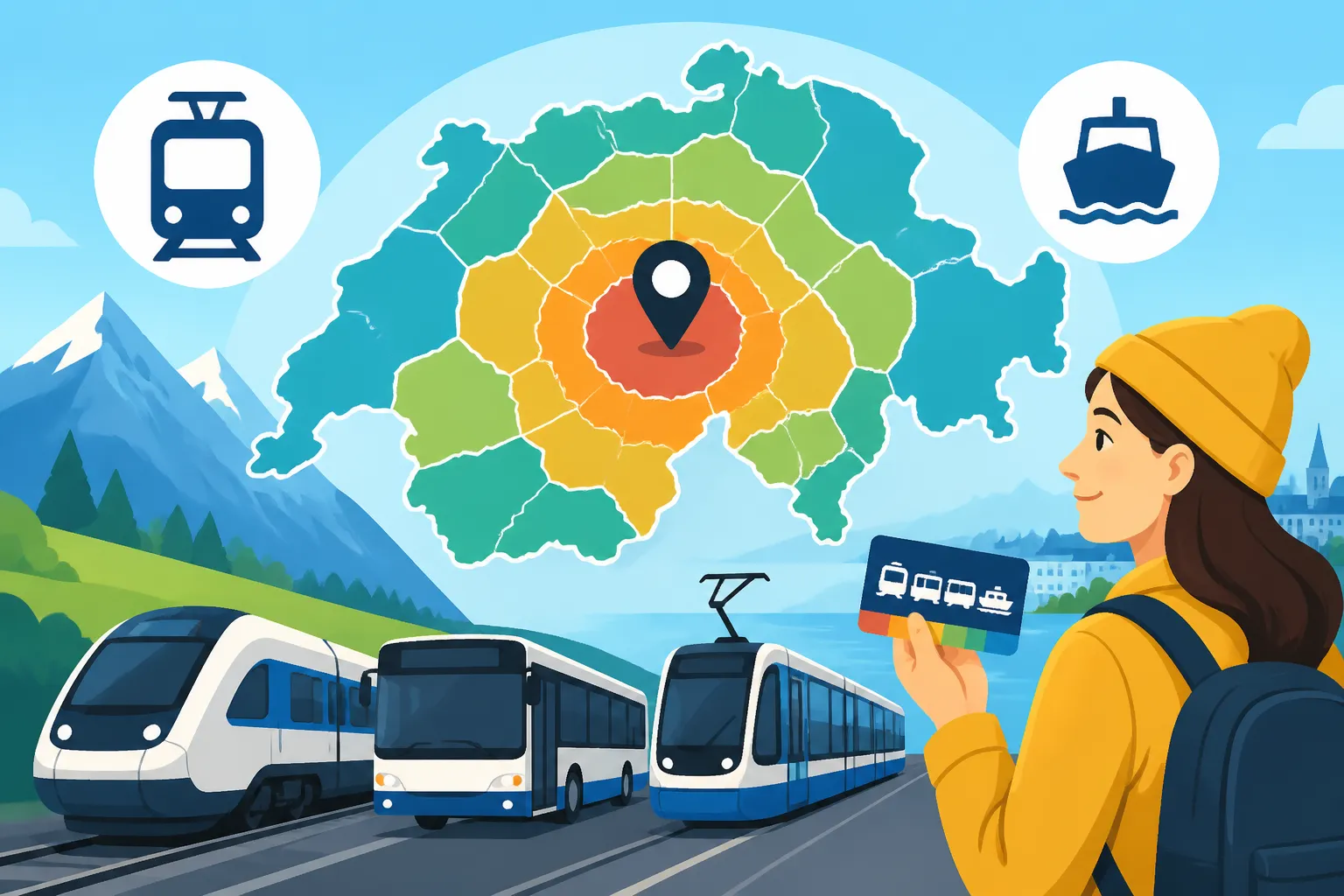
At its heart, the zone system in Switzerland is actually designed for efficiency and fairness, but it certainly doesn't feel that way when you're grappling with it for the first time. Imagine each city and its surrounding region as a series of interconnected bubbles. Each bubble, or "zone," has a fixed price, and your ticket or pass covers a certain number of these zones. Instead of paying per kilometer or per stop, you pay for the geographical areas you traverse.
The reason for this lies in Switzerland's highly decentralized structure. Every canton, and often even major cities, has its own public transport authority that works in conjunction with the national railway. So, while you have the mighty SBB (Swiss Federal Railways) connecting the country, you also have local giants like the Zürcher Verkehrsverbund (ZVV) in Zurich, Transports Publics Genevois (TPG) in Geneva, Basler Verkehrs-Betriebe (BVB) in Basel, and countless others. Each of these regional networks has its own pricing structure based on zones. This system allows for seamless transfers between different modes of transport (train, tram, bus) within a defined area, ensuring you only need one ticket for your journey, even if you switch vehicles multiple times. The confusion really kicks in because these regional systems overlap and don't always use the same numbering logic. One minute you're in ZVV zone 110, the next you've crossed into A-Welle territory, and your mind just explodes trying to figure out which pass covers what.
Key Players in the Swiss Transport Network
While the SBB (Swiss Federal Railways) is the overarching national carrier, handling most of the train lines between cities and cantons, the daily commutes within urban areas and their immediate surroundings are typically managed by regional transport associations. These associations are the ones that define and administer the zone systems you'll be navigating for your monthly passes.
In Zurich, it's the ZVV (Zürcher Verkehrsverbund). If you live in the Zurich metropolitan area, from Winterthur to Zug, you'll be dealing with ZVV zones. In Geneva, you'll primarily use the TPG (Transports Publics Genevois) for city and regional travel, which operates within the UNIRESO zone system that also covers parts of neighboring France. Over in Basel, it's the BVB (Basler Verkehrs-Betriebe), integrated into the tarifverbund Nordwestschweiz (TNW). Then you have others like Mobilis in Canton Vaud (Lausanne region), Libero around Bern, and A-Welle covering Aargau and Solothurn.
These local networks are crucial because their zone passes are often more cost-effective for daily commutes within their specific regions than buying individual SBB tickets or even a national pass, especially if you rarely travel beyond your canton. Understanding their specific zones and how they interact with each other and the SBB network is the first step to becoming a Swiss transport guru. Knowing these names will save you a lot of headache when you search for information specific to your new home.
Decoding the Zone System: How It Works in Practice
Alright, let's get down to brass tacks. You're in Switzerland, you're commuting, and you need to understand these elusive "zones." Forget mileage; it's all about these numbered areas.
Core Zones, Overlapping Zones, and Their Significance
A "zone" in the Swiss public transport system is essentially a geographical area for which a specific tariff applies. When you buy a ticket or a pass, you're buying coverage for one or more of these zones. The key thing to remember is that passes are bought for zones, not specific routes. This means if you buy a pass for zones 10 and 20, you can travel freely between any two points within those zones, and even within each zone itself, using any public transport mode.
Now, here's where it gets a little tricky: Core Zones (Kernzonen) and Double Zones (Doppelzonen).
Every major city typically forms a "core zone." For instance, in Zurich, the city center is ZVV Zone 110. This zone is a special beast: it counts as two zones for pricing purposes, even though it's just one numbered zone. Why? Because it's the busiest and most served area. So, if your pass covers Zone 110, you effectively have coverage for two zones' worth of travel time or cost. This is super important because it affects how many "zones" your pass is actually calculated for.
Then you have situations where zones from different transport associations overlap. For example, if you live near the border of the ZVV and A-Welle networks, a single physical area might be counted under both systems. When you buy a pass for a journey that spans these different networks, the system will calculate the minimum number of zones required, sometimes counting an overlapping zone once for both networks. It’s a bit like a Venn diagram, but with train lines and bus stops instead of circles. The SBB mobile app and the local transport websites are your absolute saviors here, as they'll show you exactly which zones are included in a particular ticket or pass. It's often not intuitive, and trying to manually map it out will lead to frustration, trust me.
Calculating Your Commute: How Many Zones Do You Really Need?
This is where the rubber meets the road. To figure out which pass you need, you first have to determine your "zone profile." This means identifying all the zones you'll consistently be travelling through for your daily life – typically your home-to-work commute, but potentially also the kids' school or your regular grocery run.
Let's take a hypothetical scenario. Say you live in Winterthur (which is ZVV Zone 120) and work in Zurich city center (ZVV Zone 110).
When you use the SBB app or the ZVV website to plan your route, you'll input "Winterthur" as your starting point and "Zurich HB" (main station) as your destination. The system will then show you the most direct route and, crucially, list the zones required. In this case, your journey would likely require zones like 120, 121, 122, 123, 124, 125, and then 110. Because Zone 110 counts as two zones, you would actually be paying for multiple zones.
The best way to calculate this is NOT to pull out a map and count, but to use the official tools:
- SBB Mobile App: This is indispensable. Enter your exact start and end points. When you view a connection, it will often tell you "Zones needed: X" or will specify the transport association (e.g., "ZVV Zones 120-110"). For a monthly pass, you can input your daily commute, and the app will suggest which zone combination pass to buy.
- Local Transport Association Websites: For example, the ZVV website has an excellent "Zone checker" or "Tariff calculator" where you can input your origin and destination and it will show you the exact zones.
Always double-check the "shortest route" principle, but understand that sometimes the zone boundaries might make a slightly longer physical route cheaper or covered by fewer zones. It sounds counter-intuitive, but the zone map isn't always perfectly logical in terms of travel time. For those crucial first few weeks, having reliable mobile data is a lifesaver for constantly checking these apps. If you're still waiting on your local SIM, an eSIM from a provider like Airalo can be incredibly helpful to keep you connected and navigating these complexities without missing a beat. Don't be shy about asking a local (a Swiss colleague or a friendly neighbor) to help you interpret the map or the app results; sometimes a fresh set of eyes can make all the difference.
Monthly and Annual Passes: Navigating the Options
Once you've wrapped your head around the zone system, the next step is choosing the right pass. This is where you decide if you're a local commuter or a national explorer.
The Local Transport Association Passes (ZVV, TPG, BVB etc.)
For most expats, especially those living and working in a major city and its surrounding areas, a local transport association pass will be your bread and butter. These passes are designed for daily, unlimited travel within a specified number of zones within that particular network.
Take the ZVV NetzPass in Zurich for example. You choose how many zones you need (say, 3 zones, including the core Zone 110 which counts as two). Once you have that pass, you can hop on any train, tram, or bus within those three zones, as many times as you like, for the entire month (or year, if you buy an annual pass). It's incredibly convenient for daily commutes and weekend excursions within your local region. Similarly, in Geneva, a TPG (UNIRESO) pass will cover specific zones in the canton, including your local city buses and trams.
Pros of Local Passes:
- Cost-Effective for Local Commutes: If you consistently travel within a defined set of zones, these are usually the cheapest option for unlimited travel.
- Simplicity (Once Set Up): After the initial setup, you just tap and go (or just carry your card). No need to buy individual tickets.
- Integration: Covers all public transport modes (trains, trams, buses, often even local boats) within its zones.
Cons of Local Passes:
- Limited Geographical Coverage: Venture outside your purchased zones, and you'll need to buy an additional ticket (called a "zone upgrade" or "Anschlussbillett"). This can add up if you frequently travel beyond your usual routes.
- Cantonal/Regional Specificity: The pass is only valid for that specific transport association. If you cross into another major canton for work, you might need a different pass or supplementary tickets.
- Initial Confusion: The process of figuring out which zones you need can be daunting at first.
These local passes are often available as monthly or annual subscriptions. Opting for an annual pass usually gives you a discount compared to buying 12 monthly passes. For many, this is the most practical solution for their everyday lives.
The Generalabonnement (GA) and Half-Fare Card (Halbtax): National Coverage
While local passes cover your daily grind, if you're planning on really exploring Switzerland, or if your commute takes you across multiple cantons frequently, you might start looking at the national solutions offered by SBB.
The Half-Fare Travelcard (Halbtax) is probably the first thing almost every expat gets, and for good reason. It’s not a pass for unlimited travel, but rather a discount card that slashes the price of almost every standard train, bus, boat, and mountain railway ticket by 50%. This includes tickets for individual journeys, zone upgrade tickets, and even the local zone passes themselves. Yes, you read that right – your ZVV or TPG monthly pass can be half price if you have a Halbtax! For anyone who plans to travel outside their local zones even a few times a year, the Halbtax almost always pays for itself quickly. It’s like having a universal discount code for all of Switzerland's public transport. If you want to dive deeper into this essential pass, check out our guide on The Half-Fare Travelcard (Halbtax): The Must-Have Pass for Swiss Residents.
Then there's the Generalabonnement (GA). This is the "God mode" of Swiss public transport passes. It grants you unlimited travel on almost all SBB trains, postbuses, most boats, city trams and buses, and many private mountain railways throughout the entire country. If you commute long distances daily (e.g., from Bern to Zurich), or if you’re a keen explorer who spends every weekend hopping on trains to different parts of Switzerland, the GA can be incredibly economical despite its hefty upfront cost (over CHF 4,000 annually). It takes the guesswork out of ticketing completely; you just flash your GA and go. However, for most expats with a stable local commute, the combination of a Halbtax and a local zone pass offers better value. We've got a comprehensive breakdown on whether SBB Travelcards: Is the Generalabonnement (GA) Worth the CHF 4000+ Cost? for most residents.
Here's a quick comparison of the common monthly/annual passes:
| Pass Type | Primary Use Case | Coverage | Price (approx. monthly/annual) | Discount w/ Halbtax | Best For |
|---|---|---|---|---|---|
| Local Zone Pass (e.g., ZVV NetzPass) | Daily commute within a specific urban region | Defined zones within one transport association | CHF 60-200 (monthly) | Yes (often 50%) | Commuters, daily life within city/region, cheaper option |
| Half-Fare Travelcard (Halbtax) | Discount on all tickets | 50% off most public transport in Switzerland | CHF 185 (annual) | N/A | Everyone, if you travel more than a few times a year |
| Generalabonnement (GA) | Unlimited national travel | Nearly all public transport in Switzerland | CHF 340-425 (monthly) | N/A | Frequent long-distance commuters, avid travelers |
| Saver Day Pass (Spartageskarte) | Ad-hoc national travel | All public transport for one day | CHF 29-106 (daily) | Yes (cheaper with Halbtax) | Spontaneous national day trips, cheaper than full-price GA |
Practical Tips and Common Expat Pitfalls
Even with a grasp of the zone system and pass options, navigating Swiss public transport has its quirks. Here are some real-world tips to save you grief and money.
The SBB Mobile App and Local Transport Websites: Your Best Friends
Seriously, download the SBB Mobile App right now. It is, without exaggeration, the most reliable and user-friendly public transport app I’ve ever encountered. It's your personal journey planner, ticket seller, and zone calculator all rolled into one. When you input your origin and destination, it doesn't just show you connections; it tells you exactly what kind of ticket you need, how many zones it covers, and the price (with and without a Halbtax). You can purchase tickets directly through the app, which is incredibly convenient and often saves you time at the machines.
Beyond SBB, familiarize yourself with the website and app of your local transport association. For example, if you're in Zurich, the ZVV website offers detailed zone maps and calculators, which can be invaluable when trying to figure out which NetzPass is right for you. These local resources often provide even more granular detail about specific bus routes and local tariff zones. Being able to access these resources on the go is crucial, especially when you're still learning the ropes. For those early days when you're settling in and haven't sorted out your local phone plan yet, having a reliable eSIM, like one from Airalo, can ensure you always have data to use these essential apps.
Don't Get Caught Out: Fines and Spot Checks
The Swiss public transport system operates on an "honour system" to a large extent. There are often no gates or barriers. However, plainclothes ticket inspectors are everywhere. Seriously, they pop up when you least expect them, and they are incredibly efficient. If you are caught without a valid ticket or pass for the zones you are in, you will face a hefty fine. The standard fine for traveling without a valid ticket is CHF 90. If you’re caught a second time within two years, it jumps to CHF 130, and a third time means CHF 160 plus potential legal action. Ignorance of the zone system is absolutely no excuse.
I remember a friend who swore his monthly pass covered a particular route, only to find out it only covered the main line, not the small feeder bus that took him the last two stops. He argued, explained, even showed his pass – didn't matter. Fine issued on the spot. So, always, always ensure your ticket or pass is valid for your entire journey, from door to door, including any transfers through different zones. It's better to buy an extra zone upgrade for a few francs than risk a significant fine.
Moving Cantons and Changing Your Pass
This is a scenario many expats face: you start in one canton, get a handle on its transport system, and then work or life takes you to another. Suddenly, your perfectly understood ZVV NetzPass is as useful as a chocolate teapot in Geneva, which operates under the UNIRESO system.
When you move cantons, you're not just changing your address; you're often changing your entire public transport ecosystem. You'll need to "deregister" from your old commune and "register" in your new one – a bureaucratic dance that's well-documented in our guide on Changing Cantons on a B Permit: Notification and Reapplication Processes. Along with that, you'll need to cancel your old monthly pass (adhering to its notice period) and then research and purchase a new one for your new region. This can be a hassle, as each system has its own nuances, and you'll be back to square one learning the local zone map and pass options.
It's one of those uniquely Swiss challenges that remind you how fragmented the country can feel administratively, despite its smooth national infrastructure. During such a move, managing all the logistics can be overwhelming. Companies like Sirelo can provide invaluable assistance with relocation services, taking some of the burden off your shoulders so you can focus on mastering your new commute. Don't underestimate the mental load of these changes; give yourself time to adapt and research.
Disclaimer
The information provided in this guide is for general informational purposes only and does not constitute professional advice. While we strive to keep the information up-to-date and accurate, public transport tariffs, zone systems, and regulations in Switzerland can change. Always refer to the official websites of SBB and the respective cantonal/regional transport associations (e.g., ZVV, TPG, BVB) for the most current and authoritative information. Personal circumstances and travel patterns vary, so always verify the best pass option for your specific needs.