Registering Your Religion on Your Residency Form: Tax Implications
When you sit down at the local residents' registration office to officially move into your new Swiss home, you are often handed a form that feels like a standard data collection sheet until you hit the section on religious affiliation. I remember sitting in a wooden chair in a Zurich Kreisbüro, looking at that box and wondering why the government cared about my Sunday morning habits. This guide solves the mystery of the Swiss church tax and explains the long-term financial consequences of that one little checkmark on your residency form.
The 14-Day Deadline and the Religion Question
In Switzerland, the administrative machinery starts humming the moment you cross the border with your employment contract in hand. You have exactly 14 days to register your presence at the local Gemeinde (municipality) or, if you are in a larger city like Zurich, at the specific district office. This process is the gateway to your residence permit, your tax ID, and your legal status in the country. During this appointment, you will need to present several documents, and if you are arriving from a non-German or non-French speaking country, you should look into Registering at the Kreisbüro: What Documents Do Expats Need to Bring? to ensure you don't have to make a second trip.
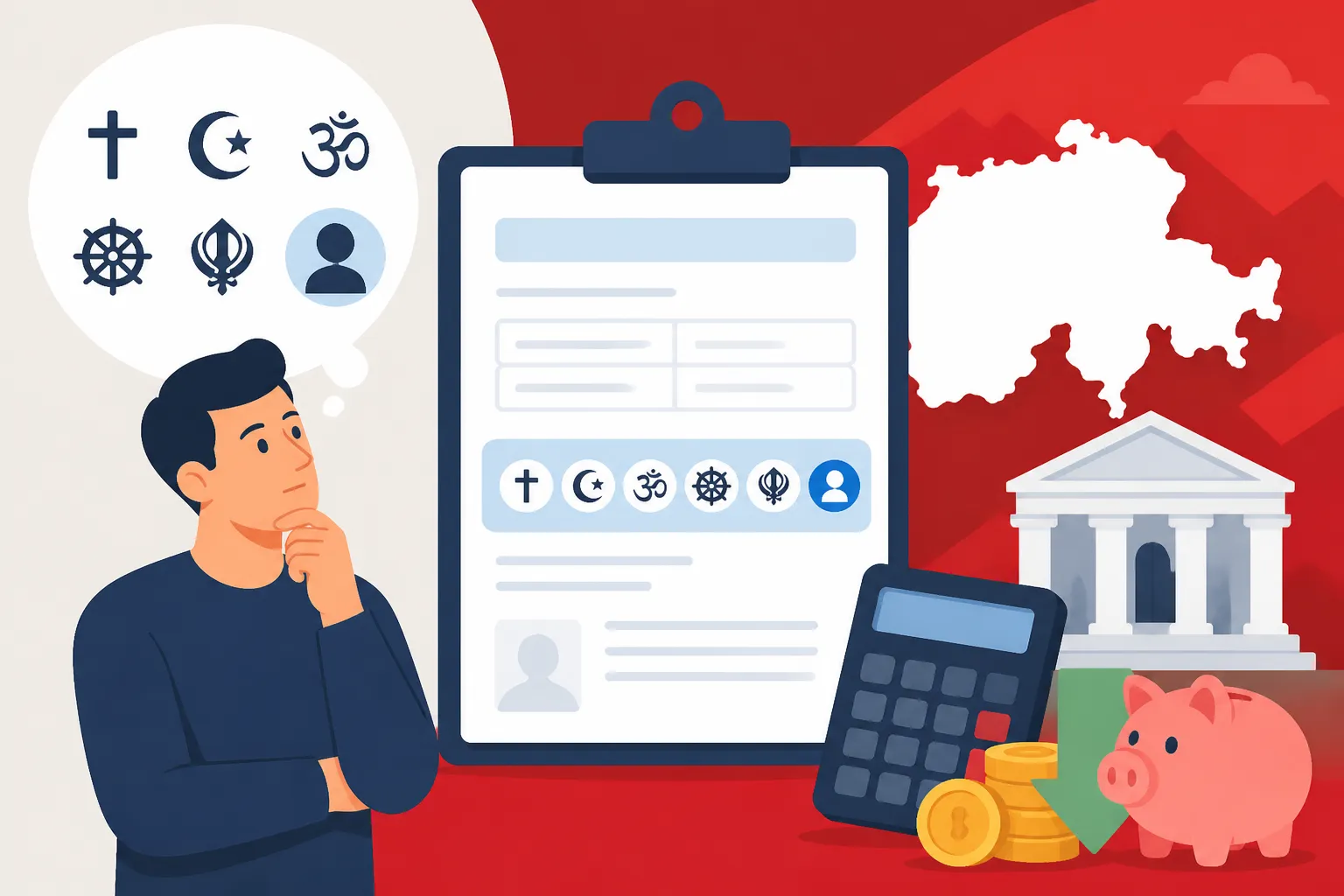
The "Religion" question on the registration form is not a survey of your personal beliefs or a demographic study. It is a formal declaration of tax liability. In most Swiss cantons, the three main national churches—Roman Catholic, Christian Catholic, and Swiss Reformed—have the status of public-law entities. This means they have the legal right to collect taxes from their members through the state's tax system. When you check "Catholic" or "Protestant," you are essentially authorizing the Swiss tax authorities to deduct a percentage of your income to fund the church’s operations, buildings, and social programs.
If you are coming with a family, the authorities will also ask for the religious status of your spouse and children. If you were married abroad, the migration office will require a translated marriage certificate to process your family’s residency. Using a professional service like RushTranslate can help ensure your documents meet the strict Swiss standards for official records. Once these details are entered into the system, they are difficult to change retroactively, so the choice you make at the counter is high-stakes.
The Mechanics of Church Tax in Switzerland
The Swiss Taxes Explained: Federal, Cantonal, and Municipal Rates system is already famously decentralized, but the church tax adds another layer of complexity. Known as Kirchensteuer, this tax is generally calculated as a percentage of your basic cantonal income tax. It is not a flat fee; rather, it scales with your earnings. The more you earn, the more you contribute to the church. For many expats, this is the first time they encounter a system where the state acts as a collection agent for religious institutions.
Cantonal Variations and Rates
Every canton has its own rules regarding which churches can tax and how much they can charge. In Geneva and Neuchâtel, the church and state are more strictly separated, and church tax is technically voluntary or handled differently. However, in the German-speaking cantons like Zurich, Zug, and Bern, it is a deeply ingrained part of the fiscal landscape. If you are living in a high-tax canton, the church tax can add hundreds or even thousands of francs to your annual tax bill.
For those on a B Permit, this tax is usually folded into your Withholding Tax (Quellensteuer) vs Standard Taxation for Foreigners. If you declare a religion, your employer’s HR department will use a different tax code to calculate your monthly take-home pay. If you later look at your pay stub and see a lower amount than you expected, check the code. You can find more details on how to decipher these entries in our guide on Understanding Swiss Payslips: Deductions for AHV, ALV, and NBU.
Who Actually Receives the Money
The funds collected are distributed to the local parish of your declared denomination. These funds support the maintenance of historic cathedrals, the salaries of clergy, and significant social services like kindergartens, counseling centers, and elderly care. Many expats feel that even if they are not active practitioners, the "cultural tax" is worth paying to support the social fabric of their new village or city. Others, however, prefer to direct their Cost of Living in Switzerland 2026: Budgeting for Singles and Families toward private charities or their own savings.
The Financial Reality: Calculating Your Contribution
To give you an idea of the impact, let's look at a hypothetical scenario. If you are a single professional living in Zurich with a taxable income of CHF 100,000, your cantonal tax might be roughly CHF 6,000. The church tax in Zurich is approximately 10% of that cantonal tax amount. This means you would pay an additional CHF 600 per year simply for checking a box. In some municipalities, the rate can be even higher.
| Canton | Typical Church Tax Rate (as % of Cantonal Tax) | Estimated Annual Cost (on CHF 100k Income) |
|---|---|---|
| Zurich | ~10% | CHF 500 – 700 |
| Zug | ~9% | CHF 300 – 500 |
| Bern | ~15% | CHF 800 – 1,100 |
| Geneva | Voluntary | CHF 0 (unless opted-in) |
| Basel-Stadt | ~8% | CHF 400 – 600 |
As you can see, the cost is not negligible. When you are already balancing high premiums for private insurance through providers like Cigna Global and the high cost of Swiss groceries, an extra thousand francs a year is a significant line item. It is also important to note that if you are a high earner (usually over CHF 120,000 per year) and are required to file a full tax return, the church tax will be calculated precisely based on your final assessment.
Registering as Konfessionslos
If you do not belong to one of the officially recognized churches or if you do not wish to pay the tax, you should register as Konfessionslos (without confession). This is the standard choice for atheists, agnostics, and members of religions that are not authorized to collect state taxes, such as Islam, Judaism (though some cantons have separate arrangements for Jewish communities), and various Eastern religions.
Be aware that if you were baptized in your home country and the Swiss authorities find out, they may occasionally try to claim you are still a member. This is rare but has happened in smaller villages where the local priest and the registration clerk might be more traditional. If you are asked for proof of your religious status, ensure your documents are translated accurately. If you have a baptismal certificate you wish to use or hide, companies like RushTranslate are essential for ensuring the Translation and Apostille Requirements for Marriage Certificates and other vital records are handled correctly for the authorities.
Changing Your Mind: The Kirchenaustritt Process
What happens if you checked the box during your first week in Switzerland because you were tired and confused, and now you want out? You cannot simply go back to the registration office and ask them to "untick" it. Leaving the church in Switzerland is a formal legal procedure known as Kirchenaustritt.
The Legal Requirements of the Letter
To stop the tax, you must send a registered letter to the local parish office (Kirchenpflege) of the denomination you are currently registered with. This letter must clearly state your intention to leave the church. It doesn't need to be a long theological treatise; a simple, firm statement that you are resigning your membership is sufficient. It is vital to send this via registered mail (Einschreiben) so you have proof of delivery.
Once the church receives your letter, they will process the resignation and notify the tax office. For a detailed walkthrough of the wording and the specific addresses, refer to our article on How to Officially Leave the Church in Switzerland to Stop Kirchensteuer. You may receive a letter back from the parish asking why you are leaving or inviting you to a "farewell" talk. You are under no legal obligation to attend these meetings or explain your decision.
Effective Dates and Retroactive Refunds
The most frustrating part of this process for many expats is that the tax liability usually only ends at the end of the month or even the end of the tax year in which you resigned. The Swiss government rarely grants retroactive refunds for church taxes paid while you were registered as a member. If you moved here in January and didn't resign until November, you are likely on the hook for the full year. This is why it is so important to get your status right during those first 14 days at the Registering at the Kreisbüro: What Documents Do Expats Need to Bring? appointment.
Cultural and Social Considerations
Before you rush to resign your membership solely for financial reasons, it is worth considering what you might be giving up. In Switzerland, being a "member" of the church provides certain rights that are not available to non-members.
- Rites of Passage: If you want a traditional church wedding in a historic Swiss chapel, or if you want your children to be christened or confirmed in the state church, you generally need to be a tax-paying member.
- Burial Rights: While everyone has a right to a burial, the specific service and the use of the church building for a funeral are typically reserved for members.
- Community Integration: In smaller mountain villages, the local church is often the center of social life. While no one will ban you from the local bakery if you don't pay church tax, being a member can sometimes provide a smoother path to local integration.
If these aspects are important to you, you might view the Church Tax (Kirchensteuer): How to Opt Out and Save Money guide not as a way to avoid a fee, but as a way to understand what you are paying for. On the other hand, if you are a digital nomad or a corporate expat who plans to stay for only a few years and has no intention of using church services, registering as Konfessionslos is the most straightforward way to keep your Swiss salary in your own pocket.
Navigating the intersection of faith and finance in Switzerland is just one of many "welcome to Switzerland" hurdles. Whether you are budgeting for your first apartment or trying to understand your first payslip, remember that every box you check on a government form has a Swiss franc value attached to it. Take your time, ask for translations when necessary, and make sure your registration reflects your true intentions and financial goals.
Healthcare and Your Transition
As you settle into your new life and finalize your tax status, don't forget the other mandatory registration: health insurance. Just like the church tax, your health insurance choice has long-term financial impacts. While the church tax is cantonal, basic health insurance is a federal requirement. Many expats choose to supplement their mandatory coverage with international plans from providers like Cigna Global to ensure they have access to private rooms and specialist care without the long waits. You can find a complete breakdown of how these systems interact in our guide on Healthcare in Switzerland for Expats: The Complete System Overview (2027). Between the church tax and insurance premiums, your first month's budget will be tight, so plan accordingly.
Disclaimer
The information provided in this guide is for educational and informational purposes only and does not constitute professional tax, legal, or financial advice. Swiss tax laws and cantonal regulations regarding church tax are subject to change. While we strive to keep our content updated for 2026, you should always consult with a qualified Swiss tax advisor or your local tax office (Steueramt) to confirm the specific rules and rates applicable to your personal situation and municipality. Registration requirements and the legal status of religious organizations can vary significantly between cantons.