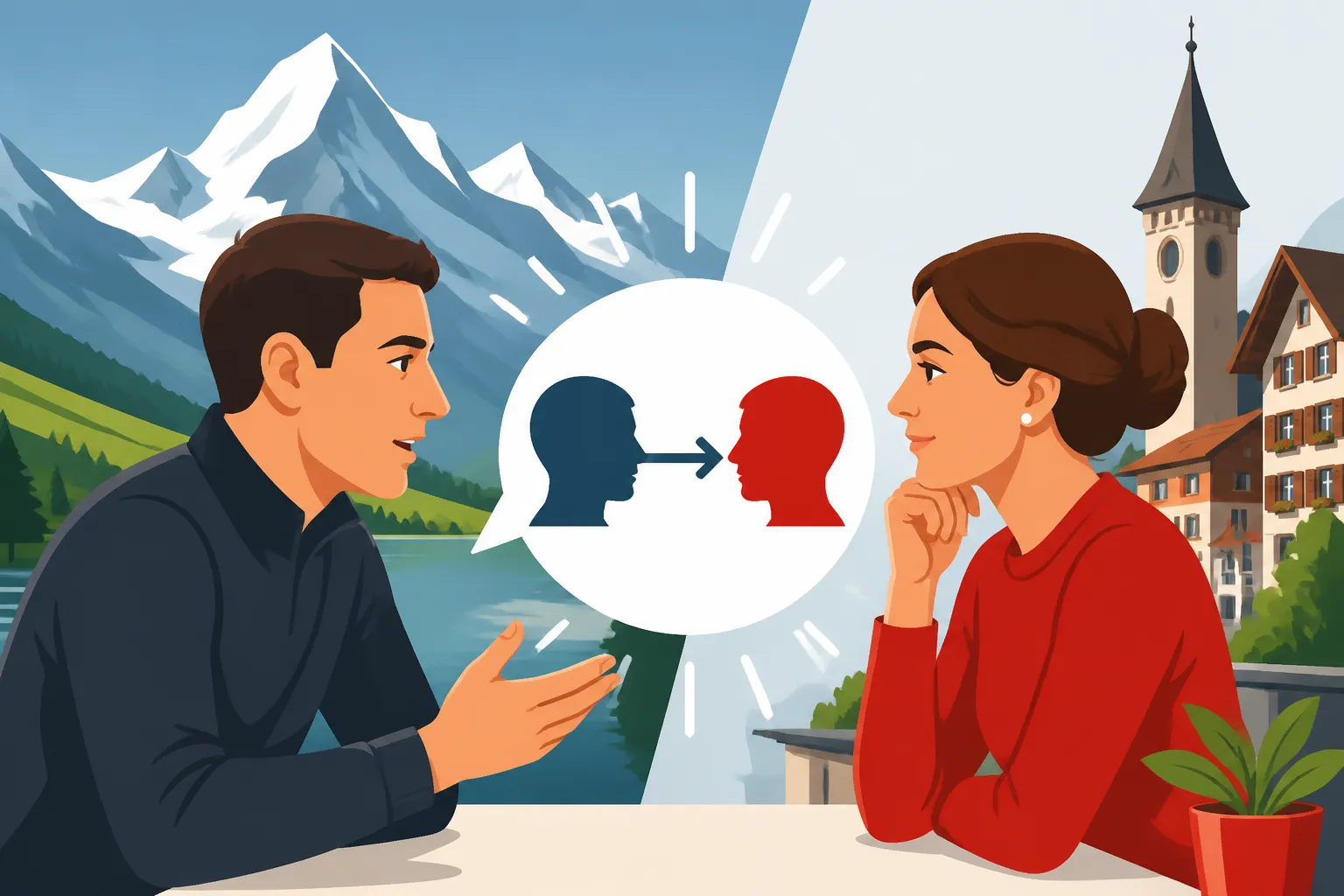
Understanding Swiss Directness and Communication Style
Let me tell you, when you first arrive in Switzerland, the directness of communication can hit you like a crisp mountain breeze – bracing, refreshing in its clarity, but sometimes, frankly, a bit cold or even shocking. You're used to softening your words, dancing around a delicate topic, or perhaps a bit of pleasantries before getting to the point. Here, that's often seen as inefficient, even disingenuous. This guide is here to help you unpack that uniquely Swiss communication style, understand its roots, and learn how to navigate it without feeling personally offended or constantly misunderstood. It’s not about being rude; it’s about being effective, and once you grasp that, you’ll find a whole new rhythm to life here.
The "Swiss Directness" You'll Encounter and Why It's Not Rude
Coming from a culture where politeness often trumps absolute clarity, the Swiss communication style can be a stark adjustment. Many expats confess to initially feeling a bit bruised or confused by what seems like an abrupt manner. However, it's vital to understand that this directness isn't a personal attack or a lack of warmth; it's a deeply ingrained cultural trait rooted in efficiency, clarity, and a preference for Sachlichkeit, or objectivity.
It's Not Personal, It's Practical: The "Sachlichkeit" Principle
In Switzerland, there's a strong emphasis on being factual and objective. This principle, Sachlichkeit, means that discussions often focus solely on the matter at hand, stripping away superfluous emotion or flowery language. Imagine you've proposed a new project at work. In some cultures, feedback might be delivered with a lot of praise sandwiching constructive criticism. Here, you might simply hear, "This aspect needs refinement," or "Your figures are incomplete."
A common scenario might involve your landlord. You might send an email asking about a slightly raised floorboard, hoping for a sympathetic response and a promise to look into it. A Swiss landlord might simply reply, "The floorboard is within acceptable parameters of wear and tear. No action is required." For some, this feels dismissive; for the Swiss, it’s a concise, factual answer that resolves the query without unnecessary back-and-forth. They’re providing information directly, without the buffer of emotional cushioning. It's about getting to the essence of the communication as quickly and accurately as possible.
Saying What Needs to Be Said: The Absence of Small Talk
One of the most frequent observations from newcomers is the noticeable lack of small talk, especially in transactional or professional settings. Don't expect your cashier to ask about your weekend, or a colleague to spend five minutes chatting about the weather before diving into a meeting agenda. This isn't because they're unfriendly; it's because they prioritize their time and yours. They value getting straight to the point, which is seen as a sign of respect for everyone's schedule.
For instance, when you ring up a utility company, you'll likely be greeted with a formal "Guten Tag, wie kann ich Ihnen helfen?" ("Good day, how can I help you?") and then a direct jump into your query. If you try to open with a personal anecdote or a lengthy preamble, you might sense a slight impatience. They are ready to solve your problem, not to engage in idle chatter. This focus on efficiency extends to meetings too; agendas are typically followed rigorously, and tangents are often gently but firmly redirected. If you're looking for more guidance on this, our guide on The Swiss Corporate Culture: Meetings, Hierarchy, and Professional Etiquette dives into this in more detail. It's all about clarity and moving forward.
The "Nein" That Means No: Clarity Over Politeness
Perhaps the most jarring aspect of Swiss directness is the straightforward "no." In many cultures, a direct refusal can be perceived as rude or confrontational. We learn to soften rejections with phrases like, "That might be difficult," "Let me think about it," or "Perhaps another time." In Switzerland, "Nein" means "No," often without elaborate explanations or apologies.
Imagine asking a local shop owner if they can hold an item for you until next week. If it's not their policy, they will simply say, "Nein, das machen wir nicht" (No, we don't do that). This can feel abrupt, but from their perspective, they are being transparent and saving you the trouble of false hope. There's no hidden meaning, no expectation that you should push further. It simply is what it is. This clarity is, in its own way, a form of honesty and respect. It ensures there's no misunderstanding and manages expectations upfront, which ultimately fosters trust.
Navigating the Nuances: Understanding the Unspoken Rules
While directness is a hallmark, Swiss communication isn't a free-for-all. There are subtle, often unwritten, rules that underpin how this directness is expressed and received. Understanding these nuances is key to feeling more comfortable and effective in your interactions.
The Importance of Punctuality and Keeping Your Word
In a culture that values efficiency and planning, punctuality isn't just a courtesy; it's a fundamental aspect of effective communication. Arriving late to an appointment or a meeting without prior notification is not only disrespectful of others' time but can also be seen as a lack of seriousness or reliability. If you say you'll do something by a certain time, it's expected that you will. If you can't, clear, timely communication is crucial.
I once knew an expat who was consistently five minutes late to team meetings, believing it to be a negligible delay. After a few weeks, his manager directly told him, "Your lateness disrupts the start of our meetings and shows a lack of respect for your colleagues' schedules." While this felt harsh to the expat, it was a perfectly normal, direct piece of feedback in the Swiss context. Our article, Punctuality in Swiss Business: Why 5 Minutes Late is Unacceptable, covers this in much greater detail and is a must-read for any newcomer. This expectation of timeliness extends to everything from showing up for a dinner party to delivering a project deadline. Your word, and your adherence to it, is a form of non-verbal communication that speaks volumes.
Written vs. Verbal: The Weight of the Written Word
While verbal communication is direct, written communication often carries even more weight and formality in Switzerland. Emails, official letters, and contracts are typically precise, comprehensive, and legally binding. There's less room for ambiguity or informal phrasing. This means that communication in writing can often feel quite formal, even for seemingly simple matters.
When dealing with administrative tasks, whether it's setting up your internet with providers like Swisscom or Sunrise, or applying for a permit at the Gemeinde, expect meticulous attention to detail in written exchanges. Any agreement or commitment is often expected to be in writing. This is particularly true for things like housing. If you're renting an apartment, every detail will be outlined in your lease agreement, and any changes or issues are best communicated in writing to ensure a clear record. This can be intimidating at first, but it also provides a clear framework and reduces misunderstandings later on.
Reading Between the Lines: When Directness is Still Subtle
Despite the overall directness, there are still moments when you need to read between the lines, particularly in social settings or when a sensitive topic is broached. The Swiss, especially those in more traditional or rural areas, are not always overtly expressive with their emotions. An emphatic statement might be delivered with a neutral expression, or a strong opinion with a quiet, firm tone.
For example, if you suggest a particular activity to a Swiss friend and they respond with a polite but unenthusiastic, "Ja, vielleicht" (Yes, maybe), it often means "no, thank you" but expressed in a way that avoids direct confrontation in a social context. This can be tricky to discern, but over time, you'll learn to pick up on these subtle cues. Observing body language, tone of voice, and the lack of follow-up can give you more insight than the literal words themselves. Similarly, our guide on Swiss Customs and Etiquette: Social Norms Every Newcomer Should Know offers valuable insights into these softer communication aspects.
Communication in Professional and Social Settings
The style of communication can subtly shift depending on whether you're in a professional environment or a more relaxed social gathering. While the underlying directness remains, its manifestation adjusts to the context.
Workplace Interactions: Efficiency Over Eloquence
In the Swiss workplace, communication is often highly task-oriented and efficient. This means conversations tend to be concise, focused on objectives, and devoid of excessive emotional expression. Feedback, as mentioned, is often direct and to the point, aimed at improvement rather than flattery. Expect clear expectations and equally clear, constructive critiques.
When you're working with Swiss colleagues, particularly in multinational companies or sectors like finance in Zurich or pharma in Basel, you'll find that meetings are usually structured, and decisions are made based on facts and data. If you have an idea, present it with solid reasoning and be prepared for robust, analytical questions. Avoid vague statements or unsupported claims. Your colleagues will appreciate your directness and clarity. When it comes to writing a cover letter for jobs, for instance, keep it professional and factual, focusing on your skills and how they align with the role, rather than overly flowery language. This approach is mirrored in documents like the Arbeitszeugnis, a critical reference letter, where specific phrasing holds significant weight. Knowing how to interpret these nuances is vital for career progression.
Social Gatherings: The Art of the Apéro and Deeper Connections
Social settings, while still characterized by a certain reservedness, allow for a different flavor of communication. Small talk might be minimal initially, but once you break through the initial barrier, conversations can become deeply engaging and intellectual. The Swiss appreciate genuine interest and meaningful discussion over superficial banter.
The Apéro, a post-work or pre-dinner drink, is a fantastic opportunity to observe and engage in Swiss social communication. You'll notice that people often form smaller, intimate groups and engage in focused discussions. If you're invited to one, don't feel pressured to fill every silence with chatter. Listen actively, ask thoughtful questions, and share your genuine perspectives. These events are where you can build stronger rapport, and our guide on Apéro Culture: Socializing with Coworkers After Work has some great tips on how to navigate them. It's less about quantity of words and more about quality and authenticity. Sometimes, you might even use apps like GetYourGuide to find local experiences, which can be a fun, low-pressure way to engage with Swiss culture and practice communication in a more relaxed setting.
Customer Service: Expecting Facts, Not Fluff
In customer service interactions, whether you're at the post office, a bank like UBS or PostFinance, or dealing with your health insurance provider, expect factual, service-oriented communication. The goal is to efficiently resolve your query or provide the requested service. Don't anticipate overly effusive pleasantries or a prolonged conversation.
For example, if you're asking about your Healthcare in Switzerland for Expats: The Complete System Overview (2027), expect a clear, concise explanation of the rules and your options. If you're at a grocery store like Migros or Coop, the cashier will efficiently scan your items and process your payment. Questions will be answered directly. While some might find this service style impersonal, it's efficient and reliable. They are focused on delivering the requested information or service without adding unnecessary emotional labor. When you're trying to figure out how to pay your Serafe bill, for example, the information provided will be purely transactional – what you owe, how to pay it, and the deadline. No fluff, just facts.
Adapting and Thriving: Strategies for Expats
Adjusting to Swiss directness can take time, but it’s an incredibly valuable skill to cultivate. It boils down to understanding the intention behind the communication and adjusting your own style.
| Aspect of Communication | Common Expat Expectation (e.g., Anglo, Southern European) | Swiss Directness | Impact on Expats |
|---|---|---|---|
| Feedback | Often softened, positive sandwich, hints | Clear, specific, task-oriented | Can feel critical, but is constructive |
| Small Talk | Expected as a social lubricant | Minimal, only if a genuine connection | Can feel cold or unfriendly |
| "No" | Often implied, softened with excuses or deferrals | Direct, unambiguous "Nein" | Unsettling at first, but efficient |
| Punctuality | Flexible, 5-10 min grace period tolerated | Non-negotiable, arrive on time or early | Essential for trust and respect |
| Written Comm. | Often informal, email for convenience | Formal, precise, legally binding | Paperwork can be overwhelming |
| Emotional Express. | Often visible, audible | Reserved, subtle, underplayed | Can seem stoic or hard to read |
| Complaint Handling | Expect sympathy, extensive apology, rapid fix | Factual assessment, adherence to policy, solution | Can feel like lack of empathy, but is objective |
Learning the Local Language: More Than Just Words
Beyond the obvious benefits, learning the local language – be it German, French, or Italian – provides a deeper understanding of the communication nuances. Each language carries its own cultural baggage and idioms that subtly influence how directness is expressed. Swiss German, for instance, can sound very blunt to a High German speaker, but within its context, it's just efficient.
Engaging in language classes or tandem partnerships can not only improve your vocabulary but also expose you to the rhythm and unspoken rules of communication. For example, knowing when to use "Du" (informal "you") versus "Sie" (formal "you") with colleagues is a crucial social cue that tells you a lot about the relationship dynamic. Our guide on Addressing Colleagues in German: Du vs Sie in Swiss Corporates can be incredibly helpful here. Don't be afraid to make mistakes; most Swiss people appreciate the effort, and it’s a direct way to show your commitment to integrating. Finding online resources or even local teachers can be a first step, and platforms like Booking.com, when planning a short trip to a different language region, could give you exposure to different dialects, further deepening your understanding.
Joining Local Clubs and Associations
One of the best ways to understand Swiss communication in a less formal, more organic setting is to immerse yourself in local community life. Joining a Verein – whether it's a hiking club, a choir, a sports team, or a volunteering group – provides ample opportunities for authentic interactions. In these settings, you'll see how directness coexists with camaraderie, how agreements are made, and how social etiquette plays out in practice.
These clubs are a fantastic way to meet Swiss people on their own turf and learn by observation and participation. You’ll see that the initial reservedness can give way to deep, lasting friendships, built on trust and shared interests. It’s a chance to understand that while communication might be direct, it's also incredibly reliable. If you want to explore more, read up on Volunteering and Local Clubs (Vereine): The Best Way to Meet Swiss People. You might even use Omio to plan a train journey to a club event in a neighboring city, gaining further insights into how the Swiss organize their leisure and social lives.
Embracing the Swiss Way: A Shift in Perspective
Ultimately, thriving with Swiss directness requires a shift in your own perspective. Instead of interpreting it as rudeness, try to see it as efficiency, honesty, and respect for your time. When someone is direct with you, they are being clear, avoiding ambiguity, and allowing you to move forward without guessing.
Over time, you might even come to appreciate it. Think about how much time is saved when you don't have to decode subtle hints or read between the lines. It means less emotional labor and more clarity. Yes, it can feel uncomfortable at first, and sometimes you might still miss the softer edge you're used to. But by adopting a mindset that values clarity and efficiency, you can turn this cultural difference into a strength. It simplifies interactions, minimizes misunderstandings, and fosters an environment of straightforwardness that, in its own way, builds strong, reliable relationships. After all, when a Swiss person says "yes," they truly mean it, and that's a refreshing kind of honesty.
Disclaimer
The information provided in this guide is intended for general informational purposes only and does not constitute professional advice. While we strive to ensure the information is accurate and up-to-date, cultural norms and administrative procedures in Switzerland can vary by canton and evolve over time. Always consult official sources or a qualified professional for specific situations.