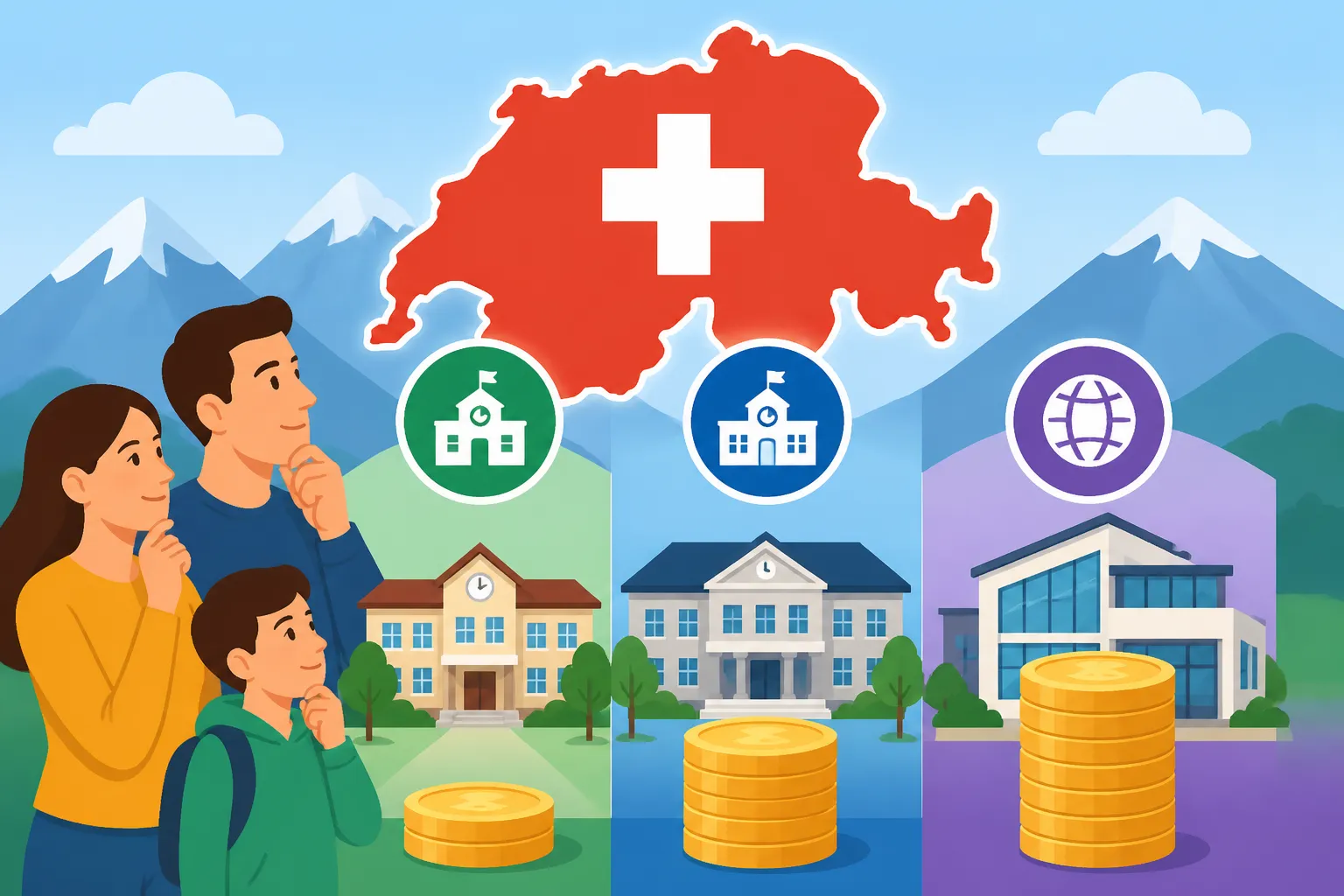
School Costs in Switzerland: Public, Private, and International Fee Comparison
Moving to Switzerland often involves a staggering realization of the high Cost of Living in Switzerland 2026: Budgeting for Singles and Families, and nothing sparks more debate among expat parents than education. You are likely torn between the prestigious, English-speaking international schools and the "free" but daunting local public system. This guide demystifies the financial landscape, comparing tuition, hidden fees, and the long-term trade-offs of each path.
The Public School Path: Quality Education at a Low Entry Point
The Swiss public school system is frequently cited as one of the best in the world, yet the term "free" can be misleading for newcomers. While there is no monthly tuition for children residing in the canton, the financial structure is more nuanced than a simple zero-franc bill. If you choose this route, your child will attend the local school in your Einzugsgebiet (catchment area), which helps with social integration but requires careful planning for ancillary expenses.
Enrollment and Cantonal Variation
Enrollment in a public school is generally straightforward once you have your residence permit and a registered address. However, the costs and services vary significantly between Zurich, Geneva, and smaller cantons like Zug. For instance, some cantons provide more subsidized After-School Care (Tagesschule and Hort) in Switzerland Explained than others. When you are Enrolling Your Child in a Swiss Public School: Step-by-Step, you should ask about the "Mittagstisch" (lunch table) costs. In many municipalities, the school day breaks for two hours at lunch, and if you cannot be home, you will pay a fee based on your income to have the child supervised and fed.
The Hidden Costs: Meals, Materials, and Camps
While books and primary supplies are usually covered, parents are often surprised by the cost of mandatory school trips and "Skilager" (ski camps). These are non-negotiable parts of the Swiss curriculum designed to foster community. A week-long ski camp might cost between CHF 300 and CHF 600 per child. Additionally, if your child requires specialized sports equipment or music lessons provided through the school’s extracurricular network, those costs add up.
Another major factor is the "Hort" or after-school care. Unlike many countries where the school day ends at 3:00 PM or 4:00 PM with inclusive care, the Swiss public system often operates on a "block time" basis. If you need care until 6:00 PM, you could be looking at Childcare Costs in Switzerland: Daycare (Kita) Prices by Canton levels of expenditure, potentially adding CHF 1,000 to CHF 2,000 per month to your budget depending on your workload and household income.
Integration and Language Support
One of the greatest "hidden" savings of the public system is the intensive language support, known as Deutsch als Zweitsprache (DaZ) in German-speaking cantons. The state provides these lessons for free to help expat children integrate. If you were to pay for equivalent private tutoring to reach that level of fluency, the costs would be astronomical. However, consider that if your child struggles, you might end up paying for private "Nachhilfe" (tutoring) in the evenings, which ranges from CHF 50 to CHF 120 per hour.
International Schools: The High-Cost High-Reward Strategy
International schools are the traditional choice for "global nomads" and corporate expats who might only be in Switzerland for three to five years. These institutions offer the International Baccalaureate (IB) or an English-centric curriculum, ensuring that your child can transition seamlessly back to their home country or into a university abroad.
Tuition Breakdown: From Pre-K to IB DP
The price tag for international education in Switzerland is among the highest in the world. Tuition typically starts around CHF 25,000 for early years and can climb to over CHF 45,000 for the final two years of the IB Diploma Programme. When evaluating International Schools in Switzerland: Costs and Admissions by City, it is vital to look beyond the base tuition. Many schools require a one-time "Capital Fund Fee" or "Development Fee" that can range from CHF 3,000 to CHF 6,000. This is essentially a non-refundable contribution to the school's infrastructure.
For families moving from the US or UK, these fees are often paid using foreign currency accounts. Using a service like Wise can be a strategic move to handle these large tuition transfers, as traditional banks often tack on significant margins to the exchange rate. Wise allows you to pay your school invoices at the mid-market rate, which can save you several hundred francs on a CHF 40,000 tuition bill.
Ancillary Fees: More Than Just Schooling
International schools operate like high-end service providers. You should budget for:
- Registration Fees: Often a non-refundable CHF 500 to CHF 2,500 per child.
- School Bus Service: Since these schools aren't always in your neighborhood, the bus can cost CHF 3,000 to CHF 5,000 per year.
- Lunch Programs: Mandatory at some schools, adding CHF 2,000 to CHF 3,000 annually.
- Technology Levies: Fees for iPads, laptops, and specialized software.
If you are paying these costs out of pocket, it is essential to consult with specialized firms like Taxes for Expats to understand if any of these expenses are deductible. While Swiss law is strict about deducting private school tuition, there are nuances for certain types of assignments or if the education is deemed necessary due to a lack of local alternatives in your language.
Is It Worth It? Curriculum vs. Community
The value proposition of an international school isn't just the English language; it is the network and the specialized support. These schools have higher teacher-to-student ratios and robust counseling departments to help with university applications. For many parents, the peace of mind that their child won't have to navigate a language barrier while trying to learn physics is worth the heavy financial burden.
If your employer is not covering these costs, you must calculate the "net benefit" of your Swiss salary. A CHF 150,000 salary might seem high, but if you have two children in international school, nearly half of your post-tax income could vanish into education alone. This is where using Wise for international payments and Taxes for Expats for US or home-country tax compliance becomes crucial to maximizing your remaining wealth.
Private Day Schools and Bilingual Alternatives
For parents who find the public system too "local" and the international schools too expensive, there is a third way: private Swiss schools and bilingual schools. These are becoming increasingly popular for long-term expats who want their children to learn the local language while maintaining high-level English skills.
Finding the Middle Ground in Cost
Bilingual schools usually follow the local cantonal curriculum but teach subjects in both English and German (or French). The price point is often the middle ground, typically ranging from CHF 18,000 to CHF 28,000 per year. These schools often have a more diverse mix of local Swiss families and expats, which can provide a more "authentic" Swiss experience without the total immersion shock of a public school. Exploring Bilingual Schools in Switzerland for Expat Families can reveal options that are significantly more affordable than the top-tier international academies.
Pedagogy and Local Curriculum Integration
Many private schools in Switzerland follow specific pedagogical styles, such as Montessori or Steiner. While these can be excellent, ensure they align with the local "Gymnasium" (high school) entry requirements if your child plans to attend a Swiss university later. Private schools often have smaller class sizes, which can justify the cost for children who need more individual attention. From a financial perspective, many of these schools do not have the same level of "hidden" capital fees as international schools, though you should still check the fine print for lunch and after-school care costs.
Financial Comparison Table
To help you visualize the potential annual impact on your household budget, here is a breakdown of the estimated costs for one child at the primary school level (approximate 2026 figures in CHF).
| Cost Category | Public School | Private / Bilingual School | International School |
|---|---|---|---|
| Annual Tuition | CHF 0 | CHF 18,000 – 28,000 | CHF 28,000 – 45,000 |
| Registration Fee | None | CHF 500 – 1,500 | CHF 1,500 – 3,000 |
| Lunch & Supervision | CHF 3,000 – 6,000* | Often Included | CHF 2,500 – 3,500 |
| Mandatory Trips/Camps | CHF 400 – 800 | CHF 800 – 1,500 | CHF 1,500 – 3,000 |
| After-School Care | CHF 5,000 – 12,000* | Included or extra | Extra (variable) |
| Materials/Tech | Minimal | CHF 500 – 1,000 | CHF 1,000 – 2,000 |
| Total Estimated Annual Cost | CHF 8,400 – 18,800 | CHF 19,800 – 31,000 | CHF 34,500 – 56,500 |
*Note: Public school care costs are often subsidized based on taxable income. High earners will pay more.
Budgeting and Tax Planning for Schooling
Education costs in Switzerland aren't just about the invoice from the school; they are about how that spending interacts with your overall financial strategy. If you are a US citizen, for example, your school choice could have implications for the Child Tax Credit or how you report "Foreign Earned Income."
Leveraging Tax Deductions and Allowances
In many cantons, you can deduct a certain amount for "Third-party Childcare" (Drittbetreuungskosten) on your tax return. This usually applies to the care portion of the school day (Hort) rather than the academic tuition itself. To ensure you are maximizing these benefits, it is worth consulting with Taxes for Expats, especially if you are navigating the "Marriage Penalty" where both parents work. They can help you determine the most tax-efficient way to pay for care. Additionally, don't forget to claim your Child Benefits (Familienzulagen) in Switzerland: Amounts and How to Claim. This federal subsidy (usually CHF 200–300 per month per child) is paid regardless of your income and can help offset some of those extracurricular costs.
Logistics of Payment and Currency Management
If you have relocated from a country with a different currency, the exchange rate volatility can effectively increase your school fees by 5-10% in a single year. Expats often make the mistake of using their home bank's "global transfer" service, which hides a 3% fee in the exchange rate. By using Wise, you can set up a multi-currency account to hold CHF when the rate is favorable, ensuring you have the funds ready when the quarterly tuition bill arrives. Wise also allows for scheduled transfers, which is perfect for monthly private school fees.
Finally, remember that the "cost" of a school is also measured in time. A "free" public school that requires you to pick up your child for a two-hour lunch may cost you more in lost career opportunities or unpaid leave than the tuition of a private school with a full-day program. Every family's "break-even" point is different, but by looking at the total cost of ownership—tuition, care, and tax—you can make a decision that protects your family's financial future in the Alps.
Disclaimer
The information provided in this guide is for informational purposes only and does not constitute financial, legal, or tax advice. School fees, cantonal regulations, and tax laws in Switzerland are subject to frequent change. We recommend consulting with professional advisors, such as tax specialists or relocation experts, and contacting individual schools directly to confirm the most current pricing and policies for your specific situation.