Public Holidays in Switzerland: National and Cantonal Days Off
One of the first things that trips up new arrivals in Switzerland is trying to figure out the public holidays. You come from a country with a clear list of national days off, and suddenly you're faced with a patchwork quilt of cantonal rules where a day off in Zurich means a regular workday in Geneva, and vice-versa. It's truly baffling at first, and frankly, a bit annoying when you realize shops are shut yet again. This guide will untangle the Swiss holiday calendar, helping you understand what to expect, when to plan your long weekends, and how to embrace the unique rhythm of Swiss days off.
The Unique Swiss Approach to Public Holidays
If you've just landed in Switzerland, you're likely used to a clear, consistent list of public holidays that apply nationwide. Forget that notion here! Switzerland, with its deep-rooted federalism and cantonal autonomy, handles public holidays in a way that can feel utterly bewildering to an expat. It's not just a minor difference; it fundamentally changes how you plan your weeks and understand the local pace of life.
Federal vs. Cantonal Autonomy
The biggest hurdle for many of us coming from more centralized nations is grasping that Switzerland operates on a cantonal level for most things, and public holidays are a prime example. While there's one solitary national holiday that everyone observes, the vast majority of other days off are determined by the 26 individual cantons, and sometimes even by specific municipalities within those cantons. This means that your colleague working in a different canton might be enjoying a lie-in while you're commuting to the office, or you might find yourself in a ghost town on a Monday while your friends just a short train ride away are having a perfectly normal workday.
This decentralized system reflects Switzerland's historical evolution, where each canton once operated with a great degree of independence. Over centuries, while some powers have shifted to the federal level, many cultural and administrative aspects, including holidays, have remained locally managed. It’s not uncommon to hear expats lamenting the "holiday lottery" – especially when a popular holiday falls on a Tuesday in one canton, creating a fantastic long weekend, while in a neighboring canton, it's a Friday, leaving them with just a regular weekend. This often leads to a constant need to double-check the specific holiday calendar for your canton and even your commune, adding an extra layer of administrative overhead that you probably didn't anticipate.
The "No Rolling Holidays" Rule and Sunday Closures
Here's another one that often catches newcomers off guard and can be a real source of frustration: the "no rolling holidays" rule. In many countries, if a public holiday falls on a Saturday or Sunday, the day off "rolls" to the nearest Monday or Friday, ensuring you still get that extra day. Not in Switzerland! If a public holiday happens to land on a weekend, tough luck, friend. You simply miss out on that day off. There’s no compensatory day given, which can make some years feel particularly stingy when several potential holidays vanish into the weekend void.
Furthermore, these public holidays typically adhere to the same strict rules as Sundays, known as Ruhetag (rest day). This isn't just a quaint tradition; it's deeply ingrained in Swiss culture and law. On these days, almost everything is closed. We're talking supermarkets, banks, post offices, most smaller shops, even many restaurants might be shut or operate with reduced hours. You absolutely cannot do your laundry, mow your lawn, or use power tools if you live in an apartment building, as the noise restrictions are in full effect. It’s a day for quiet contemplation, family time, or heading out into nature. For an expat used to 24/7 convenience, this can be a major adjustment. You'll quickly learn the importance of stocking up on groceries the day before a public holiday, especially if it's a long weekend, to avoid being caught without essentials. If you're planning any errands or grocery runs, make sure you know exactly when these days are. It really drives home why understanding Quiet Hours (Ruhezeiten): Sunday Rules for Laundry, Mowing, and Noise is so critical in Switzerland.
Switzerland's Single National Public Holiday: August 1st
Amidst the cantonal complexities, there's one day everyone in Switzerland can agree on: the national holiday. It’s a day of quiet patriotism, traditional celebrations, and a well-deserved day off for all.
Swiss National Day Explained
August 1st marks Swiss National Day, or Bundesfeier in German, Fête Nationale Suisse in French, and Festa Nazionale Svizzera in Italian. This is the only public holiday that is consistently observed across all 26 cantons, and therefore, the only one you can truly rely on no matter where you live or work in the country. The date commemorates the probable founding of the Swiss Confederation, specifically the Rütli Oath in 1291, when the three original cantons of Uri, Schwyz, and Unterwalden formed an alliance. It's a day deeply rooted in Swiss history, symbolizing the unity and independence of the country.
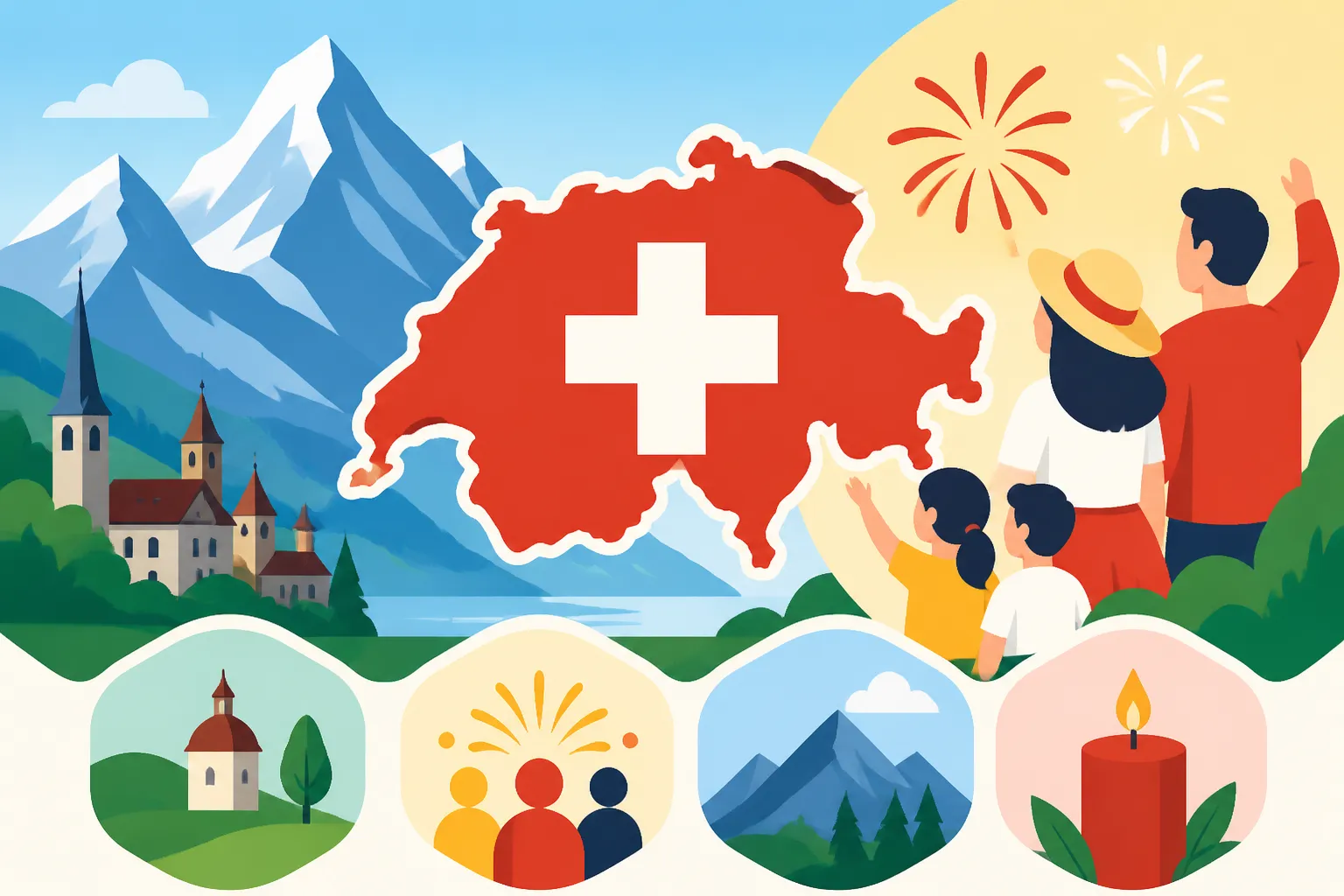
Unlike the grand military parades or massive street parties you might find in other nations, Swiss National Day tends to be a more intimate, community-focused celebration. You'll see homes adorned with Swiss flags, often draped from balconies or windows. In the evening, hillsides across the country light up with bonfires (1. August-Funken), particularly impressive in the more rural and mountainous regions. These bonfires traditionally served as signals in times of danger, but now they're a joyous symbol of unity. Many communities also organize fireworks displays, speeches by local dignitaries, and village festivals with food stalls, music, and traditional Swiss wrestling (Schwingen) or flag throwing (Fahnenschwingen) demonstrations. It's a fantastic opportunity to witness local Swiss culture up close and feel a part of your new community.
What to Expect on August 1st
So, what should you actually expect on August 1st? Well, first and foremost, consider it a proper holiday. Most shops, banks, and post offices will be firmly closed, just like a Sunday. Plan any grocery shopping or errands for the day before. However, unlike some other holidays, public transport generally operates on a Sunday schedule, and importantly, mountain transport – like cable cars and cogwheel railways – often runs on an extended or special holiday timetable to accommodate the influx of people wanting to celebrate in the mountains. Many restaurants might be open, especially those catering to tourists or offering special 1. August-Brunch events, but it's always a good idea to book ahead if you have a specific place in mind, as they can get very busy.
August 1st is an ideal day to head into the stunning Swiss Alps for a hike, enjoy a scenic boat trip on one of the many lakes, or simply relax at home and join in a local community celebration if your village has one. It's a fantastic day to get out and explore, but because it's the only national holiday, many locals have the same idea. Popular spots, especially those with good fireworks viewing, can be crowded. If you're looking to visit a specific attraction or dine out, a bit of forward planning is definitely in order. It’s one of those days where a tool like GetYourGuide could come in handy to book specific experiences, or Omio if you're thinking of a short Weekend Getaways from Switzerland: Easy Cross-Border Escapes if you want to avoid the crowds.
Major Cantonal and Regional Public Holidays
Beyond August 1st, Switzerland's holiday calendar becomes a fascinating, if sometimes frustrating, mosaic. Each region has its own rhythm, shaped by historical, religious, and cultural influences.
Holidays in German-Speaking Switzerland (e.g., Zurich, Bern, Lucerne, Basel)
The German-speaking cantons, the largest linguistic region, present a diverse but somewhat more uniform picture for holidays than you might initially think, though significant differences persist, often along religious lines (Protestant vs. Catholic heritage).
- New Year's Day (Neujahr), January 1st: Universally observed, this day kicks off the year quietly, with most businesses closed. It’s a day for recovery and gentle starts, often with special New Year's brunches offered by some hotels and restaurants.
- Good Friday (Karfreitag): Widely observed as a public holiday in most Protestant-leaning cantons, including Zurich, Bern, and Basel. Many people use this to kick off an extended Easter weekend.
- Easter Monday (Ostermontag): Also widely observed across German-speaking Switzerland, providing a welcome three-day weekend for many, with families often gathering for egg hunts and traditional meals.
- Ascension Day (Auffahrt), always a Thursday: This is a big one. Observed throughout all of Switzerland, it almost always leads to a Brückentag (bridge day) on Friday, turning it into a popular four-day weekend for many who take that extra day off work. Expect transport to be busy as people head to the mountains or abroad.
- Whit Monday / Pentecost Monday (Pfingstmontag): Another widely observed holiday, falling 50 days after Easter. It's often treated like a mini-Easter, giving families another opportunity for a long weekend, though often quieter than Easter itself.
- Corpus Christi (Fronleichnam): This is where the Catholic cantons truly stand out. Observed in cantons like Lucerne, Zug, Schwyz, Uri, Obwalden, Nidwalden, and parts of Aargau, Solothurn, and Fribourg, it’s a day with religious processions and celebrations. If you live in a historically Catholic area, don't expect to run errands on this day.
- All Saints' Day (Allerheiligen), November 1st: Again, primarily observed in Catholic cantons. It's a quieter, more reflective holiday, often involving visits to cemeteries.
- Christmas Day (Weihnachtstag), December 25th: Universally celebrated, though shops close early on Christmas Eve (December 24th) which is not itself a public holiday. This is a family-focused day, with festive meals and gift-giving.
- St. Stephen's Day / Boxing Day (Stephanstag / Berchtoldstag), December 26th: Widely observed in many German-speaking cantons, extending the Christmas break. In Bern, and some other cantons, this day is specifically known as Berchtoldstag and often involves traditional celebrations.
- Berchtoldstag, January 2nd: A unique holiday, particularly prominent in the canton of Bern, but also observed in parts of Aargau, Solothurn, and Vaud. It’s an extension of the New Year celebrations, sometimes leading to unique local customs.
Understanding these regional nuances is key to planning your time and avoiding frustration. It highlights why checking your local canton's official calendar is always the first step.
Holidays in French-Speaking Switzerland (Romandie: Geneva, Vaud, Fribourg, Neuchâtel)
Romandie, the French-speaking part of Switzerland, shares many common holidays with its German-speaking counterparts but also boasts a few distinctive ones, reflecting its own history and cultural leanings.
- New Year's Day (Nouvel An), January 1st: Just like the rest of Switzerland, it's a quiet day of rest.
- Good Friday (Vendredi Saint) & Easter Monday (Lundi de Pâques): Widely observed, forming a long Easter weekend.
- Fête du Travail (Labor Day / May 1st): This is a significant holiday across French-speaking Switzerland (and in many Catholic German-speaking cantons like Basel-Stadt), often marked by political demonstrations and celebrations. Interestingly, it’s not a public holiday in places like Zurich, which can be a point of confusion for those working across language borders.
- Ascension Day (Jeudi de l'Ascension), always a Thursday: Universally observed, and a prime candidate for a "Brückentag" or Pont (bridge) to create a four-day weekend.
- Whit Monday / Pentecost Monday (Lundi de Pentecôte): Again, widely observed, providing another long weekend in late spring or early summer.
- Jeûne Genevois (Geneva Fast), always the first Thursday after the first Sunday in September: This is a truly unique holiday, specific to Geneva. It commemorates a historical fast day following a plague. Today, it’s a cherished public holiday, leading to a long weekend (Friday often taken off), and is a major local event. Many Genevans head out of the city, or enjoy traditional plum tart (tarte aux pruneaux).
- Lundi du Jeûne (Fast Monday): Similar in origin but observed in Vaud, Neuchâtel, and Fribourg, usually a week or two after the Jeûne Genevois. This is another opportunity for a long weekend, often used for local festivities or family time.
- Christmas Day (Noël), December 25th: Universally celebrated. Christmas Eve is not a public holiday, but many businesses will close early.
The differences, like Labor Day being a holiday in Romandie but not everywhere, or the specific "Fast" days, highlight the need to consult local calendars diligently. It’s a charming quirk, but one that demands attention from expats.
Holidays in Italian-Speaking Switzerland (Ticino and parts of Graubünden)
Heading south to the Italian-speaking canton of Ticino and the Italian-speaking parts of Graubünden, you'll find a strong Catholic influence reflected in the public holidays. These days align more closely with traditions found in neighboring Italy.
- New Year's Day (Capodanno), January 1st: As with the rest of Switzerland, a day of quiet rest.
- Epiphany (Epifania), January 6th: A significant religious holiday observed in Ticino and sometimes in parts of Graubünden, celebrating the visit of the Magi.
- St. Joseph's Day (San Giuseppe), March 19th: A public holiday in Ticino, dedicated to Saint Joseph.
- Good Friday (Venerdì Santo) & Easter Monday (Lunedì di Pasqua): Observed.
- Labor Day (Festa del Lavoro), May 1st: Observed in Ticino, similar to Romandie.
- Ascension Day (Ascensione), always a Thursday: Observed.
- Corpus Christi (Corpus Domini): Observed in Ticino, marked by religious processions.
- Assumption Day (Ferragosto / Assunzione), August 15th: This is a major summer holiday in Ticino, widely celebrated and seen as the peak of the summer vacation period. Many businesses close for an extended period around this date.
- All Saints' Day (Ognissanti), November 1st: Observed.
- Immaculate Conception (Immacolata Concezione), December 8th: Another important Catholic holiday observed in Ticino.
- Christmas Day (Natale), December 25th & St. Stephen's Day (Santo Stefano), December 26th: Both observed, creating an extended Christmas break.
Ticino's calendar provides a distinct Mediterranean flavor to the Swiss holiday experience, offering unique opportunities to experience different cultural traditions within Switzerland.
Graubünden's Diverse Approach
Graubünden, Switzerland's largest canton by area, is a truly special case when it comes to holidays because it is trilingual – German, Italian, and Romansh are all official languages. This linguistic and cultural diversity means that its public holiday calendar is a patchwork even within its own borders, heavily influenced by local religious demographics and specific communal traditions.
While some major holidays like New Year's Day, August 1st, Christmas Day, and often Easter Monday and Ascension Day are widely recognized, many other holidays are only observed in specific districts or even just in particular villages. For instance, a predominantly Catholic municipality might observe Corpus Christi or All Saints' Day, while a neighboring Protestant village might not. The Italian-speaking valleys of Graubünden will often align more closely with Ticino's calendar for holidays like Epiphany or Assumption Day.
This makes navigating holidays in Graubünden arguably the most complex in Switzerland. If you live or work there, relying solely on a general cantonal list is insufficient. You absolutely must consult the specific holiday calendar for your local municipality (Gemeinde or Commune). This granular level of detail is a testament to Switzerland's extreme local autonomy and adds another layer of charm and challenge to expat life here.
Navigating Holiday Closures and Planning Your Time Off
Public holidays in Switzerland are less about parades and fireworks (except for August 1st) and more about a collective slowdown. For expats, this means a significant shift in routine, particularly concerning shopping and services.
The Dreaded "Ruhetag" (Rest Day) Impact
We've touched on this before, but it bears repeating because it's arguably the biggest practical impact for new residents: when it's a public holiday, almost everything shuts down. This isn't just a suggestion; it's a cultural norm deeply ingrained and often legally enforced. Supermarkets, department stores, banks, post offices, pharmacies (outside of emergency services), government offices – all will be closed. This means you cannot rely on popping out for milk, picking up a forgotten ingredient, or running any last-minute errands.
The exceptions are typically limited to shops found inside major train stations (like Zurich Hauptbahnhof or Geneva Cornavin), which often have extended hours, or petrol station convenience stores, and some smaller bakeries might open for a couple of hours in the morning. Even many restaurants and cafés will close for the day, or at least for part of it. The "Ruhetag" rule also extends to noise: forget about doing any noisy chores at home, like vacuuming, drilling, or (heaven forbid) laundry if your building has shared facilities. The Swiss value their peace and quiet, especially on Sundays and holidays.
So, the golden rule of Swiss holidays is: stock up on groceries and essential items the day before! This is particularly crucial if you're facing a long weekend with multiple consecutive closures. Nothing says "new expat" more than realizing you're out of coffee on a holiday Monday morning with no open shop in sight. This cultural aspect is a core part of living in Switzerland, and learning to anticipate it will save you a lot of headaches.
Maximizing "Bridge Days" (Brückentage)
While the Swiss holiday calendar might seem a bit stingy with its "no rolling holidays" rule, there's a silver lining for savvy planners: the Brückentag, or "bridge day." This concept is a lifesaver for maximizing your time off. A Brückentag refers to taking a single day of annual leave to "bridge" a public holiday that falls on a Tuesday or Thursday, effectively turning a normal weekend into a four-day mini-vacation.
The classic example is Ascension Day, which always falls on a Thursday. By taking Friday off, you instantly get a four-day weekend. Similarly, if a holiday falls on a Tuesday, taking Monday off creates another four-day break. These bridge days are incredibly popular, both for short trips within Switzerland and for quick Weekend Getaways from Switzerland: Easy Cross-Border Escapes. They're often booked up quickly by colleagues, so if you want to snag one, plan well in advance! Your company might even offer certain bridge days as automatic days off, or have specific policies for requesting them. Knowing which cantonal holidays fall on these advantageous days is a game-changer for extending your relaxation time. It's a great strategy to manage your Public Holidays and Work in Switzerland: Which Cantons Get Which Days Off and vacation days effectively.
Essential Resources for Holiday Planning
Given the complexity, you can't just rely on a generic Swiss holiday calendar. You need specifics!
- Cantonal Websites: Your first stop should always be the official website of your canton. Search for "Feiertage [Canton Name]" or "Jours Fériés [Canton Name]". Many cantons provide annual calendars that list all official holidays observed.
- Municipal Websites: For certain nuanced holidays, especially in Graubünden or smaller communes, you might need to check your specific municipality's website.
- Employer Calendar: Your company will undoubtedly have its own holiday schedule, which should align with your canton's official holidays. This is often the most reliable source for your actual days off, especially regarding payment.
- Online Calendars & Apps: There are several online resources and apps that provide holiday information, often allowing you to filter by canton. Just be sure they're up-to-date for the current year. Look for specific Swiss holiday calendars rather than generic international ones.
To help you get started, here's a simplified table outlining the major federal and cantonal holidays. Remember, this is a general guide; always verify for your specific canton and commune!
| Holiday (English) | German / French | Date / Typical Day | Observed By | Notes |
|---|---|---|---|---|
| New Year's Day | Neujahr / Nouvel An | Jan 1 | All Cantons | Universal day of rest. |
| Berchtoldstag | Berchtoldstag | Jan 2 | BE, VD, ZH (some), AG, SO | Primarily Bern & surrounding cantons. |
| Epiphany | Heilige Drei Könige / Épiphanie | Jan 6 | TI, UR, SZ, OW, NW, LU (some) | Mainly Catholic & Ticino. |
| St. Joseph's Day | Josefstag | Mar 19 | TI, UR, SZ, NW, OW, VS (some) | Mainly Catholic & Ticino. |
| Good Friday | Karfreitag / Vendredi Saint | Friday before Easter | Most Protestant & mixed Cantons (e.g., ZH, BE, BL, GE, VD) | Not a public holiday in TI, VS, GR. |
| Easter Monday | Ostermontag / Lundi de Pâques | Monday after Easter | Most Cantons | Not universally observed (e.g., in some small Catholic communes). |
| Labor Day / May 1st | Tag der Arbeit / Fête du Travail | May 1 | GE, VD, NE, JU, TI, BS, BL, SH, TG, SG, AG, SO | Widely observed in Romandie and many German-speaking cantons, but not in Zurich, Bern (mostly). |
| Ascension Day | Auffahrt / Ascension | 40 days after Easter (Thursday) | All Cantons | Universal, popular for "bridge days." |
| Whit Monday / Pentecost Monday | Pfingstmontag / Lundi de Pentecôte | 50 days after Easter (Monday) | Most Cantons | Not universally observed (e.g., in VS, GR). |
| Corpus Christi | Fronleichnam / Fête-Dieu | 60 days after Easter (Thursday) | AG, JU, LU, NW, OW, SZ, TI, UR, VS, ZG (some) | Mainly Catholic cantons. |
| Swiss National Day | Bundesfeier / Fête Nationale | Aug 1 | All Cantons | The only true national public holiday. |
| Assumption Day | Mariä Himmelfahrt / Assomption | Aug 15 | AG, JU, LU, NW, OW, SZ, TI, UR, VS, ZG (some) | Mainly Catholic cantons, very big in Ticino. |
| Jeûne Genevois | Jeûne Genevois | 1st Thu after 1st Sun in Sep | GE (only) | Unique to Geneva. |
| Lundi du Jeûne | Bettagsmontag / Lundi du Jeûne | Monday after Federal Prayer Day (mid-Sep) | VD, NE, FR, JU, BE (some) | Observed in parts of Romandie and Bern. |
| All Saints' Day | Allerheiligen / Toussaint | Nov 1 | AG, JU, LU, NW, OW, SZ, TI, UR, VS, ZG (some) | Mainly Catholic cantons. |
| Immaculate Conception | Mariä Empfängnis / Immaculée Conception | Dec 8 | LU, NW, OW, SZ, TI, UR, VS, ZG (some) | Mainly Catholic cantons, very significant in Ticino. |
| Christmas Day | Weihnachtstag / Noël | Dec 25 | All Cantons | Universal. |
| St. Stephen's Day | Stephanstag / St. Étienne | Dec 26 | Many Cantons (e.g., ZH, BE, AG, TG, AR, AI, GL, SH, ZG) | Also known as Berchtoldstag in some parts. Not universal (e.g., not in GE, VD, NE, JU, TI). |
(Note: "Some" indicates partial cantonal observance or specific communal variations. Always check locally!)
Work and Compensation on Public Holidays
Beyond knowing when the shops are closed, understanding how public holidays impact your work life is crucial for any expat in Switzerland. It’s not always as straightforward as "holiday equals paid day off."
Employer Obligations and Employee Rights
This is another area where Swiss federalism rears its head. While August 1st is federally mandated as a paid day off for all employees, the treatment of other public holidays can vary significantly. Generally, basic labor law (ArG) doesn't explicitly mandate payment for non-August 1st holidays. Instead, the payment for other public holidays usually depends on:
- Cantonal Law: Some cantons have laws that declare certain days as paid public holidays.
- Collective Bargaining Agreements (GAV – Gesamtarbeitsvertrag): Many industries and companies are bound by GAVs, which often stipulate a certain number of paid public holidays per year. For example, a GAV might state that employees are entitled to 8-9 paid public holidays annually. If more holidays occur in a year, the "extra" ones might be unpaid or treated as regular workdays.
- Individual Employment Contracts: Your specific contract might outline which holidays are paid.
- Company Policy: If there's no GAV or specific cantonal law, the employer's internal policy determines which holidays are paid.
This means you could be working at a company in Zurich where you get 9 paid holidays, while your friend at another company in the same city only gets 8. It’s not unfair; it’s simply a reflection of the decentralized system. It's essential to clarify your company's policy on public holidays when you start a new job, or if you're ever in doubt. If your employer is part of a GAV, make sure you understand how your Swiss Work Contracts and Labor Law: Notice Periods, Leave, and Rights are covered by it.
Working on a Holiday and Overtime
What if your job requires you to work on a public holiday? This is particularly common in service industries, hospitality, healthcare, and certain manufacturing sectors. The legal framework for working on public holidays often mirrors the rules for Sunday work.
According to the Swiss Labor Act (ArG), working on Sundays and official public holidays is generally prohibited. However, exceptions are made for essential services and businesses that require continuous operation. If you are required to work on a Sunday or an official public holiday, you are typically entitled to:
- Compensatory Time Off: For work up to 5 hours, you get compensatory time off during the preceding or following week. For work exceeding 5 hours, you are entitled to a full compensatory day off within the preceding or following 8 weeks.
- Increased Wages: For Sunday and holiday work, employees are usually entitled to a wage supplement of at least 50% for those hours, unless a GAV or individual contract specifies a higher rate. This means you’d get 150% of your regular hourly wage.
It's crucial to distinguish between a legal public holiday (where these rules apply) and just a local commemorative day that isn't officially recognized as a day off. Again, checking your cantonal and company policies is vital. Many expats, especially those coming from countries with numerous guaranteed paid public holidays, might initially feel that Switzerland offers fewer days off. While there are fewer national holidays, the opportunity to maximize "Brückentage" and the potential for increased wages on required holiday work can balance it out. Always understand your Overtime Laws in Switzerland: Compensation vs. Free Time Allowed and holiday work policies to ensure you are compensated fairly.
Cultural Significance and Expat Experience
Beyond the practicalities of closures and work schedules, Swiss public holidays offer a unique window into the country's diverse cultural fabric and an opportunity for expats to truly integrate.
More Than Just a Day Off: Local Traditions
While the federal structure can make holiday planning a headache, it's also what makes Swiss holidays so charming and rich in local flavor. These days aren't just arbitrary days off; many are deeply embedded in centuries of local history, religious beliefs, and seasonal rhythms.
Take Jeûne Genevois, for example. It's not just a random Thursday off for Genevans; it's a historical commemoration with specific traditions, like eating plum tart. Or think about Corpus Christi in Catholic cantons, where you might witness elaborate processions that feel straight out of a medieval painting. Even August 1st, the National Day, is celebrated with bonfires and speeches that vary from village to village, reflecting the unique character of each community.
As an expat, instead of seeing these days purely as closures, try to embrace them as opportunities to delve into local traditions. Seek out a village festival on August 1st, or perhaps a regional market around a harvest-related holiday. These are moments when the Swiss truly celebrate their heritage, and participating, even as an observer, can significantly deepen your understanding and appreciation of your adopted home. It’s a chance to see beyond the stereotypes and experience the authentic, nuanced culture of Switzerland. Learning about Swiss Customs and Etiquette: Social Norms Every Newcomer Should Know will definitely enhance these experiences.
Embracing the Swiss Rhythm
Ultimately, living in Switzerland means learning to embrace its unique rhythm, and public holidays are a big part of that. While the initial frustration of closed shops and "lost" weekend holidays is understandable, there's a certain charm to the collective slowdown. It forces you to plan, to anticipate, and perhaps, to disconnect from the consumerist rush.
Many Swiss use these quiet days to reconnect with nature, heading to the mountains for hikes, enjoying a leisurely bike ride by the lake, or simply spending quality time with family. It's a country that cherishes its natural beauty, and public holidays provide the perfect excuse to explore it. Consider using a holiday to take a scenic train ride, perhaps using your SBB Travelcards: Is the Generalabonnement (GA) Worth the CHF 4000+ Cost? or The Half-Fare Travelcard (Halbtax): The Must-Have Pass for Swiss Residents to experience the breathtaking landscapes. Omio can help you plan these journeys, while Booking.com might offer a cozy hotel if you decide to make it an overnight escape.
Instead of fighting the closures, see them as an invitation. An invitation to explore your local region, to finally tackle that mountain hike you've been eyeing, or to simply relax and recharge. The quietness can be a welcome respite from the demands of work and modern life. Public holidays are woven into the fabric of Exploring Switzerland: The Complete Travel Guide for Residents (2027), offering unique windows into its culture and natural wonders. Whether you're booking an experience through GetYourGuide or simply enjoying a peaceful day at home, these holidays are a definitive part of the Swiss experience.
Disclaimer
The information provided in this article is intended for general guidance and informational purposes only, and does not constitute legal, financial, or professional advice. Public holiday regulations, labor laws, and company policies in Switzerland can change and vary significantly by canton, municipality, and individual employment contract. Always consult official cantonal and communal websites, your employer's HR department, or a qualified legal or financial advisor for specific, up-to-date information relevant to your personal situation. We strive to provide accurate and current information, but cannot guarantee its absolute completeness or correctness at all times.