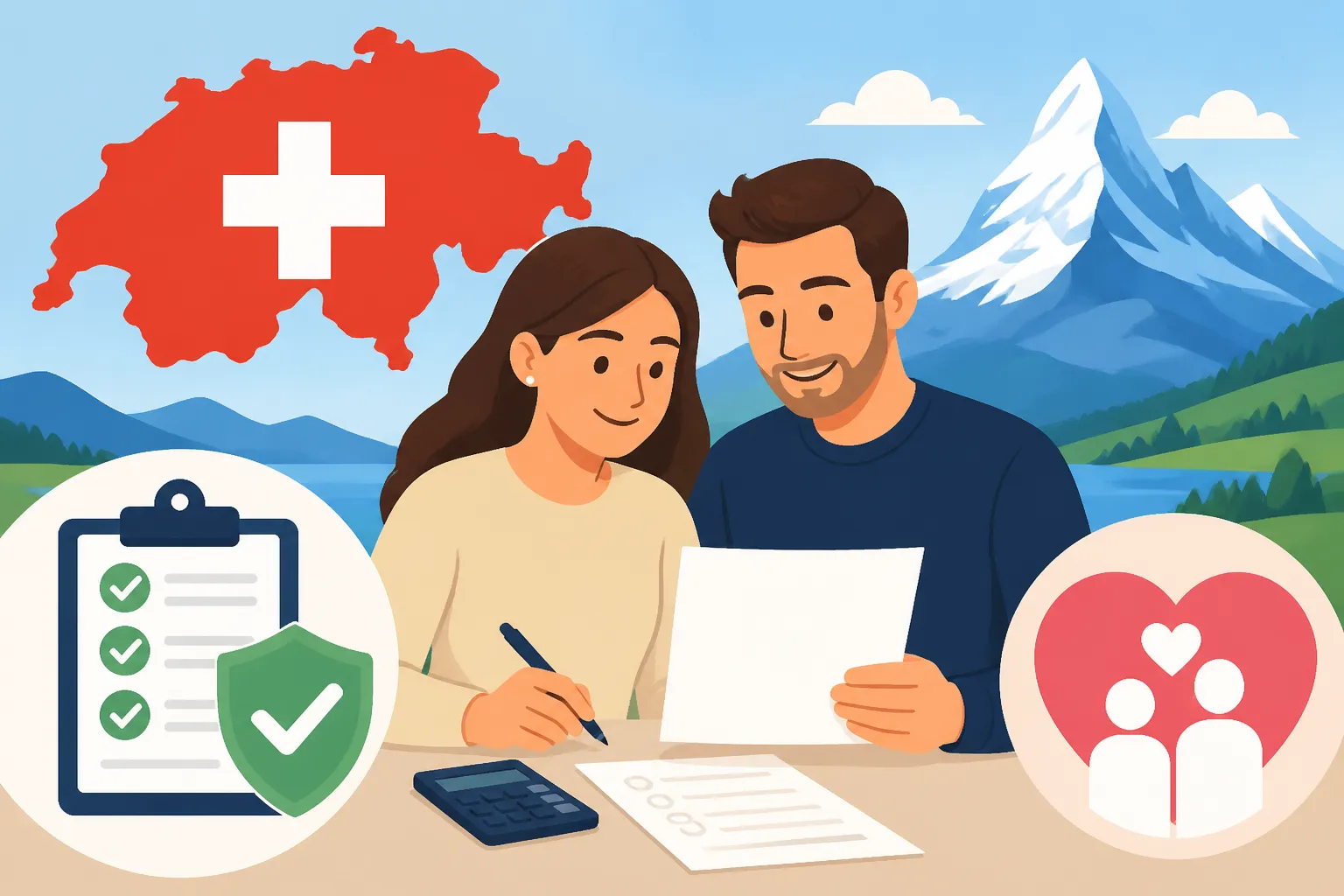
Filing Taxes Jointly as a Married Couple in Switzerland
Most expats arrive in Switzerland expecting individual tax treatment, only to realize that the moment they say "I do," the Swiss tax office views them as a single economic unit. This mandatory joint filing can lead to significant financial surprises, often referred to as the marriage penalty. This guide clarifies the mechanics of joint filing, explores common deductions, and provides a roadmap for navigating your first consolidated Swiss tax return.
The Fundamentals of Joint Taxation in Switzerland
In many countries, you can choose whether to file your taxes jointly or separately. In Switzerland, that choice does not exist. From the moment you are legally married or enter into a registered partnership, the law dictates that your incomes and assets are pooled for tax purposes. This applies for the entire tax year in which the marriage took place. If you got married on December 31st, you would still be taxed as a married couple for the preceding 364 days. This sudden shift often catches newcomers off guard, especially when they realize that their combined income might push them into a significantly higher tax bracket.
The Mandatory Nature of Joint Filing
The Swiss tax system is built on the principle of the family as an economic unit. This means that both spouses must sign the tax return, and both are legally responsible for the accuracy of the data and the payment of the resulting debt. If you are a veteran expat living in a canton like Zurich or Geneva, you know that the "Gemeinde" (municipality) expects a single, unified dossier. You cannot split your income to stay in a lower bracket. This can be particularly frustrating for couples where both partners are high earners, as the progressive tax system can be quite aggressive.
Understanding Swiss Taxes Explained: Federal, Cantonal, and Municipal Rates is essential here, as each level of government will apply its own multipliers to your joint income. It is also important to note that if one spouse is a Swiss citizen or holds a C permit while the other is on a B permit, the couple will generally transition away from withholding tax and into the ordinary filing system. This shift requires more paperwork but offers more opportunities for deductions that aren't available under the simplified withholding system.
Determining Residency and Tax Liability
Tax liability in Switzerland is determined by your "center of vital interests." For a married couple, this is almost always where the family resides together. If you work in Basel but your spouse and children live in Bern, you will likely be taxed in Bern. This is why many expats spend a great deal of time researching the Lowest Tax Cantons: Moving to Zug, Schwyz, or Nidwalden for Tax Benefits before deciding where to sign a lease.
When you file jointly, you are also reporting your global assets. This is where Wealth Tax in Switzerland: How Global Assets Are Assessed becomes a critical factor for married couples. If one spouse brought significant property or investments from their home country into the marriage, those assets will now be factored into the couple’s total wealth tax calculation. Using a service like Wise can be helpful when you need to transfer funds from overseas accounts to cover these local tax liabilities, as they offer much better rates than traditional Swiss banks for large transfers.
The Marriage Penalty Explained
The "Heiratsstrafe" or marriage penalty is a frequent topic of debate in Swiss politics. Because the tax brackets are progressive, a married couple earning 100,000 CHF each (200,000 CHF total) will often pay more in federal tax than two single people living together and earning the same amount. The logic is that a couple has lower living expenses than two individuals, but for many expats, this feels like an unfair tax on their relationship status.
However, there is a silver lining. Most cantons have introduced "splitting" models or specific married-couple deductions to mitigate this penalty. For example, the tax rate for a married couple is often lower than for a single person with the same total income. To truly understand how this affects your specific situation, it is worth looking at How Marriage Affects Your Swiss Tax Bill: The 'Marriage Penalty' Explained. It is not always a negative outcome; for couples where one spouse earns significantly more than the other, joint filing can actually lead to tax savings compared to individual filing in other jurisdictions.
Deductions and Allowances for Married Couples
While the joint income might be higher, the Swiss tax code offers several "Abzüge" (deductions) specifically designed for married pairs. Navigating these correctly is the difference between a massive bill and a welcome refund. When you move beyond the basics, you start to see that the system does try to account for the costs of maintaining a household and raising a family in one of the world's most expensive countries.
The Dual-Income Deduction
If both spouses are working, you are typically entitled to a "Zweiverdienerabzug" or dual-income deduction. This is designed to offset the additional costs associated with both partners being in the workforce, such as commuting, professional clothing, and out-of-home meals. The amount varies by canton, but it is a vital component of your filing strategy.
When filling out your forms, ensure you are tracking all professional expenses. This includes the cost of public transport or car mileage if a car is necessary for work. You should also look into Tax Allowances and Deductions: Commuting, Meals, and Childcare to see what specific caps apply in your canton. If you are managing your finances across borders, Wise can help you pay for these professional expenses or training courses from foreign-denominated accounts without losing a fortune on exchange fees.
Childcare and Education Deductions
For expat families, childcare is often the single largest expense after rent. Fortunately, Switzerland allows for significant deductions for "Drittbetreuungskosten" (external childcare costs). Whether your children are in a "Kita" (daycare) or with a "Tagesmutter" (day mother), you can deduct these costs up to a certain limit, which was recently increased at the federal level.
Education costs for the spouses themselves are also deductible. If you are taking a German or French course to better integrate or improve your job prospects, keep the receipts. These deductions are part of the broader Filing a Swiss Tax Return (C Permit or High Earners on B Permit) process. It is important to remember that these deductions must be proven with documentation, so keep a dedicated folder for all invoices throughout the year.
| Deduction Type | Applicability | Common Limit (Example) |
|---|---|---|
| Dual-Income | Both spouses employed | Up to 13,600 CHF (Federal) |
| Childcare | Children under 14 | Up to 25,000 CHF per child (Federal) |
| Pillar 3a | Residents with earned income | 7,258 CHF per person (2026) |
| Medical Costs | Out-of-pocket expenses | Above 5% of net income |
Pillar 3a and Pension Contributions
One of the most effective ways to lower your joint taxable income is through the three-pillar system. Each spouse can contribute to their own Pillar 3a account, provided they have earned income. For a married couple where both work, this means you can double your household's tax-advantaged savings. Contributing the maximum amount can lead to thousands of francs in tax savings every year.
You should coordinate your contributions to ensure you are maximizing the benefit. To see how this fits into your long-term retirement plan, read about The Three-Pillar Pension System: AHV, BVG, and Private Savings. Also, keep an eye on the yearly updates regarding Pillar 3a in 2026: Tax Deductions, Limits, and Investment Options to ensure you don't over-contribute or miss out on new incentives. For US citizens, coordinating these Swiss pension contributions with IRS requirements is tricky, and many veterans recommend using Taxes for Expats to ensure they remain compliant on both sides of the Atlantic.
Navigating the Transition and Practical Logistics
The move from being taxed individually (often via withholding) to filing an annual return as a couple is a major milestone in an expat's administrative life. It requires a different level of organization and a clear understanding of the deadlines set by your local "Steueramt" (tax office). In Switzerland, the tax year follows the calendar year, and returns are generally due by March 31st of the following year, though extensions are easily granted.
Moving from Quellensteuer to Ordinary Taxation
Most expats start their journey in Switzerland under the Withholding Tax (Quellensteuer) vs Standard Taxation for Foreigners system. In this model, tax is deducted directly from your salary by your employer. However, if your joint income exceeds a certain threshold (usually 120,000 CHF in most cantons), or if one spouse becomes a C-permit holder, you must file a full tax return.
This transition is often where couples realize they have been overpaying or underpaying. If you are still on a B permit but want to claim extra deductions, you might need to file a Tax Corrections (Tarifkorrektur): Claiming Deductions on Withholding Tax. This is a "voluntary" filing that can result in a refund, but be careful—once you request a full assessment, you cannot go back to the simplified withholding system in future years. For complicated filings involving international income, Taxes for Expats provides specialized support to help you navigate these transitions without triggering an audit.
Managing Global Income and Assets
When you file jointly, the "center of vital interests" rule means the Swiss authorities want to know about everything: your rental property in London, your 401k in the US, and your savings account in India. While you aren't always taxed on the value of the foreign property (as that is usually taxed where the property is located), the value is used to determine your "Satzbestimmung" (rate determination). Basically, your global wealth can push the tax rate on your Swiss income higher.
This is a point of stress for many couples. Transparency is key. You will need to provide bank statements and valuation documents for all foreign assets as of December 31st. If you find yourself needing to pay taxes in two countries, Wise is an excellent tool for managing those international payments with minimal fees. Furthermore, Americans should be aware that the IRS does not recognize Swiss joint filing in the same way; you still have to navigate the US "Married Filing Jointly" or "Married Filing Separately" rules, which is where Taxes for Expats earns its reputation among the community.
Professional Assistance vs. DIY
Should you do it yourself? Many expats find the Swiss tax software (like Private Tax in Zurich or VaudTax) to be surprisingly user-friendly. However, for a married couple with multi-cantonal or international interests, a professional tax advisor (Steuerberater) is often worth the investment. They can identify niche deductions you might miss, such as certain insurance premiums or maintenance costs for foreign properties.
If you decide to go the DIY route, start early. You will need your "Lohnausweis" (salary certificate) from both employers, which usually arrives in January or February. If you are a US citizen, the complexity doubles, and professionals like those at Taxes for Expats are almost mandatory to avoid the heavy penalties associated with FBAR or FATCA reporting. Regardless of the route you choose, remember that the "Steuererklärung" is a yearly ritual that gets easier the longer you live in the country.
Strategic Planning for the Future
Filing jointly isn't just about looking at the past year; it is about planning for the next. Your joint tax situation will change as your careers evolve, as you have children, or as you eventually consider Leaving Switzerland Financially: Closing Accounts and Pension Payouts. Being proactive can save you a significant amount of money over a five or ten-year stay in the country.
One strategy often used by veteran expats is to stagger their Pillar 3a withdrawals or to invest in home renovations in high-income years. Because the tax system is so cantonal, even moving a few kilometers across a border can change your joint tax bill by thousands of francs. Always stay informed about changes in local laws, as Swiss voters frequently decide on tax-related initiatives that can alter the landscape of joint filing. Switzerland is a beautiful place to build a life as a couple, and while the tax system is complex, it is ultimately predictable once you learn the rules of the game.
Disclaimer
This guide is for informational purposes only and does not constitute professional tax, legal, or financial advice. Swiss tax laws are highly complex and subject to frequent changes at the federal, cantonal, and municipal levels. Always consult with a qualified Swiss tax advisor or the relevant cantonal tax authorities regarding your specific situation before making financial decisions.