Car Sharing in Switzerland: How Mobility Works Without Owning a Car
The nightmare of finding a legal parking spot in Zurich or Geneva is enough to make any newcomer regret bringing their vehicle across the border. I remember spending my first three months in Lausanne circling the block for forty minutes every evening, clutching a "Blue Zone" disc and praying for a miracle. This guide solves the dilemma of Swiss car ownership by explaining how to navigate the high-tech, ultra-efficient world of car sharing.
Why Owning a Car in Switzerland is Often a Financial Burden
When you first arrive and start browsing HousingAnywhere for a permanent apartment, you might notice that a parking spot often isn't included in the rent. In major cities, a dedicated underground spot can cost you an additional CHF 150 to CHF 300 per month. That is before you even consider the cost of the vehicle itself, the mandatory insurance, and the annual tax. I quickly realized that unless I lived in a remote alpine village, my car was essentially a very expensive metal box that sat idle 95% of the time.
Beyond the monthly rent for a spot, there is the administrative headache. You have to deal with the Swiss Autobahn Vignette: E-Vignette vs Physical Sticker for 2026 every year just to use the motorways. Then there are the maintenance costs, which are notoriously high in Switzerland due to labor rates. If you are debating the math, it is worth looking into Buying a Car in Switzerland: Leasing vs Financing Financial Comparison to see just how much capital you are tying up. For most expats working in urban hubs, the "pay-as-you-go" model of car sharing isn't just a lifestyle choice; it is a significant boost to your monthly savings.
The Swiss government also makes it intentionally difficult to keep a car in the city. "Blue Zones" require you to move your car every few hours unless you have a specific resident permit for that district, and even then, finding a gap is like winning the lottery. When you factor in the Cost of Living Realities: Groceries, Telecoms, and Household Expenses, removing the car from your budget is often the single most effective way to lower your burn rate.
Mobility: The Dominant Force in Swiss Car Sharing
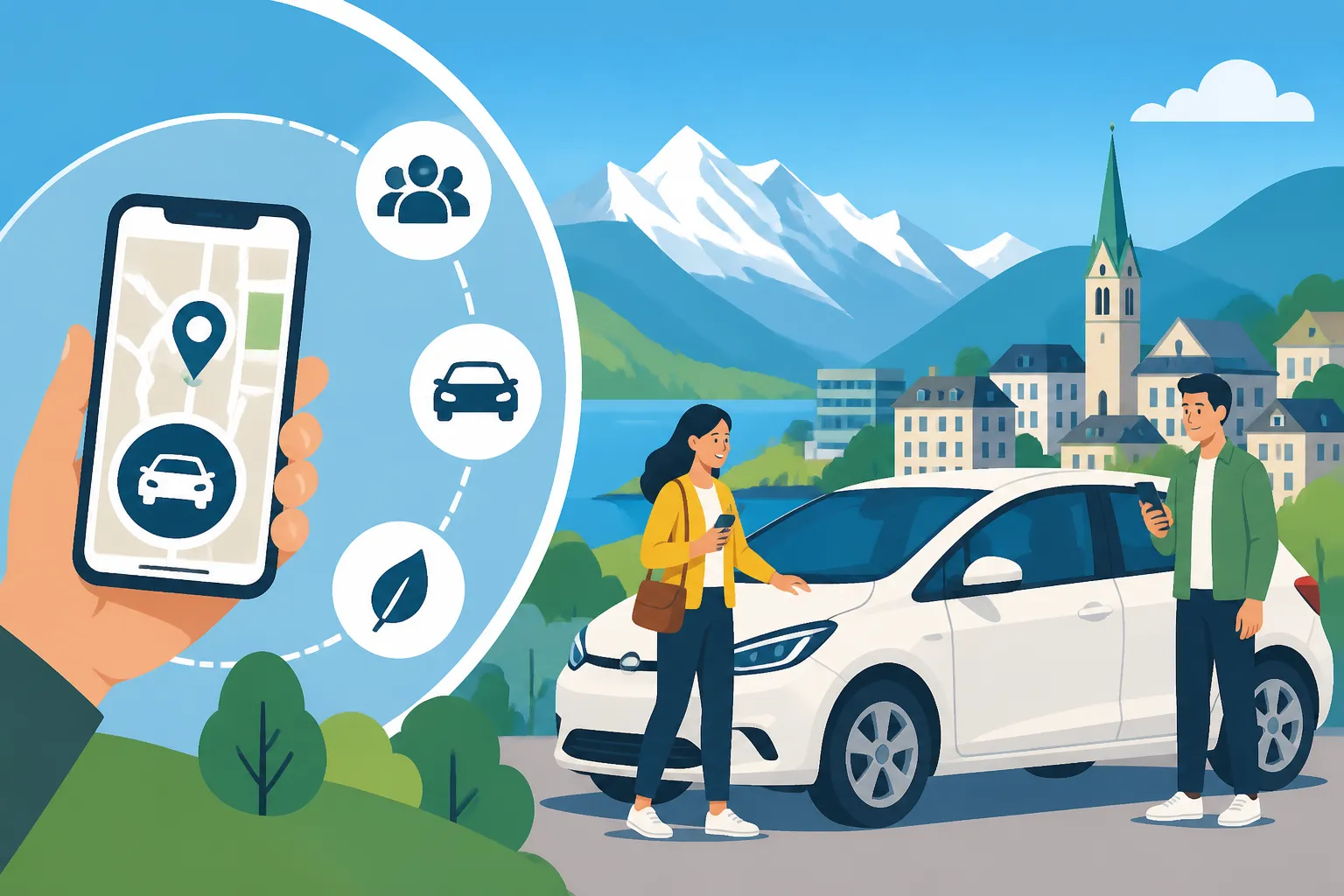
In Switzerland, car sharing is almost synonymous with one company: Mobility. You will see their distinctive red cars parked in prime locations at almost every SBB train station. This isn't just a rental car company; it is a cooperative that has integrated itself perfectly into the Transport in Switzerland: SBB, GA, Half-Fare Cards, and Commuting network. You can book a car through an app, tap your SwissPass card on the windshield to unlock it, and drive away in under sixty seconds.
What makes this system work so well is the variety of vehicle "categories." If you are just popping to the local garden center, you can grab a "Micro" or "Economy" car. If you are planning a weekend trip to the mountains with friends, you can book a 4×4 SUV. If you are ordering furniture from Amazon Germany and need to pick up a large shipment at a border package shop, you can even rent a "Transporter" van. The flexibility is incredible. I once used a Mobility van to move my entire studio apartment across Basel, and it cost me a fraction of what a professional moving company would have charged.
To get started, you will need to ensure your paperwork is in order. You cannot legally drive a Mobility car if your license isn't recognized. I highly recommend Converting Your Foreign Driver's License to a Swiss Fahrausweis as soon as you arrive to avoid any insurance complications. Once your license is verified in the Mobility app, you can choose between a subscription model or a "Best Price" guest model. If you have The Half-Fare Travelcard (Halbtax): The Must-Have Pass for Swiss Residents, you usually qualify for a significant discount on the annual Mobility subscription fee.
How the Car Sharing Mechanics Work in Real Life
The process is remarkably Swiss: efficient, punctual, and based on a high level of trust and cleanliness. You open the app—make sure you have a reliable data connection through a provider like Airalo so you aren't stuck in a parking garage with no signal—and find the nearest car. You can book it months in advance or on the spot. You then choose how long you need the car and roughly how many kilometers you will drive.
One of the best features of Swiss car sharing is that fuel and insurance are included in the price. Every Mobility car has a fuel card in the glove box. If the tank drops below a certain level, you just pull into a partner petrol station, use the card, and you don't pay a cent out of pocket. However, you must be careful about the Speed Cameras in Switzerland: Flash Radars and Zero Tolerance Margins. Mobility will pass any traffic fines directly to you, along with a hefty administrative fee for the "service" of processing your ticket.
There is also a strict etiquette involved. You are expected to return the car to its designated spot on time. If you are five minutes late, you might be blocking the next person who has a reservation, and the system will automatically charge you a late fee. You must also leave the car clean. If you've been hiking in the Berner Oberland and the floor mats are covered in mud, take five minutes to shake them out. The Swiss community spirit (and the threat of a cleaning fee) keeps the fleet in excellent condition.
| Feature | Owning a Private Car | Mobility Car Sharing |
|---|---|---|
| Monthly Fixed Cost | High (Depreciation, Insurance, Tax) | Low to Zero (Subscription based) |
| Parking | Must pay for a spot (CHF 150+) | Included at Mobility stations |
| Maintenance | Owner's responsibility | Handled by Mobility |
| Flexibility | Always available but one car type | Various types (Vans to Electrics) |
| Best For | Daily long-distance commuters | Occasional drivers and city dwellers |
| Fuel Costs | Paid by owner | Included in the hourly/km rate |
Integrating Car Sharing with Public Transport
The real "magic" of mobility in Switzerland happens when you combine car sharing with the SBB Travelcards: Is the Generalabonnement (GA) Worth the CHF 4000+ Cost?. Many expats find that they take the train for 90% of their journeys and only use a car for that "last mile" or for specific errands that involve heavy lifting. For example, if you are visiting a remote vineyard in Valais, you can take a fast InterCity train to Sion and then pick up a Mobility car right at the station for the final 15-minute drive up the mountain.
This hybrid approach also mitigates the risk of accidents. While car sharing includes basic insurance, you should check if your Private Liability Insurance (Privathaftpflicht): Why Expats Need It offers any additional "rental car" or "borrowed vehicle" coverage to reduce your deductible in case of a mishap. The standard deductible for a car-sharing accident can be quite high (often around CHF 2,500), but you can usually pay a small annual fee to Mobility to reduce this "self-risk" to zero.
Another growing trend in Switzerland is "Catch-a-Car" or "Mobility Go," which allows for one-way trips within certain cities like Geneva or Basel. Unlike the station-based model where you must return the car to its origin, these cars can be dropped off in any legal public parking spot within a defined zone. It is perfect for those nights when the trams have stopped running or you are running late for a meeting on the other side of town.
Final Practical Tips for the Car-Free Expat
If you decide to go the car-sharing route, there are a few "pro-tips" I've learned the hard way. First, always inspect the car for damage before you drive off. If there is a scratch that isn't logged in the app, report it immediately so you aren't held liable. Second, keep a pair of "driving shoes" or a clean towel in your backpack if you are coming back from a snowy or muddy hike. The Swiss pride themselves on the condition of these shared vehicles, and a little courtesy goes a long way.
Also, consider the timing of your bookings. Saturday mornings are the busiest times for Mobility, as everyone heads to the supermarkets or the local recycling center. If you know you need a van for a big shopping trip, book it at least a week in advance. Living without a car in Switzerland doesn't mean you are stranded; it means you have access to a fleet of thousands of vehicles without the headache of ever having to change a winter tire or pay a garage bill. It is, quite frankly, the most liberating way to experience the country.
Disclaimer
This guide is for informational purposes only. Car sharing regulations, insurance terms, and pricing for services like Mobility or other local providers can change frequently. Always verify the latest terms and conditions directly with the service provider and ensure your driver's license is legally valid for use in Switzerland before operating any vehicle.