Cross-Border Commuters (G Permit): Health Insurance Exemptions and Rules
Navigating the health insurance "Option Right" as a cross-border commuter in Switzerland often feels like solving a complex riddle while the clock is ticking against you. I remember the paralyzing fear of staring at a stack of German and French forms, terrified that one wrong checkbox would leave me stuck with double premiums or locked out of the care I needed. This guide meticulously breaks down the G Permit health insurance exemptions, the non-negotiable deadlines, and the strategic rules you must master to thrive as a "frontalier."
The G Permit and the Right of Option Explained
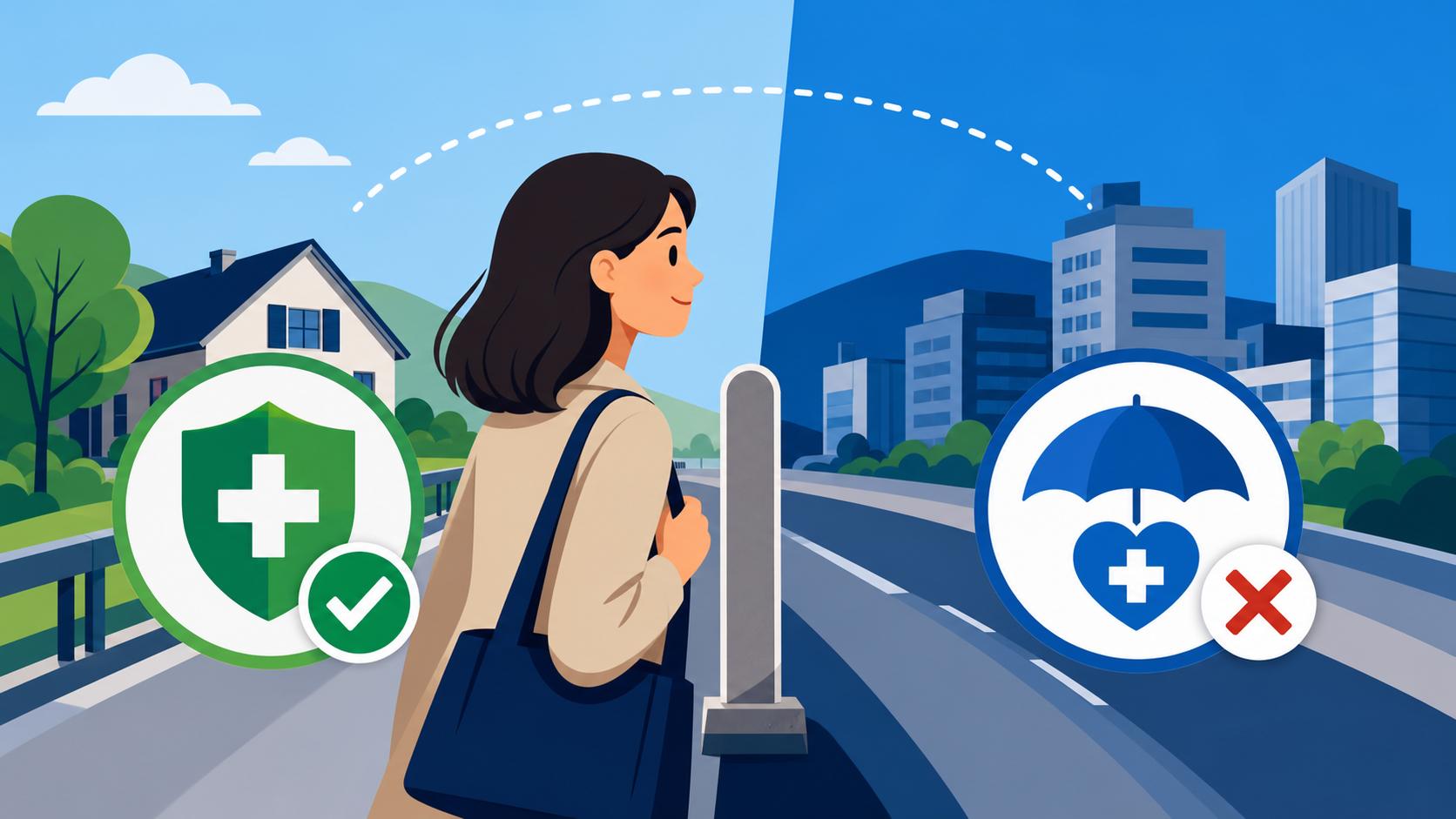
The moment you receive your G Permit to work in Switzerland while living in a neighboring country, you are entered into the Swiss social security system. However, Switzerland has unique bilateral agreements with EU/EFTA countries that grant cross-border workers a "Right of Option" (Optionsrecht). This is essentially your one-time legal opportunity to choose whether you want to be insured in the Swiss system or remain in the healthcare system of your country of residence. It sounds simple, but the administrative weight of this decision is heavy because, for most people, this choice is irrevocable as long as you remain a cross-border commuter.
The Swiss authorities generally assume you will join their system unless you explicitly prove you have opted out. This isn't just a friendly suggestion; it is a legal requirement. If you live in France, Germany, Italy, or Austria and commute to a Swiss canton like Geneva, Basel, or Ticino, you are the primary target for these regulations. I’ve seen far too many expats ignore the initial letters from the cantonal health office, assuming their home country insurance is "good enough," only to be hit with massive backdated bills a year later.
You must understand that the "Option Right" is tied to your employment status. If you lose your job and find a new one in a different canton, or if you stop working in Switzerland and then return years later, the clock might reset, but you should never count on it. The default position is that you belong to the Swiss Understanding KVG/LAMal: Mandatory Basic Health Insurance Explained system unless you navigate the exemption process correctly.
The Strict Three Month Deadline
The most critical piece of advice I can give you is this: you have exactly 90 days from the day you start your Swiss employment to exercise your Right of Option. This window is unforgiving. If you do not submit your exemption request within this timeframe, the Swiss authorities will automatically assign you to a Swiss health insurance provider. This is known as "forced affiliation," and the canton will not go out of its way to find you a budget-friendly deal. They will pick a provider for you, and you will be stuck paying those premiums.
I personally knew a commuter in Basel who thought he could "wait and see" how the commute went before filing his paperwork. By month four, he received a bill for three months of backdated Swiss premiums, even though he had already been paying his German GKV. Getting that money back is an administrative nightmare that involves multiple government agencies across two borders. You must act the moment your contract starts.
This 90-day period is also when you should be Mandatory Registration: How to Sign Up for Health Insurance Within 90 Days to ensure you aren't paying for two systems at once. The "exemption" isn't just about saying "no" to Switzerland; it’s about providing proof that your home country insurance meets the equivalent Swiss legal standards for coverage.
Why You Cannot Change Your Mind Later
The "irrevocability" of the choice is what scares most commuters, and for good reason. Once you choose to be insured in France or Germany and waive your right to Swiss insurance, you cannot simply switch back because you decided you like Swiss hospitals better. The only major life events that typically allow a "new" Right of Option are a change in your civil status (like getting married), the birth of a child, or a significant change in your employment, such as moving your workplace to a different canton.
For those who choose the Swiss system, you are essentially buying into a high-quality, high-cost model. If you later realize that the French CMU would have been 200 francs cheaper a month, you are usually out of luck. This is why the comparative analysis of your specific salary and family situation is so vital before you sign anything.
The Financial Implications of the Choice
Choosing the wrong path can cost you thousands of francs over a five-year period. In France, for example, the health insurance premium for frontaliers (the CMU) is calculated as a percentage of your income (roughly 8% after a certain deduction). If you are a high-earner, the Swiss KVG fixed-premium model might actually be cheaper. Conversely, for someone in a lower-income bracket, the French percentage-based system is often the winner.
For those with complex international lives, standard local insurance might not be enough. If you frequently travel for work or leisure outside of the EU and Switzerland, you might find that neither basic system provides the global peace of mind you need. In such cases, I often suggest looking into a private international plan like Cigna Global to provide a layer of top-tier coverage that follows you regardless of which side of the border you are on.
Choosing Between Swiss KVG and Your Home Country System
Choosing between the Swiss KVG and your home country’s system is essentially a trade-off between where you want to receive treatment and how much you are willing to pay for it. If you choose the Swiss KVG, you typically have the right to seek medical treatment in both Switzerland and your country of residence. This is a massive advantage if you want access to Swiss specialists but still want to see your local family doctor near your home.
If you choose to stay in your home country’s system (e.g., German GKV or French CMU), you are generally restricted to receiving non-emergency treatment in that country. While emergency care in Switzerland would still be covered under the European Health Insurance Card (EHIC) protocols, you wouldn't be able to book a routine surgery or a specialist appointment in Zurich or Geneva without paying out of pocket.
When evaluating these options, you also need to factor in The Swiss Franchise System: How Deductibles and Copays Work. In the Swiss system, you have an annual deductible (Franchise) and a 10% copay. In France or Germany, the out-of-pocket costs for doctor visits are usually much lower or structured differently. You have to run the math on your expected annual medical needs.
The Benefits of Swiss KVG for Commuters
The primary draw of the Swiss KVG for a G-Permit holder is the "dual-care" flexibility. By using the E106 or S1 form, you register your Swiss insurance with the local health authority in your home country. This allows you to walk into a Swiss clinic on your lunch break or visit a doctor in your home village on the weekend. For many, the efficiency and shorter wait times of the Swiss medical system are worth the monthly premium.
Furthermore, some Swiss insurers offer specific "Frontalier" packages. These are often cheaper than the premiums paid by residents of Switzerland because the insurance companies know that a large portion of your care will likely happen in your home country where medical costs are lower. This makes the Swiss KVG surprisingly competitive for commuters in certain cantons.
When to Stick with Your Home Insurance
If you have a large family with several non-working dependents, staying in your home country's system is often a financial no-brainer. In Germany, for example, the "Familienversicherung" allows you to cover your spouse and children under your premium for no extra cost, provided they meet certain income requirements. In Switzerland, every single person—from the newborn to the retiree—pays an individual premium.
Another reason to stick with your home insurance is if you have chronic conditions and an established network of doctors you trust. Moving your records and navigating a new system's Pharmacies and Medication: Prescriptions, Costs, and OTC Regulations can be a headache you don't need. If your home system is working for you and the cost is lower, staying put is usually the path of least resistance.
Comparative Overview of Health Insurance Options
| Feature | Swiss KVG (LAMal) | French CMU (Frontalier) | German GKV |
|---|---|---|---|
| Treatment Location | Both CH and Home Country | Home Country Only* | Home Country Only* |
| Cost Basis | Fixed monthly premium | % of salary (approx. 8%) | % of salary |
| Family Members | Individual premium per person | Included in % (usually) | Included (Family Ins.) |
| Deductibles | Choice of CHF 300 – 2,500 | Very low | Very low |
*Non-emergency treatment.
Country Specific Rules for Cross Border Workers
Each border has its own "flavor" of bureaucracy. The rules for someone living in Annemasse and working in Geneva are not identical to someone living in Lörrach and working in Basel. The bilateral agreements are standard, but the way the local health offices (like the CPAM in France or the Krankenkassen in Germany) interact with the Swiss cantons varies. You must be hyper-aware of the local "conventions."
In my experience, the French border is the most administratively intense. There have been long-running legal battles regarding the "right of option" for French frontaliers, particularly concerning those who were once in private insurance and were forced into the public CMU system. If you are a French Cross-Border Commuters: Choosing Between CMU and Swiss KVG, you need to pay close attention to the CNTFS (the body that collects premiums in France) to ensure your salary is being reported correctly.
For those on the Italian border, particularly in Ticino, the rules focus heavily on ensuring that the lower cost of living in Italy doesn't lead to "insurance tourism." The Italian Cross-Border Commuters: KVG Registration Requirements are strict, but they offer some of the best pathways for those who want to keep their Italian healthcare while working in the high-tech hubs of Lugano or Mendrisio.
French Cross Border Commuters Choosing Between CMU and Swiss KVG
If you are living in France, you generally have two choices: the French CMU (Couverture Maladie Universelle) or the Swiss LAMal (KVG). The CMU premium is essentially a tax on your income. If you have a very high salary, this "tax" can become incredibly expensive, often exceeding 600 or 700 Euros a month. In this scenario, the Swiss LAMal, which might cost around 180 to 250 CHF for a frontalier, is actually the cheaper option.
However, if you work part-time or have a more modest salary, the 8% calculation for the CMU usually works out in your favor. You also have to consider the "teleworking" rules. As of 2026, if you work from home in France for more than 25% of your time, you may be required to join the French social security system entirely, which would effectively make the choice for you.
German Cross Border Commuters Navigating Health Insurance Exemptions
Germany and Switzerland have a very structured relationship regarding frontaliers. Most German Cross-Border Commuters: Navigating Health Insurance Exemptions choose to stay in the German GKV because of the family coverage benefits. However, if you are young, single, and earning a high Swiss salary, the fixed Swiss premium can be tempting.
The key document for German residents is the "Befreiung von der Versicherungspflicht" (Exemption from mandatory insurance). You must take your Swiss insurance contract to a German Krankenkasse, and they will issue you a certificate of exemption. Without this piece of paper, the Swiss canton will never approve your Right of Option. It is a back-and-forth process that requires patience and a fair bit of stamps and signatures.
Italian Cross-Border Commuters and the Ticino Factor
The Italian-Swiss border is unique because of the specific tax treaties that were updated recently. For health insurance, most Italian frontaliers prefer the Italian SSN (Servizio Sanitario Nazionale) because it is funded through general taxation and specialized "contributi" from your salary. However, there is a growing number of specialists in Ticino who only accept Swiss KVG.
If you are a commuter in this region, make sure you understand the Italian Cross-Border Commuters: KVG Registration Requirements thoroughly. The Italian system is robust, but the bureaucracy of getting your S1 form recognized in the Lombardy or Piedmont regions can take several months. I always tell people to keep a digital copy of every form they submit to the ASL (Azienda Sanitaria Locale).
Practical Steps for Registration and Exemption
The process of exercising your Right of Option is a three-way dance between you, your Swiss insurer (or the Swiss cantonal office), and your home country’s health authority. You cannot simply tell your boss "I'm keeping my French insurance" and call it a day. If you don't follow the paper trail, the Swiss government will eventually catch up with you, usually in the form of a stern letter and a bill for backdated premiums.
First, decide which system you want. If you choose the home country system, you must contact the health insurance office in your Swiss canton of work. They will provide you with a specific "Right of Option" form. You then take this form to your home country's insurance provider, get them to sign and stamp it to prove you are covered, and then send it back to the Swiss authorities. This completes the Mandatory Registration: How to Sign Up for Health Insurance Within 90 Days cycle for an exemption.
If you choose the Swiss system, you first sign a contract with a Swiss provider. They will then issue you an S1 form (formerly the E106). You take this S1 form to your local health office in France, Germany, or Italy. They will register you in their system as a "Swiss-insured resident," which allows you to use your local doctors while the bills are technically handled (behind the scenes) by the Swiss system.
How to Apply for an Exemption in Your Canton
Every canton has its own office for health insurance. In Geneva, it's the SAM (Service de l'assurance-maladie); in Zurich, it's the SVA. You need to find the specific "Formulaire de choix du système d'assurance-maladie" for your canton. This form is your golden ticket. You must fill it out, check the box that says you want to be insured in your country of residence, and then—this is the annoying part—get your home insurer to verify it.
I recommend doing this via registered mail. The "Option Right" is so fundamental to your financial life in Switzerland that you don't want to lose the paperwork in a standard envelope. Once the canton receives the verified form, they will send you a formal confirmation of exemption. Keep this document forever. You will need it if you ever change jobs or if the Swiss authorities "forget" you are exempt.
Documentation Needed for the Cantonal Health Office
When you apply for your exemption, have the following documents ready in a dedicated folder:
- A copy of your Swiss employment contract.
- A copy of your G Permit (or the confirmation that the application is pending).
- A certificate of insurance from your home country provider (not just your plastic insurance card).
- The specific cantonal "Right of Option" form.
- Your proof of residence in France, Germany, or Italy (like a utility bill).
If you are coming from a country outside the EU, the process is significantly more difficult and usually requires you to join the Swiss system regardless. The bilateral agreements are specifically designed for the neighboring EU/EFTA states.
Using Technology to Manage the Paperwork
Many cantons have moved toward digital portals. You might be able to upload your documents directly to a cantonal website. However, the "home country" side of the border is often still very much based on paper and physical stamps. Don't be surprised if you have to visit a local office in person to get a signature. It's a rite of passage for every cross-border worker.
Costs Models and Specialized Coverage
If you choose the Swiss KVG, you aren't just stuck with one "standard" price. You can choose different insurance models to lower your premiums. For frontaliers, the most popular is often the Comparing Health Insurance Models: Telmed, HMO, Family Doctor, and Standard approach. The Telmed model, where you call a medical hotline before seeing a doctor, can shave 10-15% off your monthly bill.
However, remember that as a G-Permit holder, your "Family Doctor" might be across the border. You need to ensure your Swiss insurance provider understands and supports a model where your primary gatekeeper is a doctor in, say, France. Not all Swiss insurers are equally "commuter-friendly," so it pays to ask these specific questions before signing.
Another thing to consider is your lifestyle. Are you a weekend warrior who spends every Saturday skiing in the Alps? If so, you need to look into Accident Insurance (UVG): Occupational vs. Non-Occupational Coverage. Your employer covers accidents that happen at work, but if you're commuting and you have a non-work accident, you need to ensure your health insurance—whether Swiss or home-based—covers the high cost of Swiss mountain rescue.
The Role of Supplementary Health Insurance
Basic Swiss KVG is just that: basic. It covers the essentials but won't give you a private room in a hospital or cover things like adult orthodontics or alternative medicine. Many frontaliers choose to keep their basic insurance in their home country (like the French CMU) but take out "Complementary" insurance (Mutuelle in France) to cover the gaps.
Alternatively, some choose a high-end international plan like Cigna Global to act as a wrapper around their basic coverage. This is particularly useful if you want to be able to choose any specialist in either country without a referral, or if you want dental coverage that actually pays out a significant amount, which is rare in the standard Swiss system.
Dealing with International Needs and Travel
As an expat, your life probably isn't limited to the 20-mile radius around your office. If you're flying back to your original home country (the US, UK, etc.) or going on vacation, your frontalier insurance might have limitations. While the Swiss KVG covers emergencies abroad, the reimbursement is often capped at twice what the treatment would have cost in Switzerland—which sounds like a lot, but in places like the US, it's a drop in the bucket.
This is where a product like Cigna Global offers true value for the mobile professional. It allows you to maintain a consistent level of care regardless of whether you're in Basel, Paris, or New York. It simplifies the "where can I go?" question that haunts many cross-border workers who feel stuck between two systems.
Saving on Everyday Health Costs
Living between two countries means you can shop for the best prices. We all know Switzerland is expensive. When I first started working there, I was shocked that a basic bottle of Vitamin D or high-quality magnesium was nearly triple the price in a Zurich pharmacy compared to what I could find online.
For my daily health needs, I’ve found that ordering through iHerb is a massive saver. They ship to both Switzerland and the neighboring countries, and their selection of supplements and natural health products is far superior to what you’ll find in a local Swiss "Apotheke." For a commuter, having a package delivered to your home address in France or Germany is often easier and avoids the strict Swiss customs limits on importing certain vitamins.
Managing Your Health and Medications as a Commuter
One of the most confusing aspects of the G-Permit life is the prescription dance. If you see a Swiss doctor but want to fill the prescription in a French pharmacy (where it's cheaper), you might run into issues. Technically, a Swiss prescription should be valid in the EU, but the pharmacist may not be able to "direct bill" your insurance. You might have to pay upfront and claim it back later.
Understanding How to Pay Medical Bills: Tiers Garant vs. Tiers Payant Billing Systems is crucial here. If your insurance uses Tiers Payant, the pharmacy bills the insurer directly. If it's Tiers Garant, you pay and get reimbursed. Most cross-border transactions involving prescriptions fall into the "pay and wait for reimbursement" category, which requires you to be diligent with your paperwork.
You also need to be aware of the rules for Bringing Prescription Medication into Switzerland: Customs and Legal Limits. If you are carrying a three-month supply of a controlled substance (like certain ADHD medications or strong painkillers), you should always have a copy of your prescription and, ideally, a medical certificate in English, French, or German to avoid issues at the border.
Pharmacies and Medications in the Cross-Border Context
Swiss pharmacies are highly professional, but they are also strictly regulated. You won't find the same range of "over-the-counter" deals you might find in a US drugstore or even a large German "Apotheke." For common ailments, it’s often helpful to know the local equivalents. Check our guide on Cough and Cold Medicine in Switzerland: Local Brands and Pharmacy Advice to see what to look for when the winter "Bise" wind starts blowing.
If you are someone who relies on high-quality supplements or specific brands of organic personal care products, you’ll quickly realize that the Swiss versions are often "reformulated" or just prohibitively expensive. This is why I maintain an iHerb subscription; it’s the most reliable way to get the exact products I’m used to without the "Swiss premium" price tag.
Strategic Planning for Dental and Vision Care
Basic insurance—in almost every country—is notorious for being stingy with dental and vision care. In Switzerland, dental is almost entirely out of pocket unless it's the result of a serious accident or specific illness. As a cross-border worker, you have a massive advantage: you can get your dental work done in your home country (France, Germany, or Italy) where the labor costs are significantly lower.
Even if you have Swiss insurance, you can often pay for your dental cleaning in Germany and find that the price is 50% less than in Zurich. Just make sure you are getting a proper receipt. For those who want more comprehensive coverage that includes dental and vision on an international scale, a private plan like Cigna Global is often the only way to avoid these high out-of-pocket costs.
Final Thoughts on the Commuter Healthcare Journey
Being a G-Permit holder is a unique balancing act. You get the high Swiss salary but live in a lower-cost environment. The "Health Insurance Option Right" is the gatekeeper to making this lifestyle work financially. Don't rush the decision. Take your first 30 days to gather quotes, run the math on your salary percentages vs. fixed premiums, and most importantly, get those forms signed and stamped before the 90-day window closes. It’s the difference between a smooth integration and a multi-year administrative battle.
Disclaimer
The information provided in this article is for informational purposes only and does not constitute legal, financial, or medical advice. Health insurance regulations in Switzerland and neighboring countries are subject to change, and individual circumstances can significantly affect your rights and obligations. Always consult with the official cantonal health insurance office (e.g., SAM, SVA) or a qualified insurance advisor before making decisions regarding your healthcare coverage.