The Serafe Fee 2026: Paying the Mandatory CHF 335 Media Tax
One of the most jarring experiences for a new arrival in Switzerland is opening the mailbox to find a bill for several hundred francs from a company you have never heard of, for a service you never signed up for. I still remember sitting in my half-unpacked apartment in Zurich, staring at a bill from Serafe and wondering if it was a sophisticated phishing scam. This guide explains exactly why you must pay the CHF 335 media fee, how the 2026 regulations work, and how to navigate the billing system without the stress I faced.
Understanding the Swiss Media Levy
The media fee, officially managed by Serafe AG, is a mandatory household levy designed to fund public broadcasting in Switzerland. Unlike many other countries where public media is funded through general taxation, the Swiss system uses a direct fee model to ensure a level of independence from the state. In 2026, this fee stands at CHF 335 per year, a figure that has seen adjustments over recent years following intense political debates and national referendums.
The core philosophy behind this fee is "solidarity." The funds are distributed to the Swiss Broadcasting Corporation (SRG SSR), which provides radio and television programming in all four national languages: German, French, Italian, and Romansh. This ensures that even the smallest linguistic communities have access to high-quality news and cultural content. For an expat, this might feel like a steep price to pay for content you might not even consume, especially if your language skills are still developing. However, the law is very clear: if you live in Switzerland, you contribute to the national media landscape.
The Transition from Billag to Serafe
For those who have been here a long time, the name "Billag" still triggers a reflexive reaching for the wallet. Billag was the previous collection agency, and their methods were often seen as intrusive, involving physical inspections of homes to check for radios or televisions. In 2019, the system shifted to Serafe, moving from a "device-based" fee to a "household-based" fee. This was a massive win for privacy, as it meant no one would be knocking on your door to check if you had a hidden car radio.
Under the current Serafe system, the data comes directly from the cantonal and communal inhabitant registries. This means that as soon as you complete your Mandatory Registration: How to Sign Up for Health Insurance Within 90 Days or register your address at the local Gemeinde, your information is automatically forwarded to Serafe. There is no "signing up" for the fee; it finds you.
Why Device Ownership No Longer Matters
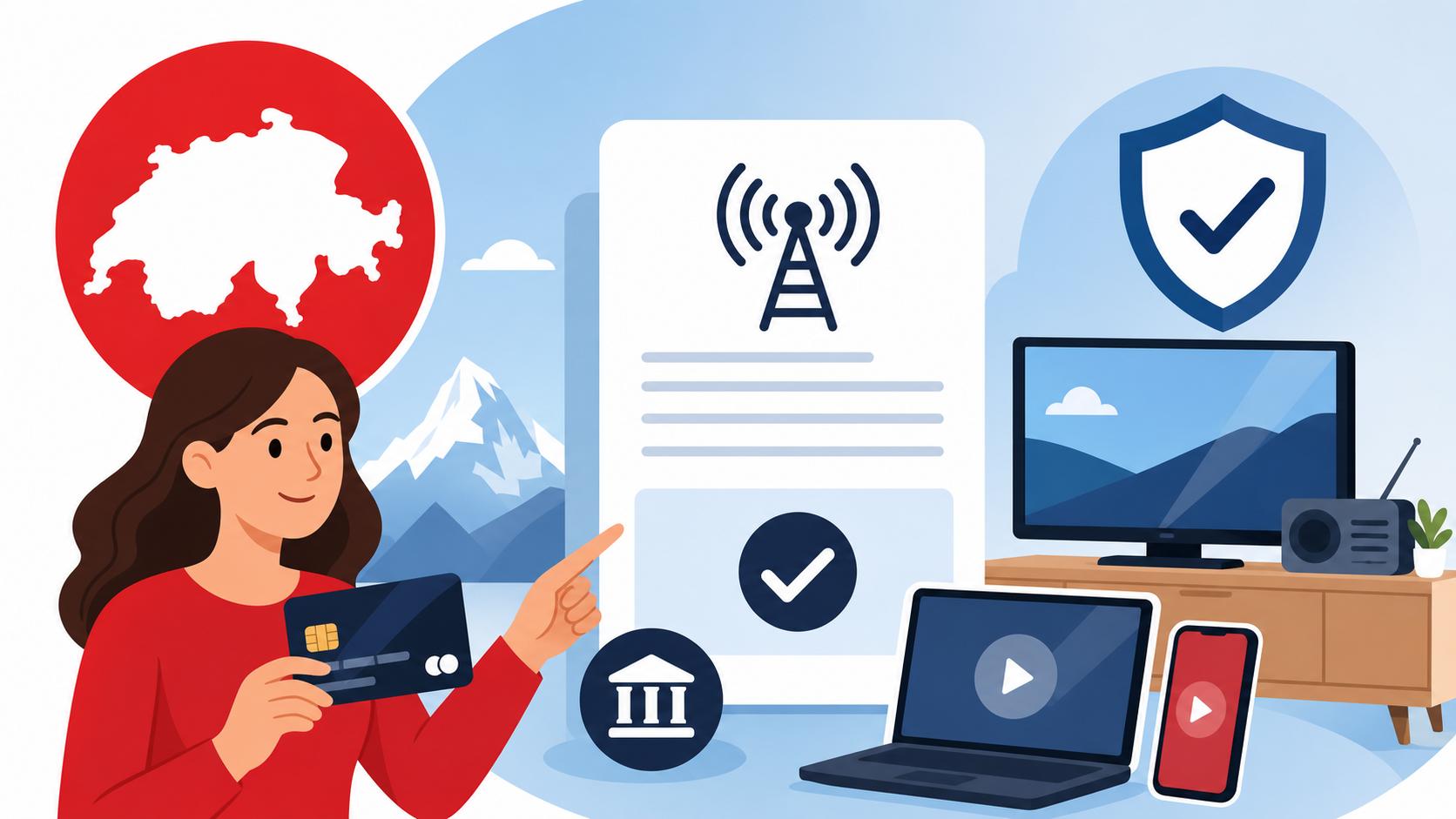
In the old days, you could theoretically avoid the fee by proving you didn't own a radio or a TV. This is virtually impossible. The Swiss government defines a "device" as anything capable of receiving broadcast signals, which includes smartphones, tablets, and computers with an internet connection. Unless you are living a strictly analog life in a remote mountain hut without a smartphone or laptop, you are considered a consumer of media.
Even if you only use your internet connection to check the Financial Checklist for Your First 30 Days as an Expat in Switzerland or to manage your investments on Trade Republic, you are still liable for the fee. The logic is that the infrastructure for public broadcasting is a public good, similar to roads or the fire department. You pay for the availability of the service, not your personal frequency of use. This is often a point of frustration for expats who primarily watch Netflix or YouTube, but the "device-neutral" fee remains a non-negotiable part of the Swiss social contract.
Billing Cycles and Payment Methods
The Serafe bill typically arrives once a year, but the timing is not synchronized with the calendar year for everyone. Instead, your billing cycle usually begins on the first day of the month after you move into your apartment. If you moved in May, your annual bill will likely arrive every May. This can make Budgeting in Zurich and Geneva: Managing Expat Expenses in High-Cost Cities a bit tricky if you aren't prepared for the sudden CHF 335 hit.
The bill itself is a standard Swiss QR-bill. It contains all the information needed to pay via your banking app. Most expats find that setting up an eBill is the most efficient way to handle this. By linking Serafe to your e-banking, the bill appears directly in your "to-pay" list, and you can authorize it with a single click.
Annual vs. Quarterly Payments
While the default is a single annual payment of CHF 335, it is possible to request quarterly billing. This breaks the cost down into more manageable chunks of approximately CHF 83.75 every three months. However, be aware that choosing the quarterly option often involves a small administrative surcharge. If you are focused on Salary and Compensation: Navigating Swiss Pay, Bonuses, and Deductions and trying to keep your overhead low, the annual payment is usually the most cost-effective route.
I personally recommend stick to the annual payment to avoid the extra paperwork. When the bill arrives, I treat it as a "welcome to Switzerland" tax that I pay and immediately forget about for the next 12 months. If you find yourself short on cash when the bill arrives, it is better to contact Serafe immediately to discuss a payment plan rather than ignoring the bill, as Swiss late fees (Mahnungen) are notoriously high.
Digital Payments and Neobanks
Most modern expats in Switzerland have moved away from traditional giants like UBS or Credit Suisse for their daily spending, opting instead for neobanks. If you are using a platform like Wise to manage multiple currencies, you can easily pay your Serafe bill using the QR-code scanner in the app. Using Best Neobanks in Switzerland: Neon, Yuh, and Zak Compared can also save you on the monthly account fees that traditional banks charge, which effectively "pays" for a portion of your Serafe fee over the year.
For those who are savvy with their digital finances, paying the Serafe bill is just another line item in a broader strategy. Many newcomers are told that the CHF 335 fee is a great excuse to look for savings elsewhere. For example, by moving your savings to a high-yield platform like Trade Republic, the interest you earn on your emergency fund can often cover the entire cost of the mandatory media tax.
| Billing Feature | Annual Option | Quarterly Option |
|---|---|---|
| Total Cost (2026) | CHF 335 | Approx. CHF 335 + Admin Fee |
| Payment Method | QR-Bill / eBill | QR-Bill / eBill |
| Trigger Event | 1st day of month after move-in | 1st day of month after move-in |
| Automatic Setup | Yes, via inhabitant registry | Requires manual request |
Shared Housing and Complex Living Situations
The "household" definition is where things get complicated, especially for students, interns, or those living in a Wohngemeinschaft (WG). In Switzerland, the Serafe fee is charged per household, not per person. If four people share an apartment, they only pay one fee of CHF 335 between them. This makes it significantly cheaper for those in shared living arrangements.
However, Serafe’s automated system sometimes fails to recognize who belongs to which household. It is common for every person in a WG to receive an individual bill for CHF 335. If this happens, do not pay it four times! You need to designate one person as the primary payer and contact Serafe to link the other residents to that same household account. Many WGs fall into heated arguments over who is responsible for the bill, so it’s best to establish a "house fund" early on.
The Shared Apartment WG Dilemma
In a WG, the person whose name is on the bill is legally responsible for the payment. If you are the one who receives the bill, you must ensure your roommates pay their share. For a four-person household, that’s only CHF 83.75 per person per year. To make this easier, many residents use apps like TWINT to settle up instantly.
If you are wondering Who Pays the Serafe Bill in a WG (Shared Apartment)?, the answer is that the household is collectively liable, but Serafe only cares that one bill is paid per "dwelling unit" as defined in the Federal Register of Buildings and Dwellings. If you receive a bill but your roommate has already paid for the household, you must provide Serafe with your roommate's customer number to clear your name from their records. This process is usually handled through their online portal, which has become much more user-friendly.
Second Homes and Vacation Rentals
If you are lucky enough to have a secondary residence, perhaps a small studio in the Alps for ski season, you might be worried about paying the fee twice. The rule is that you only pay the media fee for your primary residence. However, if your secondary home is used for commercial purposes (like an Airbnb) or if you are registered as a resident in two different cantons for some reason, you might run into issues.
For most expats, the main concern is ensuring they aren't being double-billed when they move. When you transition from one apartment to another, your old Serafe account should close and a new one should open based on your Registering Your Address at the Kreisbüro Within 14 Days of Moving. If there is an overlap, you are entitled to a pro-rata refund. Always keep your move-out confirmation (Abmeldebestätigung) from the old commune, as it is the "golden ticket" for solving any billing disputes.
Exemptions and Reductions
While the fee is mandatory for the vast majority, there are specific groups that are exempt. The most common exemption applies to households where someone receives federal disability (IV) or old-age (AHV) supplementary benefits. If you are an expat supporting an elderly relative, it is worth checking if they qualify for an exemption.
There is also an exemption for the deaf and blind, provided that no one else in the household can hear or see. This is quite a high bar to meet and requires medical certification. If you think you qualify, you must apply directly to Serafe with the necessary documentation. It is not an automatic process.
AHV/IV Recipients and Social Hardship
For those on a very low income, the CHF 335 fee can be a significant burden. While being a student or being unemployed does not automatically exempt you, those receiving Cantonal Premium Reductions (Prämienverbilligung) for Low-Income Households might find that their social status allows for other forms of assistance. However, generally speaking, the Serafe fee is one of the last things the Swiss government will waive. They view it as an essential contribution to the democratic infrastructure of the country.
If you are struggling to make ends meet, the first step is to contact the social services office (Sozialamt) in your commune. They can sometimes include the cost of the media fee in your overall social assistance package. Just remember that claiming social assistance can have long-term implications if you are planning on The Swiss C Permit (Permanent Residency): Fast-Track and Standard Routes, so always weigh the pros and cons carefully.
Opting Out for Households Without Reception
There was once a "transition phase" where households with absolutely no way to receive digital or analog signals could apply for an exemption. This "Opt-Out" period has largely ended by 2026. Because high-speed internet is now considered a standard utility in Swiss apartments, the government assumes every household has the capacity to receive public broadcasts.
If you are genuinely living in a "dead zone" without internet, mobile data, or a radio, you can still theoretically petition for an exemption, but the administrative burden is immense. You would have to prove that no one in the house has a smartphone or a computer. In a country that is as digitally advanced as Switzerland, this is a nearly impossible task. Most people find that it is simply not worth the effort to fight the CHF 335 charge and instead look for ways to integrate it into their Cost of Living in Switzerland 2026: Budgeting for Singles and Families.
Moving and Leaving Switzerland
Address changes are the number one cause of Serafe-related headaches. Because the system relies on communal registries, there is often a lag between when you move and when the billing system updates. If you move from Zurich to Geneva, for example, ensure you are deregistered in Zurich and registered in Geneva within the legal 14-day window.
If you receive a bill for your old address after you have moved, do not ignore it. Send a copy of your new registration or your old deregistration to Serafe’s customer service. They are generally quite efficient at closing accounts once they have the official documents. For those wondering Do I Need a TV License if I Only Watch Netflix? Serafe Nuances, the answer remains a firm "yes," regardless of your moving status.
Address Changes and Registering at the Kreisbüro
Every time you move, you must notify the local authorities. This isn't just for Serafe; it affects your taxes, your Health & Medical insurance, and your residency permit. The information you provide at the Kreisbüro or Einwohnerkontrolle is the "source of truth" for Serafe.
If you are moving into a household that already pays the fee (for example, moving in with a partner), make sure to mention this during your registration. Providing the existing Serafe account number at the time of registration can save you from receiving a duplicate bill. It is much easier to prevent a second account from being opened than it is to close one later.
Final Settlement When Departing
When the time comes to leave the beautiful Alps behind, you must officially deregister. This is the only way to stop the Serafe billing cycle permanently. As part of your departure process, you should notify Serafe of your move-out date. They will then calculate a pro-rata bill for the portion of the year you were resident in Switzerland.
Failing to do this can lead to debt collection (Betreibung) even after you have left the country. This can be a major issue if you ever plan to return or if you still have assets in a Swiss bank. To avoid this, follow the steps in How to Cancel the Serafe Fee when Leaving Switzerland Permanently and ensure you get a written confirmation that your account is closed. Dealing with a Betreibungsauszug from abroad is a nightmare you want to avoid at all costs.
Maximizing Your Swiss Budget
Since the Serafe fee is an unavoidable part of life, the best approach is to offset the cost by being smarter with the rest of your finances. Many expats lose hundreds of francs every year simply by using the wrong credit cards or paying unnecessary fees to traditional banks. By switching to more modern financial tools, you can easily "find" the CHF 335 needed for Serafe.
For instance, if you are an active investor, using Binance for a small portion of your portfolio or Trade Republic for your main brokerage needs can significantly reduce your transaction costs compared to using a Swiss retail bank's investment platform. These savings often exceed the annual cost of the media levy.
Reinvesting Your Serafe Savings
Think of the media fee not as a loss, but as a challenge to optimize your other expenses. Are you paying for a TV package from Swisscom or Sunrise that you don't use? Since you're already paying for public TV through Serafe, you might be able to cancel your private cable subscription and just use the free public apps like "Play SRF" or "Play Suisse." These apps give you access to a massive library of Swiss content, often with subtitles, which is a great way to practice your language skills.
Also, consider your Pillar 3a in 2026: Tax Deductions, Limits, and Investment Options. The tax savings from a full Pillar 3a contribution can often be over CHF 1,500 depending on your canton and income. This tax refund essentially pays for your Serafe fee four times over. By focusing on these larger financial levers, the "media tax" becomes a minor detail in a well-managed Swiss lifestyle.
Money and Finance Disclosure
This article is for informational purposes only and does not constitute professional financial, legal, or tax advice. While every effort has been made to ensure the accuracy of the 2026 Serafe rates and regulations, Swiss laws and fees are subject to change by federal decree or public referendum. Readers are encouraged to consult official government sources or a qualified Swiss tax advisor regarding their specific household situation and liability. Use of third-party financial platforms mentioned in this guide is at the user's own risk.