How to Use Your Swiss Health Card (VeKa) at the Clinic
Walking into a sterile Swiss medical clinic for the first time while battling a high fever can feel like navigating a labyrinth without a map. I remember standing at a reception desk in Zurich, barely able to focus, while a very polite receptionist asked for my VeKa, and I just stared blankly at my wallet. This guide simplifies the process so you can use your Swiss health card with total confidence from day one.
Understanding the Versichertenkarte and Its Function
The Swiss health insurance card, officially known as the Versichertenkarte or VeKa, is much more than a simple membership ID. In the Swiss healthcare landscape, this small plastic card serves as the digital bridge between you, your insurance provider, and the medical professionals treating you. It is the physical manifestation of your Healthcare in Switzerland for Expats: The Complete System Overview (2027) and is required for nearly every medical interaction in the country.
When you first arrive and complete your Mandatory Registration: How to Sign Up for Health Insurance Within 90 Days, your chosen provider will mail this card to your residence. It typically takes two to three weeks to arrive. The card contains a microchip that holds your administrative data, ensuring that the clinic can verify your coverage in real-time. This is essential because the Swiss system is decentralized; there is no single "government" insurance, but rather a regulated market of private insurers providing the Understanding KVG/LAMal: Mandatory Basic Health Insurance Explained coverage.
Beyond the front-facing Swiss details, the back of the card almost always functions as the European Health Insurance Card (EHIC). This is a lifesaver for expats who travel frequently within the EU or EFTA zones. It ensures that if you have a medical emergency in Italy or France, you are treated under the same conditions as a local, with the costs eventually being settled between the foreign hospital and your Swiss insurer. For those who want even broader international protection or premium service levels, some expats choose to supplement their local plan with a policy from Cigna Global, which provides a different level of global portability.
The Check-in Process at a Swiss Clinic or Hospital
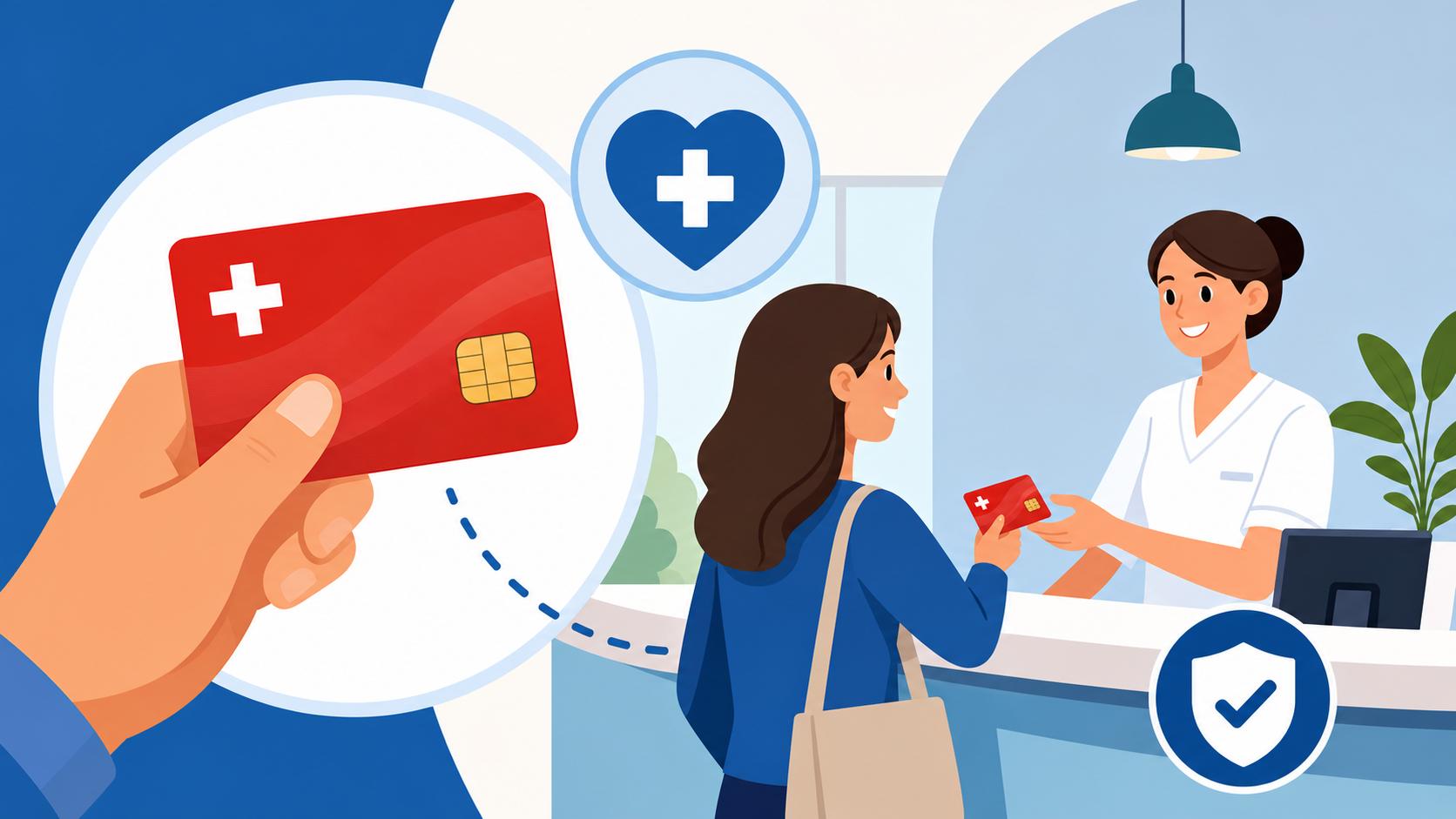
The moment you enter a doctor’s office or a hospital, the very first thing the administrative staff will ask for is your card. In Switzerland, this is a standard protocol used to open your "Dossier." Even if you have an appointment with one of the Finding an English-Speaking Family Doctor (Hausarzt) in Major Cantons, they need the card to link your treatment to the correct billing account.
When the receptionist swipes or inserts your card into their reader, they are pulling your insurance number, your date of birth, and your current insurance status. They aren't just checking if you have insurance; they are checking if your policy is active and which specific billing model you are on. It is important to remember that the card itself does not "pay" for the visit on the spot. Unlike a credit card, there is no balance deducted. Instead, it authorizes the clinic to eventually send a bill to either you or your insurance company, depending on the canton and the specific provider's agreement.
If you find yourself in a situation where you need Emergency Medical Services: Ambulances, REGA, and Crisis Protocols, and you don't have your card on you, do not panic. Hospitals will treat you first. However, you or a family member will be expected to provide the insurance details within 24 to 48 hours. The system is robust, but it relies heavily on the "VeKa-Number" (the 13-digit number starting with 80756) to ensure the high-cost Swiss medical machinery keeps running smoothly.
Administrative Information Stored on Your Health Card
The data on your card is strictly regulated by Swiss privacy laws, but it contains everything needed to identify you within the medical system. At a basic level, it includes your name, gender, date of birth, and your AHV number (the Swiss social security number). While this might seem like standard fare, the chip also carries specific technical codes that tell the doctor's software which Comparing Health Insurance Models: Telmed, HMO, Family Doctor, and Standard you have chosen.
For example, if you are on a Telmed model, the system might flag to the receptionist that you were supposed to call a medical hotline before showing up at the clinic. This is where many expats get tripped up. The card doesn't stop you from seeing the doctor, but it serves as a record-keeping tool. If you bypass your model's rules, your insurance might later refuse to pay the bill, leaving you to cover the cost out of pocket.
In recent years, Switzerland has been rolling out the Electronic Patient Record (EPR). While not yet mandatory for all, your health card can increasingly be used to grant doctors access to your digital medical history, such as allergy lists or current prescriptions. This is particularly helpful when visiting Pharmacies and Medication: Prescriptions, Costs, and OTC Regulations to ensure there are no dangerous drug interactions. If you prefer to manage your own wellness or basic supplements outside the prescription system, many expats use iHerb to source vitamins and minerals that might be more expensive at local Swiss apothecaries.
| Feature | Front of Card (Swiss VeKa) | Back of Card (EHIC/EUK) |
|---|---|---|
| Primary Use | Domestic consultations, Swiss pharmacies | Emergency care within EU/EFTA countries |
| Data Included | 13-digit VeKa number, Insurer ID | ID number, Expiry date, Country code |
| Billing Type | Linked to KVG/LAMal basic insurance | Reciprocal state-to-state billing |
| Updates | Auto-updated via chip at terminal | Requires a new physical card to update |
Billing Systems and the VeKa Card
One of the most confusing aspects for newcomers is how the billing actually works after the card is swiped. This depends on whether your insurer uses the "Tiers Garant" or "Tiers Payant" system. Understanding this distinction is vital because it determines who receives the initial bill in the mail.
In a Tiers Payant system, which is common in many French-speaking cantons and with certain insurers like CSS or Helsana at pharmacies, the provider sends the bill directly to the insurance company. You never see the full bill; you only receive a statement later for The Swiss Franchise System: How Deductibles and Copays Work. Your health card is the key that unlocks this direct-billing pathway. If the pharmacy or clinic supports it, swiping your card means you walk out without paying a cent at the counter.
Conversely, under Tiers Garant, the doctor sends the bill to you. You are then responsible for paying the doctor within 30 days and then sending the digital or paper copy to your insurance for reimbursement. Even in this model, you must still present your card at the clinic so they have your correct address and insurance ID to generate the How to Read a Swiss Medical Bill (Rückforderungsbeleg) and Claim Refunds. For major expenses, the direct billing of Tiers Payant: Which Swiss Insurances Pay the Pharmacy Directly? is much preferred by most expats to avoid temporary cash flow issues.
What to Do if You Lose Your Health Card
Losing your wallet in Switzerland is a rare but stressful event. If your VeKa card goes missing, your first step should be to notify your insurance provider immediately. Most major insurers like AXA, Sanitas, or Swica have mobile apps where you can report a lost card and order a replacement with a single click. There is usually no fee for a replacement card, but it will take about two weeks to reach your mailbox.
If you have a medical appointment scheduled before the new card arrives, don't cancel it. You can request a "Temporary Insurance Certificate" (Versicherungsnachweis) from your insurer. They can usually email this to you as a PDF within minutes. This document contains all the same data as the chip on your card, and clinics are legally required to accept it as proof of coverage. Simply show the PDF on your phone or print a copy for the receptionist.
During the interim period, you might also find that you need basic healthcare supplies or over-the-counter support. While you wait for your new card to be registered at your local pharmacy, using online resources like iHerb can be a convenient way to maintain your health routine without needing to prove your insurance status for non-prescription items. If you are a global nomad or frequently moving between countries, having a secondary international policy through Cigna Global ensures that you always have a digital card or membership number accessible via an app, providing a safety net when local administrative hurdles arise.
Navigating Pharmacy Visits with Your Card
The pharmacy (Apotheke or Pharmacie) is perhaps where you will use your card most frequently. When you bring a prescription from your doctor, the pharmacist will ask for your card to see if they can bill the medication directly to your insurer. This is a significant benefit of the Swiss system; for many chronic medications, you don't have to pay upfront.
However, there are nuances. Not all medications are covered by the basic KVG insurance. If you are buying "Lifestyle" drugs or certain specialized supplements, the pharmacist will tell you that the card "doesn't cover it." In these cases, you pay the full retail price at the register. Always ask the pharmacist if a generic version (Generika) is available. Swiss law encourages the use of generics, and using your card to track these can actually help you lower your overall healthcare costs by reducing your share of the co-payment.
If you are a new parent or planning a family, your card usage will increase. From the initial scans to the delivery, the card is the constant thread through Maternity and Child Healthcare in Switzerland: From Pregnancy to Pediatrics. Each family member, including newborns, gets their own individual card. It is a good habit to keep all family cards in a dedicated organizer, as you will need to present the specific card for the person receiving the treatment—you cannot use your own card for your child's appointment.
Disclaimer
The information provided in this guide is for informational purposes only and does not constitute legal or medical advice. Swiss healthcare laws and insurance regulations are subject to change. Always verify specific coverage details and billing procedures with your official insurance provider or a qualified legal professional in Switzerland.