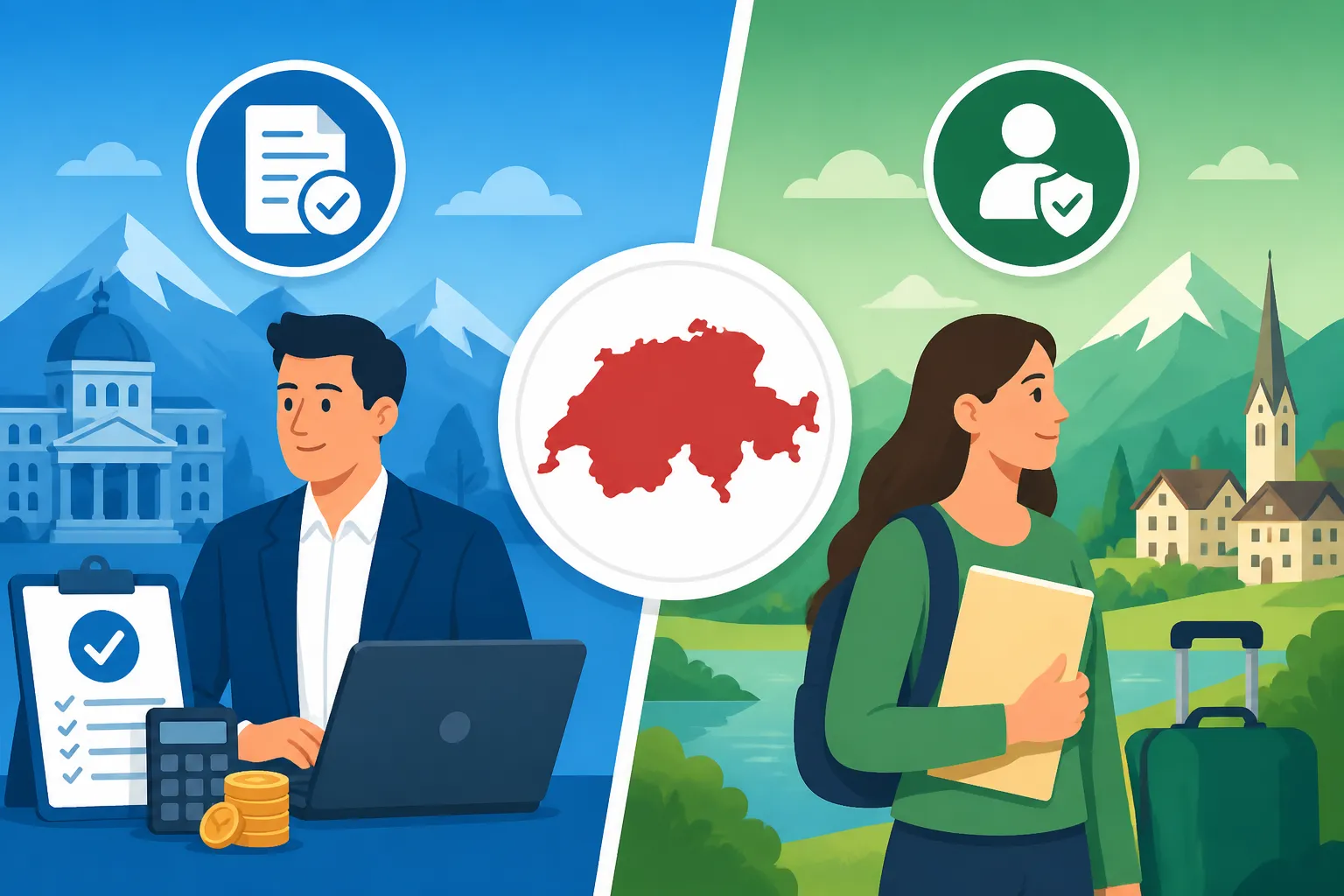
Tax Residency vs Immigration Residency in Switzerland: Key Differences
You’ve just arrived in Switzerland, or maybe you’ve been here a while, and you keep hearing terms like "tax residency" and "immigration residency." You might even think they’re the same thing, but trust me, they're not. This distinction often trips up even the most seasoned expats, leading to misunderstandings with authorities and, potentially, unexpected financial headaches. This guide is here to clear up that confusion, explaining the crucial differences and why understanding them is vital for anyone living or working in Switzerland.
The Basics: What Even Is Residency in Switzerland?
When you first land in Switzerland, brimming with excitement (and probably a healthy dose of administrative fear), the word "residency" typically brings one thing to mind: your shiny new permit. And while that's absolutely a form of residency, it's not the only one that matters here. Switzerland, in its characteristic precision, distinguishes between your right to physically live here and your obligation to pay taxes here. They're often intertwined, but not always, and that's where the nuance lies.
Immigration Residency: Your Permit Status (B, C, L)
This is the residency status most expats are acutely aware of because it dictates your legal right to actually be in Switzerland. It’s what you apply for with the cantonal migration office, and it’s what allows you to work, study, or simply reside in the country. Your immigration residency is defined by the permit you hold – be it a short-term L permit, a standard B permit, or the coveted permanent C permit.
These permits are essentially your official pass to Swiss life, granted by the State Secretariat for Migration (SEM) and managed by your specific canton's migration authorities. Their primary purpose is to regulate your presence, employment, and overall stay in the country. When you first move here, one of the very first things you do is go to your local Gemeinde or Commune office to register your address, usually within 14 days of arrival. This act of registering is the official start of your immigration residency. It tells the authorities, "Hey, I'm here, I live at this address, and I'm legally allowed to be." Without this, you're pretty much invisible and certainly not legally resident. It's the most tangible and immediate form of "residency" that newcomers grapple with, defining daily life and access to services. If you're wondering about the initial steps, our guide on Registering Your Address at the Kreisbüro Within 14 Days of Moving goes into full detail.
The Elusive Tax Residency: A Separate Legal Concept
Now, here’s where it often diverges. While your immigration permit gives you the right to live, tax residency is a whole different beast. It's determined by the federal and cantonal tax authorities, and their focus isn't just on your permit, but on where your centre of vital interests lies and where you spend your time. You might legally reside in Switzerland with a B permit, but if your family, your main home, and all your social connections are still firmly established in another country, the Swiss tax authorities (or even your home country’s tax authorities) might have a different opinion on where your primary tax obligations lie.
This concept exists independently of your visa or residence permit. For most straightforward expat scenarios, your immigration residency and tax residency will eventually align. You move to Switzerland, you get a B permit, you register at the commune, you start working, and boom – you're a tax resident. But it’s not always automatic, and ignoring this distinction can lead to double taxation, penalties, or missed opportunities for tax deductions. It’s a legal definition that fundamentally impacts where you’re expected to declare your worldwide income and assets, and which country has the primary right to tax you.
Diving Deeper: How Each Residency Is Determined
The criteria used by different government bodies to define "residency" can feel like a game of administrative whack-a-mole. You think you’ve got one aspect covered, and then another authority pops up with its own set of rules. Let’s break down how each type of residency is formally established.
Immigration Residency: The Migration Office's View
Your immigration residency is essentially the result of a contractual agreement between you and the Swiss state. The process starts with an employer, a university, or family reunification, and it's ultimately approved by the federal State Secretariat for Migration (SEM) and implemented by your local cantonal migration office. They look at a few key factors:
- Employment Contract: For most working expats, a valid employment contract with a Swiss company is the cornerstone. This contract is what your employer uses to apply for your work and residence permit. The SEM checks if your qualifications match the job, if you're a non-EU/EFTA national, if quotas are available, and if your employer has proven they couldn't find a suitable Swiss or EU/EFTA candidate.
- Financial Means: Regardless of employment, you need to prove you can support yourself and any dependents without relying on social welfare. This is particularly relevant for students or those on specific permits that don't allow immediate work.
- Family Ties: For family reunification visas, the relationship to the primary permit holder is key. They assess whether you're married or in a registered partnership, or a direct descendant. Our article on Family Reunification: Bringing Your Spouse and Children to Switzerland explains this in detail.
- Mandatory Registration: As mentioned earlier, once you arrive, you have a strict deadline (usually 14 days) to register with your local municipal office (the Kreisbüro, Einwohnerkontrolle, or Office des Habitants). This is the official timestamp that the Swiss government uses to say, "Okay, this person is officially living here." It's not just a formality; it's the bedrock of your legal presence. They’ll record your permit details, your address, and officially welcome you into the local community.
Tax Residency: The Tax Authorities' Criteria
The tax authorities, both federal and cantonal, operate under a different lens. They want to know where your "economic center of gravity" lies. Their primary concern is to establish who has the right to tax your income and wealth. This is determined based on two main principles under Swiss tax law: unlimited tax liability based on residency or stay, or limited tax liability based on economic allegiance.
- Centre of Vital Interests (Mittelpunkt der Lebensinteressen): This is the most crucial factor. Where do you genuinely live? Where is your family? Where do your children go to school? Where do you spend your free time? Where are your closest social connections and club memberships? If your family moves with you, you lease an apartment, your kids enroll in local schools, and you start building a social life here, your centre of vital interests is clearly in Switzerland. The tax office will consider your entire global income and assets taxable here.
- Physical Presence / 183-Day Rule: This is often misunderstood. Many countries have a "183-day rule" (or similar) where if you spend more than half the year (183 days) in a country, you automatically become a tax resident. Switzerland also applies this as a strong indicator. If you physically stay in Switzerland for more than 183 days within a 12-month period, you are generally considered a tax resident. However, it's not the only factor. It's possible to spend more than 183 days here but argue your centre of vital interests is still elsewhere, especially if you have strong family ties abroad. Conversely, you could spend less than 183 days but still be deemed tax resident if your "centre of vital interests" is unmistakably in Switzerland, usually through economic ties.
- Economic Ties (Wirtschaftliche Zugehörigkeit): Even if you don't physically reside in Switzerland, you can be subject to limited tax liability if you have significant economic ties here, such as owning real estate, running a business, or earning Swiss-sourced income that isn't taxed at source. For most expats, though, the "unlimited tax liability" based on actual residency is the main point of consideration.
- Tax Forms and Withholding Tax: If you hold a B permit and earn below CHF 120,000 (the threshold varies slightly by canton for full tax assessment), you'll likely be taxed at source (Quellensteuer). This is a direct deduction from your salary, and it's how the tax authorities ensure they get their due. However, if you earn above that threshold or hold a C permit, you'll be required to file a full tax return, declaring your worldwide income and assets. This transition from Quellensteuer to standard taxation is a key indicator of your full integration into the Swiss tax system. Our articles on Withholding Tax (Quellensteuer) vs Standard Taxation for Foreigners and Earning Over CHF 120,000: Transitioning to Standard Taxation offer comprehensive explanations.
To simplify the differences, here's a quick table:
| Feature | Immigration Residency | Tax Residency |
|---|---|---|
| Purpose | Legal right to live/work in Switzerland | Defines where you owe taxes on income/wealth |
| Determining Authority | Cantonal Migration Office, SEM | Cantonal/Federal Tax Authorities |
| Key Factors | Employment contract, financial means, family ties, quotas | Centre of vital interests, physical presence (183-day rule), economic ties |
| Official Document/Proof | Residence Permit (L, B, C), Commune Registration | Tax return filing, tax at source deduction, (sometimes) tax certificates |
| Governing Law | Federal Law on Foreign Nationals and Integration (FNIA) | Federal Tax Law (DBG), Cantonal/Communal Tax Laws |
Practical Implications and Common Pitfalls for Expats
Understanding this distinction isn't just academic; it has very real, tangible effects on your life as an expat in Switzerland. Ignoring these differences can lead to anything from annoying bureaucratic delays to serious financial penalties.
The Interplay: When They Align (Mostly)
For the vast majority of expats, especially those relocating for a long-term job with their families, their immigration residency and tax residency will align fairly quickly and seamlessly. You move, you register, you get your B permit, you start working, your kids go to school – your entire life is now Swiss. In this common scenario, the Swiss tax authorities will consider you a full tax resident, and you'll declare your worldwide income and assets to them, subject to any double taxation agreements.
This is the ideal and most straightforward situation. Your presence is clear, your intent is clear, and your obligations are, for the most part, clear. You become fully integrated into the Swiss system, including its social security, pension schemes, and healthcare. If you're on a B permit and taxed at source, your employer handles many of the deductions for you. However, even in this 'aligned' scenario, it's wise to review your situation, especially if you have significant assets or income streams outside Switzerland.
Where It Gets Tricky: Discrepancies and Cross-Border Situations
This is where the real expat frustrations often begin because the neat alignment can break down, leading to unexpected complexities.
-
Scenario 1: Cross-Border Commuters (G Permit Holders)
This is perhaps the clearest example of immigration residency and tax residency diverging. A cross-border commuter, or "Frontalier," lives in a neighboring country (like France, Germany, or Italy) but works in Switzerland. They hold a G permit, which grants them the right to work here but not to reside. Their immigration residency is in their home country.
However, for tax purposes, they are primarily taxed in Switzerland on their Swiss-sourced income, although specific treaties can shift some taxation back to their country of residence. They do not declare their worldwide income to the Swiss tax authorities (unless specific rules apply), only their Swiss employment income. This is a classic case where immigration residency (not in Switzerland) and tax obligations (largely in Switzerland) are distinct. Our comprehensive guide on Cross-Border Commuter Taxes: Financial Guide for G Permit Holders can help you navigate this specific maze. -
Scenario 2: Remote Workers / Digital Nomads
This is a rapidly growing area of confusion. Let's say you're employed by a Swiss company, but you're working remotely for part of the year from your home country, or perhaps you're a "digital nomad" trying to spend extended periods in Switzerland on a tourist visa.
The trap here is thinking that because you don't have a Swiss work permit, you're not a tax resident. If you spend significant time in Switzerland (e.g., more than 183 days) while maintaining economic ties (even if paid by a non-Swiss entity), you could inadvertently become a Swiss tax resident, regardless of your immigration permit status (or lack thereof). Conversely, if you have a Swiss B permit but spend most of your time outside Switzerland, your primary tax residency might be challenged by another country, or even by Switzerland itself if your "centre of vital interests" has demonstrably shifted abroad. This can lead to dual tax residency and significant headaches. -
Scenario 3: Students / Short-Term Stays
A student coming to Switzerland might have a student visa (immigration residency). But if they maintain a strong, permanent home in their country of origin – perhaps they own property there, their spouse and children remain there, and they return frequently – their tax residency might still primarily be in their home country for assets and non-Swiss income. Switzerland might only tax income earned in Switzerland. This can be complex and depends heavily on individual circumstances and double taxation agreements. For more on student visas, check out Student Visas in Switzerland: From Application to Post-Graduation Work. -
Scenario 4: Leaving Switzerland
When the time comes to leave this beautiful country, you'll perform an "Abmeldung" at your local commune, officially ending your immigration residency. You might even ship your belongings back with the help of a reputable international moving service like Sirelo. However, your tax residency doesn't always vanish the moment you deregister. If you leave mid-year, you'll still have tax obligations for the portion of the year you were resident. Moreover, if you maintain significant economic ties, like owning Swiss property or having investments here, you might still have limited tax liability in Switzerland for those specific assets or income streams, even if you're no longer physically here. This can often lead to tricky situations if your new country immediately considers you a tax resident there, potentially creating a period of dual tax residency until your affairs are fully settled. -
Scenario 5: Dual Residency and Double Taxation Agreements
It's entirely possible to be considered a tax resident by two different countries under their respective domestic laws. This is known as dual residency. For example, the US taxes its citizens on worldwide income regardless of where they live, which means a US citizen in Switzerland could be considered tax resident in both countries. This is where double taxation agreements (DTAs) come into play. Switzerland has DTAs with many countries to determine which country has the primary right to tax certain types of income and to provide relief from double taxation. Understanding these agreements is crucial, especially for specific nationalities. Our article on Double Taxation Agreements: Filing US Taxes While Living in Switzerland offers a deep dive for American expats.
Why This Distinction Matters for Your Wallet
The differences between immigration and tax residency are more than just bureaucratic nuances; they directly impact your financial life in Switzerland and beyond.
- Tax Obligations: This is the most obvious one. Your tax residency determines what income and assets you must declare to the Swiss authorities (worldwide or just Swiss-sourced) and at what rates. Misunderstanding this can lead to under-declaration, which carries heavy penalties.
- Social Security Contributions: Contributions to the Swiss three-pillar pension system (AHV, ALV, BVG) are primarily tied to employment in Switzerland. If you're deemed a tax resident and working, you'll contribute. If your situation is ambiguous (e.g., remote working for a Swiss company from abroad), clarifying your tax and social security obligations is paramount.
- Financial Planning and Pillar 3a: The advantageous tax deductions offered by the Pillar 3a (tax-privileged private pension) are generally available only to Swiss tax residents with taxable income. If your tax residency is unclear or challenged, you might not be eligible for these benefits. Our guide on Pillar 3a in 2026: Tax Deductions, Limits, and Investment Options explains the specifics.
- Inheritance and Gift Tax: These taxes are often determined by the deceased's or donor's last domicile, which is usually aligned with tax residency. If your residency is uncertain, it can complicate estate planning.
- Insurance Coverage: While KVG (basic health insurance) is mandatory for anyone residing in Switzerland (immigration residency), complex cross-border or fluid residency situations might require additional consideration. For instance, if you split your time significantly between Switzerland and another country, or have specific global needs, you might consider international health insurance providers like Cigna Global to ensure continuous and comprehensive coverage, irrespective of where you are physically at any given moment. This is especially relevant if you or your family regularly travel or reside in multiple jurisdictions. For broader insurance needs, including liability and household, refer to Mandatory and Optional Insurance: Liability, Legal, and Household.
Navigating these distinctions can be complex, and for anyone with a non-standard situation (remote work, frequent travel, split family, cross-border property), it’s highly advisable to seek professional tax advice. Don't assume your immigration permit automatically settles your tax residency – sometimes, it's just the beginning of the conversation.
Disclaimer
The information provided in this guide is for general informational purposes only and does not constitute legal, financial, or tax advice. While we strive to provide accurate and up-to-date content, Swiss laws and regulations, particularly concerning tax and immigration, are complex and subject to change. Individual circumstances can vary significantly. Therefore, we strongly recommend consulting with a qualified Swiss tax advisor or immigration lawyer for advice tailored to your specific situation before making any decisions based on this information.