Permit Implications of Working Remotely From Abroad for a Swiss Employer
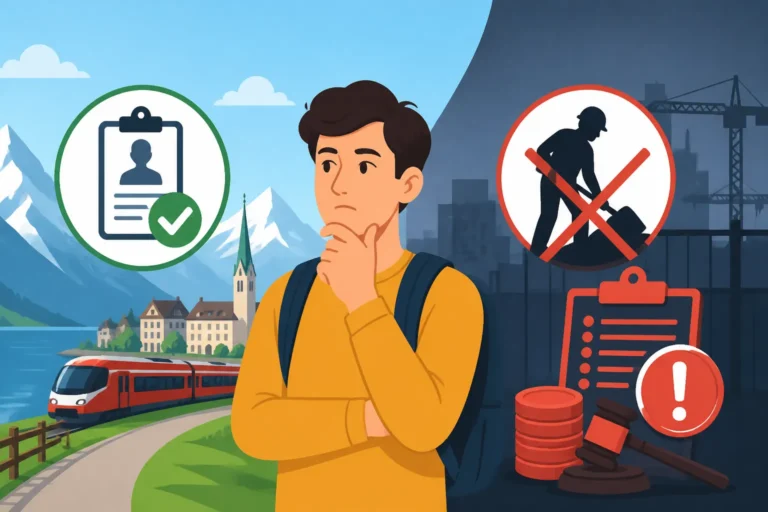
It's a common dream, isn't it? You've landed that fantastic job with a Swiss employer, you're enjoying the Swiss life, but then a thought creeps in: "Could I do this job from somewhere else for a while? Maybe my home country, or a sunnier locale?" While the allure of remote work from abroad is strong, the reality for anyone holding a Swiss residence permit and working for a Swiss company is far more complex than a simple "yes" or "no." This guide will unpack the intricate permit implications, legal pitfalls, and administrative headaches that arise when you try to merge Swiss employment with foreign residency.
The Fundamental Link Between Your Swiss Permit and Physical Presence
Let's cut right to the chase: Switzerland, much like a well-oiled clock, operates on precision, and that includes who lives and works within its borders. Your Swiss residence permit isn't just a piece of plastic or paper; it's a formal declaration that your main home, your centre of vital interests, is here in Switzerland. This isn't just bureaucracy for the sake of it; it's deeply ingrained in their system.
Understanding the Residency Requirement for Swiss Permits
When you apply for and receive a Swiss L, B, or C permit, you are explicitly agreeing to reside in Switzerland. This isn't a suggestion; it's a condition. The cantonal migration offices expect you to live here, to integrate, and to generally base your life within the country. "Residency" in Switzerland means that this is where your home is, where your family typically lives (if applicable), where you conduct your day-to-day life, and where you return after any travels.
Think of it this way: your B permit for Zurich means you're supposed to be living in Zurich, or at least in the canton of Zurich, or within reasonable commuting distance to your workplace in Switzerland. If you're consistently working from, say, Portugal or Thailand for months on end, the authorities would quite reasonably question whether your actual residency still aligns with the conditions of your permit. This could be anything from your address registration, utility bills, or even how long you've been absent from the country. It’s not just about showing up for a few days every six months; it's about making Switzerland your true home.
The Double-Edged Sword of Social Security and Tax Obligations
Beyond the permit itself, there's the whole interconnected web of Swiss social security and tax that gets incredibly messy when you start working for a Swiss company from abroad. Switzerland has a robust The Three-Pillar Pension System: AHV, BVG, and Private Savings which relies on contributions made by residents and workers. If you're suddenly working from another country, which country's social security system should you contribute to?
Typically, social security contributions are due in the country where the work is physically performed. So, if you're living and working remotely from Spain, Spain's social security system would generally be the one requiring contributions, not Switzerland's. This immediately creates a huge problem for your Swiss employer, who is obligated to deduct Swiss social security from your salary. If they do, they might be incorrectly paying into the Swiss system, and you might be missing contributions in your actual country of work. If they don't, they're not compliant with Swiss law. It’s a legal minefield for both parties.
Then there's the equally complex issue of income tax. Your Swiss residence permit usually means you are tax resident in Switzerland, and you pay Swiss Taxes Explained: Federal, Cantonal, and Municipal Rates to the federal government, your canton, and your commune. However, if you spend a significant amount of time – often more than 183 days in a rolling 12-month period – living and working in another country, you risk becoming tax resident in that other country. This can lead to the dreaded double taxation, where both Switzerland and the other country claim a right to tax your income, even with double taxation agreements in place. These agreements are designed to prevent double taxation, but they often don't account for the novelties of long-term remote work from a third country while holding a permit from a different country. It often boils down to where your "center of vital interests" truly lies, and if you're abroad for months, it's not here.
The Tightrope Walk for EU/EFTA vs. Third-Country Nationals
While some might think that EU/EFTA citizens have more leeway due to freedom of movement, when it comes to long-term remote work from outside Switzerland for a Swiss employer, the differences often aren't as vast as one might hope. For Third-Country Nationals (TCNs), the situation is significantly more rigid.
Limited Flexibility for EU/EFTA Citizens
Yes, as an EU/EFTA citizen, you have the right to reside and work in Switzerland more freely than a TCN. You don't face the same strict quotas, and the process to get your The Swiss B Permit: Eligibility, Renewal, and Restrictions is generally straightforward. However, this freedom of movement primarily applies to your right to reside in Switzerland and seek employment there. It doesn't automatically grant you the right to maintain your Swiss residency permit while actually living and working remotely from another EU country for an extended period.
The core principle remains: your permit is tied to your primary residence being in Switzerland. If you're an EU citizen living in, say, France, and working for a Swiss company, that’s usually handled by a The G Permit Cross-Border Commuter: Complete Guide for Frontier Workers. A G permit is specifically designed for people who live in a border region of a neighboring country and commute to Switzerland for work. This is a very different scenario from genuinely working remotely from a non-border region or a completely different country altogether. The expectation for a G permit holder is still physical presence in Switzerland for work, even if it's only for a few days a week. It is not intended for someone who resides in a third country and performs all their work remotely. Bilateral agreements between Switzerland and EU countries do exist, particularly for social security coordination, but they are typically geared towards traditional employment or cross-border commuting, not long-term digital nomad setups where the employee never sets foot in Switzerland.
Near Impossibility for Third-Country Nationals (TCNs)
For those of us from outside the EU/EFTA, the situation is even more precarious. Swiss immigration policy regarding Third-Country National Quotas: How the Swiss Permit Limits Work is already notoriously strict. A TCN work permit is granted only after a rigorous process where the employer often has to prove that no suitable Swiss or EU/EFTA candidate could be found. The very basis of your TCN permit is that your skills and presence are required within Switzerland to contribute to the Swiss economy.
If you, as a TCN, were to decide to work remotely for your Swiss employer from your home country, or any other non-Swiss location, for an extended period, you would be fundamentally undermining the conditions of your permit. Your permit states your address in Switzerland, and it is a residency permit. If your true place of abode and work is elsewhere, the cantonal migration office could easily argue that the conditions for your permit are no longer met. This could lead to a refusal to renew your permit or, in severe cases, even its revocation. There's simply no legal framework or permit category for a TCN to live outside Switzerland while being employed by and holding a permit for a Swiss company, unless it's a very specific intra-company transfer that officially registers you as employed in another country.
The Significant Risks to You and Your Employer
Trying to navigate the grey areas of remote work from abroad for a Swiss employer carries substantial risks, not just for you as the employee, but for the company that employs you.
Immigration and Permit Revocation Consequences
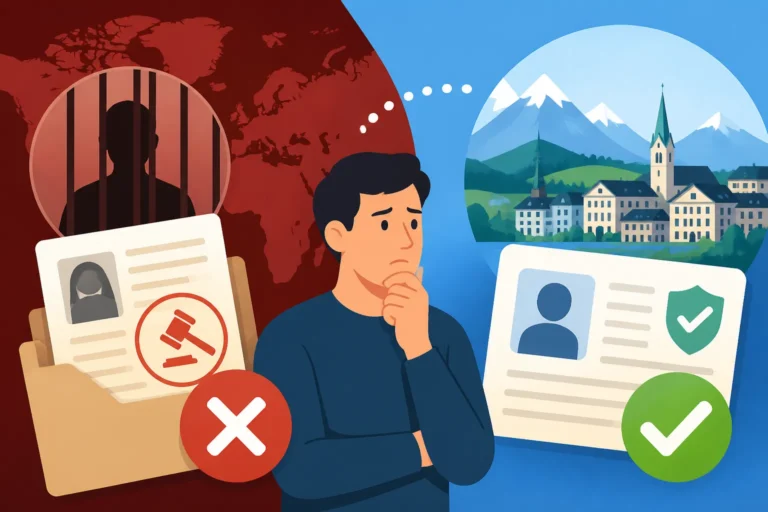
The most immediate and severe risk for you, the expat employee, is the potential for your Swiss residence permit to be revoked or not renewed. Swiss authorities are thorough, and cantonal migration offices do track residency. If they discover you're spending an unusually long time outside the country or that your primary centre of life has shifted abroad, they can initiate a review. While there's no hard-and-fast rule universally applied across all cantons for exactly how many days of absence are too many (some cantons might start asking questions after 3-6 months, others might tolerate longer if you have a valid reason and explicitly informed them), the underlying principle is always about maintaining your primary residence in Switzerland.
Consider this hypothetical: you're working remotely from your family's home in Canada for eight months, but still technically hold your B permit for Basel. When it comes time for Renewing Your Swiss Residence Permit: The Verfallanzeige Form Explained, the migration office might notice your prolonged absence or question your actual residency. If they decide you no longer fulfill the conditions, your permit could simply not be renewed. This would mean you lose your legal right to reside in Switzerland and, by extension, to work for a Swiss company. It's a risk that could completely upend your life and career plans.
Employer's Compliance Nightmare and Potential Legal Woes
From your employer's perspective, this arrangement is an absolute administrative and legal headache. A Swiss company employing someone who works permanently from another country risks creating a "Permanent Establishment" (PE) in that foreign country. This means the Swiss company could become liable for corporate taxes, social security contributions, and compliance with local labor laws in the country where you are physically working. Imagine a small Swiss tech startup suddenly having to understand and comply with Brazilian or Indian labor law, set up local tax registrations, and remit social security payments in a foreign currency. It's an enormous burden and a massive compliance risk.
Most Swiss companies, especially those without established international branches or a dedicated HR/legal team for global employment, will simply not entertain this idea. The administrative complexities, the potential for fines, and the sheer unknown of foreign legal requirements are too great. They will almost certainly insist that you work from Switzerland, or, if a remote arrangement is absolutely necessary and long-term, they would require you to be employed by a local entity in that foreign country, which essentially means you're no longer directly employed by the Swiss company for that role. This is why many Swiss Work Contracts and Labor Law: Notice Periods, Leave, and Rights will explicitly state the place of work as Switzerland.
The Financial and Personal Impact on You
Beyond the permit and employer risks, there are significant personal and financial impacts. As mentioned, you could face confusing social security gaps, meaning your pension contributions might not be properly recognized in either country, leaving you short-changed in retirement or during periods of unemployment or illness. There’s also the very real possibility of tax disputes, where you end up paying tax in two countries, or having to fight to avoid it.
Should your remote work arrangement from abroad be discovered and your permit revoked, you could face the sudden loss of your job and your right to live in Switzerland. This kind of disruption is not only financially devastating but emotionally taxing. If you've accumulated belongings in Switzerland and suddenly need to relocate, companies like Sirelo specialize in international moving services, which is great for a planned departure, but less so for a forced, unexpected one due to permit issues. While having a good international health insurance plan like Cigna Global is always wise for expats and travelers, it's crucial to understand that such insurance covers your health needs, not your legal right to residency or employment in Switzerland. It won't solve your permit problem if the authorities decide you're not a resident.
When is it (Potentially) Okay, and What Are the Alternatives?
So, is there any scenario where working remotely for a Swiss employer from abroad is permissible? And if not, what are the legitimate alternatives?
Short-Term Exceptions and the Grey Zone
Let's be realistic: working remotely for a few days, or even a couple of weeks, while on vacation or visiting family abroad is generally not going to trigger a permit crisis. Most Swiss employers and authorities are understanding of occasional, temporary remote work that doesn't fundamentally shift your primary residence. For example, if you spend a week working from a cabin in the Italian Alps or from your parents' home in Germany, but your Swiss apartment, bills, and core life remain in Switzerland, you are still considered a Swiss resident working for your Swiss employer.
The "grey zone" begins when this temporary arrangement extends into weeks and months, becoming habitual, or if your intention is to truly relocate your work and life abroad while holding onto your Swiss permit. This is where the red flags go up. Switzerland doesn't have a "digital nomad visa" (nor do many other countries) that allows you to simultaneously maintain a Swiss work permit and legally live and work elsewhere for a Swiss employer long-term. Be wary of advice that suggests otherwise – the legal frameworks simply aren't designed for it.
The Legitimate "Remote" Alternative: Cross-Border Commuting
If your goal is to work for a Swiss employer but reside outside of Switzerland, the only official, legally sanctioned route is to become a cross-border commuter. This means living in a country that shares a direct border with Switzerland – France, Germany, Italy, or Austria – and physically commuting to your workplace in Switzerland. For this, you would apply for a Cross-Border Commuting: Working in Switzerland with a G Permit.
Crucially, a G permit is not a "remote work from abroad" permit. It's specifically for those who physically cross the border to work. While some G permit holders might have flexible arrangements to work from home in their border country a few days a week, the underlying requirement is still the ability and expectation to commute regularly to the Swiss workplace. It’s a solution for proximity, not for working indefinitely from a distant, non-border country.
Discussing Options with Your Employer (and Cautionary Tales)
If you're seriously considering a long-term remote work arrangement from abroad, your first and most important step is to have a frank conversation with your employer. However, be prepared for them to likely refuse the request. As discussed, the compliance risks for them are significant, and few Swiss companies are equipped or willing to handle the tax, social security, and labor law complexities of employing someone who lives and works in another country.
If, by some rare chance, your employer does agree, it would almost certainly involve a restructuring of your employment. This could mean they would need to establish a legal entity in your country of residence (if they haven't already), or contract with a Professional Employer Organization (PEO) or Employer of Record (EOR) service that can legally employ you in that foreign country on their behalf. In this scenario, you would effectively cease to be directly employed under a Swiss contract and would instead be employed under the laws of your country of residence. This would mean your Swiss residence permit would no longer be valid, and you would need to inform the Swiss authorities of your departure and de-registration. This effectively means you're no longer an expat living in Switzerland, but rather someone living abroad, working for a company that happens to be Swiss. It's a fundamental change, not a workaround to keep your Swiss permit while living elsewhere.
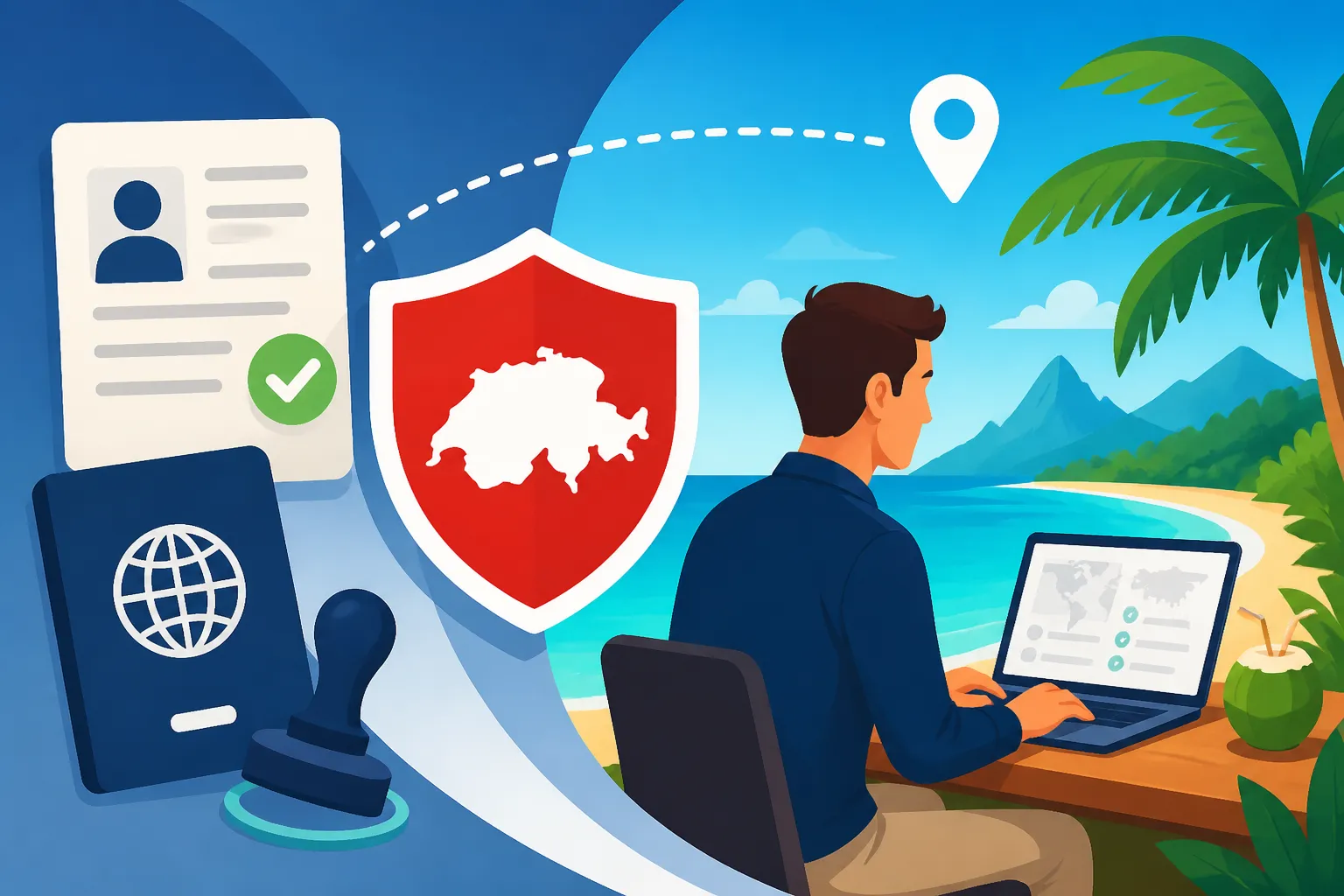
Ultimately, while the idea of working for a Swiss employer from a beach in Bali or a city in Canada sounds idyllic, the Swiss legal and immigration framework is not set up to accommodate it. It's designed for residents to reside and contribute from within the country. Any deviation from this carries substantial risks that are rarely worth taking.
Disclaimer
The information provided in this guide is for general informational purposes only and does not constitute legal, tax, or immigration advice. While we strive to provide accurate and up-to-date information, laws and regulations in Switzerland are subject to change and can vary significantly by canton. We strongly advise consulting with qualified legal, tax, or immigration professionals for advice tailored to your specific situation before making any decisions related to your residency or employment in Switzerland.