Dental Costs in Switzerland vs. Border Countries: A Price Comparison
Finding out that a routine check-up and two small fillings will cost you nearly CHF 1,000 is a jarring introduction to Swiss life. I remember sitting in a dentist's chair in Zurich, staring at a quote for a single crown that cost more than my first car. This guide breaks down the massive price gap between Swiss dental care and its neighbors to help you save your hard-earned francs.
The Reality of Dental Care in Switzerland
When you first move to Switzerland, one of the biggest shocks—aside from the price of a coffee—is realizing that your mandatory health insurance doesn't cover your teeth. In most countries with universal healthcare, there is at least a baseline of dental support. In Switzerland, the system treats your teeth as "luxury bones." Unless your dental issues are the direct result of a serious, non-avoidable illness or a significant accident, you are entirely on your own for the bill.
The financial burden can be heavy, especially for families. I have seen expats delay necessary treatments for years, only to face even more expensive emergency surgeries later. It is vital to understand that Dental Care in Switzerland: Costs, Insurance Reality, and Alternative Options is a topic that requires its own line item in your monthly budget. You cannot rely on the basic KVG/LAMal system for your annual scaling or cavity fillings.
The Swiss Dental Tariff System (Taxpunktwert)
In Switzerland, dental costs are not arbitrary, but they aren't exactly "fixed" either. They are calculated using a system called the Dentotar tariff. Every dental procedure is assigned a certain number of points. The final price you pay depends on the "tax point value" (Taxpunktwert) that the individual dentist chooses to charge.
The federal government sets a range, but dentists in high-rent areas like Zurich or Geneva often charge at the upper end of that range. For example, a dentist in a rural part of Canton Glarus might have a tax point value of CHF 1.00, while a luxury clinic in Zurich’s Enge district might charge CHF 1.20 or higher for the exact same procedure. When you receive an estimate, always look for this value. It is the single biggest lever in determining your final bill.
Why Basic Insurance Won't Save You
It is a common misconception among newcomers that their high monthly premiums will eventually kick in. As you navigate Understanding KVG/LAMal: Mandatory Basic Health Insurance Explained, you will quickly learn that dental care is the glaring exception. The basic insurance only covers dental treatment if it is caused by a "severe, unavoidable disease of the masticatory system" or if it is required as part of a major surgical procedure for a different illness.
For everything else—crowns, bridges, braces, and even the most painful root canals—the costs fall squarely within your The Swiss Franchise System: How Deductibles and Copays Work limits, or more accurately, they don't even count toward your deductible because they aren't covered services. This is why many expats look into private solutions like Cigna Global to bridge the gap that local insurers leave wide open.
Crossing the Border: Where to Go for the Best Deals
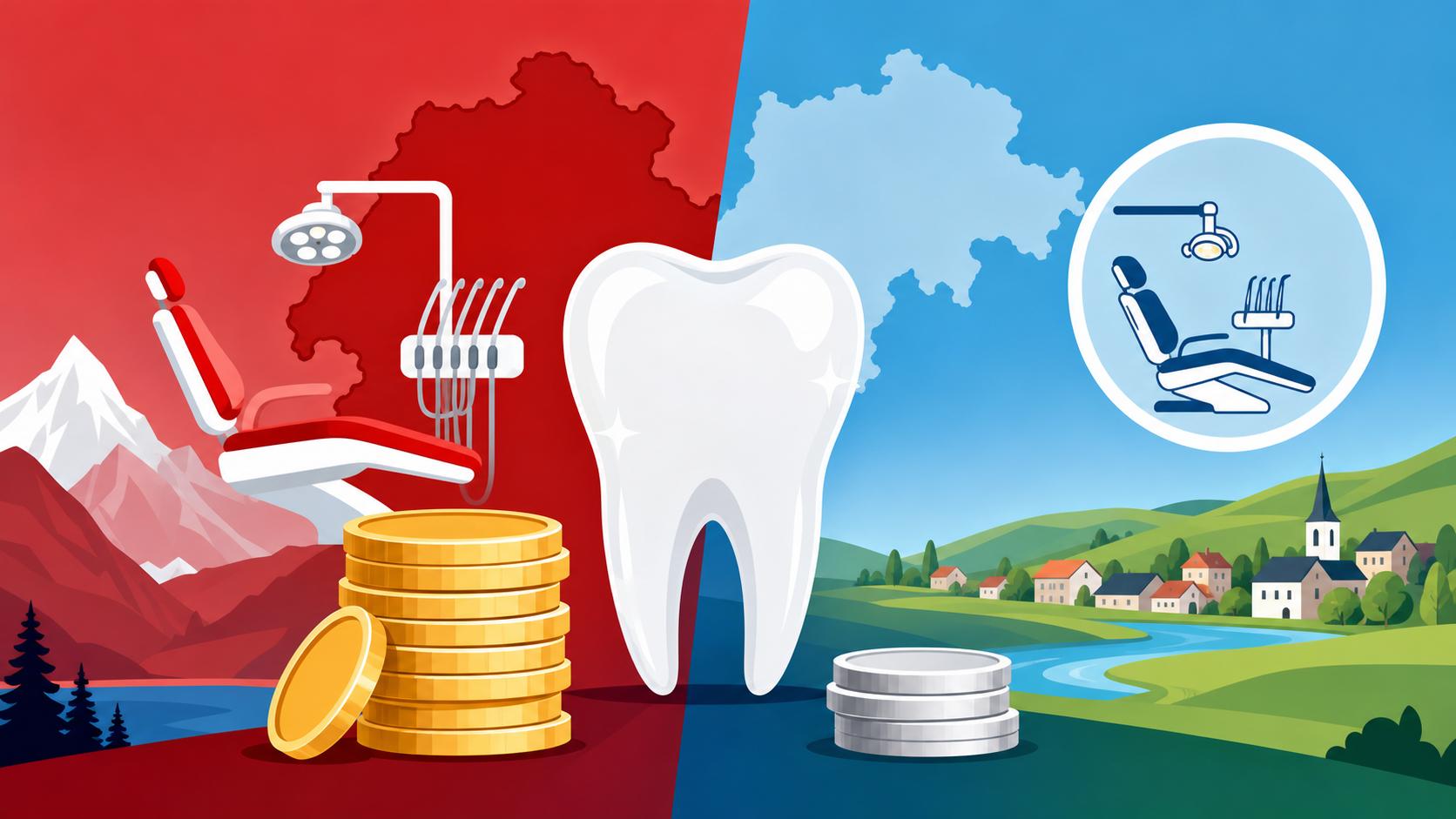
The "dental run" is a well-established tradition for Swiss residents. On any given Saturday, the trains from Zurich to Konstanz or from Geneva to Annemasse are filled with people heading across the border to save 50% to 70% on their dental work. The quality of care in Germany, France, and Italy is generally excellent, and the price difference is purely a reflection of lower labor costs, cheaper rent, and different national tariff systems.
If you are planning a major procedure like an implant or multiple veneers, the savings can easily reach into the thousands. Even after accounting for the price of a train ticket or petrol, the math almost always favors the border countries.
Germany: The Favorite of Zurich and Basel Expats
For those living in Northern Switzerland, Germany is the gold standard for dental tourism. Cities like Konstanz, Waldshut, and Rheinfelden are packed with dental clinics that cater specifically to Swiss clients. Many of these clinics even offer to handle the VAT (Value Added Tax) refund paperwork for you, which adds an extra 19% savings on top of the already lower prices.
German dentists are highly regulated and use the same high-tech equipment you find in Switzerland. The main difference is the "BEMA" or "GOZ" pricing scales used in Germany, which are significantly lower than the Swiss Dentotar. When I had to get a wisdom tooth removed, the quote in Zurich was CHF 800 per tooth. In Konstanz, the total for two teeth, including the consultation and X-rays, was under EUR 400.
France: A Strategic Choice for Romandie
Residents of Geneva, Lausanne, and Neuchâtel often look to France. Towns like Annemasse, Ferney-Voltaire, and even Lyon (for more complex work) offer a reprieve from Swiss prices. While French dental tariffs have seen some increases recently, they remain a fraction of what you would pay at a private clinic in Geneva.
In France, the "Conventionné" system means that prices for basic procedures are quite controlled. If you go to a dentist who is "Secteur 1," their prices for fillings and extractions are fixed by the state. Even for "Secteur 2" dentists who can set their own fees, the competition is fierce, keeping prices much lower than in the Lake Geneva region. For those in Vaud, it is worth checking the Vaud Expat Healthcare Guide: CHUV and Riviera Medical Centers to see if local university clinics offer lower rates before making the trek to France, though the border is usually still cheaper.
Italy and Hungary: High Savings for Complex Work
If you live in Ticino, Italy is the obvious choice. Cities like Como and Varese are hotspots for high-quality dental work at Italian prices. For those living further north who need extensive reconstructive work, such as a full set of implants or complex orthodontic work, Hungary is often cited as the ultimate destination.
While Hungary isn't a "border country" in the literal sense, the price of a flight to Budapest and a week in a hotel is often still cheaper than a single weekend of dental surgery in Switzerland. Many Hungarian clinics specialize in "dental holidays," providing airport transfers and English-speaking staff who are used to working with international patients.
| Procedure Type | Average Cost Switzerland (CHF) | Average Cost Germany (EUR) | Average Cost Hungary (EUR) |
|---|---|---|---|
| Professional Cleaning | 160 – 250 | 80 – 120 | 40 – 60 |
| Composite Filling | 250 – 450 | 80 – 150 | 50 – 90 |
| Root Canal (Single) | 800 – 1,200 | 300 – 600 | 150 – 250 |
| Ceramic Crown | 1,500 – 2,500 | 600 – 900 | 350 – 500 |
| Dental Implant | 3,500 – 5,500 | 1,800 – 2,500 | 900 – 1,300 |
The Hidden Risks and Costs of Dental Tourism
While the price tag across the border is enticing, it is not without its complications. As a veteran expat, I’ve seen people save CHF 2,000 only to spend CHF 3,000 fixing a mistake made abroad. You must weigh the financial gains against the logistical and medical risks.
The biggest hurdle is often the lack of continuity. If you have an emergency on a Tuesday night, you can’t easily pop over to Budapest. Even a drive to Germany can be a massive headache if you are in significant pain.
Warranty and Aftercare Complications
One major issue with getting work done outside of Switzerland is the warranty. If a crown fitted in Germany falls out three months later, the German dentist will likely fix it for free—but you have to go back to Germany to get it done. A Swiss dentist will likely refuse to touch the work of a foreign colleague unless it is an emergency, and they certainly won't do it under warranty.
Furthermore, some Swiss dentists can be quite "particular" about foreign dental work. I’ve heard of patients being lectured or even refused non-emergency care because their implants were a brand not commonly used in the Swiss system. Before you commit to a major procedure abroad, ask the dentist exactly which brands of implants or materials they use and ensure they are compatible with what is standard in Switzerland.
Travel Time and Opportunity Cost
Don't forget to value your time. If you live in Zurich, a trip to Konstanz is about an hour each way by train or car. For a single filling, the three hours of travel plus the cost of the ticket might not be worth the CHF 100 you save. However, if you are bringing the whole family for their annual Pediatric Care: Checkups, Vaccination Schedules, and School Health dental visits, the savings multiply.
I usually recommend making a day of it. Go for the dental appointment, do your grocery shopping (keeping in mind the meat and dairy import limits!), and have lunch. If you treat it as a chore, the stress of the border crossing and the traffic can quickly sap the joy out of those savings.
Navigating Insurance and Reimbursements
If you decide to stay in Switzerland for your dental care, you need to be very strategic about insurance. Since the mandatory system is useless here, you have two main paths: supplementary insurance (VVG) or international expat insurance.
Getting supplementary insurance is not as simple as signing a form. Most Swiss insurers require a dental exam before they will accept you for a dental rider. If you already have "bad" teeth or ongoing issues, they will likely exclude those conditions or reject your application entirely. This is why it is crucial to look into Supplementary Health Insurance (VVG): What It Covers and When to Buy It as soon as you arrive in the country, while your records are still clean.
Private International Insurance Options
For many expats, especially those who travel frequently or aren't sure how long they will stay in Switzerland, a provider like Cigna Global can be a lifesaver. These international plans often include dental modules that are much more generous than local Swiss supplementary plans.
The advantage of an international plan is that it often covers you regardless of which country you choose for your treatment. If you want to get your check-ups in Zurich but prefer to go back to your home country for major surgery, an international policy usually facilitates that. This flexibility is something local Swiss insurers rarely offer.
Challenging a Swiss Dental Bill
If you receive a bill that seems outrageously high—even by Swiss standards—you do have rights. Every bill should be broken down by the Dentotar points mentioned earlier. If the points don't match the work performed, or if the tax point value was not disclosed to you beforehand, you can contest it.
I always recommend asking for a detailed "Kostenvoranschlag" (cost estimate) before any work begins. If the final bill is more than 10-15% higher than the estimate without a valid medical reason explained during the procedure, you should contact the Swiss Dental Association (SSO). They have ombudsmen who handle disputes between patients and dentists. Understanding How to Read a Swiss Medical Bill (Rückforderungsbeleg) and Claim Refunds is a skill that will save you more than just money; it will save you a lot of stress.
Proactive Maintenance: Reducing Long-Term Costs
The cheapest dental bill is the one you never receive. In Switzerland, preventative care is the only real way to keep your costs down over a decade. While a cleaning might cost CHF 200, it is much cheaper than the CHF 2,000 root canal that results from a neglected cavity.
Most Swiss residents visit a dental hygienist (Dentalhygieniker) once or twice a year. This is a separate profession from the dentist and is often slightly cheaper. They focus purely on cleaning and early detection. If they find a small issue, they will bring the dentist in for a quick look, which is far more cost-effective than waiting until you are in pain.
Investing in High-Quality Oral Care
Since you are footing the bill for every cavity, it makes sense to invest in the best possible tools at home. In Switzerland, pharmacies and supermarkets like Coop or Migros charge a premium for high-end oral care products. I’ve found that ordering electric toothbrush heads, specific high-fluoride toothpastes, and water flossers from sites like iHerb can save a significant amount over the year.
When you are browsing for supplies, look for products that contain NovaMin or high concentrations of hydroxyapatite, which can help remineralize enamel. In a country where a single filling costs as much as a fancy dinner for two, a CHF 50 investment in a better toothbrush is the best ROI you will ever get.
Finding an English-Speaking Dentist
Communication is key when discussing expensive medical procedures. If you don't speak the local language, the stress of a dental visit is doubled. Fortunately, most dentists in major Swiss cities speak excellent English, as much of their training involves English-language medical literature.
Whether you are Finding an English-Speaking Family Doctor (Hausarzt) in Major Cantons or a specialized orthodontist, don't be afraid to ask about their language proficiency over the phone. Most clinics will be very upfront about which staff members can accommodate English speakers. In my experience, being able to discuss the nuances of a "Taxpunktwert" in your native language makes the pill much easier to swallow.
Important Disclaimer
The information provided in this article is for educational and informational purposes only and does not constitute medical, legal, or financial advice. Dental prices, insurance regulations, and customs laws in Switzerland and its neighboring countries are subject to change. Always consult with a qualified dental professional and your insurance provider before making decisions regarding your healthcare. The author and publisher are not responsible for any actions taken based on the content of this guide.