Failing the Control Drive (Kontrollfahrt): Losing Your License in Switzerland
Imagine the sinking feeling of being told you can no longer drive to your own office because of a 45-minute evaluation. When I first navigated the maze of Swiss bureaucracy, I underestimated how strictly the authorities treat the driving conversion process. This guide explains exactly what happens if you fail the Kontrollfahrt and how to rebuild your mobility from scratch.
The High Stakes of the Swiss Kontrollfahrt
The Swiss road system is governed by a principle of "one shot." For many expats arriving from non-EU/EFTA countries, the law allows you to drive on your foreign license for exactly 12 months. However, before that year is up, you must apply to exchange your document for a Swiss Fahrausweis. For a significant number of nationalities, this exchange isn't automatic; it requires a "control drive" or Kontrollfahrt.
The psychological trap many of us fall into is thinking that ten or twenty years of driving experience in our home country makes this a formality. I have seen seasoned drivers fail within the first five minutes because they didn't realize the examiner was looking for specific, almost theatrical, safety checks. The most important thing to understand is that the Kontrollfahrt is not a driving lesson. It is a one-time test of your ability to adhere to Swiss road laws. If you fail, your right to drive in Switzerland on your foreign license is revoked immediately and permanently. You cannot "retake" the Kontrollfahrt. There are no second chances for this specific simplified process.
When you are Converting Your Foreign Driver's License to a Swiss Fahrausweis, you are essentially asking the state to trust your previous experience. A failure tells the state that your experience is insufficient or incompatible with local safety standards. From the moment the examiner ticks the "fail" box, you are legally barred from getting behind the wheel. This can be devastating if you have already committed to Buying a Car in Switzerland: Leasing vs Financing Financial Comparison or if you live in a remote area where public transport is less frequent.
Immediate Consequences of a Failed Control Drive
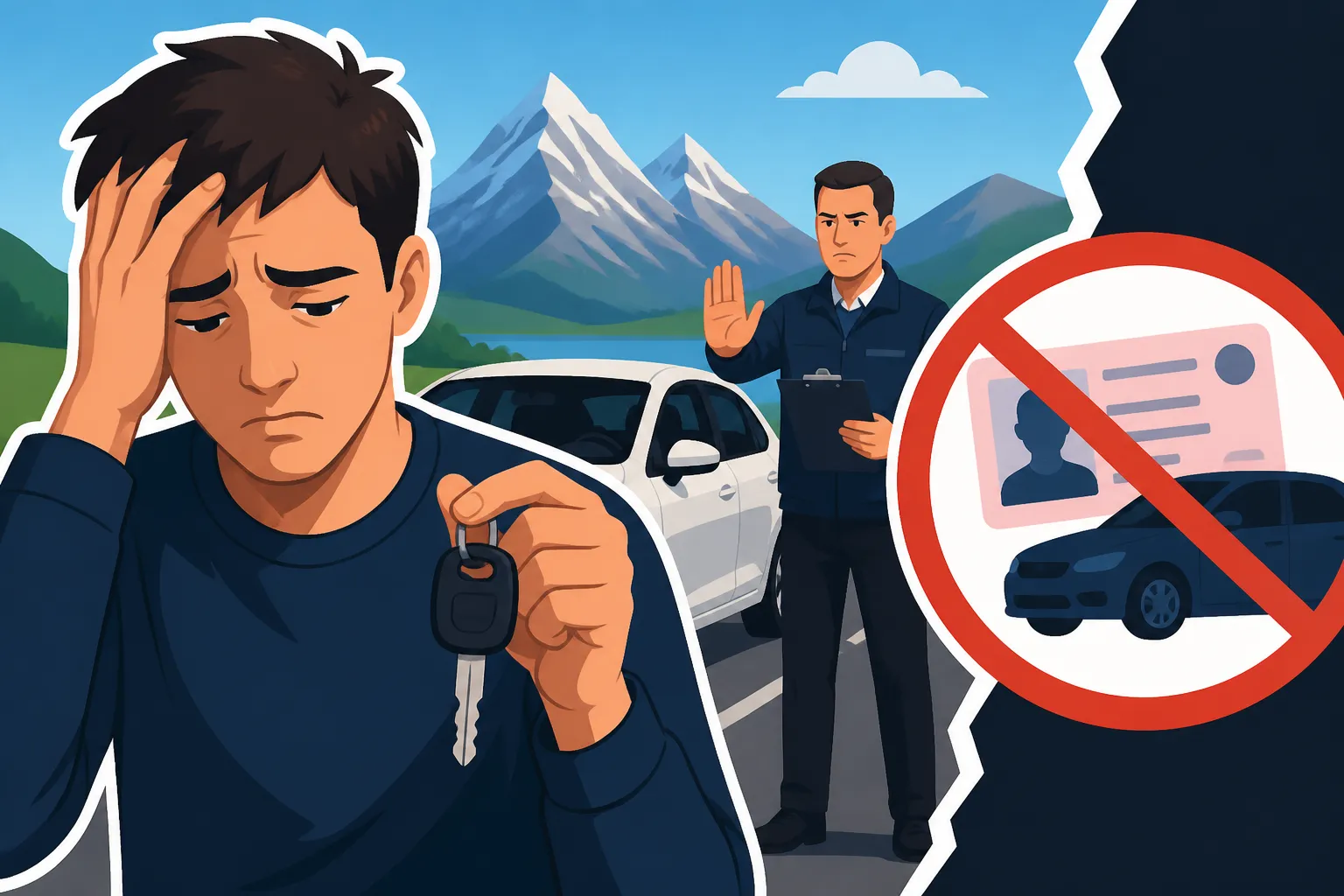
The moment the examiner concludes the test and informs you of the failure, the administrative gears begin to turn. You will not be allowed to drive the car home from the testing center. If you drove there alone, you would need to call a friend or a towing service, or leave the car and take the train. The Strassenverkehrsamt (Road Traffic Office) will officially invalidate your foreign license for use within Swiss borders.
This creates a massive logistical headache. If you used HousingAnywhere to find an apartment in a suburban "commuter" zone, thinking you could easily drive into the city, your daily routine will vanish overnight. You must then pivot to the Swiss rail network. Fortunately, the system is world-class, and you should immediately look into The Half-Fare Travelcard (Halbtax): The Must-Have Pass for Swiss Residents to mitigate the costs of your new train-reliant lifestyle.
Beyond the loss of mobility, there is the financial hit. A failed Kontrollfahrt means you have to enter the "standard" path to a Swiss driver's license, which is one of the most expensive and rigorous in the world. You are looking at a multi-step process that can easily cost between CHF 3,000 and CHF 5,000 when all is said and done. This is a significant addition to the already high Cost of Living in Switzerland 2026: Budgeting for Singles and Families.
| Step in the Process | Estimated Cost (CHF) | Requirement |
|---|---|---|
| Emergency First Aid (Nothelferkurs) | 100 – 150 | 10-hour mandatory course |
| Theory Exam Fee | 30 – 50 | Computerized test (available in English) |
| Traffic Awareness (VKU) | 200 – 250 | 8-hour mandatory classroom theory |
| Driving Lessons (Optional but recommended) | 90 – 120 per hour | Most need 10-20 hours |
| Practical Driving Test | 130 – 150 | Final 60-minute exam |
| Physical License Issuance | 50 – 100 | Administrative fee |
The Roadmap to Recovery: Starting from Scratch
If you have failed and still need to drive, you must begin the process as if you were an 18-year-old local. The first step is the Nothelferkurs, an emergency first aid course. Even if you were a doctor in your home country, you usually still need the specific Swiss certification unless you can provide very specific equivalency documents that are rarely accepted.
Once the first aid is cleared, you apply for a learner’s permit. Yes, even as an adult who has driven for decades, you will be issued a "L" plate. This permit allows you to drive only when accompanied by someone over the age of 23 who has held a Swiss license for at least three years. This is a humbling experience for most expats. During this time, you should ensure you have the right Mandatory and Optional Insurance: Liability, Legal, and Household because any accident while on a learner's permit can lead to severe legal complications and potentially reset your waiting period for a full license.
Next comes the theory exam and the Verkehrskunde (VKU). The VKU is a series of lessons focused on "traffic sense"—predicting the behavior of other drivers, understanding how weather affects the road, and the physics of driving. While it may feel redundant, it is a legal requirement. Only after completing these can you apply for the practical test. Because the pressure is so high, I highly recommend hiring a local instructor for at least five sessions to point out your "bad habits" from home that don't fly in Switzerland, such as one-handed steering or failing to look over your shoulder during every single turn.
Avoiding Common Pitfalls and Living Without a Car
Why do most expats fail the Kontrollfahrt? It is rarely about car control; it is about the "Swiss way" of driving. The most common "killer" is the "Rechtsvortritt" (Priority to the Right). In many countries, the main road always has priority. In Swiss residential zones (30km/h or 50km/h areas without specific signage), the person coming from the right always has priority. If you sail past a small side street on your right without clearly slowing down and looking, you fail instantly.
Another common failure point is the treatment of pedestrians. If a pedestrian even looks like they might want to cross at a yellow zebra marking, you must stop. Not slow down—stop. Failing to do this is seen as a major safety violation. While you are re-learning these rules, you might find that you don't actually need a car as much as you thought. Many expats decide to skip the hassle and expense of the full license and instead invest in SBB Travelcards: Is the Generalabonnement (GA) Worth the CHF 4000+ Cost?, which allows for unlimited travel on all public transport.
If you still need a car for the occasional IKEA trip or a mountain hike, look into Car Sharing in Switzerland: How Mobility Works Without Owning a Car. Companies like Mobility have thousands of cars parked at train stations. It is a fantastic bridge while you are waiting to clear your practical exam.
Administrative Realities and Moving Forward
When you are Registering Your Address at the Kreisbüro Within 14 Days of Moving, you might be told about the 12-month limit in a very casual way. Don't let that fool you. The clock starts the day you arrive, not the day you get your B-permit. If you wait until month 11 to book your Kontrollfahrt, you are playing a dangerous game. Testing centers are often backed up for months. If you fail in month 11, you have zero time to adjust.
If your job depends on driving, a failure could technically put your employment at risk. Switzerland has very strict Driving in Switzerland: Licenses, Buying Cars, and Strict Traffic Laws, and they do not make exceptions for "expats who didn't know." Always use a local SIM or an Airalo eSIM to ensure you can use GPS and traffic apps like Waze, which can help alert you to speed cameras (though be aware that radar detectors and some app functions are illegal here). If you need to study for the theory test, you can find English-language prep books and software on Amazon Germany that are specifically designed for the Swiss exam.
The emotional toll of losing your license is real. It feels like a loss of independence. However, view it as a deep dive into Swiss culture. Once you eventually pass that final practical test, you will be a safer driver, fully adjusted to the meticulous and orderly nature of Swiss roads. You will know exactly when to yield, how to navigate a multi-lane roundabout in Lausanne, and why you should never, ever flash your lights at someone on the Autobahn.
Legal Disclaimer
The information provided in this guide is for general informational purposes only and does not constitute legal advice. While every effort has been made to ensure the accuracy of the information, Swiss traffic laws and cantonal regulations are subject to change. Always consult with your local Strassenverkehrsamt or a qualified legal professional regarding your specific situation and license conversion requirements. Driving without a valid permit in Switzerland is a serious offense that can lead to heavy fines, imprisonment, and deportation.