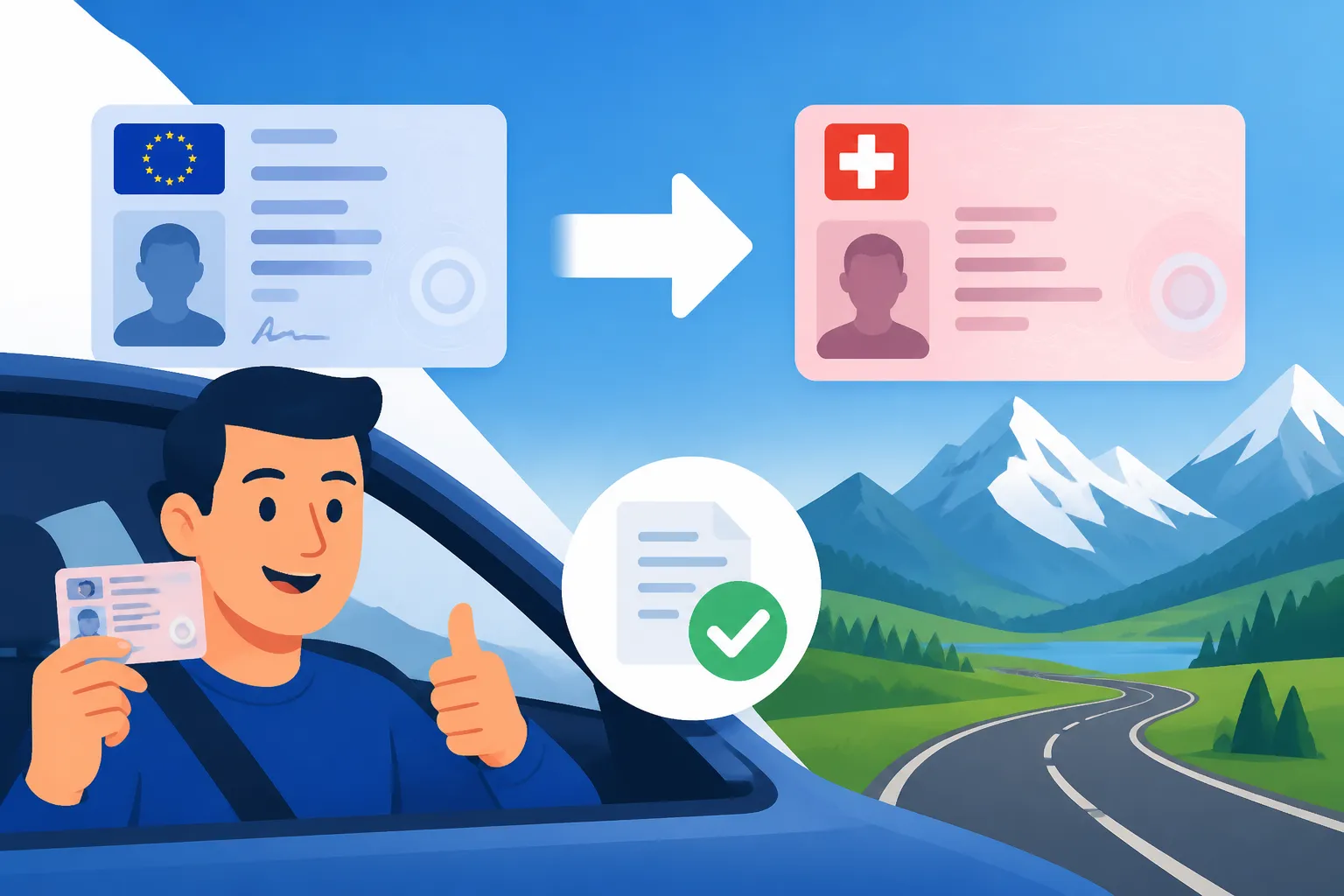
Converting an EU Driver’s License: The Simple Exchange Process
Navigating the Swiss bureaucracy often feels like a series of mountain peaks you weren't prepared to climb. I still recall the mild heart palpitations I had when I realized my valid French license had a ticking clock the moment I registered my address in Zurich. This guide demystifies the conversion process for EU/EFTA license holders, ensuring you stay legal and mobile.
The 12 Month Grace Period and Why It Matters
When you first arrive in Switzerland and settle into your new home, perhaps one you found through HousingAnywhere, your to-do list is likely miles long. Between the health insurance registrations and the search for the perfect local bakery, the driver's license often slips through the cracks. However, Switzerland operates on a strict "12-month rule." From the day you register your residency at the local Gemeinde or Kreisbüro, you have exactly one year to exchange your foreign license for a Swiss one.
During these first twelve months, your EU/EFTA license is perfectly valid for private use. You can drive from Geneva to St. Gallen without a worry. But the moment that clock strikes twelve months and one day, your foreign license is no longer legally recognized for someone resident in Switzerland. If you are caught driving after this deadline, it is treated as driving without a license, which carries heavy fines and can jeopardize your insurance coverage. I’ve seen expats wait until the eleventh month, only to find that an administrative delay left them stranded without a legal way to commute.
The rules are even stricter if you are driving professionally. If you are operating a truck, a passenger bus, or a taxi, you cannot wait for the twelve-year mark. Professional drivers must exchange their licenses immediately upon taking up employment. For the rest of us, the year goes by faster than you think. Understanding Driving in Switzerland: Licenses, Buying Cars, and Strict Traffic Laws is the first step in ensuring you don't fall into the trap of assuming your EU status grants you a permanent exemption from local paperwork.
The Consequences of Procrastination
If you miss the deadline, you won't just face a fine; you might be forced to take the full Swiss driving test, including the theory and the practical exam. For EU citizens, the exchange is usually a purely administrative "paper swap." By missing the window, you effectively volunteer for a high-stress, expensive examination process that you could have avoided with a simple visit to the traffic office.
Furthermore, insurance companies in Switzerland are notoriously detail-oriented. If you are involved in an accident after the 12-month mark and haven't converted your license, they may refuse to pay out, citing that you were not a legally licensed driver at the time of the incident. This is a financial risk no one should take, especially considering how high the costs of vehicle repair and liability can be here.
Exceptions for Short-Term Residents
If you are in Switzerland on an L permit and plan to stay for less than twelve months, you generally do not need to exchange your license. However, if your stay is extended or if you transition to a B permit, the clock starts from your original entry date. Always keep your original entry documents handy, as the Strassenverkehrsamt (Road Traffic Office) will check your residency history thoroughly.
Step by Step Guide to the Exchange Process
The Swiss call the exchange process Umschreibung eines ausländischen Führerausweises. While it sounds daunting, for EU and EFTA nationals, it is remarkably straightforward compared to the hurdles faced by third-country residents. You won't need to retake a driving test or sit through a theory class, provided your license is still valid.
The first thing you need to do is locate your cantonal Road Traffic Office. In Zurich, it’s the Strassenverkehrsamt; in Geneva, the Office cantonal du véhicule. Each canton has its own slightly different form, but the requirements are largely standardized. I remember using Airalo for an eSIM just to keep my GPS running while I searched for the traffic office in a new city, as these buildings are often tucked away in industrial zones or on the outskirts of town.
Step 1: The Mandatory Eye Test
Before you even download the application form, you must visit a certified Swiss optician for an eye test (Augentest). You cannot use a test from your home country, and it must be recent (usually within the last 24 months). Just walk into any local optician, tell them you need an eye test for your driver's license, and bring your ID.
The optician will fill out a specific section of your application form and stamp it. This usually costs between CHF 10 and CHF 20. It’s a quick process, but it’s a non-negotiable first step. If you wear glasses or contacts, make sure the optician notes this, as it will be coded onto your new Swiss license. Failing to wear your corrective lenses while driving is another way to incur heavy fines under Speeding Tickets in Switzerland: Income-Based Fines and Strict Radars and general traffic enforcement.
Step 2: Gathering Your Documentation
Once your eyes are checked, you need to compile your dossier. Swiss authorities love a complete folder. You will typically need:
- The completed application form (found on your canton’s website).
- Your original EU/EFTA driver’s license.
- Your Swiss residence permit (B, C, or L permit).
- A recent passport-sized color photo (high quality, no filters).
- Your proof of residency/registration (from the Gemeinde).
If your EU license is in a language other than German, French, Italian, or English, you might be asked for a certified translation, though this is rare for standard EU formats. It’s always best to check your specific canton’s requirements. Having all these documents ready will save you a second trip to the office—a lesson I learned the hard way after forgetting my physical residence permit card.
Step 3: Submission and Identification
For your first Swiss license, you must appear in person at the Road Traffic Office or, in some cantons, at your local town hall (Einwohnerkontrolle). They need to verify your identity against your residence permit. They will take your original foreign license from you at the counter.
Don't panic—you aren't left unable to drive. They will usually provide you with a temporary permit or a stamped copy of your application that allows you to drive within Switzerland while your new card is being printed. However, be aware that this temporary document is typically not valid for driving outside of Switzerland. If you have a cross-border trip planned for the following weekend, you might want to time your application carefully.
| Requirement | EU/EFTA Citizens | Third-Country Nationals |
|---|---|---|
| Eye Test | Mandatory | Mandatory |
| Theory Test | Not Required | Usually Not Required |
| Practical Test | Not Required | Mandatory (Control Drive) |
| Deadline | 12 Months | 12 Months |
| Fee | CHF 80 – 150 | CHF 150 – 300+ |
Costs, Categories, and Logistics
The cost of converting your license varies significantly depending on which canton you call home. Generally, you should budget between CHF 80 and CHF 150 for the administrative fee and the production of the card. This doesn't include the cost of the eye test or the passport photo. While it feels like just another "Swiss tax," remember that the Swiss license is valid for life (for category B) and doesn't require the periodic renewals common in many EU countries.
When your new license arrives in the mail—usually within 5 to 10 working days—you’ll notice it’s a credit-card-sized plastic permit. It’s highly durable and serves as an official ID within Switzerland. If you are planning to buy your first Swiss vehicle soon, check out the details on Buying a Car: Leasing, Autoscout24, and Mandatory Auto Insurance to ensure you're covered from the moment you drive off the lot.
Understanding License Categories
The Swiss system follows the standard EU categories (A, B, C, D, etc.). If you have a standard car license (Category B), the exchange is a 1:1 swap. However, if you have motorcycle categories (Category A), pay close attention. Switzerland has specific rules about engine power and age limits.
Sometimes, an older EU license might have categories that don't perfectly align with modern Swiss regulations. The authorities will do their best to match them, but you should verify the categories on your new Swiss card as soon as it arrives. If a category is missing, you have a limited window to contest it. This is particularly important for those who enjoy the alpine roads on two wheels; verify your motorcycle status before you head into the mountains.
What Happens to Your Old License?
This is the part that surprises many expats: Switzerland is required to send your original foreign license back to the issuing authority in your home country. You cannot keep both. The Swiss authorities will inform your home country that you now hold a Swiss license.
If you move back to the EU in the future, you simply reverse the process. You trade your Swiss license for a local one in your new country. It’s a seamless loop designed to prevent people from holding multiple licenses, which could be used to circumvent penalty points or disqualifications. If you find yourself needing car accessories for your new Swiss life, you can easily find these on Amazon Germany, which usually offers faster shipping for car gadgets than local stores.
Common Pitfalls and Expat Pro-Tips
Even the "simple" exchange process has its quirks. One of the most common issues arises with the date of issue. The Swiss authorities look at when you first obtained your license, not when the current card was printed. If your EU card was recently renewed and doesn't show the original start date of your driving privilege, you might need to provide a "driver record" or a "certificate of authenticity" from your home country's licensing department.
Another point of confusion is the "Probationary License" (Führerausweis auf Probe). If you have held your EU license for less than three years at the time of exchange, Switzerland will issue you a probationary license. This comes with a three-year trial period and requires you to attend two mandatory "WAB" training days (further education courses). If you've been driving for a decade, this won't apply to you, but for young expats or new drivers, it’s a significant extra cost and time commitment.
Driving with the Right Equipment
Once you have your Swiss license, you are officially part of the local driving population, which means you must adhere to all Swiss Everyday Rules: Recycling, Quiet Hours, and Neighborhood Etiquette—yes, even those that apply to when you can wash your car or use a loud garage door.
Furthermore, the transition to Swiss driving involves preparing for the climate. Don't forget to research whether Winter Tires in Switzerland: Are They Legally Mandatory in 2027? applies to your specific canton, as the police carry out frequent checks during the first snowfall. Also, make sure your car is equipped with the latest highway sticker by Buying the 2026 E-Vignette Online via the Official Via Portal before you hit the Autobahn.
Alternatives to Owning a Car
If the administrative burden of license conversion and car maintenance feels too heavy, remember that Switzerland has world-class public transport and sharing economies. You can look into Car Sharing in Switzerland: How Mobility Works Without Owning a Car as a way to maintain your freedom without the overhead of ownership. Many expats find that with a combination of a rail pass and a car-sharing membership, they rarely miss having a private vehicle.
If you are coming from outside the EU and reading this for comparison, the process is much more rigorous, as detailed in our guide on Converting a US Driver's License in Switzerland: Test Flights and Deadlines. For EU/EFTA residents, the process is a gift of simplicity—provided you respect the twelve-month clock.
Disclaimer
This guide is for informational purposes only and does not constitute legal advice. While every effort has been made to ensure the accuracy of the information provided, Swiss cantonal regulations and federal laws are subject to change. Always verify the latest requirements with your local Strassenverkehrsamt or official government sources before proceeding with your application.