eSIM Options for Newcomers Before Getting a Swiss Number
You've just landed in Switzerland, perhaps fresh off a plane at Zurich or Geneva, and the first thing you realize after the initial awe of the mountains and efficiency wears off is… you need to connect! Navigating a new country without immediate and reliable internet access on your phone is a unique kind of modern-day panic for any expat. This guide is all about giving you the lowdown on eSIM options, so you can hit the ground running, stay connected, and tackle those initial integration hurdles with confidence.
Why an eSIM is Your Lifeline as a New Arrival in Switzerland
Landing in a new country is exhilarating, but also incredibly daunting. One minute you're marveling at the pristine airport, the next you're thinking, "How do I order a taxi? Where's my accommodation? Can I let my family know I've arrived safely?" All these crucial first steps rely on one thing: a functioning phone. Relying on airport Wi-Fi is a temporary band-aid, and the minute you step outside, you're disconnected. This is where an eSIM becomes not just convenient, but an absolute lifeline.
The Immediate Need for Connectivity
Think about it: from the moment you step off the plane, your smartphone is your primary tool. You need maps to navigate the public transport system – which, by the way, is fantastic but can be complex with its zones and myriad ticket options. You might need to contact your landlord or relocation agent, check emails for work, or even just look up how to say "hello" or "thank you" in the local language. Without instant connectivity, these simple tasks become sources of stress. Imagine trying to coordinate a rental apartment viewing, or worse, an emergency, without being able to make a call or access the internet. It's a logistical nightmare many of us have faced, fumbling with unreliable Wi-Fi hotspots and burning through precious data roaming allowances. Having data from the get-go means you can use apps like SBB Mobile for train times, Google Maps for directions, and WhatsApp to update loved ones without a second thought.
Avoiding Roaming Charges and Physical SIM Hassles
One of the biggest headaches for new arrivals is the dreaded roaming charge. Your home country's mobile plan might offer some international roaming, but it's often astronomically expensive and quickly depletes, leaving you with a hefty bill. Nobody wants that shock right after dropping a small fortune on relocation costs. Before you can even consider getting a proper, long-term Swiss number, you need a stop-gap that's both affordable and reliable. The alternative? Hunting down a physical SIM card the moment you arrive. This often involves finding a specific shop, trying to understand local plans when you don't yet speak the language, and then fiddling with a tiny piece of plastic that might or might not fit your phone. And what if your phone is locked to your previous carrier? The whole process can be a huge time-sink and source of frustration. An eSIM sidesteps all of this, offering a digital solution that you can activate from the comfort of your couch (or airport lounge!).
Understanding eSIM Technology and How It Works in Switzerland
So, what exactly is an eSIM, and why is everyone suddenly talking about it? If you're anything like me, the whole "embedded SIM" concept might have seemed a bit futuristic until you actually needed one. But trust me, once you understand it, you'll wonder how you ever managed without it, especially when navigating a move to a new country like Switzerland.
What Exactly is an eSIM?
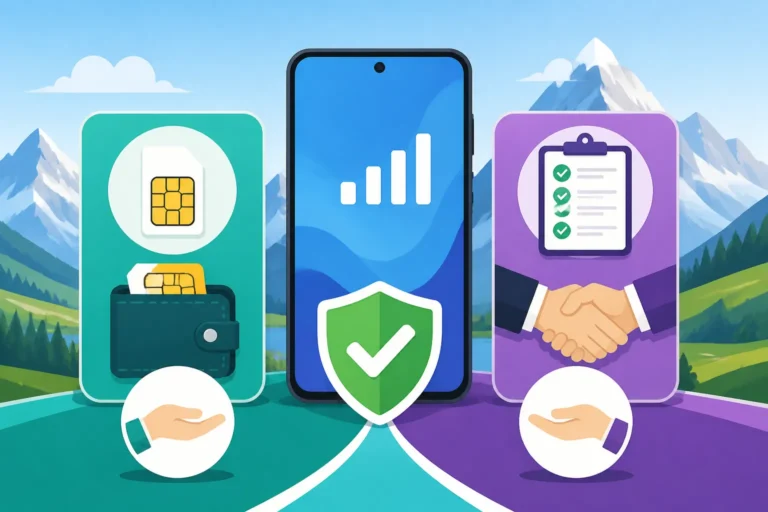
"eSIM" stands for embedded SIM. Unlike a traditional, physical SIM card that you insert into your phone, an eSIM is a small chip built directly into your device's hardware. It functions just like a regular SIM, identifying your phone to a mobile network, but it's entirely digital. This means you don't need to swap out tiny pieces of plastic when you want to change carriers or use a different plan. Instead, you download a 'profile' from a network provider, which contains all the necessary information to connect your phone to their service. It's a game-changer for international travelers and expats because you can have multiple eSIM profiles stored on your phone and switch between them with a few taps. For example, you could keep your home country's number active on your physical SIM for banking two-factor authentication, while simultaneously using a data-only eSIM for Switzerland. This dual-SIM functionality, whether physical SIM + eSIM or dual eSIM, provides incredible flexibility, ensuring you can always be reached on your primary number while enjoying local data rates.
Device Compatibility and Activation
The first step to embracing the eSIM revolution is checking if your phone is compatible. Most modern smartphones, typically those released in the last few years, support eSIM technology. This includes iPhone models XR and later (excluding certain China-specific models), Samsung Galaxy S20 and newer, Google Pixel 3 and newer, and many other flagship devices from brands like Huawei, Motorola, and Oppo. It’s always best to do a quick check on your phone manufacturer's website or in your phone settings (often under 'Mobile Data' or 'SIM Card Manager') to confirm. If your device supports it, activating an eSIM is surprisingly straightforward. You usually purchase a data plan online from a provider like Airalo, receive a QR code via email, scan it with your phone's camera, and follow a few on-screen prompts. That's it! No searching for needle-thin ejector tools, no worrying about losing a tiny plastic card. It's an entirely digital, hassle-free process that means you can literally be connected to a Swiss network within minutes of purchasing a plan, often before you even leave your home country. This pre-arrival connectivity is a massive stress-reducer.
Top eSIM Providers for Swiss Newcomers (and the Brands to Know)
When you first arrive, your primary concern is likely just having any data connection without breaking the bank. There are a few excellent international eSIM providers that cater specifically to this need, offering convenience and cost-effectiveness for those initial weeks or months before you commit to a long-term local plan.
International eSIMs for Initial Setup
For that crucial period right after you land, international eSIM providers are your best friend. They specialize in offering short-term data plans for specific countries or regions. My top recommendation, and one I've personally used countless times for various trips (and my initial move!), is Airalo. They offer a range of data packages for Switzerland specifically. For instance, you can grab 1GB for 7 days, or a larger package like 10GB for 30 days, depending on your needs. The prices are incredibly reasonable, especially when you compare them to the monstrous roaming charges your home provider would slap on you.
How it works with Airalo:
- Download the Airalo app: It's available on iOS and Android.
- Choose Switzerland: Search for "Switzerland" or "Europe" if you plan to travel beyond just Switzerland initially.
- Select a data package: Pick one that suits your estimated data usage and length of stay. For instance, if you're just using it for maps, WhatsApp, and emergency calls, a smaller package might suffice. If you plan to heavily rely on it for video calls home, go bigger.
- Install the eSIM: The app guides you through scanning a QR code or manually entering details. It's genuinely a few taps.
- Activate (usually upon arrival): Most eSIMs activate when they connect to a supported network in the destination country.
Other similar providers include Holafly, which often offers unlimited data plans for a set period, and Nomad, which also provides competitive country-specific data bundles. The beauty of these services is that you can purchase and set up your eSIM before you even leave your home country. Imagine stepping off the plane, turning off flight mode, and boom – you're instantly connected. No stress, no searching for a SIM card stall in an unfamiliar airport. This allows you to immediately access essential information like The 14-Day Registration Rule: Signing Up at the Gemeinde/Commune details, or even look up directions to your temporary accommodation via public transport, which is far superior to driving in most Swiss cities.
Here's a quick comparison of typical offerings for initial data needs:
| Provider | Plan Example (Switzerland) | Price (Approx. CHF) | Validity | Notes |
|---|---|---|---|---|
| Airalo | 1 GB | 5-7 | 7 Days | Best for light, short-term usage. Data-only. |
| Airalo | 10 GB | 20-25 | 30 Days | Good for moderate usage, longer initial stay. |
| Holafly | Unlimited Data | 30-40 | 5 Days | Ideal for heavy users, but check Fair Usage Policy. |
| Holafly | Unlimited Data | 50-60 | 15 Days | Convenience of unlimited, no worry about limits. |
| Nomad | 1 GB | 6-8 | 7 Days | Similar to Airalo, competitive rates. Data-only. |
| Nomad | 5 GB | 18-22 | 30 Days | Good mid-range option. |
Prices are approximate and subject to change by providers.
Transitioning to Local Swiss Providers
While international eSIMs are perfect for the short-term, you'll eventually want a proper Swiss number for integration into local life. This is where the big players come in: Swisscom, Sunrise, and Salt. They all offer robust networks and various plans, including eSIM options for long-term use. For a deeper dive into these, check out our guide on Swiss Mobile Plans: Best Subscriptions and Prepaid eSIMs for Expats.
Once you've settled in and completed your Mandatory Registration: How to Sign Up for Health Insurance Within 90 Days, and perhaps found a long-term rental, you'll be ready to look at these local options. Each provider has different strengths: Swisscom is often considered the most reliable with the widest coverage, especially in remote alpine areas, but it can be pricier. Sunrise offers a good balance of coverage and cost, while Salt often provides very competitive data plans, though its coverage can sometimes be less extensive in rural areas. Many newcomers find themselves exploring these options once they're past the initial "just get me connected!" phase, as having a local number is essential for things like setting up utilities or applying for jobs.
Practical Tips for Using Your eSIM Effectively
Navigating the world of eSIMs, especially when you're already grappling with the complexities of moving country, can feel like another item on an endless to-do list. But with a few practical tips, you can make your eSIM experience smooth and stress-free, ensuring you're always connected without any nasty surprises on your bank statement.
Managing Data Usage and Top-Ups
One of the biggest advantages of a data-only eSIM, especially for your initial days in Switzerland, is that it helps you become acutely aware of your data consumption. Unlike your home unlimited plan where you might stream videos constantly, with a limited eSIM, you'll be more mindful. Use Wi-Fi whenever possible – at your temporary accommodation, in cafes, at work, or even on SBB trains (though train Wi-Fi can be hit-or-miss). Most international eSIM providers, like Airalo, make it incredibly easy to track your remaining data directly through their app. You'll get notifications when you're running low, and topping up is usually just a few clicks away, letting you buy another small bundle if you unexpectedly run out. This control is empowering, helping you manage the Cost of Living in Switzerland 2026: Budgeting for Singles and Families, where every franc counts. A helpful strategy is to have a small plan, say 1-2GB, for emergencies and essential navigation, and rely on Wi-Fi for heavy use. Then, if you find yourself needing more data unexpectedly, a quick top-up is always an option. Many phones also allow you to set data usage limits and alerts, so you know exactly when you're approaching your eSIM's cap.
Keeping Your Foreign Number Active (or Not)
This is a really common dilemma for new expats: what do you do with your old number? Many of us have years, if not decades, tied to a single number – friends, family, banking, online accounts for two-factor authentication, even doctors. The good news is, with an eSIM, you don't necessarily have to give it up immediately. Most modern smartphones support "dual SIM, dual standby," meaning you can have your physical SIM (with your old number) and an active eSIM (for Swiss data) running concurrently. Your old number will still receive calls and texts, though your home provider's roaming rates will apply to any outgoing activity or incoming calls you answer.
For many, the optimal strategy is to:
- Keep your physical SIM active: This is crucial for receiving SMS for banking verifications or important calls from back home. Switch off data roaming for this SIM to avoid exorbitant charges.
- Use an eSIM for all your data needs: This handles all your internet usage, mapping, WhatsApp, and browsing at local rates.
You can then gradually transition your important contacts and services to your new Swiss number once you've secured one. For bank accounts, consider setting up a dedicated email address or using authenticator apps that don't rely on SMS. You could also look into porting your existing number to a VoIP service if you want to keep it long-term without an active physical SIM. For more detailed advice, our guide on Keeping Your Foreign Number While Living in Switzerland, offers comprehensive strategies. This balanced approach ensures you're never truly disconnected from your past, while embracing the seamless connectivity of your new Swiss life.
Making the Switch to a Permanent Swiss Number
Once the initial whirlwind of moving, finding an apartment (which, by the way, can be a full-time job – check out Renting in Switzerland: The Complete 2027 Guide for Expats), and settling into your new routine starts to calm down, you'll inevitably hit a point where relying solely on a data-only eSIM feels limiting. You'll want a proper Swiss phone number. It's a key step in truly integrating and simplifying your daily life here.
When and How to Get a Local SIM Card
The "when" is really up to you, but most expats find themselves seeking a local Swiss number within a few weeks to a couple of months after arrival. Why? Because while an international eSIM is great for data, many local services and businesses still prefer a Swiss number. Think about needing to call your bank, book a doctor's appointment (Finding an English-Speaking Family Doctor (Hausarzt) in Major Cantons, is often easier with a local line!), or even just receive delivery updates. Plus, you’ll probably want to swap over your contact number for friends and colleagues you make here.
Getting a local SIM card (or a long-term eSIM plan from a Swiss provider) is relatively straightforward once you have your residence permit (B Permit or L Permit). You'll generally need:
- Your passport or ID card: To confirm your identity.
- Your Swiss residence permit: This proves you're a legal resident.
- Proof of address: Sometimes a rental contract or a utility bill will suffice.
You can visit a physical store of major providers like Swisscom, Sunrise, or Salt. This is often the best approach as staff can help you navigate the plans and set up your new SIM or eSIM right away. They'll walk you through the options, whether it's a prepaid plan (good for limited commitment, often called "Prepaid" or "Easy") or a post-paid subscription (which usually offers better value for regular users). Don't be afraid to ask for English-speaking staff; most major stores in cities will have someone who can assist you. You can compare different packages and see what fits your data, call, and SMS needs. For utilities, for example, your new Swiss number will be essential for setting up services like electricity and water, as discussed in our Utilities in Switzerland: Electricity, Water, Heating, and Internet Setup, guide.
The Long-Term Connectivity Strategy
Your long-term connectivity strategy in Switzerland will likely involve a combination of your new Swiss mobile number and reliable home internet. Once you have a local mobile plan, you'll use it for almost all your daily communication. If your home has strong Wi-Fi (which you'll set up as part of your move-in process), you can lean on that for heavy data usage, saving your mobile data for when you're out and about.
For those who rely heavily on public transport – and let's be honest, who doesn't in Switzerland with the incredible SBB network? – having reliable mobile data means you can always check schedules, buy tickets, or even grab a Saver Day Pass (Spartageskarte): How Residents Save on Day Trips.
Think about your needs:
- Data heavy? Look for plans with ample data, or even unlimited data if available and affordable.
- Call often internationally? Some plans include international minutes, or you can use VoIP apps like WhatsApp or Signal over data.
- Travel cross-border frequently? Check if the plan includes EU roaming, which is common for Swiss providers.
Many expats also find value in securing a home internet package that includes a landline (though fewer people use them now) or at least ensures robust Wi-Fi for all their devices. This long-term strategy means you'll be well-equipped for everything from finding local information about Swiss Everyday Rules: Recycling, Quiet Hours, and Neighborhood Etiquette, to setting up your home office or even just streaming your favorite shows after a long day of navigating Swiss bureaucracy. The goal is to create a seamless communication ecosystem that supports your life, both personally and professionally, in your new Swiss home.
Disclaimer
Please remember that while I strive to provide accurate and up-to-date information, rules and regulations in Switzerland, especially regarding telecommunications, can change. This guide is for informational purposes only and does not constitute official advice. Always verify current offers and requirements directly with service providers and official sources.