Cycling Infrastructure in Swiss Cities: Bike Lanes and E-Bike Rules
Ah, the Swiss dream: crisp mountain air, stunning lakeside routes, and the freedom of two wheels! It sounds idyllic, doesn't it? But then you actually try to navigate the cycling scene here, and suddenly it's a whirlwind of unique road signs, varied e-bike classifications, and unspoken rules that can leave even seasoned cyclists scratching their heads. This guide is here to untangle the often-confusing world of Swiss cycling infrastructure and e-bike regulations, helping you pedal through your expat life with confidence and safety, no matter your cycling style.
The Lay of the Land: Understanding Swiss Cycling Paths
When you first arrive in Switzerland, you might notice that cycling isn't just a leisure activity; it's a serious mode of transport for many, integrated into the urban and rural landscape with a precision only the Swiss can achieve. However, this integration doesn't always mean perfectly uniform, dedicated bike lanes everywhere. It's a system with nuances, and understanding them is key to a smooth ride.
Types of Cycling Infrastructure You'll Encounter
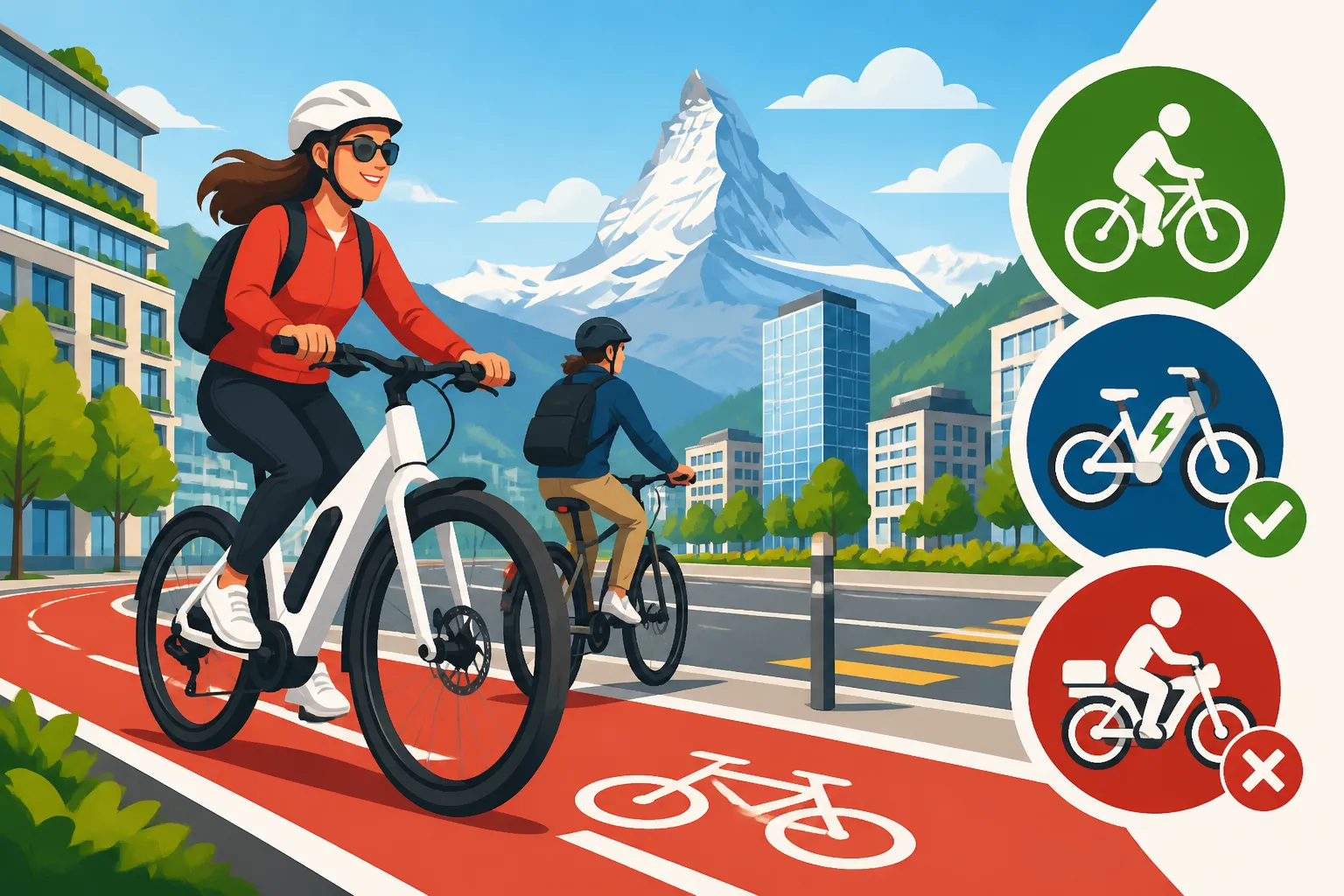
Switzerland boasts a diverse range of cycling paths, each with its own set of rules and implications for your journey. It's not just a "bike lane" here; there's a whole hierarchy of pathways. You'll see everything from clearly marked, segregated bike paths to shared bus lanes, and even designated areas within pedestrian zones. In cities like Zurich or Geneva, you might find dedicated red-painted lanes that make you feel like royalty, while just a few kilometers away, you're sharing a narrow road with cars and pedestrians, relying solely on painted bike symbols to guide you. The cantons and communes often have their own specific interpretations and developments, so what you see in Basel might differ slightly from Bern. Always keep an eye out for the signage – those blue signs with a white bicycle symbol are your best friends, indicating mandatory cycle paths.
Sometimes, the "cycling infrastructure" is simply a sign pointing you to a quieter road that’s better suited for bikes, rather than a physical lane. This can be a bit disorienting at first if you're used to more clear-cut segregation. These quieter roads are often part of the extensive national cycling network, which you can explore on SwitzerlandMobility, an invaluable resource for planning your routes. They've mapped out thousands of kilometers of official cycling routes, categorized by difficulty and type, making it easier to discover paths suitable for your comfort level. Remember, even on seemingly quiet country roads, Swiss drivers expect cyclists to adhere to traffic laws, so don't get too relaxed!
Interpreting Swiss Cycling Signage
Navigating Swiss roads effectively as a cyclist heavily relies on your ability to understand the often subtle, yet critical, signage. It's a bit like learning a new language, but for traffic. The blue circular signs with a white bicycle indicate a mandatory cycle path – you must use it. If there's a white bicycle on a red background with a diagonal line through it, that's a no-go zone for bikes. Simple enough, right? But then you have the shared zones: the blue square signs with a walking person and a bicycle, which means pedestrians and cyclists share the space, and cyclists must yield to pedestrians. This is particularly common in older town centers or pedestrianized areas, where space is at a premium.
Then there are the less obvious ones, like the "Velostreifen" (cycle strip), which is a dashed white line on the road, indicating a recommended but not mandatory cycling area. This is where you might feel a bit exposed, sharing space with cars, but it's crucial to ride predictably and clearly. Keep an eye out for the yellow diamond-shaped "Vortritt" signs, which indicate you have priority, and be equally vigilant for "Stop" or "Give Way" triangles. It's not uncommon to find a mixture of these within a single city block, leading to constant vigilance. For those of us who appreciate clarity, it can be a source of minor frustration, but with practice, it becomes second nature. And let's not forget the sheer number of signs in multiple languages – German, French, Italian – depending on the canton. It's a constant reminder that you're in a truly multilingual country!
E-Bikes: Powering Through the Rules
E-bikes have absolutely exploded in popularity here, and for good reason! Those famously steep Swiss hills? They're far less intimidating with a bit of electric assist. You’ll see everyone from young commuters to active seniors zipping around on them. However, with this added power comes a specific set of rules that differ quite significantly from traditional bicycles. Ignoring these can lead to fines or, worse, accidents.
Classifications and Speed Limits for E-Bikes
In Switzerland, e-bikes aren't just one category; they're primarily divided into two main types based on their maximum assist speed and power output. This distinction is crucial for understanding the rules that apply to you.
Firstly, you have the "light motor vehicles" (Leichtmotorfahrräder), often referred to as slow e-bikes. These have an assistance limit up to 25 km/h, and their motor power is capped at 500 watts. The motor only assists you while you're pedaling, and it cuts out once you hit 25 km/h. For these bikes, you generally don't need a license plate, a driver's license, or a helmet (though a helmet is always strongly recommended for your safety – seriously, just wear one!). These are essentially treated much like regular bicycles in terms of road access and general rules, making them a fantastic, low-barrier option for getting around.
Then there are the "motor vehicles" (Motorfahrräder), also known as fast e-bikes or "S-Pedelecs". These are the speed demons, offering pedal assistance up to 45 km/h with a motor power of up to 1000 watts. For these faster bikes, the rules are much stricter. You absolutely must have a yellow license plate attached, which means your e-bike needs to be registered with the cantonal road traffic office. You'll also need a valid M (moped) driver's license (or a B-category car license, which usually covers it), and a helmet is mandatory. Not just any helmet, mind you, but one that meets specific safety standards (EN 1078 or equivalent). These S-Pedelecs are often not allowed on dedicated cycle paths that are marked only for bicycles or slow e-bikes, and often must ride on the road with cars. This can be a bit counter-intuitive if you're not used to it, so always double-check the signage.
| E-Bike Type | Max Assist Speed | Max Motor Power | License Plate | Driver's License | Helmet Required (Legal) | Road Access |
|---|---|---|---|---|---|---|
| Slow E-Bike | 25 km/h | 500W | No | No | No (Recommended) | Cycle paths, roads |
| Fast E-Bike (S-Pedelec) | 45 km/h | 1000W | Yes (Yellow) | Yes (Cat M or B) | Yes (Mandatory) | Roads (often restricted on cycle paths) |
Helmet Requirements and Age Restrictions
While a helmet is legally mandatory only for fast e-bikes (S-Pedelecs), my advice as an expat who's seen a few spills is this: just wear a helmet, regardless of your bike type. Swiss roads, while well-maintained, can be unpredictable, and other road users (and pedestrians, who seem to have a magnetic pull towards bike lanes) aren't always looking out for you. Better safe than sorry, and a good helmet is a small investment for peace of mind.
Age restrictions also apply. You generally need to be at least 14 years old to ride a slow e-bike, and from 14 to 16, you require an M-category (moped) driver's license. From 16 onwards, no license is needed for slow e-bikes. For fast e-bikes (S-Pedelecs), the minimum age is 14 with an M license, or 16 with an M license (or any higher category like a car license, which automatically includes M). These rules are in place for a reason, acknowledging the increased speeds and potential risks associated with these powerful machines. If you're considering bringing your own e-bike from abroad, especially a specialized one, make sure it complies with Swiss regulations. Reputable moving services like Sirelo can often provide guidance on shipping and customs for vehicles, but ultimately, it's your responsibility to ensure it's street legal here.
Practical Tips for Urban Cycling in Switzerland
Cycling in Swiss cities is a fantastic way to get around – it's often faster than public transport for short distances, it's great exercise, and you get to truly experience the city up close. But it also requires a certain mindset and practical considerations.
Navigating Busy City Centers and Pedestrian Zones
Swiss cities, with their charming medieval cores and often narrow streets, present unique challenges for cyclists. In places like Zurich's Niederdorf or parts of Geneva's Old Town, you'll find areas designated as pedestrian zones where cycling is often restricted or only permitted at walking pace. Pay close attention to the specific signs. A blue sign with a bicycle and pedestrian means you can share, but the pedestrian always has priority, and your speed should match theirs. This isn't just a suggestion; it's a rule that locals take seriously. Ringing your bell aggressively will likely earn you a stern look, not a clear path.
When cycling on the road, remember that Swiss drivers are generally quite disciplined, but they expect cyclists to adhere strictly to traffic laws as well. That means stopping at red lights, signaling turns, and not weaving through traffic. You'll often find specific traffic lights for cyclists at major intersections. Missing one of these, or running a red light, is a quick way to get a hefty fine, as traffic enforcement is no joke here – just like with speeding tickets in Switzerland: income-based fines and strict radars. For longer commutes or if you're exploring, a good navigation app is indispensable. Having a reliable data connection is crucial for this, especially if you're taking impromptu detours. Consider getting an eSIM from a provider like Airalo to ensure you have consistent mobile data without worrying about roaming charges or searching for Wi-Fi hotspots, which can be spotty in less central areas.
Essential Gear and Maintenance for Swiss Conditions
Beyond the mandatory items for fast e-bikes, there's essential gear that will make your Swiss cycling experience far more enjoyable and safe. Firstly, good lights are non-negotiable. It gets dark early in winter, and tunnels and underpasses are common. Front and rear lights that are sufficiently bright and securely attached are a must. Reflective clothing, especially during the darker months or at dusk, significantly increases your visibility. Don't skimp on these.
Secondly, a robust lock is essential. Bike theft, unfortunately, isn't unheard of, especially in larger cities. Invest in a high-quality U-lock or a sturdy chain lock. If you plan to leave your bike outside overnight, consider bringing it inside or securing it in a designated bike room if your building has one. When moving to Switzerland, if you're transporting your bicycle along with your household goods, companies like Sirelo can assist in ensuring your bike is properly packed and protected for the journey, which is especially important for more expensive models.
Lastly, consider the terrain. Switzerland is known for its mountains, even if you're just in a city like Lausanne, which is built on hills. Good quality tires with decent grip are important, and if you're planning on riding year-round, especially in areas prone to ice or snow, specific winter tires for bikes exist. Regular maintenance is key too; local bike shops (Veloservice or Fahrradreparatur) are plentiful and offer excellent service, which will prolong the life of your bike and keep you safe. Given the often challenging topography, many expats also invest in REGA membership: why expats need air rescue insurance in the Alps if they plan on venturing into the mountains on their bikes, just in case of an unforeseen accident far from roads.
Safety and Etiquette for Cyclists
Cycling here isn't just about following the literal rules of the road; it's also about understanding the unwritten rules and cultural expectations that contribute to overall safety and harmony. After all, the Swiss value order and respect in public spaces.
Common Cycling Mistakes to Avoid
One of the biggest mistakes newcomers make is assuming that because they're on a bike, they're somehow exempt from traffic laws. Not so! Treat your bicycle as a vehicle. That means stopping at all red lights, respecting "Stop" and "Give Way" signs, and not riding on pavements unless explicitly permitted (which is rare outside of shared pedestrian zones, and even then, pedestrians have priority). Ignoring these rules can lead to fines, angry shouts from locals, and dangerous situations.
Another common pitfall is underestimating the speed of fast e-bikes. If you're on a traditional bike, remember that an S-Pedelec can approach you much faster than you might anticipate. Maintain awareness of your surroundings. Also, while it might seem counter-intuitive to some, cycling side-by-side with friends can be seen as inconsiderate, especially on narrower paths or roads. Stick to single file where appropriate. And for goodness sake, if you're using a bike sharing scheme, always dock it properly to avoid fines and ensure it's available for the next person! If you're relying on public transport for longer journeys or if the weather turns, remember that taking bicycles on Swiss trains: mandatory reservations and velo tickets can sometimes apply, so check before you travel.
Interacting with Pedestrians and Drivers
Respectful interaction with all road users is paramount in Switzerland. Pedestrians often have the right of way in designated zones, and they expect you to slow down significantly or even dismount and walk your bike if the area is particularly crowded. A friendly "Grüezi!" or "Bonjour!" can go a long way if you need to pass someone. Never assume they've seen you.
When it comes to drivers, make eye contact if possible, especially at intersections. Signal your turns clearly and in advance. Ride predictably, maintaining a straight line, and avoid sudden movements. Remember, even if you have the right of way, defensive cycling is always the safest approach. If you're cycling at night, your lights should be on, and if you're concerned about visibility, reflective vests are common and accepted. The overall attitude is one of mutual respect, and as an expat, demonstrating that you understand and adhere to these norms will make your cycling experience much more positive. Keeping your phone easily accessible, perhaps in a handlebar mount, is helpful for navigation, but always pull over safely to check maps or messages, especially if you're using a data package from a provider like Airalo to find your way around. After all, distractions are a major cause of accidents for all road users.
Disclaimer
The information provided in this guide is intended for general informational purposes only and does not constitute legal advice. While we strive to provide accurate and up-to-date information, rules and regulations regarding cycling and e-bikes in Switzerland can change and may vary by canton or municipality. We recommend consulting official cantonal road traffic authorities or local police for the most current and specific regulations that apply to your situation. Always exercise caution and common sense when cycling, and prioritize your safety and the safety of others.