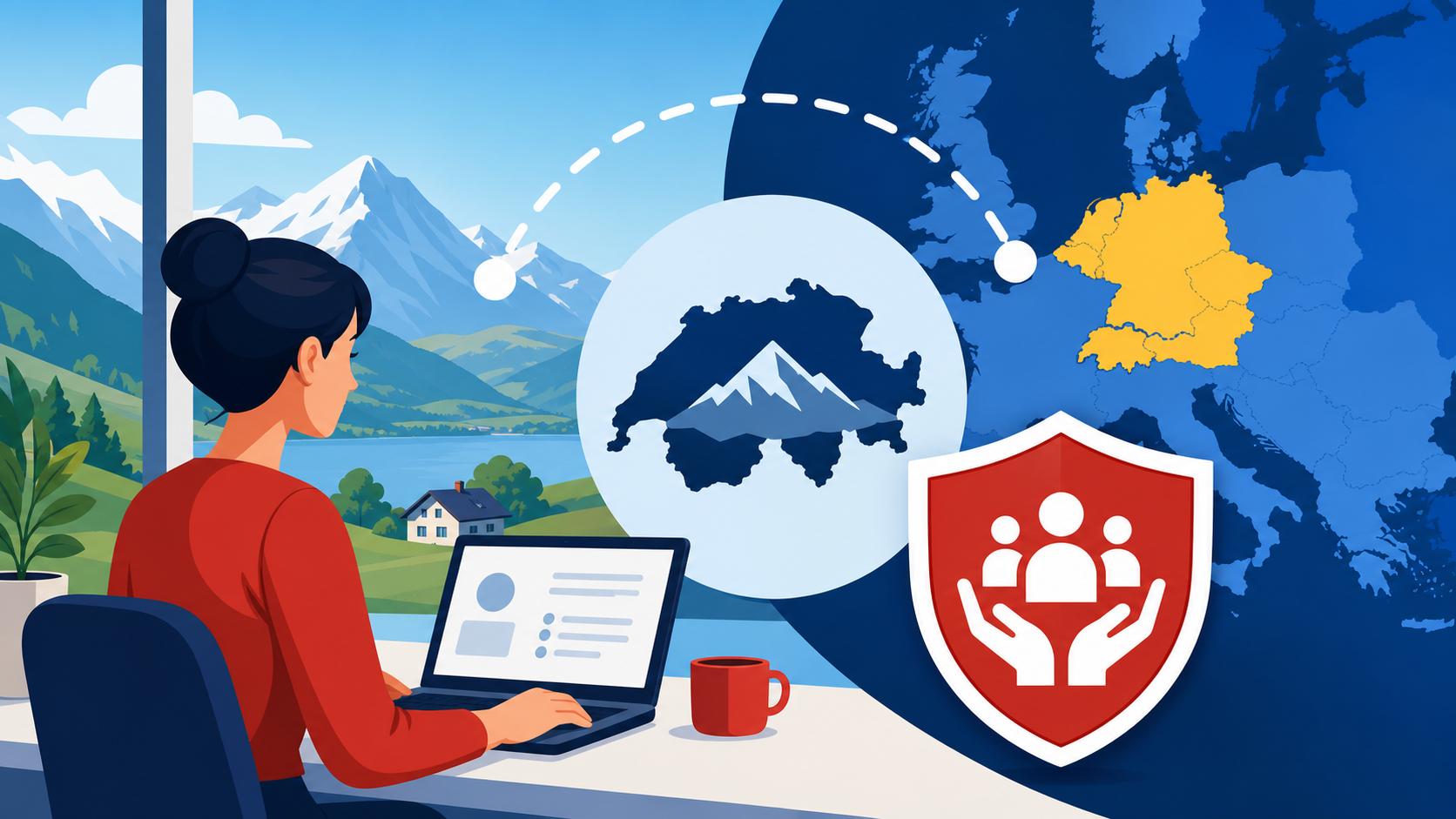
Cross-Border Telecommuting: EU/EFTA Agreements and Social Security Limits
You finally landed that high-paying Swiss job, but the thought of paying Zurich or Geneva rents makes your eyes water. I remember the exact moment I realized I could live across the border in France and commute, but then the panic set in: how many days can I actually work from my sofa before the tax office comes knocking? This guide breaks down the complex telecommuting limits and social security agreements for cross-border commuters so you don't end up with a double-taxation nightmare.
The Post-Pandemic Shift in Cross-Border Work
For decades, the life of a "frontalier" was simple: you lived in France, Germany, or Italy, you crossed the border daily, and you paid your dues according to long-standing bilateral treaties. Then came 2020, and the world changed. Suddenly, everyone was working from home, and the old rules about "substantial activity" in your country of residence threatened to upend the entire Swiss labor market. If you work too much from home, your Swiss employer might suddenly find themselves liable for social security contributions in your home country, which is an administrative headache most companies will fire you to avoid.
The Swiss government and its neighbors realized they needed a permanent solution. What we have now is a sophisticated, albeit confusing, framework that allows for more flexibility than we ever had pre-2020. However, this flexibility comes with very strict ceilings. I have seen expats lose their jobs because they assumed "hybrid work" meant they could work from their French farmhouse four days a week. It doesn’t. Understanding the interplay between Cross-Border Commuting: Working in Switzerland with a G Permit and your actual physical location is the first step to staying legal.
The Multilateral Agreement on Social Security
The most significant change in recent years is the Multilateral Agreement on the application of Article 16 (1) of Regulation (EC) No. 883/2004. This sounds like dry legal jargon, but for you, it is the difference between working one day a week at home or two and a half. Under standard EU/EFTA rules, if you perform more than 25% of your work in your country of residence, you fall under that country's social security system. For a Swiss employer, paying into the French or German social security system is a dealbreaker due to the higher costs and massive paperwork.
The new agreement, which Switzerland has signed alongside most of its neighbors, raises this threshold to 49.9% of your total working time. This means if you work a 100% workload, you can theoretically work from home two days a week without triggering a change in where your social security is paid. But there is a catch: this is not automatic. Your employer must explicitly apply for this under the "opt-in" model. If they don't, you are stuck with the old 25% limit.
Why the 49.9 Percent Rule is a Game Changer
Before this agreement, the "substantial activity" rule was a constant source of anxiety. I remember colleagues meticulously counting every hour spent answering emails from their home balcony in Germany. If you hit that 25% mark, you were no longer "Swiss insured." This had massive implications for your Accident Insurance (UVG): Occupational vs. Non-Occupational Coverage and your future pension.
Now, with the 50% limit (technically 49.9%), the "hybrid" lifestyle is much more sustainable. It allows for a standard "two days at home, three days in the office" schedule. However, you must ensure your HR department is on board. They need to issue an A1 certificate that proves you remain under the Swiss social security umbrella. Without this piece of paper, you are essentially "undocumented" in the eyes of the European social security coordinators, and that is a mountain of trouble you do not want to climb.
Taxation vs Social Security: The Great Disconnect
Here is where most expats get tripped up, and believe me, I’ve seen some expensive mistakes. Social security rules and taxation rules are not the same thing. Just because the social security agreement says you can work 49.9% of your time from home doesn't mean the tax office agrees. Taxation is governed by bilateral treaties between Switzerland and each specific neighboring country, and they all have different ideas about when they want their cut of your Swiss salary.
For instance, if you are living in France and working in Geneva, the tax treaty is quite specific. While social security might allow you to be home 49.9% of the time, the tax treaty traditionally had much lower tolerances for telecommuting. Recently, Switzerland and France signed a new agreement allowing up to 40% of working time (approximately 92 days per year) to be done via telework without affecting the right to tax the income in the state where the employer is located. If you go over that 40%, but stay under 49.9%, you might be fine for social security but find yourself owing a massive tax bill to France.
Navigating the 45 Day and 92 Day Rules
If you are a French Cross-Border Commuters: Choosing Between CMU and Swiss KVG, you need to be especially careful about the "non-return days." The French-Swiss tax situation is divided into two categories: those who pay tax in Switzerland (like in Geneva) and those who pay tax in France (like in Vaud or Basel). For those paying in Switzerland, the 40% teleworking limit is your golden rule.
In Germany, the situation is even more restrictive. The German-Swiss tax treaty generally allows for much less telecommuting before the "frontier worker" status is challenged. If you work from home too often, you might lose your status as a "Grenzgänger," which changes how your G Permit Germany: Withholding Tax Rules for Cross-Border Commuters in Basel are calculated. Always remember that "non-return days"—days where you don't cross back over the border—are tracked by both cantonal and national authorities.
The Impact on Withholding Tax (Quellensteuer)
For most G-permit holders, your tax is deducted directly from your paycheck. This is known as withholding tax or Quellensteuer. When you start telecommuting more than the allowed limit, your employer is technically supposed to stop withholding tax for those days and instead, you are supposed to declare that income in your home country.
Hardly any employer wants to deal with "split payrolls." This is why many Swiss companies simply forbid their cross-border employees from working from home more than one day a week, regardless of what the law allows. They want to avoid the risk of being audited by a foreign tax authority. If you’re negotiating a contract, don’t just ask about "remote work"; ask specifically how they handle Working from Home with a G Permit: The 25% Social Security Threshold and if their payroll system can handle the split if you exceed the limit.
| Feature | Social Security Limit (Multilateral) | Taxation Limit (France Example) | Taxation Limit (Germany Example) |
|---|---|---|---|
| Max Remote Work % | 49.9% (with A1 certificate) | 40% (approx. 92 days/year) | Strict; often 20% or less for status |
| Authority | Federal Social Insurance Office | Cantonal/National Tax Office | Finanzamt / Cantonal Tax Office |
| Required Document | A1 Certificate | Activity Log / Employer Statement | Grenzgängerbescheinigung |
| Risk of Breach | Employer pays foreign social security | Employee pays double or higher tax | Loss of Frontier Worker status |
Practical Management of Your Hybrid Schedule
Living the cross-border life requires a level of organizational discipline that would make a Swiss watchmaker proud. You cannot just "wing it" when it comes to where you are physically sitting when you open your laptop. I highly recommend keeping a "telecommuting log." This isn't just for your boss; it's your primary defense if the tax authorities ever audit your residency status.
When I first moved to the border region, I didn't realize how much the little things mattered. Taking a half-day at home to wait for a plumber? That counts as a home office day. Working from a cafe in your home village for two hours before driving to the office? The tax office might count that as a home-office day. You need to be aware of How to Handle Cross-Border Commuting Non-Return Days and how they aggregate over a calendar year.
Tracking and Documentation
Your employer is legally responsible for ensuring you don't trigger social security liabilities for them, but the burden of proof for your personal taxes often falls on you. Use a dedicated calendar to mark your "Swiss days" versus "Home days." Some cantons even require a signed statement from your employer at the end of the year confirming exactly how many days you worked in the office.
This is especially vital if you have a Sickness Benefits Insurance (KTG): Why It’s Crucial for Expats. If you are "working" from home while sick, or if you have an accident while telecommuting, the insurance company will look very closely at whether you were supposed to be working from that location. If you were working from home in violation of your contract or the 25/50% limits, they might use that as grounds to dispute a claim.
Contractual Considerations for Remote Work
Do not rely on a verbal agreement with your manager. If you intend to work from home regularly, ensure it is written into your contract or a formal addendum. This addendum should mention the A1 certificate and the specific limits allowed. Swiss labor law is generally employer-friendly, and if you trigger a tax audit for the company because you worked from home too much, that is often valid grounds for dismissal.
Also, consider your German Cross-Border Commuters: Navigating Health Insurance Exemptions. Your health insurance choice (KVG vs. your home country's system) is often tied to your status as a cross-border worker. If you lose that status because you work from home 60% of the time, your health insurance provider might also demand a change in your coverage, which can be incredibly expensive if you’ve already committed to one system.
Cultural and Language Barriers in Cross-Border HR
One aspect of cross-border telecommuting that people rarely discuss is the language barrier when dealing with complex administrative rules. If you are working in the German-speaking part of Switzerland but living in France (common in Basel), you are dealing with three different sets of legal terminology. I found that my biggest hurdles weren't just the math of the 49.9% rule, but explaining my situation to the local "Gemeinde" or "Mairie."
To navigate these conversations with HR, you really need to sharpen your professional vocabulary. Using a platform like Lingoda can be a lifesaver here, as they offer specific business-focused language tracks that cover employment and administration. If you are in the Zurich or Basel area, focusing on your "Amtssprache" via GermanPod101 will help you understand the nuances of the documents your employer sends you. Conversely, if you are in the Romandie region (Geneva, Vaud, Jura), mastering the specific terms for "preliminary tax" and "social deductions" through FrenchPod101 is essential. Being able to say "I need my A1 certificate for the multilateral agreement" in the local language will get you much faster results than a confused stare.
The Professional Etiquette of Remote Work
In Switzerland, "Pünktlichkeit" (punctuality) and presence are highly valued. Even if the law allows you to work 49.9% from home, the cultural expectation in many Swiss companies is still that you are visible. This is especially true for newer expats. I always suggest spending your first six months crossing the border every single day. Build the "social capital" first.
When you do start telecommuting, be overly communicative. The Swiss work culture relies on trust, but that trust is built on following rules to the letter. If the rule is two days of WFH, don't try to sneak in a third. If you are living in a neighboring country, you are already seen as "different" because you don't pay into the local Swiss municipal taxes (though you pay federal and cantonal ones). Don't give your colleagues or HR any reason to think you are "gaming the system."
Communication with Your Country of Residence
Finally, don't forget that you have obligations in your home country too. If you are living in a small village in Germany or Italy, the local authorities might not be familiar with the latest EU/EFTA social security updates. You may need to provide them with your Swiss Mandatory Registration: How to Sign Up for Health Insurance Within 90 Days documents to prove you aren't dodging their local insurance mandates.
I’ve had to sit down with a local French tax officer and literally print out the new treaty because they were still using the 2019 guidelines. Being your own advocate is part of the expat journey. The more you know about these limits, the more you can enjoy the benefits of a Swiss salary while enjoying the lower cost of living across the border.
Potential Pitfalls and How to Avoid Them
The biggest pitfall is the "Digital Nomad" trap. I’ve met people who thought they could work for a Swiss company while living in a van traveling through Spain and Italy. This is a legal impossibility for a G-permit holder. The cross-border agreement specifically applies to people who return to their primary residence in a neighboring country regularly (usually daily or at least once a week).
If you are caught working from a third country (one that isn't your residence or Switzerland), you are in breach of your permit, your tax status, and your social security coverage. Switzerland is highly digitalized now; they can and do track where logins are coming from. If your IT department sees you’ve been logging in from a beach in Portugal for three weeks, you are going to have a very uncomfortable meeting with HR.
Understanding Social Security Gaps
If you accidentally trigger the 25% (or 50%) rule and move to your home country's social security, you might find "gaps" in your Swiss pension. The Swiss 3-pillar system is fantastic, but it requires consistent contributions. A mistake in your telecommuting schedule could mean a year where you didn't contribute to your AHV (Old Age and Survivors' Insurance).
While you can sometimes make up these gaps later, it is much easier to just stay within the limits. This is why many expats choose to work 100% on-site, even if they have the option for hybrid work. The peace of mind of knowing your Accident Insurance (UVG): Occupational vs. Non-Occupational Coverage is fully valid in the event of a skiing accident on the weekend is worth the commute for some.
The Role of the G Permit in the Future
The G permit is a privilege, not a right. The Swiss authorities are becoming more stringent about ensuring that G-permit holders are actually commuting. If the data shows you are almost never in Switzerland, they may refuse to renew your permit and tell you to either move to Switzerland (and get a B permit) or find a job in your home country.
As we move toward 2026 and beyond, expect the digital tracking of these days to become even more automated. My advice? Embrace the hybrid model, but stay well within the "safe zone." If the tax limit is 40%, aim for 30%. If the social security limit is 49.9%, aim for 40%. It gives you a buffer for those days when you're sick or when the weather makes the mountain pass impassable.
Legal and Tax Disclaimer
This article is for informational purposes only and does not constitute legal, financial, or tax advice. The rules regarding cross-border telecommuting, social security (Regulation EC No 883/2004), and bilateral tax treaties are subject to frequent changes and cantonal interpretations. Always consult with a qualified tax professional or your company's HR department before changing your working location. The author and publisher are not responsible for any legal or financial consequences arising from the use of this information.